Dainichi-ji
The cosmic Buddha at a quiet country temple
Understand sacred places, explore living traditions, and learn how to engage respectfully with Pilgrim Map.
Access has not been verified. Check current local guidance before planning a visit.
Kōnan, Kochi Prefecture, Japan
Read the sources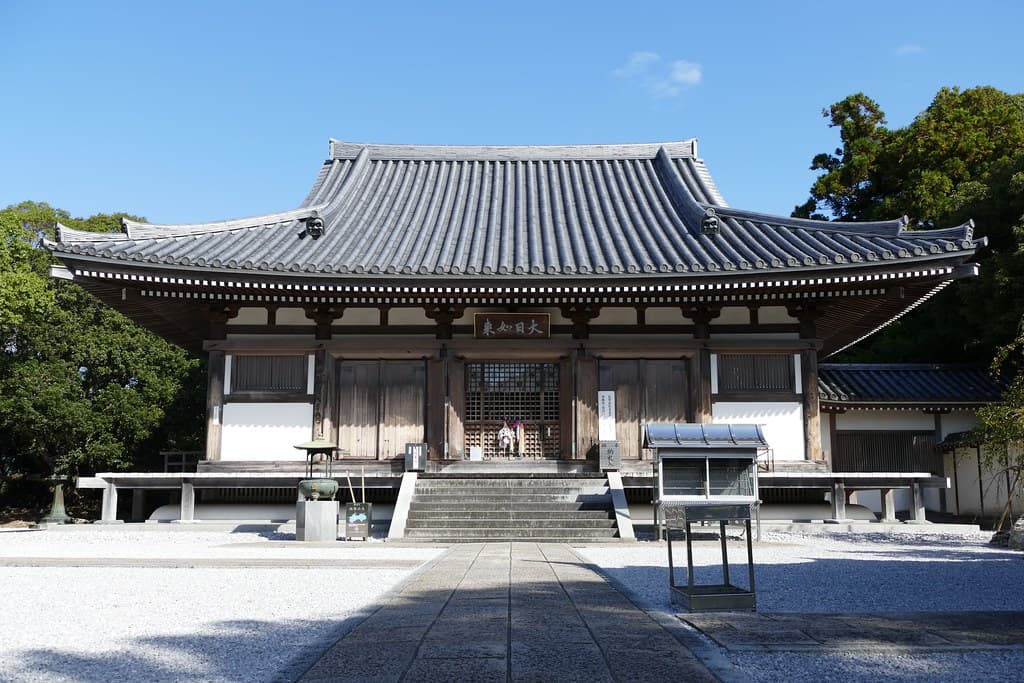
Image of Dainichi-ji (大日寺). Image source
Station 28 of 88
Shikoku 88 Temple PilgrimageVisit essentials
A quick read before you go
- Duration
- Thirty to forty-five minutes for the full pilgrim ritual at both halls.
- Access
- From JR Noichi or Akaoka stations in Kōnan: a short taxi or bus ride.
Overview
Dainichi-ji is temple 28 of the eighty-eight-temple Shikoku Pilgrimage, a small, wooded temple in rural Kōnan between the demanding mountain climb of Kōnomine-ji and Tosa Kokubun-ji's older garden. Pilgrims often note its contemplative drop in pace. Its honzon, Dainichi Nyorai or Mahāvairocana, is the cosmic Buddha at the center of Shingon esotericism: the Buddha whose body is the universe and from whom all other Buddhas and bodhisattvas radiate.
Encountering Dainichi mid-circuit is doctrinally distinct from Kannon, Yakushi, or Jizō, acknowledging the principle from which other figures emerge. The Dainichi is venerated alongside Kūkai's traditionally attributed 815 Yakushi Nyorai, joining cosmic principle with healing compassion. At the Main Hall and Daishi-dō, pilgrims follow the Heart Sutra, Dainichi mantra, and Daishi gohōgō sequence. The complete foundation and rebuilding history remains in the origin account.
Why this place is sacred
Dainichi-ji's concentration is doctrinal rather than topographical. In an unobtrusive wooded plain between Kōnomine-ji and Tosa Kokubun-ji, Dainichi Nyorai makes visible the Shingon principle that every Buddha and bodhisattva manifests one underlying cosmic reality. The traditionally attributed Gyōki Dainichi and Kūkai's 815 camphor-tree Yakushi hold universal source and concrete healing together. The 1997 Main Hall adds material continuity: pilgrims regularly note new cypress and pine joined by old, nail-free craft.
After Yamauchi patronage, the 1868 closure, and the honzon's survival, that deliberate rebuilding aligns doctrine, devotion, and craft at one altar.
A Buddhist temple founded by Gyōki under Emperor Shōmu's order in the Tenpyō era to enshrine a Dainichi Nyorai honzon, expanded by Kūkai in 815 with a Yakushi Nyorai carved from a camphor tree.
Through the medieval period the temple received Yamauchi family patronage and underwent renovations during the Keichō era. The 1868 anti-Buddhist measures briefly closed the precinct, but the Dainichi honzon survived because the hondō was renamed Dainichi-dō. The temple was rebuilt in 1884. The current main hall was reconstructed in 1997 from cypress and pine using traditional joinery without nails.
Experience and orientation
Walking henro descend from Kōnomine-ji's mountain stage into Dainichi-ji's quiet rural plain. Bow at the gate, notice the 1997 cypress-and-pine hall fitted without nails, and approach Dainichi Nyorai. Offer a coin, one candle from a fresh flame, three incense sticks, and a dated fudasho-fuda with a prayer intention; chant the Heart Sutra and Dainichi mantra. Two mantra forms are common, with the Womb Realm 'A bi ra un ken' most often used here.
Repeat the sequence at the Daishi-dō with 'Namu Daishi henjō kongō,' then receive the stamp before 17:00. For pilgrims with doctrinal grounding, the cosmic Buddha can be a quiet high point before continuing toward Tosa Kokubun-ji: new wood, old technique, and an honzon that survived suppression.
From Kōchi City, drive thirty kilometres east on Route 55 to Kōnan. From JR Noichi or Akaoka stations, take a taxi or bus to the temple. Walking henro arrive on foot from Kōnomine-ji.
Context and lineage
By temple tradition, Gyōki Bosatsu founded Dainichi-ji in the Tenpyō era (729–749) under imperial order from Emperor Shōmu and carved a Dainichi Nyorai honzon. Kūkai visited in 815 and carved a Yakushi Nyorai from a large camphor tree as a prayer for the future peace of all beings; the Yakushi added in 815 has been venerated alongside the Dainichi ever since. The temple was renovated under the Yamauchi rulers of Tosa han during the Keichō era (1596–1615).
The 1868 anti-Buddhist riots temporarily closed the temple, but the Dainichi honzon survived because the hondō was renamed Dainichi-dō. Reconstruction followed in 1884, and the current main hall was rebuilt in 1997 from cypress and pine using traditional joinery without metal nails.
Shingon Buddhism. Temple 28 of the eighty-eight-temple Shikoku Pilgrimage.
Gyōki Bosatsu
Traditional founder
Emperor Shōmu
Imperial commissioner
Kūkai (Kōbō Daishi)
Re-founder and additional sculptor
Yamauchi clan
Edo-period patrons
Traditions and practice
At each hall: bow, light one candle from a fresh flame, light three incense sticks, deposit a fudasho-fuda name slip, place a coin in the saisen-bako, ring the bell once if a small bell is provided, and chant. At the Main Hall, the Heart Sutra in full followed by the Dainichi Nyorai mantra (Womb Realm form: A bi ra un ken). At the Daishi-dō, the Heart Sutra and the Kōbō Daishi mantra (Namu Daishi henjō kongō).
After both halls, take the nōkyōchō to the nōkyō office for the temple stamp.
Daily nōkyō service is maintained by resident clergy. Ongoing Shingon liturgy is observed on the standard schedule. Pilgrim supplies are available at the nōkyō office.
Look closely at the woodwork of the rebuilt main hall before performing the ritual. Cypress and pine joined without metal nails is part of what the temple is offering as a continuing site. If new to Shingon, take a few minutes inside the Main Hall to sit quietly with the doctrinal idea of a cosmic Buddha — encountering Dainichi mid-circuit is doctrinally distinct from encountering Kannon, Yakushi, or Jizō.
Shingon Buddhism
ActiveTemple 28 of the eighty-eight-temple Shikoku Pilgrimage. The honzon Dainichi Nyorai (Mahāvairocana) is the central cosmic Buddha of Shingon esotericism — the Buddha whose body is the universe — making this honzon doctrinally significant within the circuit.
Standard pilgrim ritual at the Main Hall (Dainichi Nyorai) and Daishi-dō: candle, three incense, fudasho-fuda, Heart Sutra, Dainichi mantra, gohōgō to Kōbō Daishi, nōkyō stamp.
Perspectives and open questions
Dainichi-ji's tradition presents a Gyōki-and-Kūkai dual foundation, with continuous religious use since at least the medieval period; the present architecture is largely modern, with the 1997 main hall rebuilt in traditional joinery as a deliberate continuity gesture.
Scholarly perspective
The Gyōki-and-Kūkai dual foundation is the standard temple narrative. Pre-Meiji documentation is fragmentary because of the brief 1868 closure. Continuous religious use since at least the medieval period is well-attested. The original Gyōki-attributed Dainichi statue's chronology is debated by historians of medieval Buddhist sculpture. Current architecture is largely modern (1997 hondō).
Living and traditional perspectives
In Shingon understanding, a Dainichi Nyorai honzon makes the temple a small mandala-centre — the cosmos's central Buddha is locally accessible. The pairing of Dainichi with the 815 Yakushi Nyorai is read as a doctrinal statement: ultimate reality and concrete compassion held together at one altar.
Alternative interpretations
The pairing of cosmic principle (Dainichi) and concrete compassion (Yakushi), introduced by Kūkai's later visit, is sometimes read as a complete miniature of the Shingon path: the universal source held alongside the practical work of healing and care for living beings.
Open questions
Pre-Meiji documentation is fragmentary because of the brief 1868 closure. The original Gyōki-attributed Dainichi statue's chronology is debated by historians of medieval Buddhist sculpture. Specific cultural-property designations of the 1997 main hall reconstruction were not retrieved.
Plan your visit
Access and arrival
From JR Noichi or Akaoka stations in Kōnan: a short taxi or bus ride. By car: roughly 30 kilometres east of Kōchi City via Route 55. Free parking on site. Walking henro arrive on foot from Kōnomine-ji.
Kōnan and Akaoka have small ryokan and minshuku catering to walking henro. Kōchi City offers a wider range of options within thirty kilometres.
Respectful visit
Modest casual; henro attire welcome.
Outdoor permitted; main-hall interior and honzon typically not. Flash photography prohibited inside halls. Do not photograph pilgrims at prayer.
Candle, three incense, fudasho-fuda, monetary offering at the saisen-bako.
Stamp office closes promptly at 17:00. Keep voices quiet in the halls. Do not touch the Main Hall joinery.
Stamp office closes at 17:00. The honzon is typically not photographable. The wooded precinct is small — pace the visit so that you and other pilgrims have space at the offering boxes.
Current practical details
Address
476 Noichichō Bodaiji, Konan, Kochi 781-5222, Japan
Phone
Hours
Hours, fees, and access can change — verify on the official source before you travel. Practical details last checked Jun 2026.
Location
Map loads as you approach this section.
Pilgrim reflections
A portrait of encounter, not a score
Pilgrims describe what they felt, how present they could become, and whether the place would shape a journey. There are no stars and no ranking of traditions.
No reviewed reflections yet
The first pilgrims can help describe the character of being here.
Share a reflection
Available after an account-backed “Been there.” Every reflection is reviewed before publication.
Watch deeper
Films, episodes, and recorded talks for visitors who want more context before or after a visit. Speculative and alternative-history entries are labelled as perspectives, not as sources for established claims.
Nearby sacred places
Explore other sacred places in the region. Proximity does not establish access or travel time; check each place’s guidance.

References
Sources consulted for this page. Source categories describe the publication, not a guarantee that every claim is verified. Traditional accounts and outside interpretations may differ.
- 01Oogurizan Kezouin Dainichiji – Shikoku 88 Temple Pilgrimage — Shikoku 88 Reijokai (Official Association)officialOfficial association page
- 02Dainichiji – Konan, Kochi Prefecture, Shikoku — Henro.orgguideEnglish henro reference
- 03Customs and Etiquette of the Shikoku Pilgrimage — Henro.orgguideEtiquette baseline
- 04Dainichi-ji Temple, the 28th temple of the Shikoku Pilgrimage — Shikoku Pilgrimage NewsguideFounding legend, rebuilds, 1997 hondō reconstruction details
- 05Dainichiji Temple Kochi — Japan ExperienceguideTravel-resource overview
- 06Temple 28, Dainichiji — 88temples.infoguidePilgrim community reference
Pilgrim glossary
- Honzon
- The principal Buddhist deity enshrined as a temple's central object of worship.
- Kannon
- The bodhisattva of compassion, central to many East Asian pilgrimage routes.
- Bodhisattva
- An enlightened being who postpones full nirvana to help others toward awakening.
- Mandala
- A symbolic diagram of the cosmos used in meditation and ritual.
- Sutra
- A canonical Buddhist scripture, often chanted as part of practice.
- Mantra
- A sound, word, or phrase repeated as part of meditation or ritual.
- Shingon
- An esoteric Japanese Buddhist school emphasizing ritual, mantra, and mandala practice.
Share a photo
Help visitors recognize Dainichi-ji. Every submission is reviewed before publication.