Hotsumisaki-ji
Sky and sea — the cape where Kūkai took his name
Understand sacred places, explore living traditions, and learn how to engage respectfully with Pilgrim Map.
Access has not been verified. Check current local guidance before planning a visit.
Muroto, Kochi Prefecture, Japan
Read the sources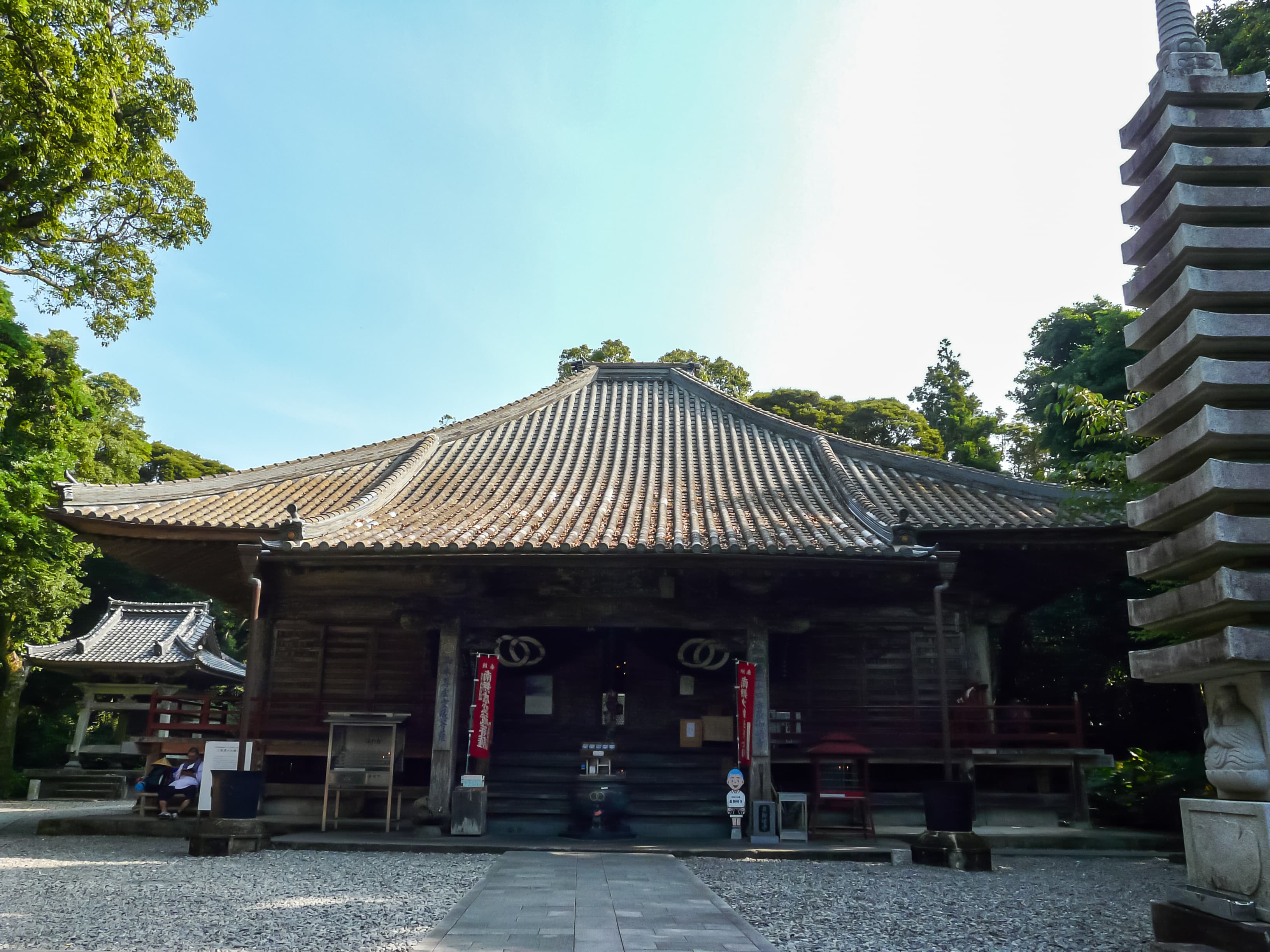
Image of Hotsumisaki-ji (最御崎寺). Image source · CC-BY-SA-4.0
Station 24 of 88
Shikoku 88 Temple PilgrimageVisit essentials
A quick read before you go
- Duration
- Half-day if combining Mikurodō Cave visit with the temple ascent and precinct exploration.
- Access
- Address: 4058-1 Murotomisaki-chō, Muroto, Kōchi 781-7101.
Overview
Hotsumisaki-ji stands about 165 metres above the Pacific on Cape Muroto, the first Shikoku 88 temple in Kōchi—the old Tosa, shugyō no dōjō, the place of ascetic practice. Arriving after the 76-km walk from Yakuō-ji marks the henro's passage from Awa into its most austere prefectural segment.
At sea level below, Mikurodō Cave anchors the temple's meaning. Kūkai's Sangō Shiiki, written around 797, attests that the young monk practised the Kokūzō Gumonji-hō at Cape Muroto. Tradition says the 100-day rite of one million mantra recitations culminated when the morning star, Myōjō, entered his mouth. From the cave he saw only sky and sea—kū-kai 空海—and took those characters as his name.
In 807, after returning from Tang China, he formally founded the temple with Emperor Saga's sanction and carved its Kokūzō Bosatsu image.
The working Toyama-ha Shingon temple is Cape Muroto's Higashi-dera, paired with Konkō-fuku-ji (T26), the Nishi-dera. Mikurodō remains a technically separate sacred-natural site reached from the coastal road. Together, cave, cliff-top precinct, subtropical foliage, ancient cycads, and Pacific wind make arrival here one of the henro's most emotional passages.
Why this place is sacred
Few sacred-landscape pairings in Japan equal the convergence at Cape Muroto. The ocean below, the cliff above, the cave at sea level, and the cliff-top temple — together they form a single thin place sustained across vertical distance. Kūkai's own writings (the Sangō Shiiki, written around 797) name this cape, alongside Mount Tairyū, as a site of his decisive youthful ascetic practice.
The acoustics of Mikurodō Cave amplify chanting; the visual frame from inside the cave compresses the world to two elements, sky and sea. The young monk took these as his name. The morning star — Venus, Myōjō — figures in the legend as the moment of culmination. Esoteric Shingon reads the morning star as a recurring symbol of awakening; the temple's 'in' name Myōjō-in 明星院 holds the character.
Whether the name-taking happened in the cave at the moment of attainment or only later, in formal redaction, is a matter scholars debate. The thinness of the place does not depend on the answer. Local Muroto tradition treats the cape as a kami-place predating Buddhist consecration; Kūkai's practice is read as a recognition rather than an introduction. Subtropical vegetation — cycads, palms — adds to the cape's atmosphere of being elsewhere, of being already different from the rest of Shikoku.
Founded in 807 CE by Kūkai upon his return from Tang China, on the cliffs above Cape Muroto. The earlier function — the youthful Gumonji-hō practice in Mikurodō Cave below — predates the temple's formal establishment by perhaps a decade. The original purpose was both to commemorate and to continue the practice that had given Kūkai his name.
Imperial decree under Emperor Saga formalised the temple. Across centuries it has remained the head temple of Cape Muroto's tripartite sanctuary — paired with Konkō-fuku-ji (T26, Nishi-dera) and Tsuteraji as the cape's three sacred sites. The Toyama-ha Shingon affiliation is primary today (sometimes also recorded as Buzan-ha or Kōyasan in different sources). Today Hotsumisaki-ji is an active temple offering full pilgrim services, a working shukubo, and a daily morning service.
Cape Muroto is part of the UNESCO Global Geopark — a geological designation rather than a cultural inscription, but one that protects the cape's distinctive rock formations and subtropical vegetation.
Experience and orientation
Most pilgrims approach Cape Muroto via the coastal road from Mugi or Tokushima. Walkers have just completed the 76-km stretch from Yakuō-ji — the longest inter-temple distance on the entire henro. The cape itself begins to declare its character before the temple does. Subtropical vegetation crowds the road, palms and cycads, the Pacific to the east, cliffs above. Most pilgrims visit Mikurodō Cave first, on the coastal road below the temple.
The cave is reached on foot from the bus stop or by car. Inside, an altar has been arranged, and pilgrims chant or remain silent. The cave's acoustics carry the Kokūzō mantra ('On bazara aratannō on taraku sowaka') in a way few open spaces do. From inside, looking out, the visible world divides cleanly into two: sky above the horizon line, sea below. There is no third thing. The view that gave Kūkai his name is the same view today.
After the cave, pilgrims ascend to the cliff-top precinct of Hotsumisaki-ji. Walkers face a steep ~30-minute footpath; drivers and bus passengers can take the switchback road. The cliff-top precinct holds the Hondō (Kokūzō Bosatsu), the Daishidō (Kūkai), the temple office, and the shukubo. Subtropical foliage and Pacific wind shape the atmosphere. Pilgrims complete the formal worship, receive the nōkyōchō stamp, and often pause longer here than at most temples — the long walk and the cave together leave residue.
If possible, visit Mikurodō Cave before ascending to the temple. The cave is on the coastal road; allow at least 20-30 minutes for chanting or silence inside. From the bus stop or parking, walkers face a steep ~30-minute footpath to the temple, or a switchback road for cars and taxis. Bow at the gate. Purify hands and mouth at the stone basin. Offer at the Hondō first to Kokūzō Bosatsu, then at the Daishidō to Kōbō Daishi.
Drop your osamefuda, light incense, chant or read the Heart Sutra and the Kōbō Daishi mantra. If your practice includes it, chant the Kokūzō mantra at the Hondō. Receive your nōkyōchō stamp at the temple office. If staying at the shukubo, check arrangements in advance. Allow a half-day if combining cave and temple visits.
Context and lineage
Late in the 8th century, the young Kūkai (still as Saeki Mao, the dharma name Kūkai-in-formation) practised the Kokūzō Gumonji-hō in Mikurodō Cave at the foot of Cape Muroto. By tradition, the 100-day rite of one million Kokūzō mantra recitations culminated in the morning star entering his mouth, sealing his enlightenment. Looking out from inside the cave, all that is visible is sky above and sea below; he took these characters — kū-kai 空海 — as his name.
Decades later, in 807, after his return from Tang China, he formally established the cliff-top temple, with imperial sanction under Emperor Saga, and carved the principal Kokūzō Bosatsu image. The temple's full name — Murotozan Myōjōin Hotsumisaki-ji — encodes both the cape (Murotozan) and the morning star (Myōjō-in).
Toyama-ha Shingon Buddhism (sometimes recorded as Buzan-ha or Kōyasan in different sources). Hotsumisaki-ji is the 24th of the Shikoku 88 in standard order, the first temple in Kōchi. As Higashi-dera (East Temple) of Cape Muroto, it is paired with Konkō-fuku-ji (T26, Nishi-dera, West Temple) and historically with Tsuteraji to form the cape's tripartite sanctuary.
Kūkai (Kōbō Daishi)
Founder, principal-image carver, biographical witness
Emperor Saga
Imperial patron
Traditions and practice
Daily morning service. Goma fire rituals on key Shingon dates. Commemorative services on Kūkai-related dates. New Year and Setsubun observances. Toyama-ha Shingon liturgical calendar shapes the rhythm of the year.
Pilgrim worship at the Hondō (Kokūzō Bosatsu) and Daishidō (Kūkai). Pre-temple visit to Mikurodō Cave at sea level — chanting inside the cave (Kokūzō mantra: 'On bazara aratannō on taraku sowaka') is the temple's most distinctive practice. Reception of nōkyōchō stamp. Shukubo lodging available with advance reservation.
Visit Mikurodō Cave before ascending to the temple. Allow time inside the cave for the Kokūzō mantra or for silent sitting; the acoustics are part of the practice. The 'sky-and-sea' view from inside the cave is integral to the henro at this point — the place where Kūkai took his name. After the cave, the cliff-top precinct asks for the standard liturgy with full attention.
If staying at the shukubo, the early-morning service in the Hondō is one of the most direct introductions to Toyama-ha Shingon liturgy you will encounter on the henro.
Shingon Buddhism (Toyama-ha)
ActiveHotsumisaki-ji is one of the foundational sites of Shingon esoteric Buddhism in Japan — the place where, by his own attestation in the Sangō Shiiki, the young Kūkai completed the Kokūzō Gumonji-hō and adopted the dharma name Kūkai (空海, sky-and-sea) after the panorama he beheld from inside Mikurodō.
Daily monastic services; pilgrim worship; meditation in or before Mikurodō Cave; goma fire rituals. The temple is the Higashi-dera (East Temple) of Cape Muroto, paired with Konkō-fuku-ji (T26, Nishi-dera).
Perspectives and open questions
Hotsumisaki-ji and Mikurodō are among the few Shikoku 88 sites whose connection to Kūkai's biography is supported by his own writings. Different readings emphasise different layers.
Scholarly perspective
Religious historians read the morning-star and sky-and-sea narratives as integrated expressions of Kūkai's Kokūzō Gumonji-hō attainment, with Cape Muroto's natural acoustics and visual frame functioning as both stage and content of the experience. The Sangō Shiiki, dated 797, names Cape Muroto alongside Mount Tairyū; both sites have legitimate biographical claims. Whether Kūkai actually adopted the name 'Kūkai' immediately at the cave or only later, in formal redaction, is debated.
Living and traditional perspectives
Local Muroto tradition treats the cape as a kami-place predating Buddhist consecration. Kūkai's practice is read as a recognition rather than an introduction of the cape's sacredness. The pairing of Hotsumisaki-ji (East Temple) with Konkō-fuku-ji (West Temple) frames the cape itself as a tripartite sanctuary in which the Buddhist temples are recent arrivals to an older landscape.
Alternative interpretations
Within Shingon, Kokūzō (Ākāśagarbha, 'storehouse of empty space') is the bodhisattva whose mantra opens infinite memory and wisdom. The 'sky-and-sea' name encodes a non-dualism — outer cosmos and inner mind as the same storehouse. The morning star (Venus, Myōjō) is a recurring esoteric symbol of awakening; its appearance in the legend is not narrative coincidence but iconographic marker.
Open questions
Whether Kūkai actually adopted the name 'Kūkai' immediately upon the cave experience or only later is debated. The exact rock or seat within Mikurodō where he meditated is identified by tradition but not archaeologically secured. The question of whether his 'sky-and-sea' enlightenment occurred primarily here or at Mount Tairyū remains unresolved; both sites claim primacy and both have textual support.
Plan your visit
Access and arrival
Address: 4058-1 Murotomisaki-chō, Muroto, Kōchi 781-7101. Bus from Kōchi to Cape Muroto stops at Mikurodō and at the foot of the temple road. From the bus stop, ~30-minute walk uphill on a footpath, or taxi via the switchback road. Phone: 0887-23-0024 (verify). Standard nōkyō hours 07:00-17:00.
The temple's shukubo offers pilgrim lodging with advance reservation. Muroto town below has minshuku and small inns. The cape's exposure makes typhoon-season planning important; have a backup if weather closes the road.
Respectful visit
Modest casual; pilgrim attire welcomed. Sturdy shoes for the cape paths.
Outdoor photography permitted in the precinct and at the cave entrance. Inside Mikurodō, photography is discouraged out of respect for the chanting practice and the altar; a brief, silent photo from the entrance looking out (the sky-and-sea view) is usually tolerated.
Coin, three sticks of incense, one candle, an osamefuda dropped in the wooden box at each hall. In the cave, many pilgrims offer chants of the Kokūzō mantra rather than physical objects.
Do not climb on cape rock formations (UNESCO Global Geopark protection). No fires. No overnight stays in the cave.
The cliff paths are exposed and the cape is genuinely weather-vulnerable; check forecasts during typhoon season (August-September). Mikurodō Cave is not a casual photo backdrop — chanting and silence are the expected modes inside. Walkers should plan the steep ~30-minute ascent in daylight.
Current practical details
Address
4058-1 Murotomisakichō, Muroto, Kochi 781-7101, Japan
Phone
Hours
Hours, fees, and access can change — verify on the official source before you travel. Practical details last checked Jun 2026.
Location
Map loads as you approach this section.
Pilgrim reflections
A portrait of encounter, not a score
Pilgrims describe what they felt, how present they could become, and whether the place would shape a journey. There are no stars and no ranking of traditions.
No reviewed reflections yet
The first pilgrims can help describe the character of being here.
Share a reflection
Available after an account-backed “Been there.” Every reflection is reviewed before publication.
Watch deeper
Films, episodes, and recorded talks for visitors who want more context before or after a visit. Speculative and alternative-history entries are labelled as perspectives, not as sources for established claims.
Nearby sacred places
Explore other sacred places in the region. Proximity does not establish access or travel time; check each place’s guidance.

References
Sources consulted for this page. Source categories describe the publication, not a guarantee that every claim is verified. Traditional accounts and outside interpretations may differ.
- 01Murotozan Myoujyouin Hotsumisakiji — Shikoku 88 ReijokaiofficialOfficial temple page.
- 02Hotsumisakiji – Muroto, Kochi Prefecture, Shikoku — Henro.orgguideDetailed Mikurodō linkage.
- 03Mikurodo Cave – Muroto, Kochi Prefecture, Shikoku — Henro.orgguideCave details, chanting altar.
- 04Hotsumisaki-ji — Wikipedia contributorsencyclopediaFoundation, sect, sky-and-sea narrative.
- 05Hotsumisakiji Temple Kochi — Japan ExperienceguideSubtropical setting, 300 m elevation.
- 06Temple 24, Hotsumisaki-ji — Shikoku ToursguidePractical access details.
- 07Temple twenty four in the Shikoku Ohenro pilgrimage is also known as the Cape Temple — Japan TravelguideCultural framing as 'Cape Temple'.
Pilgrim glossary
- Shukubo
- A temple lodging where pilgrims and visitors can stay overnight, often with vegetarian meals and morning service.
- Bodhisattva
- An enlightened being who postpones full nirvana to help others toward awakening.
- Sutra
- A canonical Buddhist scripture, often chanted as part of practice.
- Mantra
- A sound, word, or phrase repeated as part of meditation or ritual.
- Dharma
- The teachings of the Buddha; also the universal law underlying them.
- Shingon
- An esoteric Japanese Buddhist school emphasizing ritual, mantra, and mandala practice.
Share a photo
Help visitors recognize Hotsumisaki-ji. Every submission is reviewed before publication.