Knidos
Where two seas meet at the tip of the Datça Peninsula — ancient city of Aphrodite, the goddess of love who was first shown naked to the world
Understand sacred places, explore living traditions, and learn how to engage respectfully with Pilgrim Map.
Access has not been verified. Check current local guidance before planning a visit.
Muğla, Turkey
Read the sources
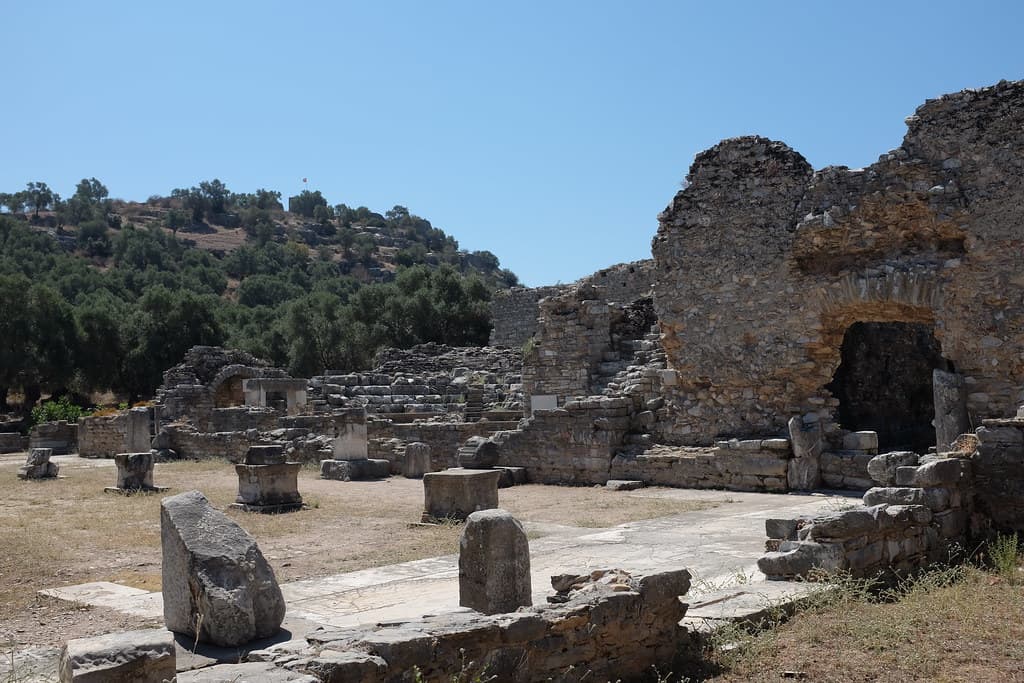
Image of Knidos. Image source
Visit essentials
A quick read before you go
- Duration
- Two to four hours on site.
- Access
- 35 km west of Datça along the peninsula road.
Overview
Arriving at Knidos by boat follows the city's logic. Two harbors, one military and one commercial, were joined by a causeway that partly turned the natural headland into an island, creating one of the ancient Aegean's most sophisticated harbor designs. Its patron, Aphrodite Euploia—Aphrodite of the Fair Voyage—was a sea deity whose protection was sought by every captain negotiating the passage where the Aegean and Mediterranean converge. The site's edge location is integral to its sacred identity.
Praxiteles sculpted the Aphrodite of Knidos around 365 BCE after Kos rejected his nude version for a conventional draped figure. Knidos chose the nude and placed it in a circular, open-sided temple whose two doors allowed views from every angle, front and back. Ancient writers describe pilgrims sailing specifically to see it in accounts both devotional and erotic, even visionary.
Lucian wrote that changing light made the statue appear to move; another account tells of a young man spending the night in the temple. Antiquity's most copied, discussed, and transformed sculptural image is now lost.
The surviving city terraces above twin harbors at the end of a forty-kilometer peninsula road. Active excavation continues amid a quietly astonishing view.
Why this place is sacred
The sacred significance of Knidos is concentrated in a paradox. The Aphrodite of Praxiteles was controversial in antiquity not merely because it showed the goddess nude — there were other nude female figures in Greek art — but because it was a cult statue, the object of active worship, the inhabiting form of the goddess in her sanctuary.
To show the divine naked was to claim that the divine could be encountered without protection, without the formal armor of cult dress and architectural mediation. The circular temple with doors on both sides was an architectural expression of this claim: the goddess could be approached from any direction, seen wholly, met face to face.
Aphrodite Euploia — of the fair voyage — added a maritime dimension to this intimacy. The goddess who protected sailors did so not from distance but from proximity. Her city sat at the point where currents change and the sea's character shifts, where every captain needed reassurance. The ancient world's most intimate cult statue occupied a promontory between two seas: a threshold site for a threshold deity.
For the seeker, Knidos raises a question that the ancient pilgrims navigated in their own terms: what does it mean to seek divine encounter through beauty? The statue is gone; every Roman marble copy is a translation from an original whose specific presence ancient writers described as overwhelming. What remains is the location — the peninsula tip, the harbour below, the site where the circular temple stood. The absence is a kind of presence.
The site still marks the point where people came to stand before something they found difficult to describe.
Primary cult sanctuary of Aphrodite Euploia, protector of sailors and goddess of love and beauty, housing the most celebrated cult statue of antiquity. Secondary sanctuary of Apollo Triopios within the Dorian Hexapolis cult federation.
Originally settled at modern Datça; relocated to the Tekir Burnu peninsula in the fourth century BCE as a planned Hellenistic harbour city. Flourished as a Dorian city of the Hexapolis, a centre of intellectual culture (the mathematician Eudoxus, the physician Ctesias were natives), and above all as the site of Praxiteles' Aphrodite. Continued through Roman and Byzantine periods. First systematically excavated by Sir Charles Thomas Newton (1857–58), whose finds are in the British Museum.
New York University excavations 1966–72 under Iris C. Love located the Temple of Aphrodite. Selçuk University excavations from 2012 continue; protected visitor routes established 2022.
Experience and orientation
The road to Knidos runs 35 kilometres west along the narrowing Datça Peninsula, with the sea visible on both sides for much of its length. This approach is not incidental: the peninsula concentrates attention, reduces the world to a single direction, and delivers you to the site with a sense of having left the ordinary world at a recognisable distance.
Ancient sailors had a different version of this narrowing — the promontory appearing through haze after days at sea — but the phenomenology is not entirely different.
Arriving at the site, the first impression is vertical: the city climbs steeply from the twin harbours through a series of terraces, each holding a different public building. The theatre, partially excavated, occupies a central terrace with a view directly over the commercial harbour and out to the open sea. This is one of the finest theatre settings in the ancient Aegean: the stage opens onto a horizon of water rather than an urban backdrop.
The site of the circular Temple of Aphrodite Euploia — identified by Iris Love's 1970 excavation — sits on an upper terrace. The circular plan is traceable in foundation courses; the absence of the statue amplifies rather than diminishes the quality of the location. The platform looks west, toward the sea confluence. In clear conditions the outline of the Greek island of Kos is visible — the island whose citizens famously rejected Praxiteles' nude statue, leaving it to Knidos.
Move through the site slowly. The terracing means that each level has its own atmospheric quality: the lower harbour area retains the functional logic of a working port, while the upper terraces have a contemplative exposure. The excavation trenches of the Selçuk University team reveal new layers at various points. The site continues to yield material.
Visiting by boat maintains the ancient logic most fully. Excursion vessels from Datça harbour arrive at the site from the sea, making landfall in a cove below the ruins. The visual sequence — water, harbour walls, terraced city, hilltop sanctuary — is the sequence ancient visitors experienced.
The site occupies a peninsula tip with the commercial harbour to the north and the military harbour to the south, connected by a causeway. The main terrace monuments — theatre, stoa, agora, temple sites — are accessed from the harbour area by a path climbing through the terraces. The circular Aphrodite temple platform is on an upper western terrace. The Lion Tomb, a significant funerary monument, stands above the commercial harbour.
Context and lineage
The Dorian settlers of Knidos traced their ancestry to the Spartan colony tradition and their sacred identity to the Triopian sanctuary of Apollo on the peninsula — a cult federation (the Dorian Hexapolis) shared with five other Dorian cities including Kos, Halicarnassus, and Lindos. The city's defining act of sacred self-determination was the commission of Praxiteles' Aphrodite — specifically the choice of the nude statue over the draped version that Kos purchased.
This decision placed the city in a unique position in the Greek sacred landscape: the earthly home of the nude Aphrodite, a title no other city could claim.
Praxiteles sculpted the figure around 365 BCE; ancient accounts date to its reputation as the most famous statue in the world. The circular open temple that housed it, designed with both front and back door access, was an architectural choice that shaped the quality of encounter the sanctuary offered. Pilgrims circled the statue. The accounts of these visits recorded by ancient writers are among the most vivid descriptions of aesthetic and religious experience to survive from antiquity.
Dorian Greek settlement → relocation to Tekir Burnu peninsula (4th century BCE) → commission of Praxiteles' Aphrodite (c. 365 BCE) → flourishing Hellenistic and Roman city → Byzantine period → gradual decline → Newton excavations (1857–58) → Love excavations (1966–72) → Doksanaltı/Selçuk University excavations (2012–present) → protected visitor routes established (2022)
Traditions and practice
The primary sacred practice at Knidos was pilgrimage to the Temple of Aphrodite Euploia — an approach that, for the most devoted visitors, began with the sea voyage and ended with circumambulation of the Praxiteles statue via both doors of the circular temple. Sailors making passage through the Aegean-Mediterranean confluence offered votive dedications to Aphrodite Euploia for safe passage.
The Triopian sanctuary of Apollo, shared with five other Dorian cities of the Hexapolis, hosted competitive sacred games — the Triopia — that brought the wider Dorian religious community to the peninsula.
No active religious ceremonies. Active archaeological excavations by Selçuk University. The site is a popular yachting destination in summer, which maintains something of the ancient maritime approach. Heritage tourism operating through both the overland road and excursion boats from Datça.
Arrive by boat if possible — the Datça harbour excursion vessels in summer deliver the site in its proper orientation, from the sea. Walk the full height of the terraces, from the harbour edge to the upper precincts, pausing at each level. At the theatre, sit for a time with the harbour and sea behind the stage; consider what it meant to attend a performance in a theatre whose backdrop was an open horizon.
At the Aphrodite temple platform, allow the specific absence of the statue to be present — the circular foundation without its object is its own kind of teaching. The statue that stood here changed how Western civilization imagined the divine body; it is gone, and the platform where it stood holds a particular quality of emptiness. At the harbour edge, where ancient sailors made their votive dedications, the water still moves between the Aegean and Mediterranean.
The geography that made Knidos sacred has not changed.
Ancient Greek — Worship of Aphrodite Euploia
HistoricalThe preeminent sanctuary of Aphrodite in the ancient Greek world, housing Praxiteles' Aphrodite of Knidos — the first life-size nude cult statue of a goddess, the most copied and analyzed sculpture of antiquity, housed in a circular open temple designed for circumambulatory approach.
Pilgrimage from across the Mediterranean; votive offerings for safe sea passage; circumambulation of the statue through the dual-door circular temple; individual prayer and votive dedication.
Dorian Hexapolis — Cult of Apollo Triopios
HistoricalKnidos was a founding member of the Dorian Hexapolis, a federation of six cities sharing the Triopion sanctuary of Apollo and holding shared sacred games.
Shared sacrifices and competitive games at the Triopion sanctuary.
Archaeological and Maritime Heritage
ActiveOne of Turkey's most dramatically situated coastal archaeological sites, with active excavations and a natural pilgrimage quality maintained by its sea approach.
Ongoing Selçuk University excavations, heritage tourism, yachting.
Perspectives and open questions
Knidos rewards both the archaeological and the philosophical visitor differently. The site's physical remains are substantial but not among the most spectacular in western Turkey; its sacred significance as the home of the Aphrodite of Praxiteles — the most influential and most analyzed sculpture of antiquity — demands a different kind of attention.
Scholarly perspective
Knidos is significant in classical scholarship for three overlapping reasons: as an important Dorian city of the Hexapolis with a distinguished intellectual tradition (Eudoxus's astronomical work, Ctesias's historical writings); as the planned Hellenistic harbour city with a sophisticated dual-harbour design studied by ancient and modern urban historians; and above all as the site of the Aphrodite of Praxiteles, whose influence on the history of Western art and on the ancient practice of art criticism (the ekphrasis tradition) is without parallel.
The site also has significance for the study of ancient maritime sacred geography and the cult of Aphrodite as a sea deity.
Living and traditional perspectives
In the Dorian tradition, Knidos's identity rested on two pillars: the Hexapolis cult of Apollo Triopios, which connected the city to its ancestral religious federation, and the Aphrodite sanctuary, which gave it a unique sacred role. Sailors of the ancient Aegean understood Knidos as a threshold — the city where Aphrodite Euploia held the junction of two seas — and treated it accordingly with votive dedications and propitiatory offerings.
Alternative interpretations
Several contemporary spiritual traditions identify Knidos as one of the primary ancient sites of the sacred feminine — a place where the divine was understood in its full embodied beauty rather than in its more austere or martial aspects. The lost Praxiteles statue figures in some feminist theological writing as an example of pre-Platonic goddess theology that valued physical beauty as a vehicle for divine encounter rather than an obstacle to it.
The dual-harbour design and peninsula geography have been interpreted by some researchers in terms of sacred landscape geometry.
Open questions
The original Praxiteles Aphrodite is lost; all surviving representations are Roman marble copies of varying quality and fidelity. The precise plan and dimensions of the original circular Temple of Aphrodite Euploia are still being established through ongoing excavation. The full extent and design of the Triopion sanctuary of Apollo on the peninsula remains incompletely known. The astronomical observatory associated with Eudoxus has not been definitively located on the site.
Plan your visit
Access and arrival
35 km west of Datça along the peninsula road. By dolmuş: June to mid-September from Datça otogar (11am and 4pm departures; returns 2:20pm and 8:30pm). By excursion boat from Datça harbour in summer, departing approximately 10am, returning by 7pm. By private car or yacht. Admission: approximately €5 for foreign visitors. Open: April–October 09:00–20:00; November–March 09:00–17:00.
Datça town (35 km east) offers a range of hotels, pensions, and rental accommodation. The peninsula has several small resort settlements. Marmaris (80 km) provides larger hotel infrastructure.
Respectful visit
No dress requirements. Sturdy footwear strongly recommended for the steep terraced paths.
Permitted throughout the accessible areas of the site.
Not applicable to the archaeological site.
Do not enter cordoned excavation areas. Do not remove any material from the site. Stay on marked visitor paths. Photography of active excavation staff and equipment requires their permission.
The site is remote and can be hot in summer — carry sufficient water for the full visit. The terrain is steep in places. Some excavation areas are inaccessible. Boat excursions from Datça are seasonal (roughly June to mid-September); out of season, the overland road is the only access, and return dolmuş service is limited.
Location
Map loads as you approach this section.
Pilgrim reflections
A portrait of encounter, not a score
Pilgrims describe what they felt, how present they could become, and whether the place would shape a journey. There are no stars and no ranking of traditions.
No reviewed reflections yet
The first pilgrims can help describe the character of being here.
Share a reflection
Available after an account-backed “Been there.” Every reflection is reviewed before publication.
Nearby sacred places
Explore other sacred places in the region. Proximity does not establish access or travel time; check each place’s guidance.



References
Sources consulted for this page. Source categories describe the publication, not a guarantee that every claim is verified. Traditional accounts and outside interpretations may differ.
- 01Knidos – Wikipedia — Wikipedia contributorsencyclopediaComprehensive overview of history, geography and archaeology
- 02Temple of Aphrodite, Knidos – Wikipedia — Wikipedia contributorsencyclopediaDetailed account of the Temple of Aphrodite Euploia and the Praxiteles statue
- 03Aphrodite's City of Knidos Enters a New Phase – Anatolian Archaeology — Anatolian ArchaeologyacademicRecent archaeological news on excavation and visitor route development
- 04Muğla Knidos Archaeological Site | Turkish Museums — Turkish MuseumsofficialOfficial Turkish ministry museum portal listing
- 05Knidos – History and Facts | History Hit — History HitSource contextAccessible historical summary
- 06Knidos: a stunning ancient city in Turkey | Peter Sommer Travels — Peter Sommer TravelsguideExpert travel writing with historical context
- 07Knidos | Lonely Planet — Lonely PlanetguidePractical visitor information including opening hours and admission
- 08Knidos: Exploring the Ancient City at the Tip of the Datça Peninsula — Nomadic NikoguidePractical visitor guide with access and transport information
Share a photo
Help visitors recognize Knidos. Every submission is reviewed before publication.