Klazomenai
Birthplace of the philosopher who called the sun a hot rock—and still heard swans bring Apollo home
Understand sacred places, explore living traditions, and learn how to engage respectfully with Pilgrim Map.
Access has not been verified. Check current local guidance before planning a visit.
İzmir, Turkey
Read the sources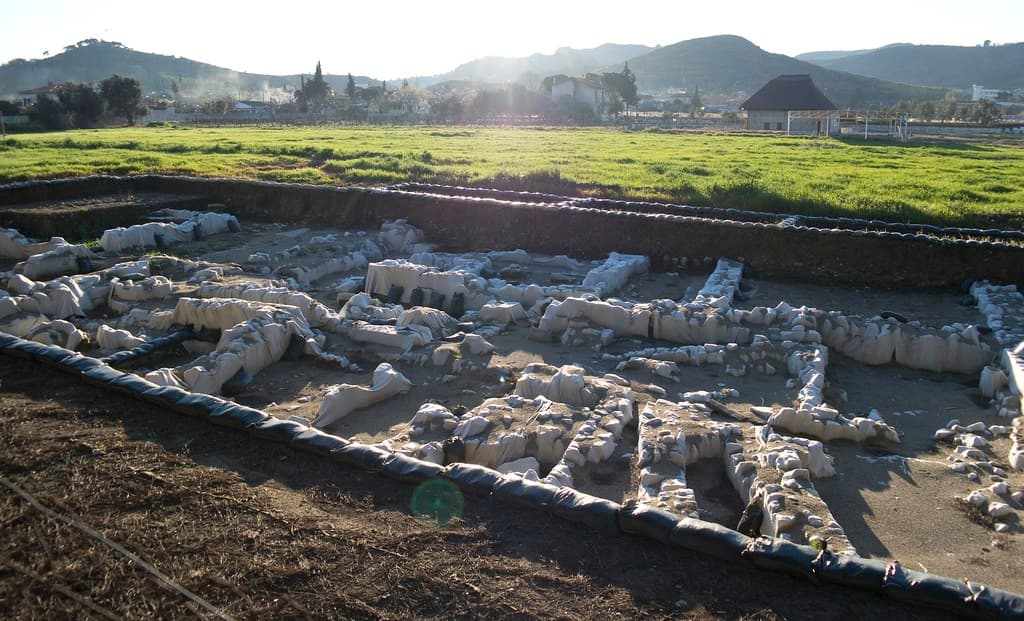
Image of Klazomenai. Image source
Visit essentials
A quick read before you go
- Duration
- 1.5–2 hours for the Klazomenai site itself.
- Access
- Located near Urla–İskele, approximately 35 km west of İzmir city center.
Overview
Klazomenai occupies a divided geography: the Bronze Age predecessor at mainland Limantepe; Karantina Island, ancient Aghios Yannis, where the city moved after the Ionian Revolt; and the water between them, crossed by Alexander the Great's still-partly-visible causeway. More than topography, this movement between island and mainland, sea and land, mirrors the city's intellectual character.
Klazomenai was sacred to Apollo, who local myth said returned each winter in a swan-drawn chariot, an arrival marked on city coins. It also gave birth to Anaxagoras, who around 450 BCE argued that the sun was not divine but a burning rock larger than the Peloponnese, a claim radical enough to bring exile from Athens.
The city of Apollo's winter return also produced the thinker of a cold sun. Klazomenai offers no resolution between sacred and rational, only their coexistence in one place.
Why this place is sacred
Apollo did not simply patronize Klazomenai from a distance. Local tradition held that the god spent his winters in the city, arriving by swan-drawn chariot from wherever the sun retreats in the cold months. This myth appeared prominently on Klazomenian coinage—the chariot and swans were the city's civic signature—suggesting the myth was not decorative but structurally important to how citizens understood their relationship to the divine. The sun came home to Klazomenai.
Then Anaxagoras was born here, and he spent his life arguing that the sun was no god at all but a white-hot stone, incandescent and indifferent. He moved to Athens, taught Pericles, and was eventually tried for impiety. His native city watched from across the water. The juxtaposition is not merely interesting; it is the site's essential nature.
Klazomenai sits at the exact historical moment when the sacred and the rational began their long divergence in Western thought—and it sits on both sides of that divide. The waters of the bay, the island that sheltered refugees from Persian reprisals, Alexander's causeway linking island to mainland: all of these carry the same structural logic of the place, a threshold where two things that seem opposed turn out to share ground.
Ionian Greek polis with Apollo as principal patron deity; center of olive oil production, painted terracotta sarcophagus manufacture, and maritime trade within the Ionian League.
From Bronze Age predecessor at Limantepe to Ionian Greek mainland city to island refuge after the Ionian Revolt (5th century BCE), then causeway reconnection under Alexander the Great. The city declined through Hellenistic and Roman periods and was ultimately abandoned.
Experience and orientation
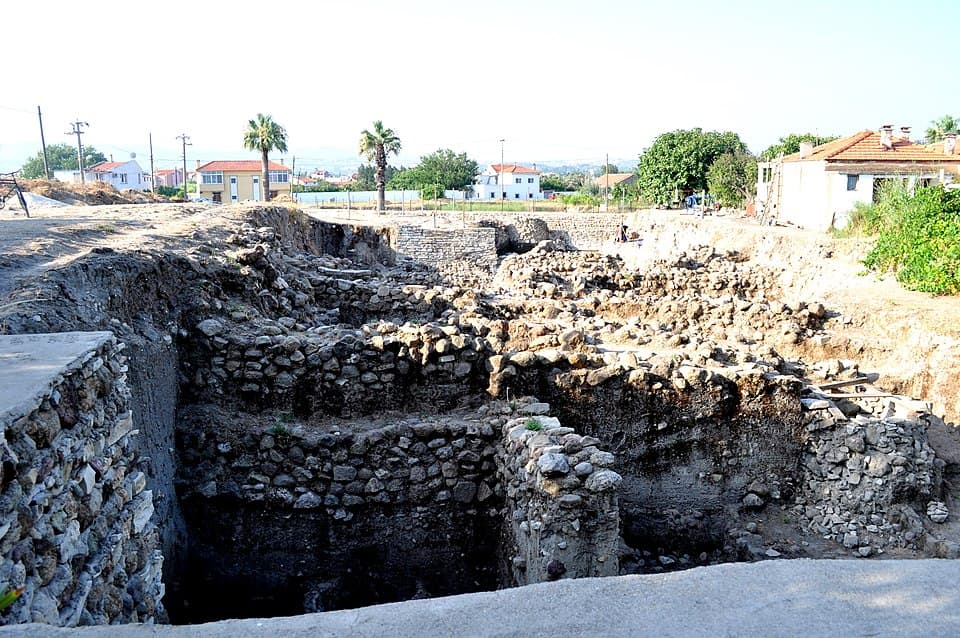
Walk the mainland site and you encounter the world's oldest known olive oil production facility—pressing stones and drainage channels that represent an agricultural technology being formalized for the first time. The sarcophagus workshops produced distinctive painted terracotta coffins for a century and a half during the Archaic period; fragments of their vivid imagery still appear in the İzmir Archaeology Museum.
The causeway remnants in the water between shore and island are visible from the shore, stone humps rising from the bay at low water. This narrow channel is the site's most charged space: Alexander's engineering connecting the city back to the mainland it had fled, the physical trace of a civilization's attempt to hold two realms together.
The light on the Aegean here changes through the day in ways that would have carried obvious significance for a community whose patron god was associated with the sun's annual cycle. Come in spring if you can—when the migratory birds that use the Urla wetlands are active, the image of Apollo arriving on swans ceases to be purely mythological.
The site occupies the Limantepe coastal area and extends to former Karantina Island, connected to the mainland today by land reclamation as well as the ancient causeway. Combine with the adjacent Liman Tepe prehistoric mound for a complete view of the area's long occupational sequence.
Context and lineage
Klazomenai was founded by Ionian Greek settlers, traditionally associated with colonists from Colophon, on the site of an existing Bronze Age coastal settlement at Limantepe. The city's early history was bound up with the Ionian League and the wider Aegean trade networks of the Archaic period (8th–6th centuries BCE). The Ionian Revolt against Persian rule (499–493 BCE) was a turning point: following the revolt's failure, the city relocated to the offshore island of Karantina (Aghios Yannis) for security.
Alexander the Great's arrival in the 4th century BCE prompted the construction of a causeway reconnecting the island to the mainland, and the city gradually returned to its earlier configuration. By the Hellenistic and Roman periods, Klazomenai had diminished in importance, eventually being absorbed into the expanding orbit of nearby Smyrna.
Ionian Greek Religion (Apollo worship, Ionian League) → Hellenistic period decline → Roman assimilation into greater Smyrna → archaeological site
Anaxagoras
Philosopher born in Klazomenai c. 500 BCE; proposed the sun was a burning rock rather than a deity; taught Pericles; exiled from Athens for impiety
Alexander the Great
Constructed the causeway between Karantina Island and the mainland in the 4th century BCE, physically reconnecting the city to its original territory
Traditions and practice
The cult of Apollo in Klazomenai had a distinctive local character rooted in the myth of the god's annual winter arrival by swan-drawn chariot. Temple worship, votive offerings, and civic festivals marked this cycle. A 4th-century BCE clay seal of Apollo has been discovered at the site. Demeter was also worshipped through festivals tied to the olive harvest—a particularly significant rite in a city that operated the ancient world's most productive known olive oil facility.
As a member of the Ionian League, Klazomenai participated in the pan-Ionian religious observances at the Panionion sanctuary on the Mykale peninsula.
Archaeological excavations continue at the site. The İzmir Archaeology Museum holds the most significant finds, including painted Klazomenian sarcophagi from the Archaic period.
Walk to the water's edge where the causeway remnants are visible. The channel between shore and island—perhaps 200 meters at its narrowest—was once a defensive barrier and then a symbolic divide. Alexander's causeway stones in the water mark the moment when that divide was bridged. Stand there and consider the double movement the site embodies: a community that first fled to the island for safety, then was reconnected to the mainland by an imperial project that erased its island autonomy.
The same waters that once protected Klazomenai from Persian reprisals later became the medium through which Macedonian power asserted its reach. Move through the olive press area slowly. Press your hand to a stone if it is accessible. This is the oldest known olive pressing facility in the world. What preceded it by a thousand years we can only imagine.
Ancient Greek Religion (Ionian)
HistoricalKlazomenai was a member of the Ionian League and maintained the religious traditions of Ionian Greek culture, with Apollo as the city's principal divine patron. The myth of Apollo wintering in the city, arriving on a chariot of swans, was central to civic identity and appeared on the city's coinage.
Temple worship, votive offerings, civic religious festivals aligned with agricultural seasons. Apollo's solar cycle and winter return were central. Demeter festivals tied to olive harvest. Participation in pan-Ionian observances at the Panionion.
Archaeological Heritage
ActiveKlazomenai hosts the world's oldest known olive oil production facility and the manufacturing center for the distinctive Klazomenian painted terracotta sarcophagi of the Archaic period. Ongoing excavations continue to yield significant finds.
Annual archaeological excavations by Turkish universities. Artifacts housed in İzmir Archaeology Museum.
Perspectives and open questions
Klazomenai presents three interpretive frames that do not fully resolve into each other: the sacred Apolline city, the cradle of rationalist philosophy, and the archaeological site whose material remains do not easily speak of either.
Scholarly perspective
Scholarly attention has focused on two areas: Klazomenai's role as the dominant center for painted terracotta sarcophagus production in the Archaic Aegean (a distinctively local art form with no close parallels elsewhere), and its significance as the world's earliest known location of large-scale olive oil production. The birthplace of Anaxagoras gives the city additional intellectual-historical weight. The ongoing excavations have been producing results since the 1990s that continue to refine understanding of the city's extent and chronology.
Living and traditional perspectives
No surviving indigenous tradition interprets Klazomenai. Ancient texts—including passing references in Herodotus, Strabo, and Pausanias—provide the main non-archaeological record. The Apollo-and-swans myth was sufficiently central that it was the city's primary coin image for centuries; its precise ritual enactment is not documented.
Alternative interpretations
In neo-pagan and Hellenist traditions, Klazomenai carries significance as a city where Apollo's solar character—his departure and return, the wheel of the year—was given a specific local form. The city is occasionally included in reconstructionist pilgrimage itineraries of the Ionian coast. The Anaxagoras angle has attracted interest from philosophy of religion writers for whom Klazomenai represents the exact point at which Western thought began distinguishing between natural phenomenon and divine agency.
Open questions
The exact location of the Apollo temple has not been identified archaeologically. The full extent of the offshore Bronze Age harbor complex shared with Liman Tepe remains under investigation. The transition from mainland to island settlement and its precise social and religious implications are still being worked out from stratigraphic evidence.
Plan your visit
Access and arrival
Located near Urla–İskele, approximately 35 km west of İzmir city center. Accessible by car via the coastal road from Urla town. Limited dolmuş (shared taxi) service from Urla. Parking available at the site. The İzmir Archaeology Museum in central İzmir displays the most significant Klazomenian finds and is more accessible for most visitors. Mobile phone signal may be unreliable in parts of the peninsula.
Current visitor hours and entry fees were not confirmed at time of writing; check the Turkish Museums official listing or the İzmir Provincial Directorate of Culture for current arrangements.
Urla town (c. 5 km) offers local hotels and guesthouses. Çeşme (c. 30 km) provides coastal resort accommodation. İzmir city (35 km) has the full range of options.
Respectful visit
No religious requirements. Sun protection is strongly recommended in summer; temperatures on the Urla peninsula can be high from June through September.
Generally permitted throughout. Check with site staff for any restrictions near active excavation areas.
None appropriate.
Do not enter active excavation trenches or roped-off conservation areas. Do not remove any material from the site.
Some excavation zones are active and roped off; respect all boundaries. Check current site conditions before visiting.
Location
Map loads as you approach this section.
Pilgrim reflections
A portrait of encounter, not a score
Pilgrims describe what they felt, how present they could become, and whether the place would shape a journey. There are no stars and no ranking of traditions.
No reviewed reflections yet
The first pilgrims can help describe the character of being here.
Share a reflection
Available after an account-backed “Been there.” Every reflection is reviewed before publication.
Nearby sacred places
Explore other sacred places in the region. Proximity does not establish access or travel time; check each place’s guidance.


References
Sources consulted for this page. Source categories describe the publication, not a guarantee that every claim is verified. Traditional accounts and outside interpretations may differ.
- 01İzmir Klazomenai Archaeological Site — Turkish MuseumsofficialOfficial Turkish museum listing with site information
- 02Klazomenai - Topostext — TopostextacademicAcademic geographic and historical database entry with coordinates
- 03Klazomenai - Wikipedia — Wikipedia contributorsencyclopediaCovers history, relocation, and key figures
- 04New Discovery At Klazomenai, The Ancient Greek Ceramic Centre In Asia Minor — Greek City TimesSource contextCovers recent archaeological discoveries including olive oil production facility
- 05The Greek City That Was the Ceramic Center of the Ancient World — GreekReporter.comSource contextOverview of Klazomenai's craft and trade prominence
- 06Klazomenai - Archiqoo — ArchiqooSource contextLocation and historical summary
- 07Greek History - Clazomenae — historygreek.orgSource contextHistorical overview of the Ionian city
- 08Klazomenai Ancient City - LikeCesme — LikeCesmeguidePractical visitor information and local guide
Share a photo
Help visitors recognize Klazomenai. Every submission is reviewed before publication.