Erythrai
Ionian oracle city of the Sibyl, where a Phoenician god arrived by sea and women gave their hair to the sacred
Understand sacred places, explore living traditions, and learn how to engage respectfully with Pilgrim Map.
Access has not been verified. Check current local guidance before planning a visit.
İzmir, Turkey
Read the sources
Visit essentials
A quick read before you go
- Duration
- 2–3 hours including the ascent and descent, time at the theater and walls, and exploration of…
- Access
- Located in Ildırı village, Çeşme district, İzmir Province.
Overview
Erythrai's acropolis rises above Ildırı and the Chios strait, where myth says a Phoenician raft bearing Heracles's cult image drifted ashore and was claimed by those who wove the right rope. The celebrated Erythraean Sibyl was said to be born in a Mount Mimas cave and prophesy through Apollo's sanctuary; early Christian apologists later read her acrostic as testimony to Christ.
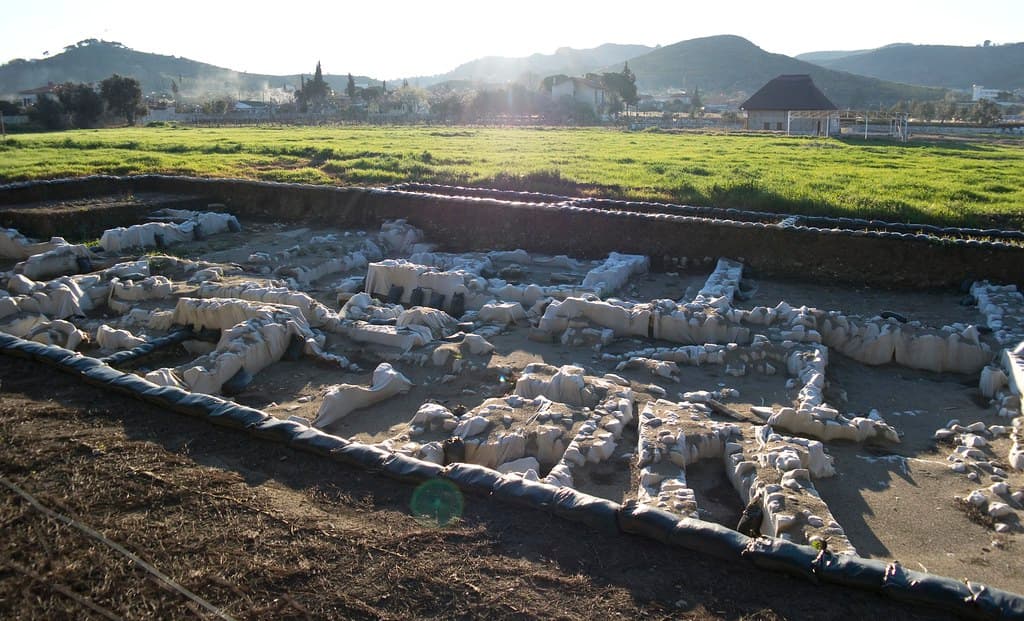
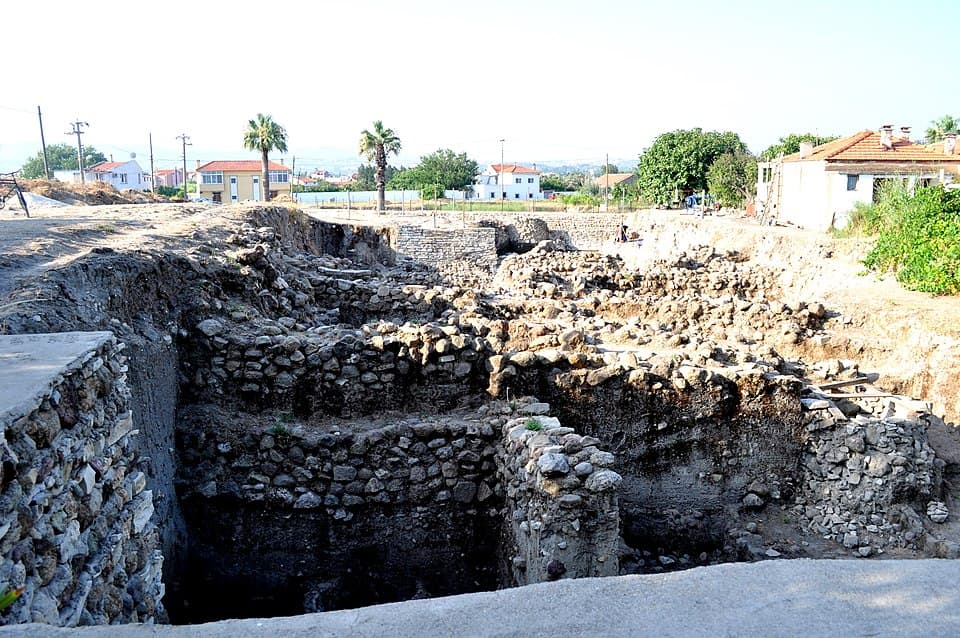
Excavations since 1964 reveal unusual sacred density: Athena Polias's 8th-century BCE podium, among the earliest monumental Ionian religious works; Apollo Delphinion and the Sibyl; and Heracles's Tyrian-linked cult. Ancient sources uniquely record women dedicating locks of hair here, for reasons still unexplained. Above the fishing village, the partly restored bedrock theater and acropolis walls remain open to the unchanged sea.
Why this place is sacred
Erythrai's sacred quality accumulated through distinct but convergent threads. The Athena Polias sanctuary, with its 8th-century BCE podium, establishes the site's antiquity in Ionian religious architecture — among the earliest monumental expressions of the goddess who protected the polis. But Erythrai was never simply a standard Ionian city.
The Heracles cult introduced a distinctly non-Greek element: the tradition that the god's cult image arrived from Phoenician Tyre on a raft, floating across the Mediterranean until it reached this coast. The Tyrians had tried and failed to pull the raft ashore; the fishermen of Erythrae succeeded because they wove their rope from the hair of their women.
This myth is remarkable on multiple levels — it encodes a Phoenician-Greek religious transfer, attributes the god's arrival to a specifically female act of material devotion, and suggests that the hair-dedication practice documented at Erythrai had its origins in this founding moment.
The Erythraean Sibyl, Herophile, added another layer: the voice of Apollo given to a woman born in a coastal cave, whose prophecies were taken down and studied for centuries. Her acrostic prophecy — in which the first letter of each verse spells out a prophetic message — was cited by early Christian writers as proof that pagan tradition had already foretold Christian revelation. This placed Erythrai at a theological hinge between classical and Christian sacred history.
The combination of female hair sacrifice, a god arriving by sea from the east, an oracle-woman born in a cave, and the city's panoramic position facing Chios creates a sense of accumulated sacred charge that the site still communicates.
Ionian Greek polis with multiple major cult sanctuaries: Athena Polias, Apollo Delphinion (Sibyl oracle), Heracles with Phoenician connections
Settled by Ionians in the 10th–9th century BCE; monumental religious architecture from the 8th century BCE; flourished as a full Ionian League member; Hellenistic expansion including theater and villa complexes; Roman continuation; Byzantine reoccupation; modern fishing village of Ildırı established at the base of the acropolis; systematic archaeological excavation from 1964
Experience and orientation
The approach begins in Ildırı village — a small fishing community of whitewashed houses and harbor boats, the smell of the sea constant. Buy water here, and use the restrooms if available, because the site above offers neither. The path uphill from the village is steep enough to require focus; the terrain is uneven and the summer sun, without shade, is relentless.
The effort is not wasted. The acropolis reveals itself gradually as the path climbs: first the line of the ancient walls, still tracing the hilltop perimeter in courses of 4th-century BCE masonry; then the theater, carved into the natural bedrock of the hillside, its orchestra and lower seating rows partially restored.
The theater faces seaward, and on a clear day the island of Chios is visible across the strait — the same view that greeted every audience that sat here in the 4th through 2nd centuries BCE.
From the uppermost point of the acropolis, the sacred geography of the ancient city becomes legible below: the footprint of the Athena Polias sanctuary area, the lower terrain where the Apollo precinct and the Sibyl's oracle tradition were located. The harbor of Ildırı is visible, and beyond it the open Aegean. This is a site where the relationship between sea, sky, and human settlement is held in unusually clear proportion.
Late afternoon is the optimal time to be on the acropolis. The western light at that hour saturates the limestone and the sea simultaneously, and the temperature drops enough to make extended sitting possible. The site is rarely crowded; Erythrai is not on standard tourist itineraries. The experience of being alone on an Ionian acropolis with a panoramic sea view and the Sibyl tradition at your back rewards whatever effort the ascent requires.
Park in Ildırı village and walk uphill toward the ruins. The theater and walls are visible on the hillside and serve as orientation points. The path is passable for reasonably fit visitors but is steep; allow 20–30 minutes for the ascent. Carry water, sunscreen, and a hat in summer. No admission fee; no formal entrance gate.
Context and lineage
Erythrai's foundation is attributed by ancient sources to two different figures: a Cretan hero Knopus, son of Codrus, who led the Ionian settlers; and a Thessalian figure Erythros, whose name the city bears. These parallel traditions reflect the complexity of the Ionian migration, in which settlers from multiple Greek regions converged on the Anatolian coast.
The Heracles cult provided a second, more dramatic founding story: a Tyrian fishing community discovered a raft carrying a wooden cult image of Heracles floating in the sea. Neither they nor others could bring the raft ashore. Then the women of Erythrae wove a rope from their own hair, and with that rope the fishermen of Erythrai pulled the god in.
This myth established the hair-dedication practice as a foundational act of female devotion — women of Erythrai thereafter dedicated their hair to Heracles in memory of that original act.
The Erythraean Sibyl Herophile, said to have been born in a cave on the nearby Mount Mimas, became the voice of Apollo's oracle at the city's Delphinion sanctuary. Her prophecies circulated in antiquity and were collected alongside the oracles of other Sibyls, eventually becoming part of the Sibylline Books that Rome consulted in times of crisis.
Early Christian writers read her acrostic prophecy as evidence that even pagan tradition had foretold the coming of Christ, making her a figure of unusual importance in the history of interfaith prophetic transmission.
Ionian Greek colonial; one of the twelve cities of the Ionian League; post-Hellenistic decline; Byzantine reoccupation of acropolis; medieval village of Ildırı established at the base
Erythraean Sibyl (Herophile)
Oracular prophetess of Apollo's Delphinion sanctuary
Ekrem Akurgal
Archaeologist; director of excavations from 1964
Hakkı Gültekin
Co-director of early excavations
Knopus of Crete
Legendary Ionian founder
Traditions and practice
The Apollo Delphinion sanctuary at Erythrai housed the oracle tradition associated with the Sibyl Herophile. Citizens and travelers came to the sanctuary with questions; the Sibyl's answers, understood as divine speech, were recorded and transmitted. The Apollo oracle at Erythrae was considered the most significant in Ionia after Didyma and Claros.
The Heracles cult carried a unique ritual dimension: the annual dedication of women's hair in memory of the foundational act by which the god's image was brought ashore. Ancient sources record this as distinctive to Erythrai, practiced by local women and — in a notable specification — not by the women colonists who came from other places. The hair-dedication thus marked indigenous belonging and cult membership simultaneously.
The Athena Polias temple, whose 8th-century BCE podium represents one of the earliest monumental Ionian religious structures known, anchored the city's civic religion. Worship here was not a private or ecstatic practice but a public expression of the polis's identity under divine protection.
No active ancient religious ceremonies. Occasional cultural events in Ildırı village. Scholarly excavation continues under Turkish university direction.
Climb to the acropolis in the late afternoon. The ascent itself is a form of practice: the effort, the altitude gained, the widening view all prepare the quality of attention the site rewards. When you reach the theater, sit in the bedrock seating and face the sea. Chios is visible on the right.
Let the site's layered history become present in sequence: first the theater's human scale; then, looking at the walls, the city's defensive perimeter; then, lifting your gaze to the sea, the strait across which Heracles' raft drifted from Tyre. The Sibyl's cave tradition lies below and north — Mount Mimas forms the horizon beyond the village. None of these can be formally visited. But they can be held in attention from this hilltop.
Allow the sunset if you are there in time. The descent in early dusk, with the harbor lights of Ildırı below, closes the experience without needing language.
Ancient Greek Ionian Religion
HistoricalErythrai maintained multiple major sanctuaries: Athena Polias (with one of the earliest Ionian temple podia, 8th century BCE); Apollo Delphinion (housing the Erythraean Sibyl oracle); and Heracles with its uniquely Phoenician-derived cult image. The city's religious life was extraordinarily diverse even by Ionian standards.
Athena Polias temple worship; Apollo oracle consultation through the Sibyl; Heracles cult veneration with annual hair-dedication by native Erythraean women; private and domestic cult practices
Sibyl Prophetic Tradition
HistoricalThe Erythraean Sibyl Herophile was considered the second most important Sibyl after the Cumaean, and her acrostic prophecy was cited by early Christian writers as evidence of pre-Christian revelation. She represents a rare intersection between Greek oracular tradition and early Christian sacred history.
Prophetic utterances at the Apollo Delphinion sanctuary; written oracles transmitted and studied across the ancient Mediterranean; her acrostic read as Christological prophecy by Church Fathers
Archaeological Heritage
ActiveSystematic excavations since 1964 have documented Erythrai's urban development from the 8th century BCE through the Byzantine period, contributing significantly to the understanding of Ionian religious architecture, theater design, and villa culture.
Ongoing excavation and site documentation; the theater has undergone partial restoration; site administered by Turkish Ministry of Culture
Perspectives and open questions
Erythrai has been read by scholars of Greek religion, students of prophetic tradition, and those interested in the intersection of Greek and Phoenician sacred culture — each emphasis illuminating a different aspect of a genuinely unusual site.
Scholarly perspective
Academic scholarship focuses on several distinct features of Erythrai's importance. The Athena Polias temple podium dating to the 8th century BCE places this among the earliest documented monumental Ionian religious architecture — predating the great temples of Samos, Miletus, and Ephesus in their canonical forms. The theater, carved into bedrock and reconstructed in the Hellenistic period, is well-studied as a specimen of Ionian civic architecture.
Ekrem Akurgal's excavations from 1964 established the sequence of occupation and the spatial relationships between the major sanctuaries. The Heracles cult's Phoenician connection is taken seriously by scholars of ancient religious transfer as evidence of real trans-Mediterranean cult movement in the early Iron Age.
Living and traditional perspectives
The hair-dedication practice documented at Erythrai belongs to a broader category of Anatolian pre-Greek ritual in which women's bodily offerings — hair, blood, specific acts of physical devotion — marked membership in a community and its gods. The specification in ancient sources that the practice was limited to native Erythraean women (not women who came from elsewhere) suggests it was understood as marking indigenous belonging and continuity, even within a Hellenized polis framework.
The Heracles cult's Tyrian origin, accepted rather than suppressed in the local founding myth, reflects an unusual openness to acknowledged religious syncretism.
Alternative interpretations
The Erythraean Sibyl occupies a genuinely liminal position in Western religious history. Her acrostic prophecy — read by Lactantius, Eusebius, and other Church Fathers as a pre-Christian oracle — made her a bridge figure between Greek prophetic tradition and Christian eschatology. This reading was not imposed on her; early Christian writers believed they were discovering what she had genuinely foretold.
The site where she was said to prophesy thus holds an unusual claim: a place where two religious traditions locate a shared prophetic moment, each reading the same voice as confirmation of their own tradition.
Open questions
The precise location of the Sibyl's oracle chamber or cave has not been archaeologically identified — the tradition places her birth on nearby Mount Mimas, but no excavation has confirmed the oracle site's physical form. The full ritual protocol of the Apollo Delphinion sanctuary is undocumented. The exact form of the hair-dedication practice — whether collective, annual, individual, or tied to specific life events — is not specified in surviving sources.
Plan your visit
Access and arrival
Located in Ildırı village, Çeşme district, İzmir Province. Approximately 20 km north of Çeşme town center by road; 30 minutes by car. From İzmir, take the road to Çeşme then north toward Ildırı (allow 1.5 hours). Taxis available from Çeşme; dolmuş service is limited and irregular — confirm schedules locally. No formal parking area; street parking in Ildırı village. No admission fee. Mobile phone signal: generally available in Ildırı village; may become intermittent on the upper acropolis.
Nearest emergency services: Çeşme town (20 km). Stock up on water and food in the village before ascending.
Ildırı village has no hotels. Çeşme town (20 km south) offers a full range of accommodation from boutique hotels to pensions. The Çeşme peninsula is a popular summer destination; book ahead for June–August. İzmir (80 km) provides the broadest accommodation range.
Respectful visit
Comfortable walking clothes; sturdy shoes or boots with ankle support are strongly recommended for the hillside ruins. A hat and sun protection are essential in summer.
Freely permitted throughout the site. The theater, walls, and sea views are the primary photographic subjects.
None associated with the site's contemporary state.
Stay on established paths near the walls and theater; the terrain drops sharply on the seaward side of the acropolis. Bring water and sun protection from the village below — there are no facilities on the site.
The ascent is steep and exposed in summer; heat exhaustion is a genuine risk in July and August — time your visit for morning or late afternoon. Bring water from the village; none is available above. Uneven terrain throughout; ankle-support footwear is advised. Limited shade on the acropolis plateau.
Location
Map loads as you approach this section.
Pilgrim reflections
A portrait of encounter, not a score
Pilgrims describe what they felt, how present they could become, and whether the place would shape a journey. There are no stars and no ranking of traditions.
No reviewed reflections yet
The first pilgrims can help describe the character of being here.
Share a reflection
Available after an account-backed “Been there.” Every reflection is reviewed before publication.
Nearby sacred places
Explore other sacred places in the region. Proximity does not establish access or travel time; check each place’s guidance.


References
Sources consulted for this page. Source categories describe the publication, not a guarantee that every claim is verified. Traditional accounts and outside interpretations may differ.
- 01Erythrae | Ionian Coast, Aegean Sea, Ruins — Britannica — Britannica editorsencyclopediaAuthoritative summary
- 02Erythrae | Turkish Archaeological NewsacademicExcavation news and site overview
- 03Erythrae - Wikipedia — Wikipedia contributorsencyclopediaComprehensive overview of history, cults, and excavations
- 04Erythrai (Ildırı) Ancient Settlement — Visit İzmir — Visit İzmirofficialOfficial tourism overview
- 05Erythraean Sibyl - Wikipedia — Wikipedia contributorsencyclopediaOracle tradition at Erythrai
- 06The Village of Ildiri and the Ancient Ruins of Erythrai — Frommer's — Frommer'sguidePractical visitor guidance
- 07Erythrai (Ildırı) Ancient City — A Complete Guide — destinations.com.trguideVisitor details, access, and site description
- 08The Land of Women Who Dedicated Their Hair to the Gods — Ancientist — AncientistSource contextCovers unique cult practices including hair-dedication ritual
Share a photo
Help visitors recognize Erythrai. Every submission is reviewed before publication.