Teos
Ancient home of the world's greatest Dionysus temple and the guild that gave theatre to the Greek world
Understand sacred places, explore living traditions, and learn how to engage respectfully with Pilgrim Map.
Access has not been verified. Check current local guidance before planning a visit.
İzmir, Turkey
Read the sources
Visit essentials
A quick read before you go
- Duration
- 1–2 hours for the ruins themselves.
- Access
- Located south of Sığacık village in Seferihisar district, approximately 60 km southwest of İzmir…
Overview
Teos, one of the twelve Ionian League city-states, was for centuries the Greek world's earthly center of Dionysiac religion and headquarters of the Technitai Dionysou, the Guild of Dionysiac Artists. Its diplomatically immune members performed across warring states, carrying the god of wine, theatre, and ecstatic release from city to city. Their sanctuary was the ancient world's largest Temple of Dionysus, an Ionic design by Hermogenes later cited as a model by the Roman architect Vitruvius.
The partially revealed city includes the bouleuterion's standing columns and Hellenistic proportions, a temple precinct emerging after decades of excavation, and remains beneath olive-covered hills toward the Aegean. Fighting-cupid mosaics and an unread inscription discovered at the bouleuterion in 2025 show that Teos is still yielding its story.
Why this place is sacred
Dionysus was the god of edges: between life and death, between sanity and ecstasy, between the human and the divine, between the cultivated vineyard and the wild mountain. He was unlike any other Olympian in that his worship demanded not observation from a distance but participation — the loss of self, the transformation of the ordinary into the transcendent through music, wine, and performance.
Teos was consecrated to this god more fully than almost any other place in the ancient world. The Technitai Dionysou — the Dionysiac Artists — were neither wandering entertainers nor minor clergy but something unprecedented: a pan-Hellenic professional religious guild whose members received sacred exemption from taxation and military service and who could move unmolested between cities at war. From Teos, they carried Dionysiac festivals to every corner of the Greek world.
Wine, theatre, and the transformation of the self through the arts were understood as spiritual states, not entertainments. The guild's headquarters at the world's largest Dionysus temple made Teos a kind of spiritual capital of creative transformation. That function is extinct. What remains is the silence of an unfinished excavation — the bouleuterion's columns casting long shadows in the afternoon, the temple precinct mostly underground, the sense of a city whose full story is still beneath your feet.
The site served as the earthly center of Dionysiac religion through its temple — the largest in the ancient world dedicated to this god — and as the headquarters of the Technitai Dionysou, the guild that organized theatrical and musical festivals across the Hellenistic world.
Teos flourished from its founding (8th century BCE) through the Hellenistic and Roman periods. It was refounded as Antioch on the Sea by Antiochus II and later reasserted its original name. The city declined in the Byzantine period. The archaeological excavation led by Ankara University (from the 1990s, intensifying in the 2010s) has since revealed the bouleuterion, mosaic floors, and is progressively uncovering the temple complex.
Experience and orientation
The bouleuterion is where the site gives most directly. Its columns still stand to substantial height, and the discovery in 2025 of mosaic floors depicting fighting cupids and a still-unread inscription suggests how much the building once communicated through image and text. Stand inside the precinct in the early morning — when tour buses have not yet arrived and the light angles across the columns — and notice the architecture's intention to impress, to convoke, to solemnize.
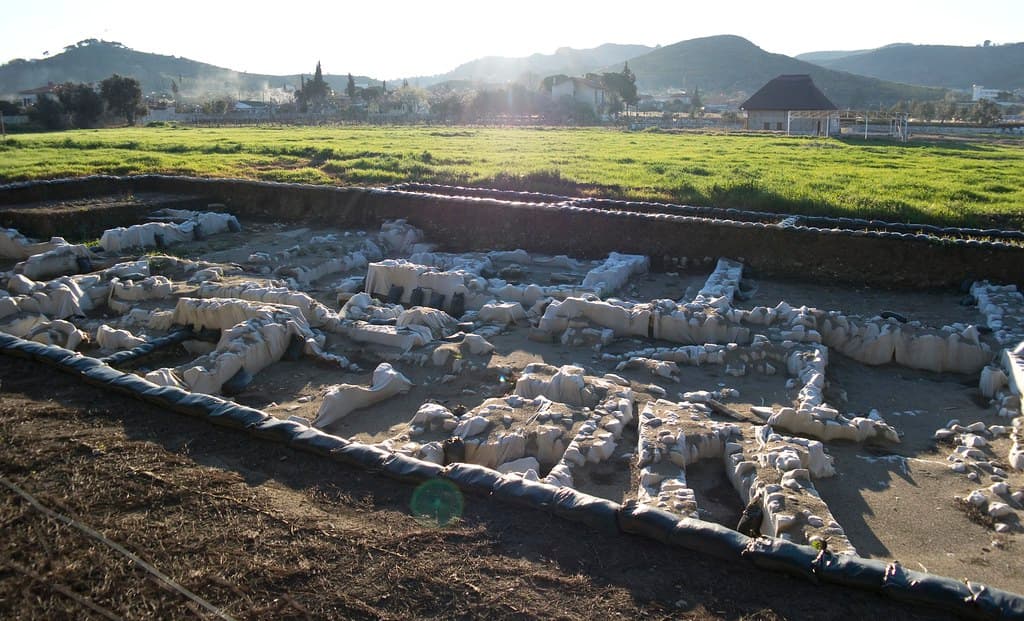
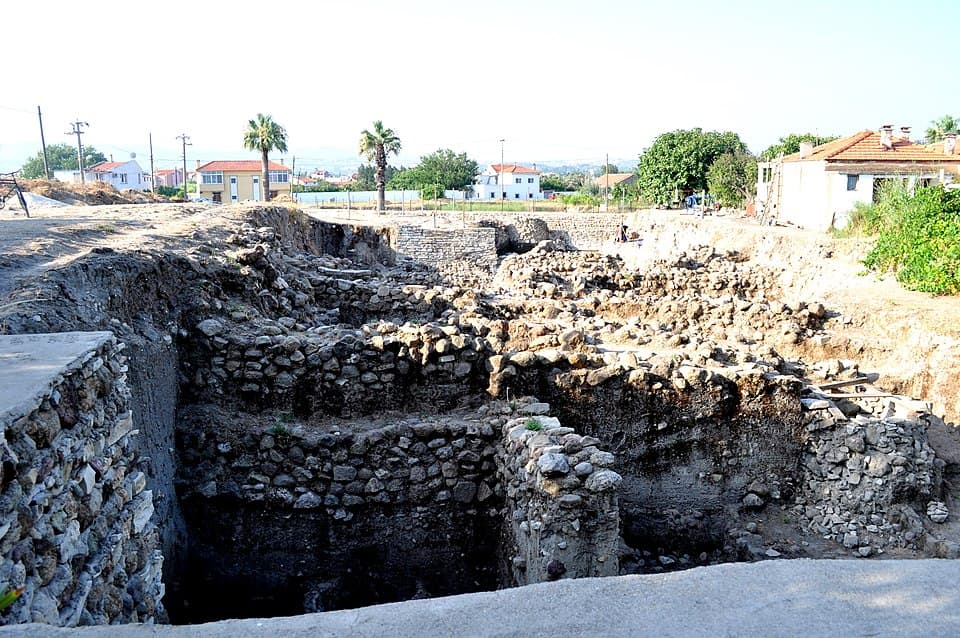
This was a council hall where civic decisions were made under the symbolic eye of Dionysus. The temple precinct lies further into the site, still largely unexcavated, identifiable by foundation outlines and the ongoing work of the excavation team. The contrast between what has been revealed and what remains buried is itself part of the experience — Teos is a site actively in the process of being reclaimed from the earth.
The broader city extends across olive-covered hillsides that roll down toward the harbor, ruins of walls and structures visible wherever you look. The proximity to the harbor at Sığacık adds a Mediterranean immediacy: this was always a coastal city, a port of arrival and departure, and the Aegean light that falls across the ruins is the same light the Technitai would have sailed toward on their way to festivals across the Greek world.
The main approach is from Sığacık village to the south. The bouleuterion is the best-preserved standing structure and a natural anchor for the visit. Allow your walk to extend outward toward the less-excavated temple precinct area to get a sense of the site's larger scale. Morning light is favorable for the bouleuterion.
Context and lineage
Teos was founded, according to ancient tradition, by colonists from Athens and Boeotia and joined the Ionian League by the 7th century BCE. Its dedication to Dionysus appears to have been early and deep — attested by both the scale of the sanctuary built in the city's honor and the guild that grew from it.
The Technitai Dionysou, the Guild of Dionysiac Artists, established their headquarters here, receiving legal protections from the great powers of the Hellenistic world (the Attalids, the Seleucids, Rome itself) that allowed their members to function as a kind of sacred diplomatic corps.
The Temple of Dionysus, attributed to the architect Hermogenes in the 2nd century BCE, was built in the Ionic order and stood as the definitive Dionysus sanctuary of the ancient world — praised in writing by Vitruvius and visited by scholars and pilgrims.
When Antiochus II depopulated the city and renamed it Antioch on the Sea, the citizens fled to Abdera on the Thracian coast; they eventually returned and the original name was reasserted, a small act of civic defiance preserved in the historical record.
Teos belonged to the Ionian League alongside cities such as Ephesus, Miletus, and Priene. Its cultural legacy flowed through the Dionysiac Artists guild and through the two famous sons — the poet Anacreon and the philosopher Protagoras — who became central figures in the intellectual culture of classical Greece. The city continued through Hellenistic and Roman times, appearing in Roman-period records and retaining its temple until late antiquity.
Anacreon
Lyric poet born at Teos (c. 582–485 BCE), whose poetry of wine, love, and the pleasures of life embodies the Dionysiac spirit of his birthplace
Protagoras
Sophist philosopher born at Teos (c. 490–420 BCE), best known for his statement 'Man is the measure of all things'
Hermogenes
Architect who designed the Temple of Dionysus at Teos in the Ionic order, cited by Vitruvius as a model of the style
Musa Kadıoğlu
Current excavation director at Ankara University, leading the ongoing archaeological project at Teos
Mantha Zarmakoupi
University of Pennsylvania archaeologist directing the bouleuterion excavation (2022–present), whose team uncovered the 2025 mosaic discoveries
Traditions and practice
The Dionysiac Artists guild held annual festivals in honor of Dionysus involving theatrical competitions, choral performances, wine libations, and processions. Guild members — actors, musicians, poets, and technical staff — possessed a unique semi-sacred status that allowed them to cross borders between warring states. Their festivals were diplomatic events as much as religious ones, bringing news, culture, and the god's presence to cities across the Greek world.
The bouleuterion, where the city's council met, was also the venue for civic religious ceremonies that intertwined governance and Dionysiac observance.
The site is under active excavation by Ankara University and the University of Pennsylvania, with visiting seasons continuing to uncover new structures and artifacts. The site received approximately 70,000 visitors in 2024, and the restoration of the Temple of Dionysus is ongoing. No active religious practices take place.
Walk the bouleuterion precinct slowly, at whatever hour of day the light falls across the standing columns most directly. The mosaic floor uncovered in 2025 — depicting two fighting cupids and bearing an unread inscription — is a reminder that even well-studied sites hold undisclosed messages.
Move toward the temple precinct afterward and allow the incomplete excavation to be part of the experience: the outline of foundations, the sense of scale implied by what has been found, the knowledge that most of the sanctuary still lies beneath the surface. If you come in the late afternoon, the coastal light off the nearby Aegean reaches into the ruins in a way that is particular to this stretch of the Ionian shoreline.
Greek Dionysiac Religion
HistoricalTeos housed the largest Temple of Dionysus in the ancient world, designed by the architect Hermogenes. The city was the headquarters of the Dionysiac Artists (Technitai Dionysou), a professional guild of actors, musicians, and poets who organized festivals throughout the Greek world, holding special diplomatic protections from multiple Hellenistic kingdoms and Rome.
Annual festivals in honor of Dionysus; theatrical and musical competitions; wine libations; processions; the guild held formal assemblies at the sanctuary and maintained a treasury for members' welfare.
Ionian Civic Religion
HistoricalAs one of the twelve cities of the Ionian League, Teos participated in pan-Ionian religious festivals and the civic religious obligations of a Greek polis, centered on the bouleuterion and agora as well as the Dionysus sanctuary.
Participation in Ionian League religious assemblies at the Panionion; public sacrifices; civic oath-taking; religious observances intertwined with governance
Archaeological Heritage
ActiveActive excavation since the 1990s under Ankara University, with parallel work by the University of Pennsylvania on the bouleuterion, has progressively revealed the civic and sacred architecture of an Ionian city-state. The 2025 mosaic discoveries have added Teos to the list of actively news-making archaeological sites.
Ongoing excavation, architectural restoration of the Temple of Dionysus, academic publication, visitor program
Perspectives and open questions
Teos invites multiple approaches: as the world's most important Dionysiac sanctuary, as a center of creative professional life in antiquity, as an ongoing archaeological puzzle, and as a meditation on what a city dedicated to transformation looks like when the transformation is complete.
Scholarly perspective
Scholarly consensus identifies Teos as a significant Ionian city-state whose primary distinction was the Technitai Dionysou guild, whose headquarters here made the city a unique hub of pan-Hellenic cultural and religious activity. The Temple of Dionysus, attributed to Hermogenes and praised by Vitruvius, was the largest of its type in the ancient world. Recent excavations led by Ankara University and the University of Pennsylvania have significantly advanced knowledge of the site, particularly the bouleuterion with its well-preserved Hellenistic mosaic floors.
The 2025 discovery of a mosaic depicting fighting cupids and an as-yet-uninterpreted inscription represents active new knowledge.
Living and traditional perspectives
No surviving indigenous tradition. The Technitai guild represented an unusual form of pan-Hellenic religious-artistic community — more a professional sacred order than a local cult community — and their legacy dispersed across the Greek world rather than remaining rooted in Teos after the city's decline.
Alternative interpretations
As the world headquarters of Dionysiac religion in its most organized form, Teos holds particular interest for those drawn to the god who stood at civilization's edges. Dionysus was uniquely a deity of borders — between life and death, sanity and ecstasy, the individual and the collective. The Technitai's diplomatic immunity speaks to an ancient understanding of the arts as a zone outside political conflict, a kind of sacred commons.
Those interested in mystery religion, theatrical shamanism, or the spiritual dimensions of creative practice find in Teos a historical anchor for such ideas.
Open questions
The full extent of the Dionysiac sanctuary complex remains unexcavated and its spatial organization not yet fully understood. The precise initiatory rites practiced by the Technitai guild — if any — are not documented. The inscription discovered alongside the 2025 bouleuterion mosaics had not been fully interpreted at the time of writing. Much of the ancient harbor complex has not been located.
Plan your visit
Access and arrival
Located south of Sığacık village in Seferihisar district, approximately 60 km southwest of İzmir city center. Accessible by car via the D300 road toward Seferihisar; parking is available near the site entrance. Public transport options from İzmir to Seferihisar exist, with onward local options to the site that may be limited. Mobile signal: generally available near the site given its coastal proximity to inhabited areas.
Check with the Ankara University excavation project (teos.ankara.edu.tr) for current access information and any seasonal closures.
Sığacık village (3 km north of the site) has small hotels, guesthouses, and pansiyons. The harbor town is pleasant and quiet; Seferihisar town has additional options. İzmir (60 km) has full city hotel offerings.
Respectful visit
No specific attire requirements. Comfortable footwear with ankle support is practical for the uneven terrain of a partially excavated hillside site.
Photography is generally permitted throughout the site. The bouleuterion columns and mosaic areas are the most photographed features. Respect any temporary barriers around active excavation work.
Not applicable at this archaeological site.
Stay on marked paths near active excavation zones. Respect fencing around ongoing digs. Do not remove any material from the site.
Some excavation zones are fenced and restricted. Respect signage indicating active dig areas. The terrain is uneven; sturdy footwear is recommended.
Location
Map loads as you approach this section.
Pilgrim reflections
A portrait of encounter, not a score
Pilgrims describe what they felt, how present they could become, and whether the place would shape a journey. There are no stars and no ranking of traditions.
No reviewed reflections yet
The first pilgrims can help describe the character of being here.
Share a reflection
Available after an account-backed “Been there.” Every reflection is reviewed before publication.
Nearby sacred places
Explore other sacred places in the region. Proximity does not establish access or travel time; check each place’s guidance.


References
Sources consulted for this page. Source categories describe the publication, not a guarantee that every claim is verified. Traditional accounts and outside interpretations may differ.
- 01Teos Archaeological Project - Ankara University — Musa KadıoğluacademicOfficial excavation project website; director Musa Kadıoğlu
- 02The Sanctuary of Dionysus – Teos — Teos Archaeological ProjectacademicOfficial description of the Dionysus sanctuary and temple
- 03Mosaics Uncovered in Turkey's Ancient City of Teos — Archaeology MagazineacademicReports 2025 mosaic discovery at bouleuterion
- 04Archaeologists Discover Mosaics of Two Fighting Cupids at an Ancient Greek City Hall — Smithsonian MagazineSource contextReports on the bouleuterion excavation and mosaic finds
- 05Teos Bouleuterion Project (Türkiye, 2022–25) — Mantha Zarmakoupi (UPenn)academicExcavation director's project page
- 06Teos - Wikipedia — Wikipedia contributorsencyclopediaGood overview of history, geography, and notable residents
- 07Temple of Dionysos in Teos - Turkish Archaeological News — Turkish Archaeological NewsSource contextGood structural description of Dionysus sanctuary
- 08Unearthing the Secrets of Teos, a Forgotten Greek City-State in Ionia — Ancient OriginsSource contextPopular archaeology overview
Share a photo
Help visitors recognize Teos. Every submission is reviewed before publication.