Kiyomizu-dera (Osaka)
Osaka's own Kiyomizu-dera — a 1640 translation of the Kyoto namesake, built around the city's only natural waterfall
Understand sacred places, explore living traditions, and learn how to engage respectfully with Pilgrim Map.
Access has not been verified. Check current local guidance before planning a visit.
Osaka Prefecture, Japan
Read the sources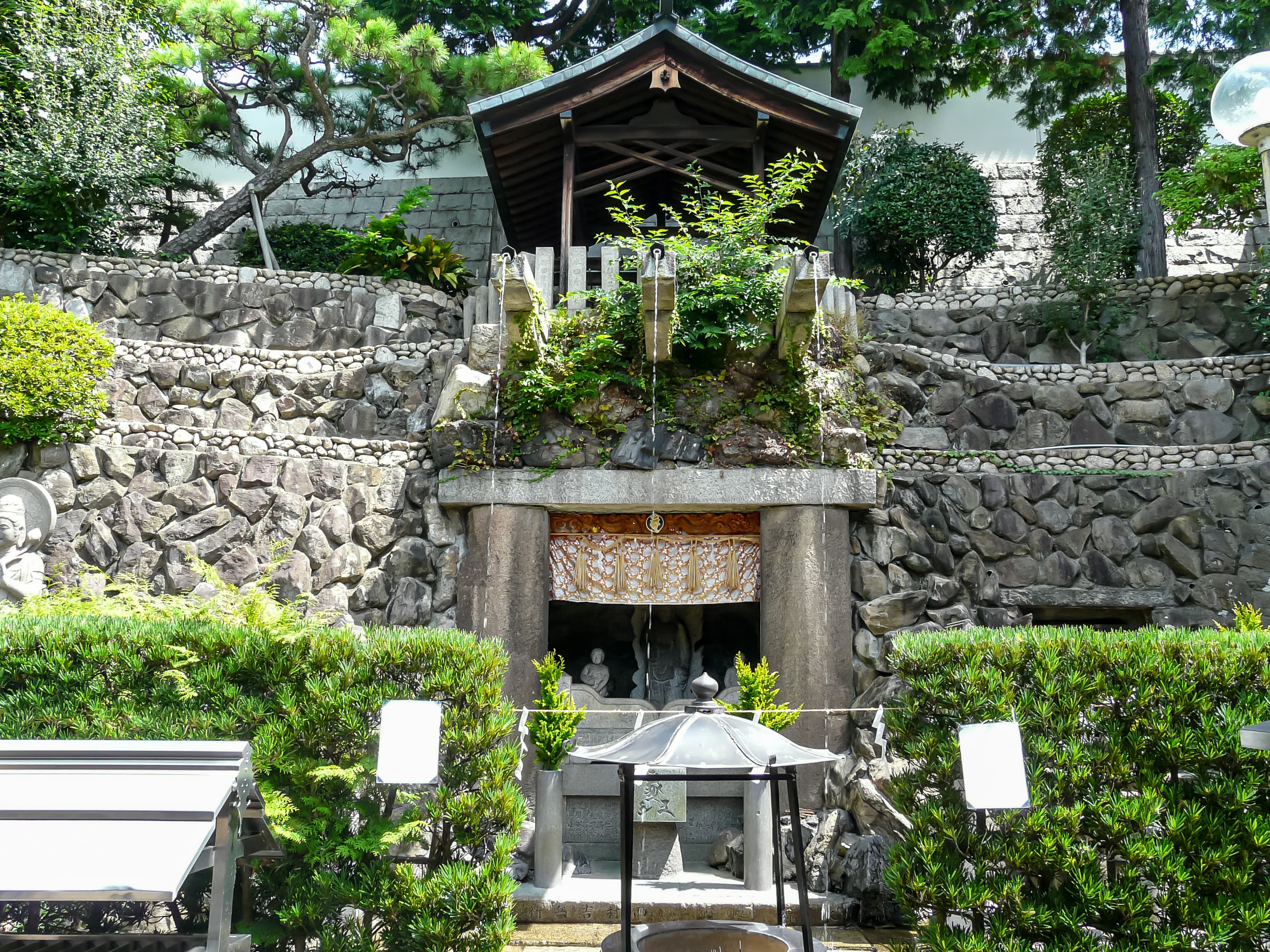
Image of Kiyomizu-dera (Osaka). Image source · CC-BY-SA-4.0
Bangai bangai-1
New Saigoku Kannon PilgrimageVisit essentials
A quick read before you go
- Duration
- 30 to 60 minutes.
- Access
- About a 10-minute walk from Shitennōji-mae Yūhigaoka Station (Osaka Metro Tanimachi Line) or…
Overview
This is Osaka's Kiyomizu-dera—Arisusan Seikōin Kiyomizu-dera in Reijin-chō, Tennōji-ku, about 700 metres southwest of Shitennō-ji—not the famous Higashiyama temple in Kyoto or namesakes in Hyōgo (Banshū), Chiba (Isumi), and Shimane. An ancient predecessor, Arisu-ji, is traditional but chronologically lost.
In 1640 priest Enkai, following a Kannon oracle, brought from Kyoto an Eleven-Faced Thousand-Armed Kannon said to be Prince Shōtoku's carving and refounded the temple in its namesake's image: kake-zukuri hillside stage, name, and waterfall. A Shitennō-ji subsidiary, it belongs to post-WWII Wa-shū, despite travel sources' mistaken Shingon label.
Tamade Falls (玉出の滝), Osaka City's only natural waterfall, hosts taki-shugyō—standing under cold water while chanting sūtras. A mossy alcove enshrines Fudō Myō-ō, Eight Great Dragon Kings, and Hakuryū-ō. Folk tradition links its water underground to Seiryū pond beneath Shitennō-ji's Kondō, forming one dragon-water axis.
As New Saigoku Kannon Pilgrimage's bangai station, it pairs with Shitennō-ji at the route's start. Tadao Andō's new main hall was completed in July 2025.
Why this place is sacred
Tamade Falls is the central thin-place feature. As Osaka City's only natural waterfall — a hydrological singularity in a dense urban core that has been paved, canalized, and rebuilt many times over — its persistence is itself a small miracle. The basin is used year-round for taki-shugyō, with mid-winter Kanchū-shugyō especially intense.
Behind the falling water, in the rock alcove, are images of Fudō Myō-ō, the Eight Great Dragon Kings, and the Hakuryū-ō (White Dragon Deity); these are venerated together with the falls as a single sacred complex. Local devotional belief holds that Tamade's water travels underground from the Seiryū-no-ike (Blue Dragon Pond) beneath Shitennō-ji's Kondō, linking the two sacred sites along a continuous dragon-water axis.
Whether or not this is hydrologically accurate, the belief is active, and pilgrims walking from Shitennō-ji to this temple are following what tradition reads as a single underground stream surfacing twice. The kake-zukuri stage, borrowed in design from the Kyoto Kiyomizu-dera, looks not over Higashiyama's wooded slopes but over the merchant city — which is part of the gesture: Kannon's compassion projected over the port-merchant capital rather than the imperial one.
A 1640 Wa-shū revival of an earlier 'Arisu-ji' tradition, deliberately modeled on Kyoto's Kiyomizu-dera as a Kannon-presence in Osaka.
Predecessor 'Arisu-ji' of unknown date; revived 1640 by Enkai with a Kannon image transferred from Kyoto Kiyomizu-dera; renamed Shin-Kiyomizu-dera during the Kyōhō era (1716–1736); subsidiary to Shitennō-ji within the Wa-shū sect after WWII; new main hall designed by Tadao Andō completed July 2025.
Experience and orientation
Compared with the Kyoto Kiyomizu-dera's continuous river of visitors, this Osaka temple is quiet. The stage projects from the hillside in the same architectural idiom but on a far smaller scale, and the view is not Higashiyama wooded ridge but central Osaka — billboards, train lines, sometimes Tsūtenkaku tower in the distance.
Tamade Falls is the destination most visitors come for: the basin sits in a rock alcove with Fudō Myō-ō, the dragon kings, and the Hakuryū-ō image, the water cold even in summer. Taki-shugyō practitioners come in white robes, sometimes alone, sometimes with a teacher; the basin is not for casual bathing.
For pilgrims walking the New Saigoku circuit, this is paired with Shitennō-ji as the route's opening — Shitennō-ji as station 1, this temple as the bangai, and the underground dragon-water belief drawing the two together.
Walk from Shitennōji-mae Yūhigaoka Station or directly from Shitennō-ji (about ten minutes); enter the precinct, walk around the stage, then descend the path to Tamade Falls in its rock alcove.
Context and lineage
An earlier temple called Arisu-ji is said to have stood at this site in antiquity, but its founding chronology is irrecoverable. The current temple traces to 1640, when the priest Enkai received an oracle from Kannon and rebuilt the place.
He brought to it an Eleven-Faced Thousand-Armed Kannon image — said to have been carved by Prince Shōtoku — from Kyoto's Kiyomizu-dera, and modeled the new temple architecturally on its Kyoto namesake: a hillside kake-zukuri stage, a sacred waterfall, the same temple name. During the Kyōhō era (1716–1736), it was renamed Shin-Kiyomizu-dera. As Shitennō-ji's subsidiary, it sits within the Wa-shū sect today.
Local lore connects Tamade Falls to the Seiryū pond beneath Shitennō-ji's Kondō via an underground watercourse, treating the two temples as a single dragon-water sacred geography.
Wa-shū (和宗) — subsidiary temple of Shitennō-ji; some travel sources still mistakenly describe it as Shingon.
Traditions and practice
Taki-shugyō under Tamade Falls is the temple's signature practice — ascetics chant beneath the cold cascade, often with Fudō Myō-ō devotion. Mid-winter (kanchū) practice is the most intense traditional period. Goma fire ceremonies, esoteric in their inheritance, are held on certain dates. Veneration of Fudō Myō-ō, the Eight Great Dragon Kings, and the Hakuryū-ō (White Dragon Deity) is centered on the rock alcove behind the falls.
Daily Kannon prayers and sūtra recitation continue. Pilgrim stamping is offered at the nōkyō reception for the New Saigoku Kannon (bangai-1), the Kinki Thirty-Six Fudō, and the Settsu Eighty-Eight pilgrimages. Lay participation in waterfall practice is possible by prior arrangement with the temple.
If walking the New Saigoku circuit, pair this temple with Shitennō-ji as the route's opening Tennōji-ku loop. Approach Tamade Falls quietly, especially when ascetics are present. The basin is for sacred practice, not casual contact.
Buddhism (Wa-shū)
ActiveSubsidiary to Shitennō-ji within the post-WWII Wa-shū sect. The 1640 revival under Enkai re-enshrined an Eleven-Faced Thousand-Armed Kannon traditionally said to be carved by Prince Shōtoku and transferred from Kyoto's Kiyomizu-dera, embedding the Kannon presence of the Kyoto temple at the heart of Osaka's port-merchant city.
Taki-shugyō (waterfall austerity)
ActiveTamade Falls is one of the few active urban sites for taki-shugyō in Japan and the only natural waterfall within Osaka City. Behind the falls, Fudō Myō-ō, the Eight Great Dragon Kings, and the Hakuryū-ō (White Dragon Deity) form a wrathful-protective complex venerated together with the cold water itself.
Perspectives and open questions
Three frames are in tension at Kiyomizu-dera (Osaka): the architectural intent (a deliberate translation of the Kyoto Kiyomizu-dera into the Osaka cityscape), the ascetic intent (Tamade Falls as a working site of cold-water practice), and the folk-geomantic intent (a single underground dragon-water axis with Shitennō-ji).
Scholarly perspective
The temple is documented as a 1640 revival under Enkai of an earlier 'Arisu-ji' tradition, modeled architecturally on Kyoto's Kiyomizu-dera. It is administratively a subsidiary temple of Shitennō-ji within the Wa-shū sect. Tamade Falls is geographically confirmed as Osaka City's only natural waterfall.
Living and traditional perspectives
Within the temple's own tradition, the honzon's continuity with Prince Shōtoku and Kyoto Kiyomizu-dera is read not as architectural mimicry but as a Kannon-led extension of compassion into the merchant capital of Osaka — bodhisattva geography rather than reproduction.
Alternative interpretations
Folk geomancy connects Tamade Falls to the Seiryū (Blue Dragon) pond beneath Shitennō-ji's Kondō via an underground watercourse, making the two sites a single dragon-water axis. Whether or not hydrologically true, this is an active devotional belief that shapes how pilgrims walk between the two temples.
Open questions
The original 'Arisu-ji' chronology is genuinely lost. The provenance of the Shōtoku-carved Kannon image is a tradition rather than documentary fact. The naming overlap with Kiyomizu-dera in Kyoto, Hyōgo (Banshū), Chiba (Isumi), and Shimane creates persistent confusion that pilgrims should be aware of.
Plan your visit
Access and arrival
About a 10-minute walk from Shitennōji-mae Yūhigaoka Station (Osaka Metro Tanimachi Line) or directly from Shitennō-ji. Address: 5-8 Reijin-chō, Tennōji-ku, Osaka 543-0061.
Central Osaka and the Tennōji district offer extensive lodging. No on-site lodging at this temple.
Respectful visit
Modest, comfortable dress; pilgrim white welcomed.
Permitted in outer grounds; respectful pause when ascetics are at the falls; no flash inside halls.
Coin offerings at the honden; candles and incense available; goshuin at the nōkyō desk.
Tamade Falls basin is reserved for sacred use; lay waterfall practice by prior arrangement only.
Do not bathe in the Tamade Falls basin casually. Mid-winter practice is genuinely cold; lay participation should be arranged with the temple in advance.
Current practical details
Address
3-28 Reininchō, Tennoji Ward, Osaka, 543-0061, Japan
Phone
Hours
Hours, fees, and access can change — verify on the official source before you travel. Practical details last checked Jun 2026.
Location
Map loads as you approach this section.
Pilgrim reflections
A portrait of encounter, not a score
Pilgrims describe what they felt, how present they could become, and whether the place would shape a journey. There are no stars and no ranking of traditions.
No reviewed reflections yet
The first pilgrims can help describe the character of being here.
Share a reflection
Available after an account-backed “Been there.” Every reflection is reviewed before publication.
Nearby sacred places
Explore other sacred places in the region. Proximity does not establish access or travel time; check each place’s guidance.


References
Sources consulted for this page. Source categories describe the publication, not a guarantee that every claim is verified. Traditional accounts and outside interpretations may differ.
- 01有栖山 清水寺 — 新西国霊場会 (New Saigoku Pilgrimage Association) — Shin-Saigoku ReijōkaiofficialOfficial pilgrimage association; lists this temple as the bangai (客番) station; describes Tamade Falls and Enkai's revival
- 0275. 清水寺 — 大阪市 (Osaka City) — Osaka City GovernmentofficialMunicipal heritage description
- 03Kiyomizu — Tennoji-ku Ward, Osaka City — Tennōji Ward Office, Osaka CityofficialOfficial ward tourism page in English
- 04清水寺 (大阪市) — Wikipedia (Japanese) — Wikipedia contributorsofficialCoordinates 34.65518°N, 135.51142°E; Wa-shū sect; honzon Eleven-Faced Thousand-Armed Kannon; restoration 1640 by Enkai
- 05Kiyomizu-dera (Osaka) — Sanpai Japan — Sanpai JapanguideEnglish-language temple guide; details on stage and Tamade Falls
- 06玉出の滝(清水寺) — 大阪のパワースポット — Tabibun.netguideNotes the legend that Tamade Falls' water is connected via underground channel to Shitennō-ji's Seiryū (Blue Dragon) pond — folkloric, not hydrologically documented
Pilgrim glossary
- Honzon
- The principal Buddhist deity enshrined as a temple's central object of worship.
- Kannon
- The bodhisattva of compassion, central to many East Asian pilgrimage routes.
- Bodhisattva
- An enlightened being who postpones full nirvana to help others toward awakening.
- Sutra
- A canonical Buddhist scripture, often chanted as part of practice.
- Shingon
- An esoteric Japanese Buddhist school emphasizing ritual, mantra, and mandala practice.
Share a photo
Help visitors recognize Kiyomizu-dera (Osaka). Every submission is reviewed before publication.