Shitennō-ji
Japan's first state-sponsored Buddhist temple, founded by Prince Shōtoku as a vow to the Four Heavenly Kings
Understand sacred places, explore living traditions, and learn how to engage respectfully with Pilgrim Map.
Access has not been verified. Check current local guidance before planning a visit.
Osaka Prefecture, Japan
Read the sources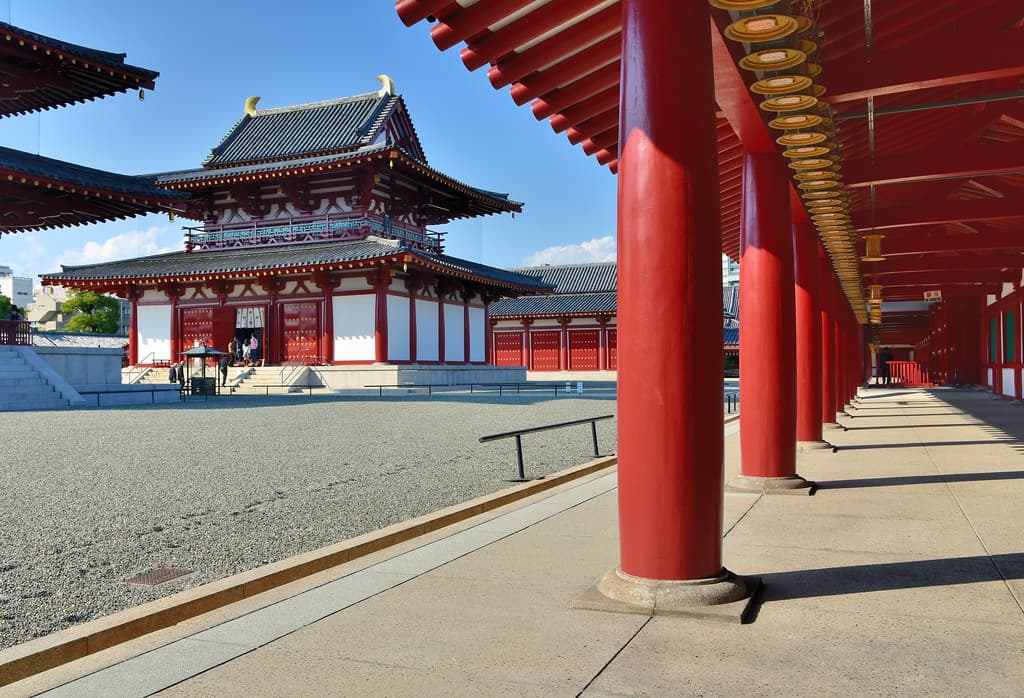
Image of Shitennō-ji. Image source
Station 1 of 33
New Saigoku Kannon PilgrimageVisit essentials
A quick read before you go
- Duration
- 1.5 to 3 hours, including the inner precinct, pagoda climb, and Gokuraku-jōdō Garden.
- Access
- Five-minute walk from Shitennōji-mae Yūhigaoka Station (Osaka Metro Tanimachi Line) or…
Overview
Shitennō-ji marks the beginning of Japanese state Buddhism. In 587 CE, before battle between the pro-Buddhist Soga clan and anti-Buddhist Mononobe, the young Prince Shōtoku is said to have vowed that victory would be followed by a temple to the Four Heavenly Kings—Bishamonten, Jikokuten, Zōchōten, and Kōmokuten, guardians of the four directions. The Soga won, and six years later, in 593 CE, construction began at this Osaka site.
Shitennō-ji predates Hōryū-ji and the formal arrival of major Mahāyāna schools. From it grew Asuka-period state Buddhism, the seven-hall garan plan, and an ideal of socially engaged Buddhist practice. Shōtoku's original shika-in comprised a school, hospice for the destitute, clinic, and pharmacy, joining spiritual practice to material care.
Every visible above-ground structure is a 1963 reinforced-concrete reconstruction. The temple burned and was rebuilt repeatedly across fourteen centuries, most recently after WWII firebombing, while its garan layout, liturgical year, and institutional spine persisted. The Kondō's principal image is the Kuse Kannon, or Salvation Kannon, traditionally identified as Prince Shōtoku appearing as Avalokiteśvara—founder, ruler, and bodhisattva of compassion. After WWII, the temple left its Tendai affiliation and became head temple of the independent Wa-shū sect.
It is also the first station of the New Saigoku Kannon Pilgrimage, beginning that route within Prince Shōtoku's lineage before it opens into the wider Kansai geography of Kannon devotion.
Why this place is sacred
What gives Shitennō-ji its devotional density is layered continuity. Worship has not paused on this plot since the late 6th century. The seven-hall garan layout — south gate, central gate, five-story pagoda, Kondō, Kōdō, all enclosed by a covered cloister — is among the earliest surviving plan-types in East Asian Buddhist architecture, and it has been rebuilt to the same template after every fire.
The 1294 stone torii at the West Gate, oldest of its kind in Japan, marks what medieval pilgrims understood as the eastern gate of the Western Pure Land: at the spring and autumn equinox the sun sets directly through the torii, and for centuries pilgrims practiced nissō-kan — sun-meditation toward Amida's paradise — at this threshold.
Tennōji Bugaku, the court music and dance performed each 22 April for Prince Shōtoku's death anniversary, has been transmitted with sufficient fidelity that it is now a National Important Intangible Folk Cultural Property. The 21st of every month draws Daishi-e crowds for Kōbō Daishi; the 22nd brings Taishi-e for Shōtoku himself. The buildings are concrete. The continuity is not.
A vow-temple to the Four Heavenly Kings and a state-Buddhist institutional foundation under Prince Shōtoku, integrating worship, education, medicine, and welfare in a single compound.
Originally an Asuka-period state temple, later affiliated with Tendai through the Heian and medieval periods, repeatedly destroyed by fire and rebuilt, severely damaged in WWII, reconstructed in reinforced concrete in 1963, and reorganized as the head temple of the independent Wa-shū sect post-war.
Experience and orientation
Despite the post-war reconstruction, visitors describe the central garan as quietly imposing. The pebble-floored courtyard absorbs sound. The five-story pagoda — rare among Japanese temples in being open for visitors to climb — gives a lateral view across the cloister roofs and into the lower city. The Kondō holds the Kuse Kannon and a Shitennō statue cycle.
The 21st-day Daishi-e and 22nd-day Taishi-e transform the precincts into a sensory field of incense, antique stalls, monastic chanting, and circulating pilgrims; the temple ground becomes a periodic city-within-a-city. At equinox, those who know stand at the West Gate as the sun aligns with the stone torii — a practice continuous since the medieval period.
The Gokuraku-jōdō Garden, just outside the inner precinct, restages a Pure Land scene with stone bridges and water; it is paid entry, smaller than its pretension suggests, but quiet.
Enter from the south gate or from Shitennōji-mae Yūhigaoka Station, walk the inner precinct circuit (paid), ascend the pagoda, then exit westward through the stone torii at sunset if the season allows.
Context and lineage
In 587 CE, with the fate of Buddhism in Japan uncertain, the pro-Buddhist Soga clan and the anti-Buddhist Mononobe clan met in battle. The young Prince Shōtoku, fighting with the Soga, vowed to the Four Heavenly Kings that if his side won, he would build them a temple. The Soga prevailed. In 593 CE, Shōtoku founded Shitennō-ji on this Osaka plot, reportedly aided by three carpenters from the Korean kingdom of Baekje.
The Kondō image came to be identified, in tradition, as Shōtoku himself in the form of Kuse Kannon — the Salvation Kannon — collapsing the figures of founder, ruler, and bodhisattva into a single iconographic body. The 1294 stone torii at the West Gate marked the temple as the eastern threshold of Amida's Western Pure Land for medieval pilgrims; Tennōji Bugaku, performed each year on Shōtoku's death anniversary, has continued without break.
Twentieth-century fire and reconstruction altered every visible surface, not the underlying vow.
Wa-shū (和宗) — an independent post-WWII sect with Shitennō-ji as its head temple, drawing on Tendai-derived liturgical practice but no longer formally Tendai-affiliated.
Traditions and practice
The temple's annual ritual cycle is dense and well-attended. The Shōryō-e on 22 April is the signature rite: ten bugaku pieces performed on the stone stage in front of the Rokuji-dō over roughly four-and-a-half hours, designated a National Important Intangible Folk Cultural Property. Doyō-e cooling-water rituals take place at the Kameido — a turtle-shaped 7th-century stone basin — in mid-summer. Setsubun bean-throwing happens in early February. The Mantō-kuyō at Obon floats thousands of lanterns on the temple pond at dusk.
The 21st of each month is Daishi-e, drawing devotees of Kōbō Daishi alongside an extensive flea-market and antique stalls; the 22nd is Taishi-e for Prince Shōtoku, with similar pilgrim energy.
Daily morning prayers continue in the Kondō. Pilgrims receive nōkyō stamps for the New Saigoku Kannon, the Thirteen Buddhist Sites of Osaka, and other Kannon and Daishi circuits. The five-story pagoda is climbable for visitors — a practice rarely permitted at other Japanese temples.
If approaching as a New Saigoku pilgrim, begin at the Kondō with the Kuse Kannon, then ascend the pagoda for orientation, then walk westward through the courtyard to the stone torii. If timing allows, return at sunset on the equinox to witness the alignment. Receive the nōkyō stamp before leaving the inner precinct.
Buddhism (Wa-shū)
ActiveShitennō-ji is the head temple of the independent Wa-shū sect — a post-WWII reorganization drawing on the temple's earlier Tendai-derived liturgical practice. As Japan's first state-sponsored Buddhist temple, founded in 593 CE under Prince Shōtoku, it is foundational to Japanese institutional Buddhism. The temple combined religious, educational, medical, and welfare institutions in its original 'four institutions' (shika-in) plan, making it an early model for engaged Buddhist practice.
Pure Land (Jōdo) folk devotion
ActiveFrom the medieval period onward, Shitennō-ji's West Gate stone torii has been understood as the eastern threshold of Amida's Western Pure Land. The equinoctial alignment of the setting sun with the torii made the temple a major Kansai site for nissō-kan, sun-meditation toward the western paradise. This devotion remains active each spring and autumn equinox.
Perspectives and open questions
Shitennō-ji is read differently by different communities. Architectural historians focus on the Asuka-period garan plan and the post-war concrete reconstruction. Wa-shū devotees venerate the temple as Prince Shōtoku's continuing presence as Kannon. Esoteric Pure Land practitioners attend to the West Gate's solar alignment with Amida's western paradise.
Scholarly perspective
Scholarly consensus accepts Shitennō-ji as among the oldest officially sponsored Buddhist temple sites in Japan, founded in 593 CE under Prince Shōtoku. Archaeological evidence supports continuous occupation since the late 6th to early 7th century, although every above-ground structure has been rebuilt many times — most recently in 1963 after wartime destruction. The seven-hall garan layout is recognized as one of the earliest surviving plan-types in East Asian Buddhist architecture.
Living and traditional perspectives
Within Wa-shū devotion, Shitennō-ji is the embodied vow of Prince Shōtoku — at once a Kannon manifestation, a state-Buddhist founder, and a bodhisattva ideal of integrated spiritual-social practice expressed in the four institutions (school, hospice, clinic, pharmacy). Pilgrimage here is understood as receiving the lineage of Shōtoku as Kannon.
Alternative interpretations
Esoteric Pure Land circles emphasize the West Gate stone torii's equinoctial alignment with the setting sun as a built-in nissō-kan visualization gate toward Amida's Western Pure Land — connecting the temple to medieval Pure Land devotion practiced at this site for centuries.
Open questions
The exact iconographic continuity of the original Kuse Kannon image is uncertain; centuries of fires and reconstructions mean continuity is largely a matter of tradition rather than verifiable provenance. The legendary contribution of three Korean Baekje carpenters to the original construction is widely cited but archaeologically ambiguous.
Plan your visit
Access and arrival
Five-minute walk from Shitennōji-mae Yūhigaoka Station (Osaka Metro Tanimachi Line) or ten-minute walk from JR Tennōji Station. Address: 1-11-18 Shitennōji, Tennōji-ku, Osaka 543-0051.
Central Osaka offers extensive lodging across all price ranges; the Tennōji and Umeda districts both work well as bases for the early stations of the New Saigoku circuit.
Respectful visit
Modest clothing; pilgrim white welcomed; remove hats inside halls.
Permitted in outer grounds; restricted near the honzon and on Treasure House interiors. Avoid flash.
Coin offerings at the honden; candles and incense for purchase; goshuin issued at the nōkyō desk for a fee.
Inner precinct, Gokuraku-jōdō Garden, and Treasure House require separate paid admission. Silence during the Shōryō-e bugaku and other memorial services.
The 21st and 22nd of each month bring large crowds; pilgrims wishing for quiet contemplation should plan around them. Photography of the honzon is restricted — observe posted signs.
Current practical details
Address
1-chōme-11-18 Shitennōji, Tennoji Ward, Osaka, 543-0051, Japan
Phone
Hours
Hours, fees, and access can change — verify on the official source before you travel. Practical details last checked Jun 2026.
Location
Map loads as you approach this section.
Pilgrim reflections
A portrait of encounter, not a score
Pilgrims describe what they felt, how present they could become, and whether the place would shape a journey. There are no stars and no ranking of traditions.
No reviewed reflections yet
The first pilgrims can help describe the character of being here.
Share a reflection
Available after an account-backed “Been there.” Every reflection is reviewed before publication.
Nearby sacred places
Explore other sacred places in the region. Proximity does not establish access or travel time; check each place’s guidance.


References
Sources consulted for this page. Source categories describe the publication, not a guarantee that every claim is verified. Traditional accounts and outside interpretations may differ.
- 01Shitennoji — OSAKA-INFO (Osaka Tourism Bureau) — Osaka Convention & Tourism BureauofficialOfficial municipal tourism bureau; describes founding, garan layout, monthly festivals on 21st/22nd
- 02Tennoji Bugaku (Shoryo-e Bugaku) — Kansai Tourism BureauofficialDesignation as National Important Intangible Folk Cultural Property; Shōryō-e on 22 April
- 03Shitennō-ji — Wikipedia (English) — Wikipedia contributorsofficialCoordinates 34.6539°N, 135.51645°E confirmed; founding 593 CE; Wa-shū after WWII; reconstructed 1963
- 04Shitennoji Temple — Osaka Travel — japan-guide.comguideVisitor information including admission fees and inner-precinct details
- 05Shitennoji Temple in Osaka: the first temple in Japan — Japan ExperienceguideBackground on Mononobe-Soga conflict and temple's foundation vow
- 06Saigoku Kannon Pilgrimage — Wikipedia — Wikipedia contributorsofficialContext for the related Saigoku and New Saigoku (Shin-Saigoku) Kannon circuits
Pilgrim glossary
- Honzon
- The principal Buddhist deity enshrined as a temple's central object of worship.
- Kannon
- The bodhisattva of compassion, central to many East Asian pilgrimage routes.
- Bodhisattva
- An enlightened being who postpones full nirvana to help others toward awakening.
- Torii
- The traditional Japanese gate marking the entrance to a Shinto sacred area.
- Tendai
- A Japanese Buddhist school based on the Lotus Sutra, foundational to many later traditions.
- Pure Land
- A Buddhist tradition focused on rebirth in Amida Buddha's western paradise through devotional practice.
Share a photo
Help visitors recognize Shitennō-ji. Every submission is reviewed before publication.