Taiyū-ji
A 1,200-year-old Shingon temple in the heart of Umeda, with the Senju Kannon that survived every fire
Understand sacred places, explore living traditions, and learn how to engage respectfully with Pilgrim Map.
Access has not been verified. Check current local guidance before planning a visit.
Osaka Prefecture, Japan
Read the sources
Station 2 of 33
New Saigoku Kannon PilgrimageVisit essentials
A quick read before you go
- Duration
- 20 to 45 minutes.
- Access
- About a 10-minute walk east of JR Osaka / Umeda Station along Ōgimachi-dōri.
Overview
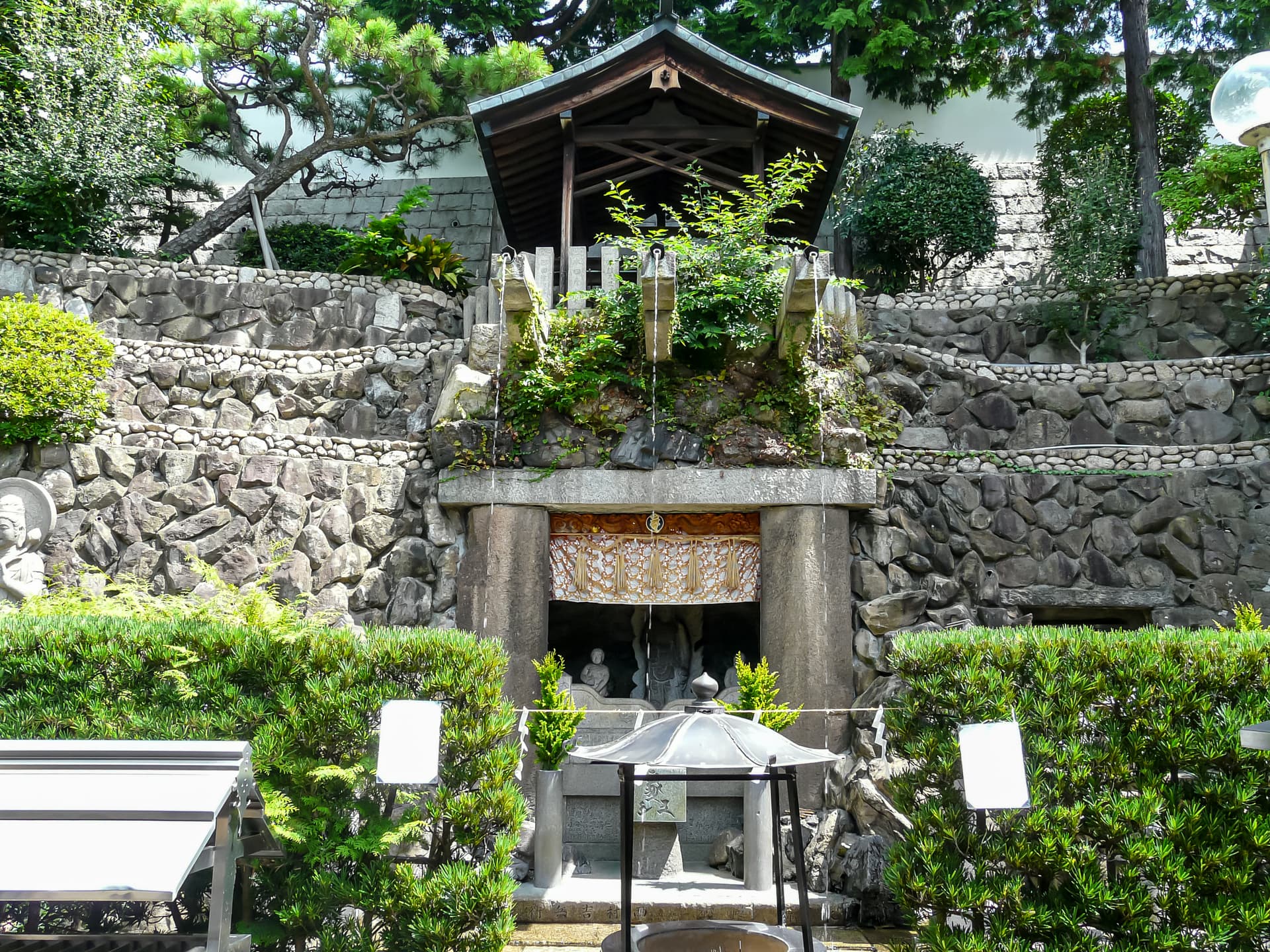
Taiyū-ji sits in a paradox of place: ten minutes east of Umeda Station, the entertainment district's neon gives way to mossy stones, a bell tower, and small stone Buddha groups. One of central Osaka's oldest temples, it remains a Kōyasan Shingon site centered on the Senju Kannon honzon. Its Heian patron Minamoto-no-Tōru was Emperor Saga's twelfth son; the temple also holds Yodo-dono's grave and memories of the Toyotomi house's fall.
As station 2 of the New Saigoku Kannon Pilgrimage, Taiyū-ji is the first stop outside the Tennōji-ku core, beginning the route's outward Kansai movement.
Why this place is sacred
What Taiyū-ji concentrates is Kannon's persistence. The temple was burned to the ground in 1615 at the close of the Siege of Osaka, when the Toyotomi house fell and the surrounding city burned with it. It was rebuilt. It was burned to the ground again in 1945 in the WWII firebombings of Osaka. It was rebuilt.
The Senju Kannon image, said to have been Emperor Saga's personal guardian gift to Kūkai's hermitage, is the only treasure that, by tradition, survived both destructions intact. For devotees, this is not symbolic but devotional fact: the same Kannon image that watched over the Heian-period founding watches the modern one.
The temple is also continuously bound to two of Osaka's most freighted historical moments — the Saga Genji aristocratic foundation under Minamoto-no-Tōru in the 9th century, and the dynastic catastrophe of the Toyotomi house in the 17th, marked by the relocation of Yodo-dono's grave to these grounds.
Originally a Kūkai hermitage for the carved Jizō and Bishamonten images; expanded as a Saga Genji clan temple under Minamoto-no-Tōru's patronage with the Emperor Saga Senju Kannon as honzon.
Founded c. 821/816 by Kūkai; expanded 843 by Minamoto-no-Tōru into a full temple complex; destroyed in the 1615 Siege of Osaka and rebuilt; destroyed again in the 1945 WWII firebombings and rebuilt; remains a Kōyasan Shingon-shū temple.
Experience and orientation
Visitors are surprised to find Taiyū-ji where it is. The walk from Umeda Station moves through commercial Osaka — restaurants, pachinko parlours, late-night clubs — and then opens into the temple compound. The contrast is the most-cited first impression: mossy stones, a bell tower, small statue groups, the smell of incense after the smell of grilled food. The grave of Yodo-dono behind the bell tower is a quiet, contemplative spot drawing history enthusiasts and Toyotomi-era devotees.
Goma fire ceremonies on calendar dates and the Kannon-en monthly observances on the 18th give the temple its devotional rhythm. As New Saigoku station 2, the temple marks the symbolic shift from the Tennōji-ku core into the wider Kansai geography of the route.
Walk east about 10 minutes from JR Osaka or Umeda Station along Ōgimachi-dōri to the temple's south entrance; the bell tower and Yodo-dono grave are toward the rear of the compound.
Context and lineage
Tradition holds that Kūkai (Kōbō Daishi), traveling through what was then a forested area of Kawachi, came across a fragrant tree and carved from its wood images of Jizō Bodhisattva and Bishamonten. He built a small hermitage to enshrine them — the founding of Taiyū-ji, dated either 821 CE (English sources) or 816 CE / Kōnin 12 (Japanese tradition). Emperor Saga later visited the hermitage and donated his personal guardian Senju Kannon image, which became the principal honzon.
In 843 CE, Saga's son Minamoto-no-Tōru — ancestor of the Saga Genji clan and a historical model cited for Hikaru Genji in The Tale of Genji — donated 8 hectares of land and built a full-scale temple complex, naming it Taiyū-ji from the alternate reading of his own name (融 → 'tōru' / 'taiyū').
The 1615 Siege of Osaka and the 1945 firebombings each destroyed the temple buildings, which were rebuilt; the Senju Kannon honzon is said to have survived both. The grave of Yodo-dono, mother of Toyotomi Hideyori, was relocated to the grounds after her suicide at the fall of Osaka Castle.
Kōyasan Shingon-shū — esoteric Shingon Buddhism with continuous institutional presence at this site since the early 9th century.
Traditions and practice
Goma fire ceremonies on calendar dates form the temple's esoteric core, drawing devotees who wish to make formal Shingon prayer. The 18th of each month is Kannon-en, dedicated to the Senju Kannon honzon. The 21st is Daishi-e, the monthly Kōbō Daishi memorial. Memorial services at the Yodo-dono grave are observed traditionally in the seventh lunar month (mid-summer) marking her death anniversary. Setsubun bean-throwing and New Year hatsumōde fill the seasonal calendar.
Daily prayers and sūtra recitation continue. Goshuin issuance is offered for the New Saigoku Kannon (no. 2), the Settsu Eighty-Eight, and the Kinki Thirty-Six Fudō pilgrimages. Public participation in goma rituals on advertised dates is welcomed.
If walking the New Saigoku, time the visit for either the 18th (Kannon-en) or 21st (Daishi-e) to encounter the temple in active devotional rhythm. Otherwise, an early-morning visit allows the contrast with Umeda's daytime energy to be felt most directly.
Buddhism (Kōyasan Shingon-shū)
ActiveOne of central Osaka's oldest Shingon temples, founded according to tradition by Kūkai in the early 9th century. Imperial patronage from Emperor Saga gave the temple its principal Senju Kannon image; aristocratic patronage from Saga's son Minamoto-no-Tōru built the full Heian-period temple complex in 843. The Senju Kannon is said to have survived both the 1615 Siege of Osaka and the 1945 firebombings, making it for devotees a continuous embodiment of Kannon's protective compassion.
Perspectives and open questions
Taiyū-ji's significance is read across at least three frames: as a Kūkai-trace site within Kōyasan Shingon, as a Saga Genji literary-genealogical anchor for readers of The Tale of Genji, and as a Toyotomi-era memorial via Yodo-dono's grave.
Scholarly perspective
Taiyū-ji is documented as a Kūkai-foundation temple with subsequent Heian-period imperial-aristocratic patronage. The 821/816 CE founding tradition cannot be archaeologically verified, but continuous Shingon institutional presence on this site is well documented. The 1615 and 1945 destructions, and post-war reconstructions, are matters of public record.
Living and traditional perspectives
Within Kōyasan Shingon, Taiyū-ji is venerated as a Kūkai-trace (jiseki) and as the place where Emperor Saga's protective Kannon was institutionalized. The continuous survival of the Senju Kannon honzon across destructive events is read as ongoing Kannon agency.
Alternative interpretations
The Saga Genji genealogical link via Minamoto-no-Tōru — read by some as the historical model for Genji in The Tale of Genji — gives the temple a literary-mystical resonance for readers of the Heian classical canon.
Open questions
The exact founding year and the early architectural plan are genuinely lost to fire. The chronology of Yodo-dono's grave's relocation to this site is also imprecise.
Plan your visit
Access and arrival
About a 10-minute walk east of JR Osaka / Umeda Station along Ōgimachi-dōri. Address: 3-7 Taiyūji-chō, Kita-ku, Osaka 530-0051.
Umeda offers extensive central-Osaka lodging at all price ranges. No on-site lodging at this temple.
Respectful visit
Modest dress; hats off inside halls.
Permitted in outer grounds; avoid photographing the honzon directly without permission.
Coin offerings; candles and incense available; goshuin issued at the nōkyō desk.
Quiet during goma and memorial services.
Quiet behaviour during goma services; this is an active urban temple, not a tourist site.
Current practical details
Address
3-7 Taiyūjichō, Kita Ward, Osaka, 530-0051, Japan
Phone
Hours
Hours, fees, and access can change — verify on the official source before you travel. Practical details last checked Jun 2026.
Location
Map loads as you approach this section.
Pilgrim reflections
A portrait of encounter, not a score
Pilgrims describe what they felt, how present they could become, and whether the place would shape a journey. There are no stars and no ranking of traditions.
No reviewed reflections yet
The first pilgrims can help describe the character of being here.
Share a reflection
Available after an account-backed “Been there.” Every reflection is reviewed before publication.
Nearby sacred places
Explore other sacred places in the region. Proximity does not establish access or travel time; check each place’s guidance.


References
Sources consulted for this page. Source categories describe the publication, not a guarantee that every claim is verified. Traditional accounts and outside interpretations may differ.
- 01高野山真言宗 太融寺 公式 (Official Site) — Taiyū-jiofficialOfficial site listing rituals, history, festivals
- 02Taiyuji Temple — OSAKA-INFO — Osaka Convention & Tourism BureauofficialFounding by Kūkai; Emperor Saga; gift of Senju Kannon; Minamoto-no-Tōru's expansion (843); Lady Yodo's grave
- 03Taiyuji — City of Osaka, Naka-tsu Historic District — Osaka CityofficialMunicipal historic-district description
- 04Taiyū-ji — Wikipedia (English) — Wikipedia contributorsofficialCoordinates 34.7018°N, 135.5041°E; founded 821; Kōyasan Shingon-shū
- 05太融寺 — Wikipedia (Japanese) — Wikipedia contributorsofficialMountain name 佳木山; honzon Senju Kannon; New Saigoku no. 2
- 06A Look at Osaka's Historic Taiyu-ji Temple — Kansai OdysseyguideEnglish summary of history including 1615 Siege of Osaka burning and WWII rebuilding
Pilgrim glossary
- Honzon
- The principal Buddhist deity enshrined as a temple's central object of worship.
- Kannon
- The bodhisattva of compassion, central to many East Asian pilgrimage routes.
- Bodhisattva
- An enlightened being who postpones full nirvana to help others toward awakening.
- Sutra
- A canonical Buddhist scripture, often chanted as part of practice.
- Shingon
- An esoteric Japanese Buddhist school emphasizing ritual, mantra, and mandala practice.
Share a photo
Help visitors recognize Taiyū-ji. Every submission is reviewed before publication.