House of Taga
Tinian's tallest latte stones, and the chief whose life is bound to them
Understand sacred places, explore living traditions, and learn how to engage respectfully with Pilgrim Map.
Access has not been verified. Check current local guidance before planning a visit.
San Jose, Tinian, Northern Mariana Islands, Northern Mariana Islands, United States
Read the sources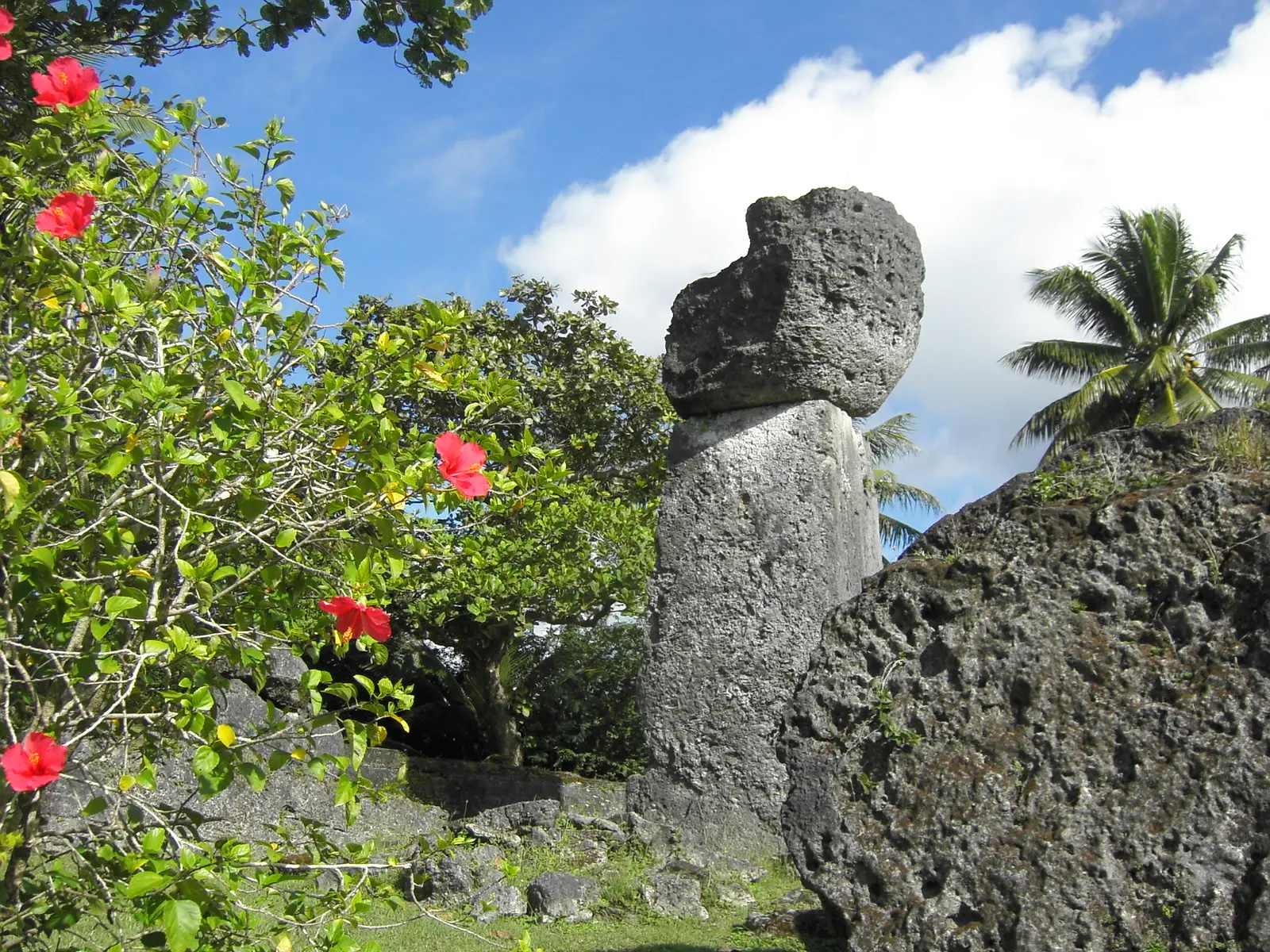
Image of House of Taga. Image source
Visit essentials
A quick read before you go
- Duration
- Typically a brief stop; the site is a compact open field accessible on foot, generally suitable…
- Access
- Located near San Jose Village, Tinian, accessible via public roads and footpaths off Route 202 —…
Overview
A single word from Chamorro grandmothers explains why this field still matters: taotaomona, the people of before, believed to remain resident at places like this one. House of Taga was the largest latte stone construction in the Mariana Islands — twelve pillars, or haligi, once rising up to fifteen feet and topped with hemispherical capstones, or tåsa, forming the foundation for the house of a legendary chief remembered as a giant among Chamorro maga'låhi.
European documentation of the site dates as early as 1742, when George Anson recorded twelve stones standing; today only one remains upright, the rest toppled by a combination of earthquakes and, by some accounts, wartime disturbance during the 1944 battle for Tinian.
Archaeological excavation between 2011 and 2013 found something the popular chronology hadn't anticipated: occupation deposits near the site dating back roughly 3,500 years, many centuries before the Latte Period itself began, meaning this ground drew people to it long before anyone raised these particular stones.
Chamorro oral tradition holds the site's namesake, Taga, as a real historical memory refracted through legend — a chief of superhuman strength whose family story ends in tragedy, and whose standing pillar is popularly said to mean, as the saying goes, that as long as one stone stands at Taga House, Taga lives.
Why this place is sacred
Latte stones were never simply architecture. Within Chamorro cosmology, they mark a threshold: the dead were buried within and beside the house platforms they supported, tying these locations to aniti, the Chamorro concept of spirit, and making each latte site a place where origin, life, and passage to what follows converge.
House of Taga carries this significance at its largest scale — the biggest and most architecturally prominent latte formation anywhere in the Marianas, meaning whatever weight an ordinary latte site holds, this one holds at its fullest. The legend attached to the site personalizes that weight.
Chamorro oral tradition remembers Taga as a giant chief of extraordinary strength, born in Ritidian Village on Guam, who relocated first to Rota and then to Tinian after losing a contest of strength with his own father — and who is said to have personally quarried and erected the pillars that would become his house. The story does not end triumphantly.
Taga's young son revealed a strength that threatened to surpass his father's own, and in a jealous rage Taga killed the boy; his daughter and wife died of grief and shock in turn, leaving the chief to live out his life in shame despite his renown.
Sources disagree on the exact details — some versions have the daughter instead killing Taga in retribution before dying of a broken heart — and this content holds both as attested oral-tradition variants rather than settling on one. A later, distinct layer of the same legend, recorded by Guampedia, folds in a colonial-era story: Taga rescuing shipwrecked Spanish sailors in 1638 and converting to Christianity after a vision, becoming, in this telling, the first Chamorro Christian.
What makes the site's thinness durable across all these versions is a simple Chamorro saying, still repeated today: as long as one stone stands at Taga House, Taga lives.
Foundation platform for the residence of the chief Taga, the largest latte stone house structure documented in the Mariana Islands, comprising twelve pillars (haligi) topped with hemispherical capstones (tåsa).
Latte pillars believed erected during the Latte Period, roughly AD 900/1000 to 1521, though archaeological excavation in 2011-2013 found occupation deposits near the site dating to approximately 3,500 years ago, indicating the broader area was inhabited many centuries before the visible megalithic structures were built. Only one of the original twelve pillars remains standing today, the rest toppled by earthquakes and, in some accounts, damage associated with 1944 wartime activity on Tinian.
Experience and orientation
There is a particular strangeness to finding a monument this old standing in an open field beside a public road, with no ticket booth or gate between you and it. Visitors describe an evocative, somewhat mysterious atmosphere: one ancient pillar rising well above head height, its companions toppled and scattered across the grass, jungle fringing the site's edges.
The scale registers immediately and without needing interpretation — this was, demonstrably, meant to be the largest such house in the region, and the single remaining upright shaft makes that scale legible even in ruin.
Walk the field slowly and look for the felled pillars as much as the standing one; their positions on the ground, some in fragments, tell part of the story of how the site was lost, whether to earthquake or to war, that the one surviving stone cannot tell alone.
The compact size of the site means a short visit suffices, but the atmosphere — quiet, a little uncanny, at odds with the roadside accessibility — is worth sitting with rather than rushing past on the way to somewhere else on Tinian.
Located near San Jose Village, Tinian, accessible via public roads and footpaths off Route 202; no entrance fee or restricted-access protocol is documented.
Context and lineage
Chamorro oral tradition holds that Taga, born to the maga'låhi of Ritidian Village on Guam, lost a strength contest with his father and relocated first to Rota, where he married, then to Tinian, where he became chief and began quarrying and erecting the latte pillars for his house. His young son later revealed superhuman strength, provoking Taga's jealousy; in one well-documented version, Taga killed the boy, after which his daughter and wife both died of shock and grief.
An alternate ending has the daughter instead spearing Taga to death in retribution before dying of a broken heart herself. A later, colonial-era layer of the legend holds that Taga rescued Spanish galleon survivors in 1638 and, after a vision during recovery, became the first Chamorro Christian, baptized as Sebastian Hurtado de la Corcuera; a stone receptacle at the site is said to mark where the first Spanish cross was erected.
Taga is remembered as maga'låhi (chief) of Tinian after relocating from Guam via Rota; no further genealogical lineage beyond his immediate family (son, daughter, wife) is documented in available sources.
Taga
Legendary chief and namesake
Legendary giant maga'låhi remembered for personally quarrying and erecting the House of Taga's pillars; his story carries both a pre-contact family tragedy and, in a later colonial-era layer, a conversion narrative.
George Anson
First European documenter
British naval officer whose 1742 voyage produced the earliest European documentation of the site, recording twelve standing stones.
Alexander Spoehr
Archaeologist, 1949-1950 survey
Conducted the mid-20th-century survey identifying House of Taga as the central structure among eighteen latte sites documented on Tinian; published 1957.
Mike T. Carson
Lead archaeologist, 2011-2013 excavation
Led excavation of the landward portion of the House of Taga site, uncovering occupation deposits dating to roughly 3,500 years ago, predating the Latte Period latte construction itself by many centuries.
Traditions and practice
No specific ceremonial ritual is documented as historically performed at House of Taga itself. Broader Chamorro practice around latte sites includes burial of the dead beside and within the house platform, and general protocols of respect associated with places understood to be inhabited by taotaomona.
No organized ceremonial or ritual use of the site by contemporary practitioners is documented. Contemporary Chamorro cultural practice emphasizes quiet, respectful behavior at latte sites generally, refraining from touching or disturbing stones, and treating them as inherited legacy to preserve rather than as inert tourist curiosities. Retelling of the Taga legend continues as part of Chamorro cultural education and storytelling.
Approach the standing pillar first, then walk the field to find the toppled ones — noticing the scale difference between what remains upright and what has fallen tells you more about the site's history than the single photograph most visitors take. Sit for a moment with the Chamorro saying that as long as one stone stands, Taga lives; it reframes the single remaining pillar from a fragment of ruin into an ongoing claim.
Keep voices low, as you would at any site understood by its own tradition to hold resident spirits.
Chamorro ancestral/taotaomona veneration
ActiveLatte stone sites, including House of Taga, are understood within Chamorro cosmology as places where taotaomona reside and continue to watch over descendants and land, linked to the concept of aniti and to ancestor burial beside and between latte pillars.
Contemporary Chamorro cultural practice emphasizes quiet, respectful behavior at latte sites, refraining from touching or disturbing stones, and treating them as inherited legacy to preserve for future generations.
Legend/oral tradition of Chief Taga
ActiveChief Taga is remembered in Chamorro oral tradition as a legendary giant maga'låhi of superhuman strength said to have personally quarried and erected the House of Taga's pillars; the site's remaining standing pillar is popularly said to represent Taga's continued 'life.'
Retelling of the Taga legend continues as part of Chamorro cultural education and storytelling, though no organized ritual practice tied to the legend itself is documented.
Perspectives and open questions
House of Taga is read at once as the Marianas' foremost archaeological example of latte architecture, as living Chamorro ancestral ground, and — in more speculative circles — as a puzzle in the register of megalithic mystery, though mainstream archaeology attributes its construction to organized ancient labor rather than any unexplained mechanism.
Scholarly perspective
Archaeologists agree House of Taga is the largest and most architecturally significant latte stone formation in the Mariana Islands, dated to the Latte Period (roughly AD 900/1000 to European contact in 1521, or CNMI-specific colonization by 1668). Documented by European visitors as early as George Anson's 1742 voyage, formally surveyed by Alexander Spoehr in 1949-1950, and more recently excavated by Mike T.
Carson and colleagues between 2011 and 2013, whose work uncovered an adjacent landward living surface with occupation deposits dating back roughly 3,500 years — indicating the broader locale was inhabited long before the visible megalithic structures were built.
Living and traditional perspectives
Within Chamorro cultural tradition and Guampedia's encyclopedic documentation, the site and latte stones generally are understood as ancestral dwelling-and-burial places imbued with aniti and inhabited or watched over by taotaomona. The legendary chief Taga is remembered as both the personified builder and namesake of the site, with his story functioning as a foundational cultural narrative and a moral tale about pride and jealousy within the family, later layered with a colonial-era conversion narrative.
Alternative interpretations
Some popular, alternative-history-oriented outlets frame the site's scale and the giant-chief legend in the register of megalithic mystery comparable to other giant-monument folklore worldwide, emphasizing the unresolved question of how such massive stones were quarried and erected without modern equipment — though mainstream archaeology attributes this to organized ancient Chamorro labor and technique rather than any unexplained mechanism.
Open questions
The precise construction methods and labor organization used to quarry stone from roughly 1,200 meters away and erect it at this scale are not fully documented and remain a subject of ongoing archaeological interest.
The relationship between the newly identified 3,500-year-old occupation layer near the site and the later Latte Period monumental construction — how a much older settlement history connects to the site's eventual selection for the largest latte formation in the Marianas — is an active area of research rather than a settled question.
Plan your visit
Access and arrival
Located near San Jose Village, Tinian, accessible via public roads and footpaths off Route 202 — roughly one mile south on Route 1 from San Jose, then about 2.5 miles on Route 202, with signage. No entrance fee or restricted-access protocol is documented; reachable by car, taxi, or local bus plus a short walk.
No specific on-site or nearby accommodations are documented in available sources.
Respectful visit
No specific dress code documented; general outdoor and tropical-site visiting attire and sturdy footwear are recommended due to uneven terrain.
No restriction found; photography appears to be commonly practiced by visitors without documented prohibition.
No tradition of leaving offerings is documented at this specific site.
Visitors are commonly asked not to touch the remaining latte stones, and CNMI law (Commonwealth Historic Preservation Act of 1982) prohibits removing historic properties or artifacts from CNMI sites.
Visitors are commonly asked not to touch the remaining latte stones, and CNMI law under the Commonwealth Historic Preservation Act of 1982 prohibits removing historic properties or artifacts from CNMI sites.
Location
Map loads as you approach this section.
Pilgrim reflections
A portrait of encounter, not a score
Pilgrims describe what they felt, how present they could become, and whether the place would shape a journey. There are no stars and no ranking of traditions.
No reviewed reflections yet
The first pilgrims can help describe the character of being here.
Share a reflection
Available after an account-backed “Been there.” Every reflection is reviewed before publication.
Nearby sacred places
Explore other sacred places in the region. Proximity does not establish access or travel time; check each place’s guidance.

As Nieves Latte Stone Quarry
Songsong / Sinapalo area, Rota, Northern Mariana Islands, Northern Mariana Islands, United States
100.6 km away

Mangyol Stone Money Bank
Makiy, Gagil, Yap State, Yap, Federated States of Micronesia
1008.7 km away

Badrulchau Stone Monoliths, Palau
Ngebei, Ngarchelong, Palau
1440.5 km away

Nan Madol
Temwen Island, Pohnpei State, Pohnpei, Federated States of Micronesia
1653.7 km away
References
Sources consulted for this page. Source categories describe the publication, not a guarantee that every claim is verified. Traditional accounts and outside interpretations may differ.
- 01Taga — Guampedia — Don Farrell (Guampedia, a project of the Guam Humanities Council / University of Guam affiliated encyclopedia of Chamorro/CHamoru culture and history)Source contextIndigenous-community-affiliated encyclopedic source on the Taga legend, House of Taga architecture, and the later colonial-era legend of Taga's baptism as first Chamorro Christian in 1638. Strongest available source for the oral-tradition legend as told within Chamorro cultural institutions.
- 02Latte's Significance — Guampedia — Fred Rodriguez, MA (Guampedia)Source contextIndigenous-affiliated source discussing latte stones as sacred space, the concept of aniti (spirit), and ancestor burial practices adjacent to latte structures. Directly informs sacred_significance and traditions fields.
- 03Latte — Guampedia — Rosalind L. Hunter-Anderson, PhD (Guampedia)Source contextIndigenous-affiliated academic source on latte construction, dating (c. 1200-300 BP on Guam), materials, and contemporary use of the latte shape as a symbol of CHamoru cultural identity in government seals, logos, and design.
- 04An overview of latte period archaeology (Micronesica 42(1/2): 1-79) — Mike T. CarsonacademicPeer-reviewed academic overview of latte period archaeology across the Mariana Islands; establishes the Latte Period as roughly AD 900/1000 to European contact (1521/1668), used for chronology.
- 053500 years in a changing landscape: The House of Taga in the Mariana Islands, Western Micronesia — Mike T. CarsonacademicAcademic paper on 2011-2013 excavations at the landward portion of the House of Taga site, documenting occupation deposits dating to ~3,500 years ago (pre-Latte Period), distinct from the later megalithic latte construction. Source of the key chronological nuance/conflict noted in research_meta.
- 06Early-Period Material Culture at House of Taga in Tinian — Mike T. CarsonacademicBook chapter detailing early (pre-Latte Period) material culture recovered near the House of Taga site.
- 07House of Taga — Wikipedia — Wikipedia contributorsacademicGeneral overview of location, dimensions, NRHP listing (Dec 19, 1974), Anson's 1742 documentation of 12 stones, Spoehr's 1957 survey identifying it as central among 18 latte structures on Tinian, and the Taga legend summary.
- 08Guma Taga; House of Taga, Northern Mariana Islands — ClioSource contextPublic historical-marker style entry corroborating site description and legend summary.
- 09House of Taga: Tinian Island's Unique Megalithic ConstructionSource contextPopular alternative-history-adjacent site; used only for cross-checking commonly repeated legend/description details, not treated as authoritative.
- 10House of Taga — GrokipediaSource contextAI-generated encyclopedia entry; used only as a cross-check against other sources for factual consistency (e.g., typhoon damage, pillar counts), not as a primary citation for contested claims.
- 11House of Taga - An Homage to Chamorro Culture — Alexie Zotomayor (journalist)Source contextIndependent journalistic cultural-heritage publication named after the site, not an official Chamorro cultural organization; homepage did not yield specific content on the archaeological site's sacred status or interpretive protocols.
Share a photo
Help visitors recognize House of Taga. Every submission is reviewed before publication.