As Nieves Latte Stone Quarry
Rota's unfinished quarry, where the work simply stopped
Understand sacred places, explore living traditions, and learn how to engage respectfully with Pilgrim Map.
Access has not been verified. Check current local guidance before planning a visit.
Songsong / Sinapalo area, Rota, Northern Mariana Islands, Northern Mariana Islands, United States
Read the sources
Visit essentials
A quick read before you go
- Duration
- Not documented in sources found.
- Access
- Located near Sinapalo village on the island of Rota, Northern Mariana Islands.
Overview
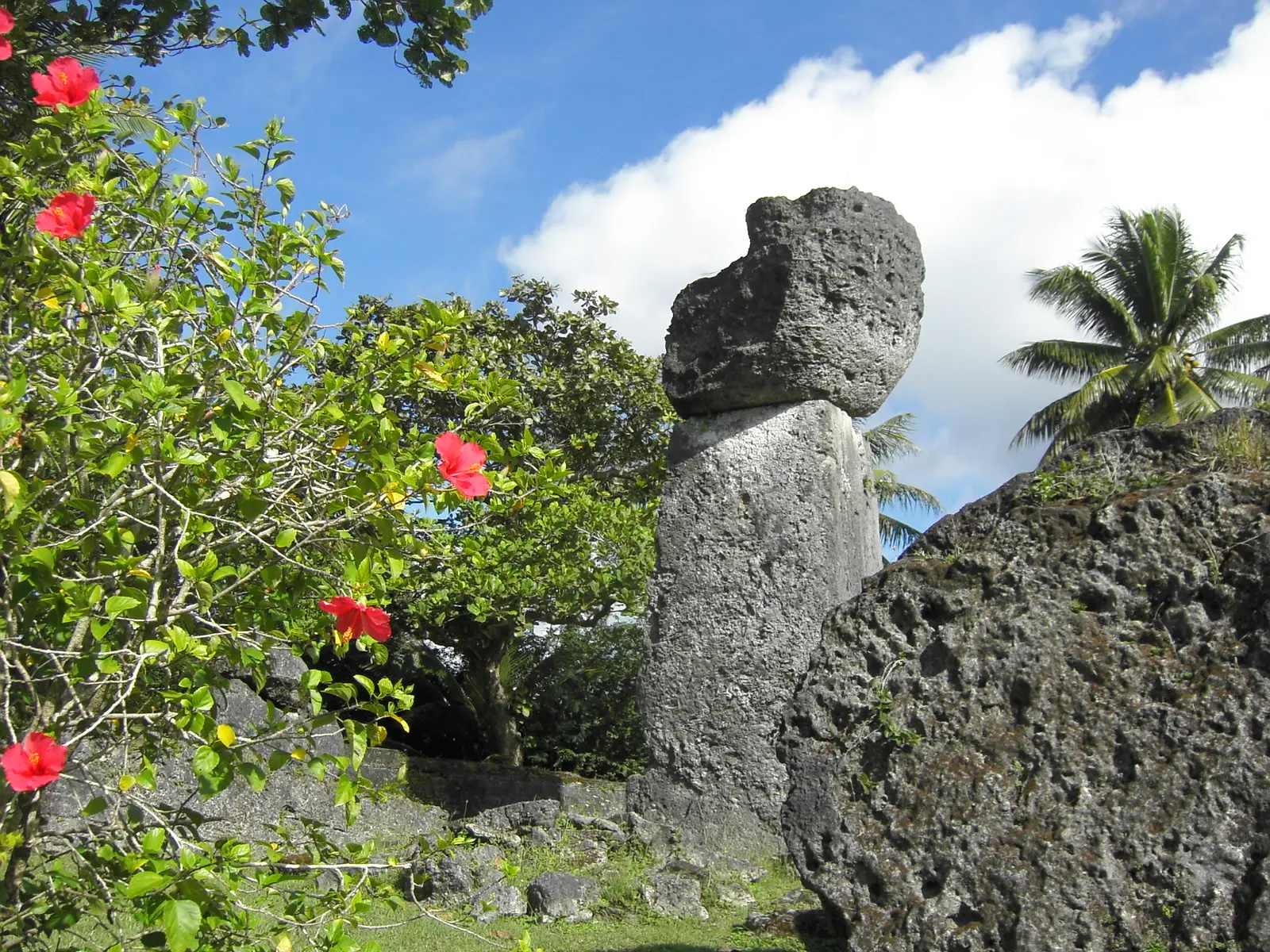
At As Nieves on Rota, nine coral-limestone shafts (haligi) and seven hemispherical capstones (tåsa)—some weighing up to thirty-four or thirty-five tons and rising nearly twenty-six feet—remain in situ where ancient Chamorro quarriers left them unfinished, never transported to a building site. Why work stopped is unknown. Chamorro legend says Chief Taga began quarrying here before moving to Tinian and completing a house with twelve latte stones, the residence documented at the separate House of Taga site.
Archaeology neither confirms nor denies this account; sudden warfare is another possibility, while at least one source states there is 'no record or indication' of the cause. Researcher Hans G. Hornbostel first documented As Nieves in 1925; it entered the National Register of Historic Places in 1974 and became a National Historic Landmark in December 2024. The Marianas' largest and most complete set of latte elements in original quarry context records interrupted ancestral labour rather than a finished monument.
Why this place is sacred
Latte stones, wherever they stand or lie unfinished, carry a particular kind of weight in Chamorro cosmology: they are bound to aniti, the concept of spirit, and to the practice of burying the dead within and around the house platforms they supported, making these locations consecrated ancestral spaces rather than purely functional architecture.
As Nieves holds this significance in an unusual form, because nothing here was ever completed into a house — what remains is potential rather than fulfillment, labor interrupted rather than labor realized.
Chamorro legend gives this interruption a story: Taga, the giant chief born to the maga'låhi of Ritidian village on Guam, is said to have relocated to Rota after a dispute with his father, defeated local rivals, and begun quarrying these massive stones — possibly, in this telling, to impress his father — before abruptly abandoning the site and moving to Tinian, where he built his residence using twelve latte topped with a wooden house.
The legend that follows him to Tinian ends in family tragedy: fearing his son's growing strength would surpass his own, Taga is said to have killed the boy, after which his daughter, having witnessed the act, fled and later died, the shame of it shadowing Taga's renown for the rest of his life.
Some alternative local traditions credit ghosts, rather than Taga himself, with transporting the stones — a separate strand of explanation for how such weight could move at all. What makes As Nieves distinct from House of Taga is precisely its incompleteness: this is the site where the work began and stopped, not where it succeeded, and that unfinished quality is treated in scholarship and tradition alike as part of its meaning rather than an unfortunate gap in the record.
An unfinished prehistoric quarry site for latte stone elements — haligi shafts and tåsa capstones — intended, per Chamorro legend, for use in a chief's house construction before the work was abandoned.
Latte stones broadly date to the Latte Period, with sources describing this as roughly 1,000 to 500 years before present, or specific latte dated to at least 845 AD in some cases; the precise age of the As Nieves quarry itself is undetermined. First documented by Hans G. Hornbostel in 1925; the site progressed from National Register of Historic Places listing in 1974 to National Historic Landmark designation in December 2024, reflecting growing recognition of its archaeological and cultural significance.
Experience and orientation
One of the rarer gaps in the research behind this content shows up here: no travel account, blog post, or visitor testimonial describing an actual encounter with As Nieves was found in the sources gathered, despite its December 2024 elevation to National Historic Landmark status.
What can be said comes from archaeological and administrative description rather than firsthand report — nine shafts and seven capstones, some of the largest latte elements documented in the Marianas, left exactly as their carvers left them in the quarry rock near Sinapalo village.
This absence of visitor narrative is worth naming honestly rather than inventing an experience to fill it: As Nieves may be one of the least-visited, least-written-about sites of its kind in the region, at least in English-language sources, even as its formal heritage status has recently increased.
Located near Sinapalo village on Rota, in the Northern Mariana Islands; no detailed visitor logistics (hours, parking, trail conditions, fees, or guide requirements) were located in available official sources.
Context and lineage
Chamorro legend holds that Taga, a giant chief born to the maga'låhi of Ritidian village on Guam, relocated to Rota after a dispute with his father, defeated local rivals, and began quarrying the massive latte stones at As Nieves — possibly to impress his father — before abruptly abandoning the site and moving to Tinian, where he completed his residence using twelve latte stones instead.
Some alternative local traditions credit ghosts, rather than Taga, with the labor of moving the stones. This account is treated by all available sources as legend and oral tradition, not verified history.
Taga
Legendary chief credited with beginning the quarry
Legendary giant chief said to have begun quarrying the As Nieves stones before abandoning the site to relocate to Tinian, where he completed his house using different latte stones.
Hans G. Hornbostel
First documenter, 1925
Researcher who first formally documented the As Nieves quarry site in 1925, establishing the earliest academic record of its existence and condition.
Michael Lujan Bevacqua
Contemporary Chamorro scholar and activist
Guam-based scholar, activist, and language-revitalization advocate whose writing documents the latte's shift from dismissed 'colonial detritus' to an actively embraced symbol of Chamorro identity and decolonial consciousness.
Traditions and practice
No source documents a specific traditional ritual or ceremony performed at the As Nieves quarry itself. Ancestor burial and veneration are associated with latte stones generally during the Latte Period, but this is historical practice tied to completed house platforms elsewhere, not documented at this unfinished quarry.
None documented specifically for As Nieves. Broader Chamorro custom, documented for Guam though not confirmed for Rota specifically, includes asking permission of the taotaomo'na before entering wild or ancestral land, sometimes accompanied by a small offering such as betel nut.
Approach the shafts and capstones as evidence of labor rather than as a finished monument — notice where each element sits in relation to the quarry rock it was cut from, since that positioning is the clearest physical trace of work simply stopping mid-process.
If you know the Taga legend, hold it lightly as one possible explanation among several rather than treating it as settled history; the honesty of not knowing why the work ended is part of what this site preserves. Move quietly, in keeping with the broader Chamorro practice of respect toward ancestral and wild land.
Chamorro Latte Period ancestral house-building and burial practice
HistoricalLatte stone pairs served as foundations for houses and community structures, with the space beneath and around them used for burying the dead, making the latte a site of ancestor veneration and possibly an expression of the Chamorro spirit concept aniti.
Quarrying of coral limestone shafts and capstones, transport by means not archaeologically confirmed, erection of paired stones as house foundations, interment of the dead between the stones.
Taotaomo'na ancestral spirit reverence
ActiveTaotaomo'na, ancestral spirits described in Chamorro belief as inhabiting and protecting the islands' jungles, mountains, and ancient sites, are widely associated with latte stones in local tradition.
In broader Chamorro practice, documented for Guam though not confirmed specifically for As Nieves, it is customary to ask permission of the taotaomo'na before entering forested or ancestral areas, sometimes with a small offering such as betel nut.
Legend of Chief Taga
HistoricalTaga is credited with beginning the massive latte stones at As Nieves before abandoning the site and relocating to Tinian to build the House of Taga; the legend is intertwined with a tragic family narrative and remains part of contemporary Chamorro oral tradition and cultural memory.
Oral storytelling; the legend is referenced in interpretive and educational materials rather than enacted ritually.
Contemporary Chamorro identity and decolonial symbolism
ActiveSince the mid-to-late 20th century, the latte has shifted from being dismissed as ancient cultural detritus under colonial framing to becoming a proud, actively invoked symbol of Chamorro identity, resilience, and political voice, including use in campaigns against militarization and land development on Guam.
Use of latte imagery in cultural, artistic, and political expression; invocation of the latte as a decolonial and community-mobilizing symbol.
Perspectives and open questions
As Nieves is read by archaeologists as the most significant surviving latte quarry in the Marianas, by Chamorro tradition as a site tied to Chief Taga's unfinished ambition, and by contemporary Chamorro scholarship as part of a broader reclamation of the latte as a living symbol of identity.
Scholarly perspective
Archaeologists and the National Park Service recognize the As Nieves quarry as the most significant and largest-scale latte quarry site in the Marianas, notable for preserving unfinished shafts and capstones in their original quarry context. First documented in 1925 by Hans G. Hornbostel, listed on the National Register of Historic Places in 1974, and elevated to National Historic Landmark status in December 2024.
Scholars have not established why the quarrying was abandoned, nor fully reconstructed the transport and erection techniques that would have been used had the work been completed.
Living and traditional perspectives
Contemporary Chamorro sources, including Guampedia and scholar-activist Michael Lujan Bevacqua, frame latte stones as bound up with the spirit concept aniti, ancestor veneration through burial practice, and social status. Bevacqua documents a shift from colonial-era dismissal of latte as cultural detritus to their embrace today as a proud, actively mobilized symbol of Chamorro identity, including in environmental and anti-militarization advocacy on Guam.
No source located gives a Chamorro cultural organization's specific position on how As Nieves itself should be treated or interpreted following its 2024 designation — this remains an open gap rather than an assumed consensus.
Alternative interpretations
No esoteric or alternative-spiritual interpretive material specific to this site was located in available sources.
Open questions
The reason quarrying was abandoned mid-process is unresolved — possibilities raised include sudden warfare or, per legend, Chief Taga's abrupt relocation to Tinian, with at least one source stating plainly there is no record or indication of the cause. The precise techniques used to quarry, transport, and erect stones weighing up to thirty-four to thirty-five tons remain scientifically unproven, even for the elements that were successfully completed elsewhere.
The exact age of the As Nieves quarry specifically, as distinct from the broader Latte Period date range, is also undetermined.
Plan your visit
Access and arrival
Located near Sinapalo village on the island of Rota, Northern Mariana Islands. Rota's Mayor's Office lists the site among the island's official historic sites. No source provided detailed directions, trail conditions, parking, entry fees, or whether a guide is required; the Marianas Visitors Authority or CNMI Historic Preservation Office would be the logical official contacts, but this was not confirmed in sources retrieved.
No mobile phone signal or emergency-access information was available at time of writing; check with the CNMI Historic Preservation Office for current details before visiting.
Not documented in sources found.
Respectful visit
Not documented in sources found.
Not documented in sources found; no restrictions noted in any source.
Not documented specifically for this site. In broader Chamorro taotaomo'na custom, a small offering such as betel nut may accompany a verbal request for permission before entering ancestral or wild land — this is not confirmed as an expectation specifically at As Nieves.
No formal access restrictions were found in any source; the site received National Historic Landmark status in December 2024, which typically increases legal protection against disturbance or removal of features, but sources did not specify visitor rules.
No formal access restrictions were found in any source; the site's 2024 National Historic Landmark status typically increases legal protection against disturbance or removal of features, though specific visitor rules were not documented in sources located.
Location
Map loads as you approach this section.
Pilgrim reflections
A portrait of encounter, not a score
Pilgrims describe what they felt, how present they could become, and whether the place would shape a journey. There are no stars and no ranking of traditions.
No reviewed reflections yet
The first pilgrims can help describe the character of being here.
Share a reflection
Available after an account-backed “Been there.” Every reflection is reviewed before publication.
Nearby sacred places
Explore other sacred places in the region. Proximity does not establish access or travel time; check each place’s guidance.
House of Taga
San Jose, Tinian, Northern Mariana Islands, Northern Mariana Islands, United States
100.6 km away

Mangyol Stone Money Bank
Makiy, Gagil, Yap State, Yap, Federated States of Micronesia
919.5 km away

Badrulchau Stone Monoliths, Palau
Ngebei, Ngarchelong, Palau
1353.5 km away

Nan Madol
Temwen Island, Pohnpei State, Pohnpei, Federated States of Micronesia
1650.6 km away
References
Sources consulted for this page. Source categories describe the publication, not a guarantee that every claim is verified. Traditional accounts and outside interpretations may differ.
- 01Latte's Significance — Fred Rodriguez, MAacademicGuampedia is a Chamorro-community-affiliated educational encyclopedia (Guam Humanities Council). Rodriguez discusses aniti (spirit) concept, ancestor veneration/burial, and social-status housing (Guma' Uritao, Matua/Acha'ot castes). Explicitly indigenous-informed source; author notes documentation gaps and uses cautious ('possibly,' 'theoretically') language rather than overstating certainty.
- 02TagaacademicGuampedia entry on the legend of Chief Taga, directly connecting the As Nieves quarry to the House of Taga on Tinian. Indigenous-community-affiliated source.
- 03An overview of latte period archaeology — Mike T. CarsonacademicPeer-reviewed academic overview (Micronesica journal, University of Guam) of Latte Period archaeology across the Marianas; not fully excerpted in this research pass but identified as a high-reliability academic reference for the broader Latte Period context.
- 04Rota Latte Stone QuarryacademicMost comprehensive single overview found; cites National Register/NHL dates, stone counts, dimensions, dating, and the Taga legend. Useful synthesis but not a primary source.
- 05Rota's Latte Quarry on As Nieves designated as a historic landmarkSource contextPacific regional news wire reporting on the December 2024 NHL designation; includes official DOI/NPS statements but no CNMI or Chamorro community quotes.
- 06Manenggon Camp, Rota Latte Quarry listed among 19 new National Historic LandmarksSource contextRegional news outlet covering Guam/CNMI; includes quote from Guam Delegate James Moylan on heritage tourism and preservation access.
- 07Rota's Latte Quarry up for National Historic Landmarks designationSource contextLocal CNMI newspaper; page could not be fetched directly (404) so content not verified beyond search snippet referencing NPS/CNMI HPO cooperation on the nomination.
- 08Latte Stone Significance — Michael Lujan BevacquaSource contextBevacqua is a prominent Chamorro scholar, activist, and language-revitalization advocate based in Guam. Blog format lowers formal reliability rating but this is a genuinely indigenous-authored, decolonial-perspective source discussing the latte's shift from 'colonial detritus' to a symbol of contemporary Chamorro pride and political mobilization (e.g. against militarization/development).
- 09Historic Sites – Mayor Aubry Hocog (Rota)officialOfficial CNMI/Rota mayoral office page listing the As Nieves/Taga Stone Quarry among Rota's historic sites; confirms local government recognition but offers no detailed visitor protocol or cultural-protocol guidance.
- 10Historic Preservation Office – Department of Community and Cultural Affairs (CNMI)officialOfficial CNMI Historic Preservation Office page; page could not be fetched (server error) during this research pass, so content is unverified beyond confirming the office's existence and its role (per secondary sources) in cooperating with NPS on the NHL nomination.
- 11Day 119: Taga Latte Stone Quarry, Rota, Commonwealth of the Northern Mariana IslandsSource contextAsian Pacific Islander American Historic Places project entry; a heritage-advocacy nonprofit source, not deeply excerpted in this pass but flagged as a potentially relevant indigenous/AAPI-heritage-affiliated source for future follow-up.
- 12Rota Latte Stones Quarry (As Nieves Quarry)Source contextTravel/geography enthusiast site; useful for stone dimension figures but not an authoritative source.
Share a photo
Help visitors recognize As Nieves Latte Stone Quarry. Every submission is reviewed before publication.