Shōfuku-ji
Iizumi Kannon, the Shingon temple of Ninomiya Sontoku's awakening
Understand sacred places, explore living traditions, and learn how to engage respectfully with Pilgrim Map.
Access has not been verified. Check current local guidance before planning a visit.
Odawara, Kanagawa Prefecture, Japan
Read the sources
Visit essentials
A quick read before you go
- Duration
- 30–60 minutes for a contemplative visit.
- Access
- Bus or taxi from JR Odawara Station to the Iizumi-bashi or Hosoda bus stop; the temple is about…
Overview
Shōfuku-ji stands in the Iizumi neighborhood of Odawara, north of the city center on the broad Sagami plain that opens westward toward the Ashigara mountains. As Bandō #5, it is the temple where pilgrims leaving the Kamakura cluster begin to move outward — across the plain, toward Hakone and the mountains beyond. The mountain name is Iizumi-san; the temple has been known locally as Iizumi Kannon since at least the medieval period.
The principal image is an Eleven-Headed Kannon. Temple tradition links it to Tang China: in the 8th century the Chinese vinaya master Jianzhen (Ganjin), arriving in Japan in 753, gifted an Eleven-Headed Kannon to Empress Kōken, who entrusted it to the priest Dōkyō. After Dōkyō's failed attempt to seize the throne and his subsequent exile, he installed the image in a small chapel in the Ashigara mountains.
In 830 CE the image was relocated to its present Iizumi site; the temple was renamed Shōfuku-ji during the Muromachi period. These attributions are devotional rather than historically verified, but they place Iizumi Kannon at the head of a continental lineage of compassion.
The temple has carried several layers of patronage. The Soga brothers reportedly prayed here in the 12th century for success in their celebrated vendetta. The Late Hōjō clan, based at nearby Odawara Castle, supported the temple in the Muromachi period. The current main hall was rebuilt in 1706 by Ōkubo Tadamasu, daimyō of Odawara Domain.
Most famously, the young Ninomiya Sontoku — Edo-period agronomist, philosopher, and economist whose ethical and economic teachings shaped late-Edo and Meiji rural Japan — is said to have received a transformative spiritual awakening here at age fourteen, upon hearing a traveling monk recite the Kannon Sutra inside the hondō. A statue of Sontoku in the precinct marks the spot.
Each December 17 and 18, the Iizumi Kannon Daruma-ichi fills the temple grounds with stalls selling daruma dolls — the first daruma market of the Kantō New Year season.
Why this place is sacred
Shōfuku-ji's quality of thinness is historical and ethical rather than visually dramatic. The precinct is spacious and flat, with grand cedars marking the approach and the 1706 main hall in the center; nothing about the setting overstates its significance. What concentrates here is layered memory.
The oldest layer is the Tang-China lineage of the principal Kannon. Jianzhen (Ganjin), Empress Kōken, the controversial monk Dōkyō — figures who shaped Nara-period Japan — are bound by tradition to this image. The medieval layer is the Late Hōjō patronage from Odawara Castle, which made Iizumi Kannon part of the regional Buddhist landscape that the warlord Hōjō Sōun and his successors maintained.
The early-modern layer is the Ōkubo daimyō family's 1706 rebuild of the main hall, the building that stands today.
The most distinctive layer for many modern visitors is Ninomiya Sontoku's awakening. The story of a fourteen-year-old hearing the Kannon Sutra at this temple and re-orienting his life around steady ethical work has made Shōfuku-ji a place of pilgrimage for those thinking about vocation and integrity.
The annual Daruma-ichi extends this register: a daruma doll bought at Iizumi Kannon, painted with a single eye on the day of purchase and the second eye when an intention is fulfilled, is widely understood as a small ritual of New Year resolve.
The site has been a place of Eleven-Headed Kannon devotion since at least 830 CE, when temple tradition records the relocation of the principal image from a chapel in the Ashigara mountains to the present Iizumi location. The temple was renamed Shōfuku-ji during the Muromachi period; before that, it operated under the name of the original Ashigara chapel.
Shōfuku-ji has been a Shingon-school temple since at least the medieval period; predecessor affiliations are uncertain. Late Hōjō patronage in the Muromachi period embedded the temple in the Odawara regional Buddhist landscape. The current main hall dates to a 1706 rebuild by Ōkubo Tadamasu, daimyō of Odawara Domain. The annual Daruma-ichi has been observed for many generations and remains a major regional Buddhist event.
Experience and orientation
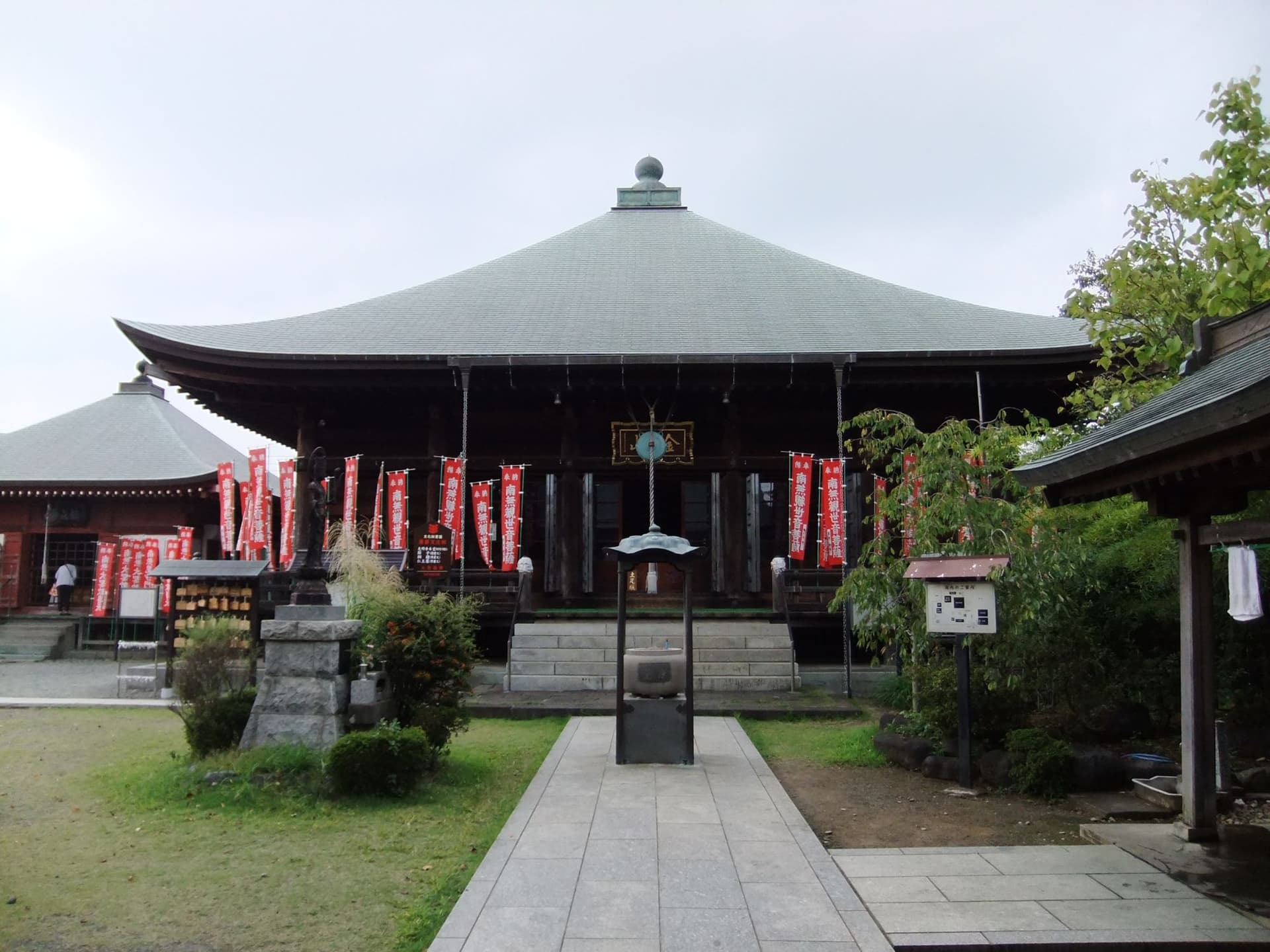
From JR Odawara Station, the temple is reached by a short bus or taxi ride north into the Iizumi neighborhood. The approach passes through residential and farmland landscape — Odawara's older agricultural plain rather than its tourist seafront. The temple gate opens onto a level precinct with grand cedars along the central approach, the 1706 main hall in the middle distance, the statue of Ninomiya Sontoku to one side, and the distinctive boat-shaped dragon water basin (chōzubachi) for ritual hand-washing.
Outside festival days the precinct is quiet, often with only a handful of visitors. The hondō can be entered for prayer; incense is available at the main hall. Bandō pilgrims approach the office for the Bandō #5 stamp. The Sontoku statue draws individual visitors who pause to read the inscription describing the Kannon Sutra awakening.
The atmosphere changes completely on December 17 and 18. The Daruma-ichi — the first daruma market of the season in the Kantō region — fills the precinct with stalls. Tens of thousands of visitors come to buy daruma dolls of varying sizes; festival foods (yatai), tea, and Buddhist devotional items are sold around the perimeter.
Inside the main hall, the recitation of the Kannon Sutra — the same scripture that awakened Ninomiya Sontoku here — provides the ritual core of the festival.
Take the bus or a taxi from JR Odawara Station to the Iizumi-bashi or Hosoda bus stop; the temple is a 15-minute walk from the bus stop. Enter the precinct (free admission to the grounds), walk the cedar-lined approach to the main hall, pause at the boat-shaped dragon chōzubachi for ritual hand-washing, and enter the hondō for prayer. The Sontoku statue stands to one side of the precinct.
Bandō pilgrims should bring their nōkyō-chō to the office for the Bandō #5 stamp. During the December 17–18 Daruma-ichi, plan extra time and arrive prepared for crowds.
Context and lineage
In the 8th century the Tang Chinese vinaya master Jianzhen (Ganjin), who arrived in Japan in 753 after several failed crossings, gifted an image of the Eleven-Headed Kannon to Empress Kōken. The empress entrusted it to the priest Dōkyō. After Dōkyō's controversial career — including his failed attempt to seize the throne and his subsequent exile from court — he installed the image in a small chapel in the Ashigara mountains of western Sagami Province.
In 830 CE (Tenchō 7), the image was relocated to its present Iizumi site. The temple was renamed Shōfuku-ji during the Muromachi period. In the early Kamakura period, the Soga brothers prayed at this temple for success in their celebrated vendetta — a famous episode of medieval samurai history that the Heike-era literary tradition preserves. The Late Hōjō clan, based at nearby Odawara Castle, supported the temple in the Muromachi period as part of their regional Buddhist patronage.
The Ōkubo family — daimyō of Odawara Domain after the Hōjō fall in 1590 — continued patronage; Ōkubo Tadamasu rebuilt the main hall in 1706, and that hall stands today.
Ninomiya Sontoku (1787–1856) — one of the most influential Edo-period agronomists, philosophers, and economists, whose teachings on hōtoku (gratitude and reciprocity) shaped late-Edo and Meiji rural reform — is said to have visited Shōfuku-ji at age fourteen and received a transformative spiritual awakening upon hearing a traveling monk recite the Kannon Sutra inside the hondō. The story is preserved in temple tradition and Edo-period biographies of Sontoku.
Shōfuku-ji belongs to the Shingon-shū Tōji-ha branch of Japanese Shingon Buddhism — the esoteric school founded in Japan by Kūkai (774–835), with the Tōji-ha lineage centered on Tō-ji in Kyoto. Daily liturgy includes mantra recitation, mandala visualization, and the school's characteristic esoteric ritual frame. The principal Kannon devotion is held within this Shingon framework, although the image's traditional lineage traces back through Empress Kōken's court to Tang China — predating the Shingon school's establishment in Japan.
Jianzhen / Ganjin (688–763)
Traditional source of the principal Kannon image
Tang Chinese vinaya master who arrived in Japan in 753 after multiple failed crossings; by tradition gifted the Eleven-Headed Kannon image now enshrined at Shōfuku-ji to Empress Kōken.
Empress Kōken / Empress Shōtoku (718–770)
Imperial intermediary
Nara-period empress who, by tradition, received the Kannon image from Jianzhen and entrusted it to the priest Dōkyō.
Dōkyō (700–772)
Traditional enshriner
Controversial Nara-period Buddhist priest who, after his failed attempt to seize the throne and subsequent exile from court, installed the Kannon image in a small chapel in the Ashigara mountains; the image was later moved to the present Iizumi site in 830.
Late Hōjō clan
Muromachi-period patrons
The warlord family based at Odawara Castle that supported Shōfuku-ji as part of their regional Buddhist patronage from the late 15th century until their fall in 1590.
Ōkubo Tadamasu (1656–1713)
Rebuilder of the main hall
Daimyō of Odawara Domain in the early Edo period; rebuilt the main hall of Shōfuku-ji in 1706, the structure that stands today.
Ninomiya Sontoku (1787–1856)
Subject of the awakening story
Edo-period agronomist, philosopher, and economist whose teachings on hōtoku and steady ethical work shaped late-Edo and Meiji rural reform; said to have received a transformative spiritual awakening at Shōfuku-ji at age fourteen upon hearing the Kannon Sutra.
Traditions and practice
Resident Shingon clergy maintain the daily liturgical schedule, including mantra recitation, mandala visualization, and the school's characteristic esoteric ritual frame. The Kannon Sutra — the same scripture said to have awakened Ninomiya Sontoku here — is recited regularly in the hondō. Bandō pilgrimage reception continues year-round. The Daruma-ichi (Daruma Doll Fair) on December 17 and 18 is a major annual event and the first daruma market of the season in the Kantō region.
Lay visitors come for prayers concerning compassion, family, and well-being, and to venerate the statue of Ninomiya Sontoku — a particularly common stop for visitors thinking about vocation and ethical life. Bandō pilgrims arrive at the office for the Bandō #5 stamp.
During the Daruma-ichi the precinct hosts tens of thousands of visitors; daruma dolls of varying sizes are sold by stalls throughout the grounds, with the central ritual act being the purchase of a daruma to be placed at home as a marker of New Year intention.
Approach the precinct slowly along the cedar-lined path. Pause at the boat-shaped dragon chōzubachi for ritual hand-washing before entering the main hall. Inside the hondō, allow some quiet time before the Eleven-Headed Kannon. Walk to the Sontoku statue and read the inscription. If you are walking the Bandō circuit, ask at the office for the Bandō #5 goshuin and inquire about the practice of sutra-copying.
If you are visiting on December 17 or 18, plan extra time and arrive ready for crowds; the daruma doll you choose can be painted with one eye on purchase and the second eye when your intention is fulfilled.
Buddhism
ActiveShōfuku-ji — popularly known as Iizumi Kannon — is the fifth station of the Bandō Sanjūsankasho and one of the most active Shingon Kannon temples in Kanagawa. Its principal image, an Eleven-Headed Kannon, is said by temple tradition to have been a gift from the Tang Chinese vinaya master Jianzhen (Ganjin) to Empress Kōken in the 8th century, then handed to the priest Dōkyō, who enshrined it in the Ashigara mountains after his political fall. The image was relocated to its present site in 830. The temple was renamed Shōfuku-ji in the Muromachi period and was supported by the Late Hōjō clan based at nearby Odawara Castle. The Soga brothers reportedly prayed here for success in their famous 12th-century vendetta. The young Ninomiya Sontoku — Edo-period agronomist, philosopher, and economist — is said to have received a transformative spiritual awakening here at age fourteen upon hearing a traveling monk recite the Kannon Sutra.
Perspectives and open questions
Shōfuku-ji holds together legendary continental lineage, documented samurai-era patronage, an Edo-period rebuild, and a story of teenage awakening that continues to draw visitors thinking about vocation. Each register tells a slightly different temple.
Scholarly perspective
The Jianzhen / Empress Kōken / Dōkyō lineage of the principal Kannon image is treated as legendary in academic sources. What is documented is the relocation of the image to the present Iizumi site in 830 CE and the temple's later medieval growth under Late Hōjō patronage. The current main hall is well-attested as a 1706 reconstruction by the Ōkubo daimyō family. The Ninomiya Sontoku awakening story is preserved in temple tradition and Edo-period biographies of Sontoku.
Living and traditional perspectives
In the temple's own narrative, the Kannon image is a transmission from Tang China to Japan via Ganjin and Empress Kōken — placing Iizumi Kannon at the head of a continental lineage of compassion. The Eleven-Headed Kannon's ten supplementary faces represent stages of bodhisattva insight, as in other Bandō Eleven-Headed Kannon temples; here that classical iconography is amplified by the temple's Shingon esoteric framework.
Alternative interpretations
Folk-Buddhist devotion treats the December Daruma-ichi as the most auspicious time for purchasing a daruma here, where political ambition (Dōkyō, the Soga brothers, the Late Hōjō) and ethical resolve (Ninomiya Sontoku) have all been petitioned. A daruma from Iizumi Kannon is widely sought for prayers regarding new year intentions, recovery from setbacks, and steady perseverance — a particular folk-Buddhist register that the Sontoku story reinforces.
Open questions
{"Original 8th-century location of the chapel where Dōkyō first enshrined the image in the Ashigara mountains","Exact carving date and provenance of the present principal Kannon image (whether the legendary Tang origin or a later Japanese carving)","Complete annual liturgical calendar beyond the Daruma-ichi"}
Plan your visit
Access and arrival
Bus or taxi from JR Odawara Station to the Iizumi-bashi or Hosoda bus stop; the temple is about a 15-minute walk from the bus stop. Address: 1161 Iizumi, Odawara, Kanagawa Prefecture. Admission to the precincts is free. Specific opening hours and admission for any inner halls were not consistently documented in English-language sources at time of writing; check seasonally for Daruma-ichi timing and any temporary access changes via the Bandō Sanjūsankasho official site (bandou.gr.jp).
Mobile phone signal is reliable on all major Japanese carriers in this part of Odawara.
Odawara has hotels and ryokan near the station, with additional onsen ryokan options westward toward Hakone. Many Bandō pilgrims base themselves in Odawara for the Bandō #5 visit before continuing eastward to subsequent stations or westward into the Hakone–Ashigara region.
Respectful visit
Modest, walking-comfortable clothing. Pilgrim coat (hakui) and staff appropriate for those on the Bandō circuit.
Permitted in the precincts; refrain from photographing inside the Kannon-dō unless explicitly allowed; ask before photographing daruma vendors during the festival.
Incense, candles, monetary saisen, transcribed sutra (nōkyō), and — during the Daruma-ichi — purchased daruma dolls inscribed with intentions.
Quiet behavior inside the main hall | Heavy crowds during the December 17–18 Daruma-ichi require patience and respect for fellow visitors | No photography inside the Kannon-dō unless explicitly allowed
Heavy crowds during the December 17–18 Daruma-ichi require patience and respect for fellow visitors. Photography inside the Kannon-dō is generally not permitted unless explicitly allowed. The precinct is large but largely flat — comfortable shoes are sufficient.
Current practical details
Address
1161 Iizumi, Odawara, Kanagawa 250-0863, Japan
Phone
Hours
Hours, fees, and access can change — verify on the official source before you travel. Practical details last checked Jun 2026.
Location
Map loads as you approach this section.
Pilgrim reflections
A portrait of encounter, not a score
Pilgrims describe what they felt, how present they could become, and whether the place would shape a journey. There are no stars and no ranking of traditions.
No reviewed reflections yet
The first pilgrims can help describe the character of being here.
Share a reflection
Available after an account-backed “Been there.” Every reflection is reviewed before publication.
Nearby sacred places
Explore other sacred places in the region. Proximity does not establish access or travel time; check each place’s guidance.


References
Sources consulted for this page. Source categories describe the publication, not a guarantee that every claim is verified. Traditional accounts and outside interpretations may differ.
- 01Shōfuku-ji (Odawara) — Wikipedia contributorsacademicConfirms Shingon-shū Tōji-ha affiliation, Jūichimen Kannon honzon, Bandō #5 status, Dōkyō legend, 1706 main hall by Ōkubo Tadamasu, Ninomiya Sontoku enlightenment story.
- 02勝福寺 (小田原市) — ウィキペディアacademicJapanese encyclopedia entry — Dōkyō exile and Kannon enshrinement; Soga brothers prayer; Late Hōjō patronage; 1706 hondō; Daruma-ichi market; relocation to current site in 830.
- 03小田原市 | 飯泉山勝福寺(飯泉観音) — Odawara City (official)officialOfficial municipal description of the temple as a major Odawara cultural site.
- 04飯泉山 勝福寺(飯泉観音) — Bandō Sanjūsankasho official site (bandou.gr.jp)officialOfficial Bandō circuit page — confirms Iizumizan mountain name, Bandō #5, Eleven-Headed Kannon honzon.
- 05Iizumi Kannon Daruma Fair at Iizumizan Shofuku-ji Temple — Visit Kanagawa / Tokyo Day TripofficialDaruma-ichi (Daruma Doll Fair) on December 17–18, the first daruma fair of the season in the Kantō region.
- 06勝福寺。小田原市飯泉にある真言宗東寺派寺院 — Tesshow.jpguideDetailed Japanese-language history including Soga brothers' vendetta prayer, Ninomiya Sontoku enlightenment story, and Late Hōjō patronage.
- 07Shofukuji Temple (Iizumi Kannon), Odawara — TripAdvisor visitor reviews and overviewguideVisitor experience details; confirms free entry to the precincts.
- 08iwafu — Iizumi Kannon Daruma Market — iwafu (limited-time cultural travel guide)guideDaruma market schedule, address (1161 Iizumi, Odawara, Kanagawa), and visitor practicalities.
Pilgrim glossary
- Kannon
- The bodhisattva of compassion, central to many East Asian pilgrimage routes.
- Bodhisattva
- An enlightened being who postpones full nirvana to help others toward awakening.
- Mandala
- A symbolic diagram of the cosmos used in meditation and ritual.
- Sutra
- A canonical Buddhist scripture, often chanted as part of practice.
- Mantra
- A sound, word, or phrase repeated as part of meditation or ritual.
- Shingon
- An esoteric Japanese Buddhist school emphasizing ritual, mantra, and mandala practice.
Share a photo
Help visitors recognize Shōfuku-ji. Every submission is reviewed before publication.