Harran
Where the moon god held court for four thousand years and Abraham paused before Canaan
Understand sacred places, explore living traditions, and learn how to engage respectfully with Pilgrim Map.
Access has not been verified. Check current local guidance before planning a visit.
Şanlıurfa, Turkey
Read the sources
Visit essentials
A quick read before you go
- Duration
- 2–4 hours for the ruins, beehive houses, and Culture House.
- Access
- Harran is 44 km southeast of Şanlıurfa city centre.
Overview
Harran lies on the plain forty-four kilometres south of Şanlıurfa, the city tradition calls Abraham's birthplace, where the Mesopotamian world grades into the Syrian steppe.
Occupied since at least the early second millennium BCE, possibly the third, it has served as the foremost sacred city of the moon god Sin; a waystation on Abraham's journey; a Roman garrison; the last redoubt of a planetary religion combining Mesopotamian star worship with Greek Neoplatonism; the site of Anatolia's first mosque; and an Islamic scholarly centre that transmitted Aristotle and Plato to the Arab world.
These layers remain visible in the ancient mound, the Grand Mosque ruins and square minaret, and the beehive houses adapted to brutal summer heat. Across four thousand years, the place has repeatedly been inhabited, venerated, defended, and revisited.
Why this place is sacred
The thinness of Harran is cumulative rather than sudden. It is not the thinness of a dramatic natural feature or a single overwhelming monument, but the thinness produced by layer upon layer of sacred intention pressed into the same piece of land for so long that the compression itself becomes palpable.
The Eḫulḫul — the 'Temple of Rejoicing' — was rebuilt and lavishly renovated by the Assyrian king Ashurbanipal (7th century BCE), by Nabonidus the last Babylonian king (6th century BCE), and by Seleucid, Roman, and later rulers, because the temple of Sin was so important that no ruling dynasty could afford to let it fall into disrepair.
To come to Harran and receive the moon god's blessing was not a luxury for ancient Near Eastern kings — it was a political and metaphysical necessity. When Nabonidus devoted himself so completely to Sin at Harran that he neglected the Marduk temple in Babylon and was eventually expelled from his own capital, he was expressing something about the spiritual force concentrated in this place that his contemporaries found credible even when they opposed its political consequences.
The Abrahamic tradition added another register: the Book of Genesis placed the patriarch here at the turning point of his journey — arrived from Ur, his father dead in Harran, the divine call coming to him here to continue to Canaan.
Whether or not one reads the Genesis narrative as historical, its placement of the covenant's critical moment at this specific city, in this specific landscape, reflects the sense that Harran was a place where something changed — where threshold experiences were possible.
The Sabians, who preserved their planetary religion here across the full span of Islamic expansion by claiming the identity of a Quranic 'People of the Book,' added the final layer: a community for whom the study of the stars was a religious act, whose scholars transmitted Greek mathematics, astronomy, and philosophy into Arabic, and whose tradition carried the Mesopotamian lunar cult through a twelve-hundred-year transition from ancient polytheism to Islamic modernity.
The foremost temple city of the Mesopotamian moon god Nanna/Sin, active from at least the early second millennium BCE and continuously maintained by successive empires as a place of divine blessing and royal legitimation.
Sumerian/Akkadian moon temple city (c. 2000+ BCE) → Hurrian, Assyrian, Babylonian religious centre → Achaemenid Persian patronage → Macedonian/Seleucid city ('Hellenopolis') → Roman garrison and commercial city → Sabian star-worship and Hermetic philosophy hub (Islamic period, 7th–13th centuries CE) → Umayyad mosque construction (8th century CE) → first Islamic university (8th–9th centuries CE) → Mongol destruction (1251 CE) → gradual depopulation, ruins remain → modern archaeological excavation and active UNESCO nomination.
Experience and orientation
Harran arrives quietly. The drive south from Şanlıurfa across the flat plain gives few signals of what is coming — the landscape is largely agricultural, the horizon distant — until the beehive houses appear above a small rise and suddenly the site is there: the conical earthen domes clustering behind their walls, the broken tower of the Grand Mosque rising above them, and beyond, the archaeological mound.
The first thing to understand about Harran is that it is simultaneously a ruin and a living place. The beehive houses are occupied or recently occupied; a modern village (Altınbaşak) sits adjacent to the ancient site; local residents move through the archaeological zone in their daily routines. This is not a site sealed off from ordinary time.
Approach the Grand Mosque ruins — the 8th-century Umayyad structure that was reportedly the first mosque in Anatolia — and notice the square minaret, distinctive in its form from the round minarets common in Ottoman architecture: older, blunter, more monumental. The mosque is ruined but the minaret stands, its stone darkened, its function long since ended, its form insisting on something about the significance of what was built here.
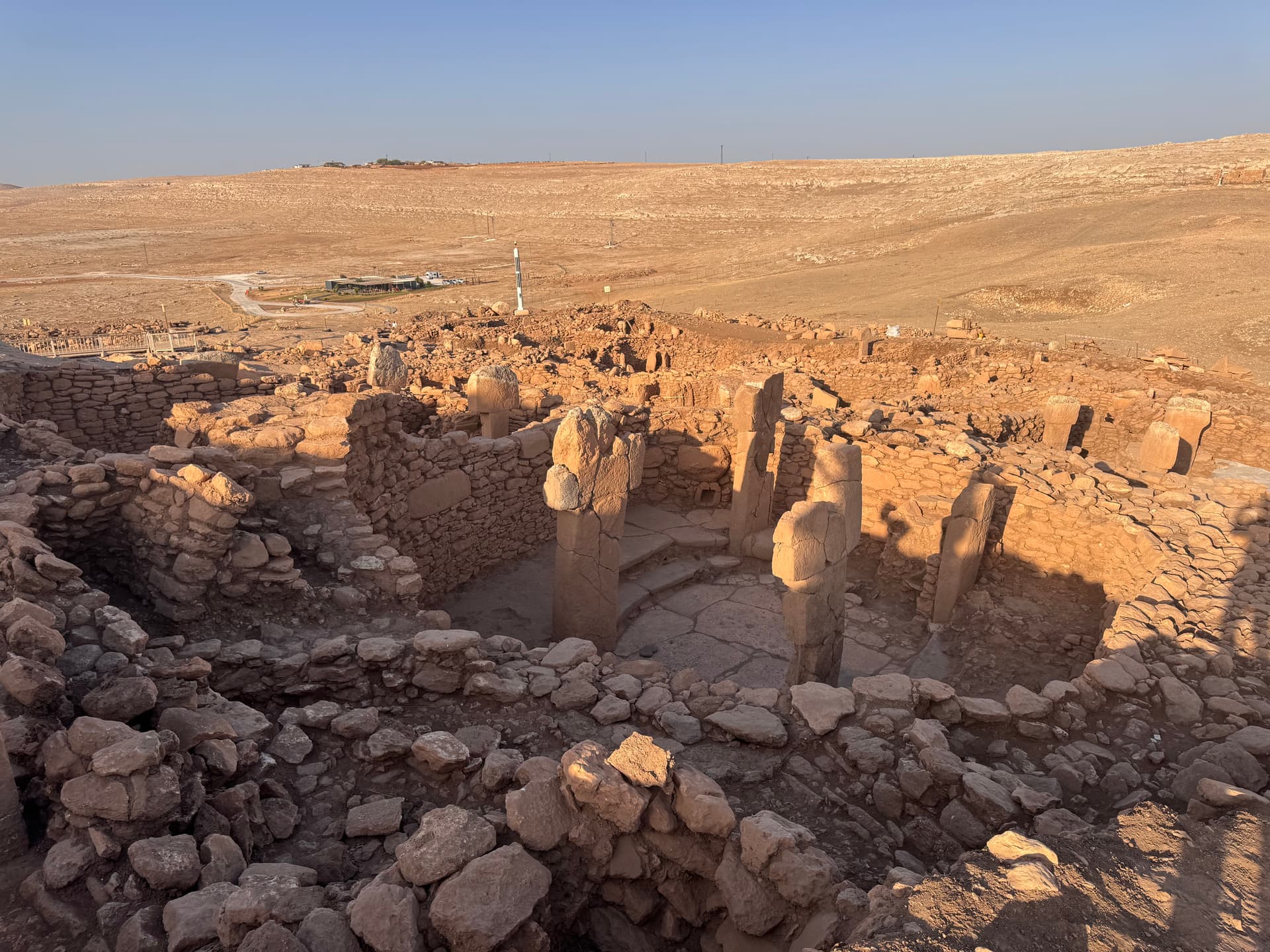
The Eḫulḫul moon temple lies beneath the mound — its full extent unexcavated, its precise location within the tell still being determined by ongoing archaeological work. Walk around the mound in the late afternoon when the low sun emphasises surface irregularities, and the ancient city's bones become legible in the undulation of the earth.
The beehive houses, whatever their current state of occupancy, are worth extended attention: the thermal logic of their conical shape (which sheds heat upward through a vent at the apex), the way they cluster together sharing walls, the fact that their form has been documented here since at least the 7th century BCE — makes them a living architecture as ancient in its principle as the temple mound beside them.
Visit early in the day in any season to avoid heat and tourists; in spring and autumn, the late afternoon light on the beehive clusters is remarkable.
Harran is 44 km southeast of Şanlıurfa. Accessible by dolmuş from Şanlıurfa's Yeni Garaj (new bus station) or private taxi. The archaeological site is open daily 8:30 AM–7:30 PM. The Harran Culture House (Harran Kültür Evi) offers guided access to a traditional beehive house interior. The main visible monuments are the Grand Mosque ruins and the citadel mound; the beehive houses are adjacent.
Context and lineage
Mesopotamian tradition held that Harran had been sacred to Sin from time immemorial — that the god himself dwelt in the Eḫulḫul, 'the Temple of Rejoicing.' The city was likely established as a trading colony from the Sumerian city of Ur in the early second millennium BCE, which would explain the Genesis narrative's logic: Abraham's family, coming from Ur, would naturally have paused at Ur's commercial outpost on the way to Canaan.
In the Abrahamic tradition, Harran is the place where the patriarch's father Terah died (Genesis 11:31–32) and where God gave Abraham the command to continue — 'Go from your country and your kindred and your father's house to the land that I will show you' (Genesis 12:1).
The Sabians, when the 9th-century Caliph al-Ma'mun arrived at Harran and asked them which People of the Book they were, reportedly consulted among themselves before declaring themselves Sabians — a Quranic category that granted them protection as a recognised religious community. Whether this was genuine identity or tactical self-description remains debated; what is certain is that it allowed the Harranians to continue practising their planetary religion for another four centuries until the Mongol destruction of 1251.
Harran's documented sacred history spans at least four thousand years: from Sumerian/Akkadian moon worship through Hurrian, Assyrian, Babylonian, Achaemenid, Hellenistic, Roman, Sabian, and Islamic periods to the present. No other site in Anatolia or Mesopotamia maintains this combination of duration, diversity, and survival of physical remains.
Traditions and practice
The lunar temple rites of the Eḫulḫul were among the most elaborated in the ancient Near East. Monthly and new moon festivals brought the city to its highest ceremonial activity. Kings from across Mesopotamia came to Harran to receive the moon god's blessing — understood as divine legitimation of their rule — and to participate in rites that were kept distinct from the temples of other cities.
Nabonidus's account of his restoration of the Eḫulḫul in the 6th century BCE describes the god appearing to him in a dream and commanding the reconstruction, the gathering of craftsmen, the performance of specific rites.
The Sabian tradition that followed synthesised these Mesopotamian practices with Greek Neoplatonism and Hermetic philosophy, producing a planetary religion in which each of the seven planets received prayers and offerings at specific hours — a system of seven daily prayer times that paralleled the Islamic five prayers but addressed the celestial intelligences rather than a single God. The Sabians also conducted pilgrimages to Mecca and to the pyramids of Egypt, which they interpreted as monuments of their Hermetic tradition.
Harran is visited as part of the broader Şanlıurfa Abraham pilgrimage circuit by Muslims, Jews, and Christians who come to honour the patriarchal connection. The Grand Mosque ruins draw visitors interested in early Islamic history. Archaeological excavation continues; UNESCO nomination is actively pursued. The Harran Culture House offers access to a traditional beehive house interior.
Arrive in the early morning, before the heat settles. Begin at the edge of the archaeological site where the city walls are visible, and walk the perimeter to develop a sense of scale — this was a major ancient city, not a small shrine. Move toward the Grand Mosque ruins and spend time with the minaret: look at the construction of the stones, the age in the surface, the way it sits against whatever sky the day offers.
Then approach the main mound slowly. This is where the Eḫulḫul stood, where Nabonidus received his dream, where Abraham's family stopped on their journey. Sit somewhere on the mound where you can see both the sky and the beehive houses below.
Consider what it means that the same piece of land has been considered sacred by worshippers of the moon god, by a Babylonian king, by the earliest monotheists, by a community of Hermetic philosophers, and by Muslim scholars who found in this place's intellectual tradition the key to recovering Greek thought. The landscape will not dramatise this for you; the flatness is part of the teaching. In the afternoon, visit the beehive houses.
Ask your guide to show you the interior logic of the cone — the air movement, the clay construction, the way the form has remained essentially unchanged because it works.
Moon God Sin Worship
HistoricalHarran was the principal temple city of the Mesopotamian moon god Nanna/Sin from at least 2000 BCE. The Eḫulḫul was the foremost Sin temple in the ancient world — a site where kings from across Mesopotamia came to receive divine blessing and royal legitimation. Nabonidus, the last Babylonian king, was its most famous devotee.
Temple rites; monthly and new moon festivals; royal pilgrimages to receive divine blessing; sacrificial offerings; lunar calendar observations
Sabian Star Worship and Hermetic Philosophy
HistoricalAfter the Islamic conquest, the Harranians adopted the 'Sabian' identity to protect their practice. They venerated seven planetary deities through a system of daily prayer timed to planetary hours, combining Mesopotamian lunar cult with Greek Neoplatonism. Their scholars — above all Thābit ibn Qurra — translated the major works of Greek science and philosophy into Arabic, making them pivotal figures in the transmission of classical learning to the Islamic world and thence to medieval Europe.
Seven daily prayers timed to planetary hours; lunar and planetary observations; pilgrimage to Mecca and to the pyramids of Egypt; philosophical study and translation; ritual timed to celestial events
Abrahamic Patriarchal Tradition
ActiveAccording to Genesis, Abraham (Abram) sojourned at Harran after leaving Ur, and God called him from Harran to continue to Canaan. Abraham's father Terah died here (Genesis 11:32). The site is venerated as a waystation of the patriarch in Jewish, Christian, and Islamic traditions.
Pilgrimage visits as part of the broader Şanlıurfa Abraham circuit; prayer at the site; visits in connection with Balıklıgöl and the Cave of Abraham in Şanlıurfa
Islamic Heritage
ActiveThe Grand Mosque of Harran, built in the 8th century CE under Umayyad Caliph Hisham ibn Abd al-Malik, was reportedly the first mosque in Anatolia. An early Islamic university stood beside it. Muslim scholars at Harran transmitted Greek philosophy and medicine into Arabic, catalysing the Islamic Golden Age.
Prayer at the mosque area; heritage visits; scholarly commemoration of the Sabian-to-Islamic intellectual transmission
Perspectives and open questions
Harran can be approached through the lens of Mesopotamian religious history, Abrahamic tradition, the Sabian Hermetic legacy, Islamic intellectual history, or simply as a site where four millennia of accumulated sacred attention have left a landscape unlike any other in the region.
Scholarly perspective
Harran is one of the longest continuously inhabited sites in the world, with documented occupation from at least the early second millennium BCE. Its moon temple (Eḫulḫul) was one of the most important in the ancient Near East — rebuilt by multiple empires over two thousand years.
The Sabian scholarly tradition based here was central to the transmission of Greek scientific and philosophical texts into Arabic, making Thābit ibn Qurra and his circle crucial mediators of classical thought to Islamic civilisation. Archaeological excavation is ongoing; year-round campaigns have been permitted to strengthen the UNESCO nomination. The site's stratification from Early Bronze Age through medieval Islamic period makes it one of the most archaeologically significant tells in the region.
Living and traditional perspectives
Islamic tradition regards Harran as one of the sacred places of Abraham's journey, visited as part of the broader Şanlıurfa pilgrimage circuit. Local inhabitants maintain strong awareness of the site's ancient and Islamic heritage. The beehive house tradition, though now primarily maintained for tourism, is a genuine living form continuous with documented predecessors going back centuries.
Alternative interpretations
Harran occupies an important place in Hermetic, Neoplatonic, and esoteric traditions as the home of the Sabians — the last known community to formally practise an ancient planetary religion in the Islamic Near East. Some contemporary practitioners of Hermetism regard Harran as a sacred city of the Western esoteric tradition.
The Sabian planetary prayer system has structural parallels in Hermetic, Kabbalistic, and alchemical texts, making Harran's Sabian community a plausible historical node through which some of these traditions were transmitted or codified.
Open questions
The full extent of the Eḫulḫul moon temple has not been excavated — its precise layout, inner sanctuary, and associated structures remain substantially unknown. The precise nature of the Sabian religion — how much was original Mesopotamian lunar cult versus Neoplatonic adaptation versus conscious fabrication of a protective identity — is still debated. Whether Harran was the birthplace of techniques later systematised as Hermetic astrology remains an open question.
The city's founding — whether it was genuinely established from Ur, and when — has not been archaeologically confirmed.
Plan your visit
Access and arrival
Harran is 44 km southeast of Şanlıurfa city centre. Accessible by dolmuş (shared minibus) from Şanlıurfa's Yeni Garaj (new bus station) or by private taxi. Fly to Şanlıurfa GAP Airport (served from Istanbul and Ankara), then travel by bus or taxi to Şanlıurfa, then dolmuş or taxi to Harran. Site open daily 8:30 AM–7:30 PM. Entry fee applies to the archaeological site.
Harran itself has limited accommodation (basic guesthouses). Şanlıurfa (44 km north) offers the full range from budget to boutique hotels and is the practical base for visiting Harran, Göbekli Tepe, and other sites in the region. Day trips from Şanlıurfa are standard.
Respectful visit
Modest dress is recommended, particularly for women — covered shoulders and knees are appropriate given the Muslim-majority local community. Comfortable, heat-appropriate clothing in summer.
Permitted throughout the archaeological site. Ask permission before photographing local residents, particularly women and children.
Not applicable at the archaeological site. If visiting or praying at the mosque ruins, remove shoes as appropriate.
Respect all fencing around active excavation areas. The main archaeological site is open during published hours (8:30 AM–7:30 PM). Some areas may have restricted access during prayer times or local events.
Summer heat at Harran is extreme — temperatures regularly exceed 40°C in July and August, and the site is almost entirely unshaded. Spring and autumn visits are strongly recommended. Carry water. Some excavation areas are fenced and restricted; respect these boundaries.
Location
Map loads as you approach this section.
Pilgrim reflections
A portrait of encounter, not a score
Pilgrims describe what they felt, how present they could become, and whether the place would shape a journey. There are no stars and no ranking of traditions.
No reviewed reflections yet
The first pilgrims can help describe the character of being here.
Share a reflection
Available after an account-backed “Been there.” Every reflection is reviewed before publication.
Nearby sacred places
Explore other sacred places in the region. Proximity does not establish access or travel time; check each place’s guidance.



References
Sources consulted for this page. Source categories describe the publication, not a guarantee that every claim is verified. Traditional accounts and outside interpretations may differ.
- 01Harran — Ancient Türkiye | Atlas Anatolia — Atlas AnatoliaacademicSpecialist ancient history site with detailed coverage of the moon cult
- 02Harran - Madain Project — Madain ProjectacademicDetailed archaeological and historical reference with citations
- 03Harran | Turkish Archaeological News — Turkish Archaeological NewsacademicSpecialist archaeological coverage of the site
- 04Harran - Wikipedia — Wikipedia contributorsencyclopediaComprehensive overview of history, religions, and archaeology
- 05Harran: The Ancient Center of the Sabians – Sailingstone Travel — Sailingstone TravelguideVisitor guide with good coverage of Sabian religious tradition
- 06Harran: Turkey's Ancient Gateway to Science and Faith — Memphis ToursguideVisitor-oriented summary of history and sacred significance
- 07The Sabians of Harran — hermetics.orgSource contextDetailed account of Sabian religious philosophy and practices
- 08Harran: Exploring the Ancient City & Its Unique Beehive Houses — Nomadic NikoguideVisitor guide with practical access and beehive house information
- 09Harran, City of Sin, Crusaders And Caliphs | Ancient Origins — Ancient OriginsSource contextCultural history overview
Share a photo
Help visitors recognize Harran. Every submission is reviewed before publication.