Göbekli Tepe
The world's oldest sanctuary — where hunter-gatherers built the first temple before the first city
Understand sacred places, explore living traditions, and learn how to engage respectfully with Pilgrim Map.
Access has not been verified. Check current local guidance before planning a visit.
Haliliye, Şanlıurfa, Turkey
Read the sources
Visit essentials
A quick read before you go
- Duration
- Allow 2–3 hours at Göbekli Tepe.
- Access
- 15 km northeast of Şanlıurfa city centre, accessible by rental car, taxi (roughly 20–25 minutes…
Overview
On a barren ridge above southeastern Turkey's Harran Plain, Göbekli Tepe suggests organized spiritual life may have preceded and possibly driven civilization. Nomadic communities without permanent villages, writing, or agriculture carved, moved, and raised T-shaped limestone pillars up to 5.5 metres and 10 tonnes, leaving work that endured twelve millennia.
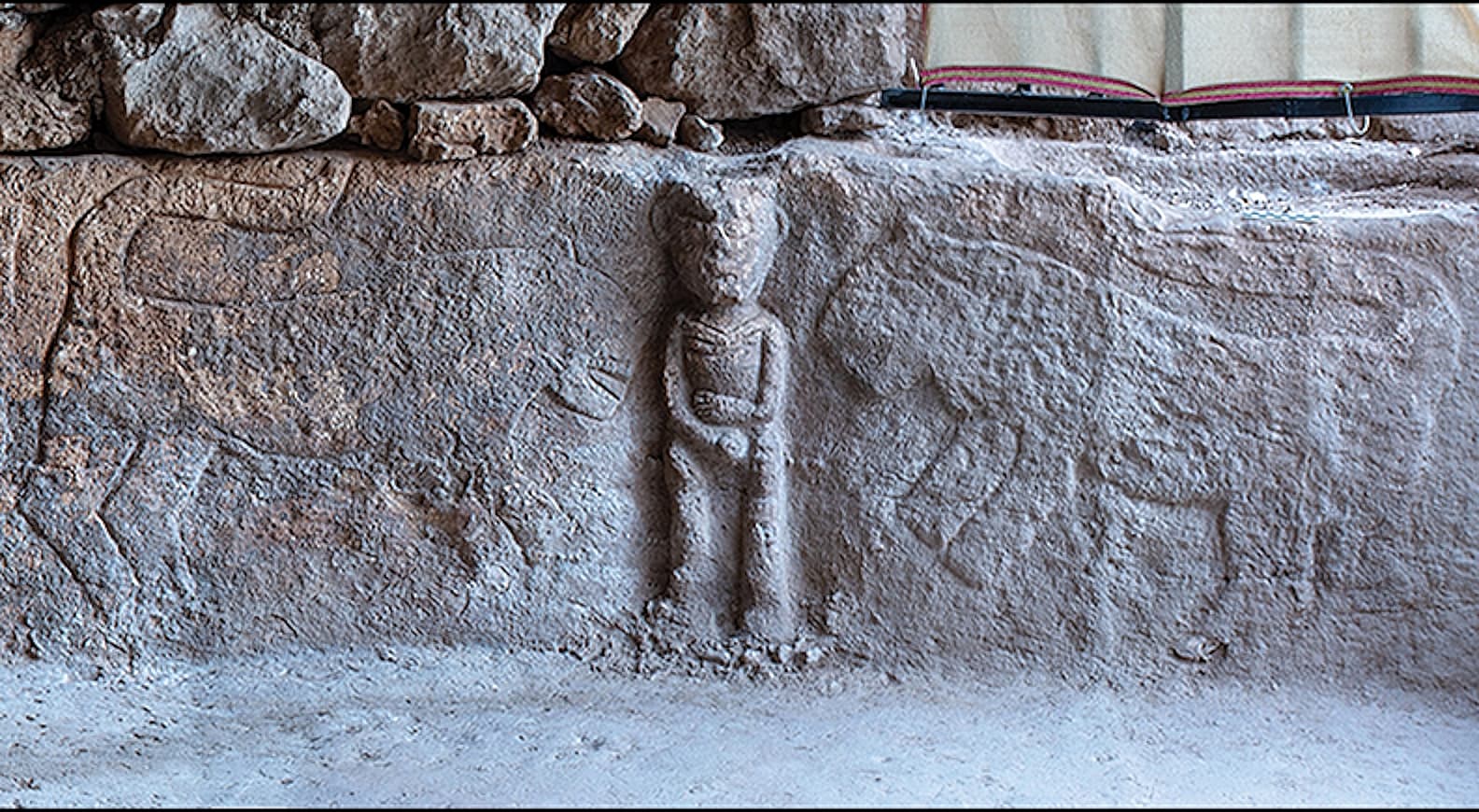
Dating from about 9500 BCE—when dogs had only recently been domesticated and no other animal was under human management—the pillars bear foxes, aurochs, cranes, snakes, scorpions, and spiders interpreted as cosmological rather than decorative. Paired larger central pillars are read as anthropomorphic beings; their makers likely returned from seasonal landscapes for gatherings whose purposes remain inferred. Around 8000 BCE, people deliberately and systematically filled the enclosures with rubble.
No agreed explanation exists, though the act itself may have been ritual, and it preserved the site for ten thousand years. Less than five percent has been excavated; the rest waits.
Why this place is sacred
The conventional story of human spiritual development positioned it downstream of other civilisational achievements: first agriculture, then cities, then temples, then religion. Göbekli Tepe inverted this entirely. Communities who hunted wild gazelle and gathered wild grasses converged here to quarry and erect megaliths of extraordinary technical and artistic sophistication.
The scale of collective effort required — coordinating dozens or hundreds of people without permanent leadership structures — implies that shared ritual purpose was not a luxury of settled life but possibly its very engine.
Seekers across traditions find in this place a confirmation that the drive toward the sacred is not learned behaviour but something constitutive of what it means to be human. There was no city here, no priest class, no written creed. There was stone, sky, and the carving of animals that these people watched and feared and revered. The enclosures create a sense that one is inside something — inside a held space that ancient builders understood as set apart.
That quality of separateness persists. The hilltop isolation, the circular geometry, the weight of the carved pillars: these speak a language whose grammar we have partly lost but whose force is immediate.
The deliberate burial of the site around 8000 BCE adds another layer. Whatever concluded there — a cycle, an era, a cosmological dispensation — was honoured by concealment rather than destruction. The enclosures were hidden within the hill for ten millennia, preserved by the very act of being ended. That double quality of termination and preservation gives the site an atmosphere of contained time.
Communal ritual gathering place for Pre-Pottery Neolithic hunter-gatherer communities; probable site of seasonal feasting, cosmological ceremony, and social renewal. The T-shaped central pillars are interpreted as anthropomorphic beings — supernatural ancestors or cosmological figures who presided over gatherings.
Built and used c. 9500–8000 BCE, then deliberately buried around 8000 BCE, the transition period coinciding with the emergence of agriculture in the region. In the modern era the site lay unrecognised until Klaus Schmidt's 1994–1995 excavations identified its true significance. Since inscription as a UNESCO World Heritage Site in 2018, it has become one of the world's most visited prehistoric sites and a global touchstone for discussions of human spiritual origins.
Experience and orientation
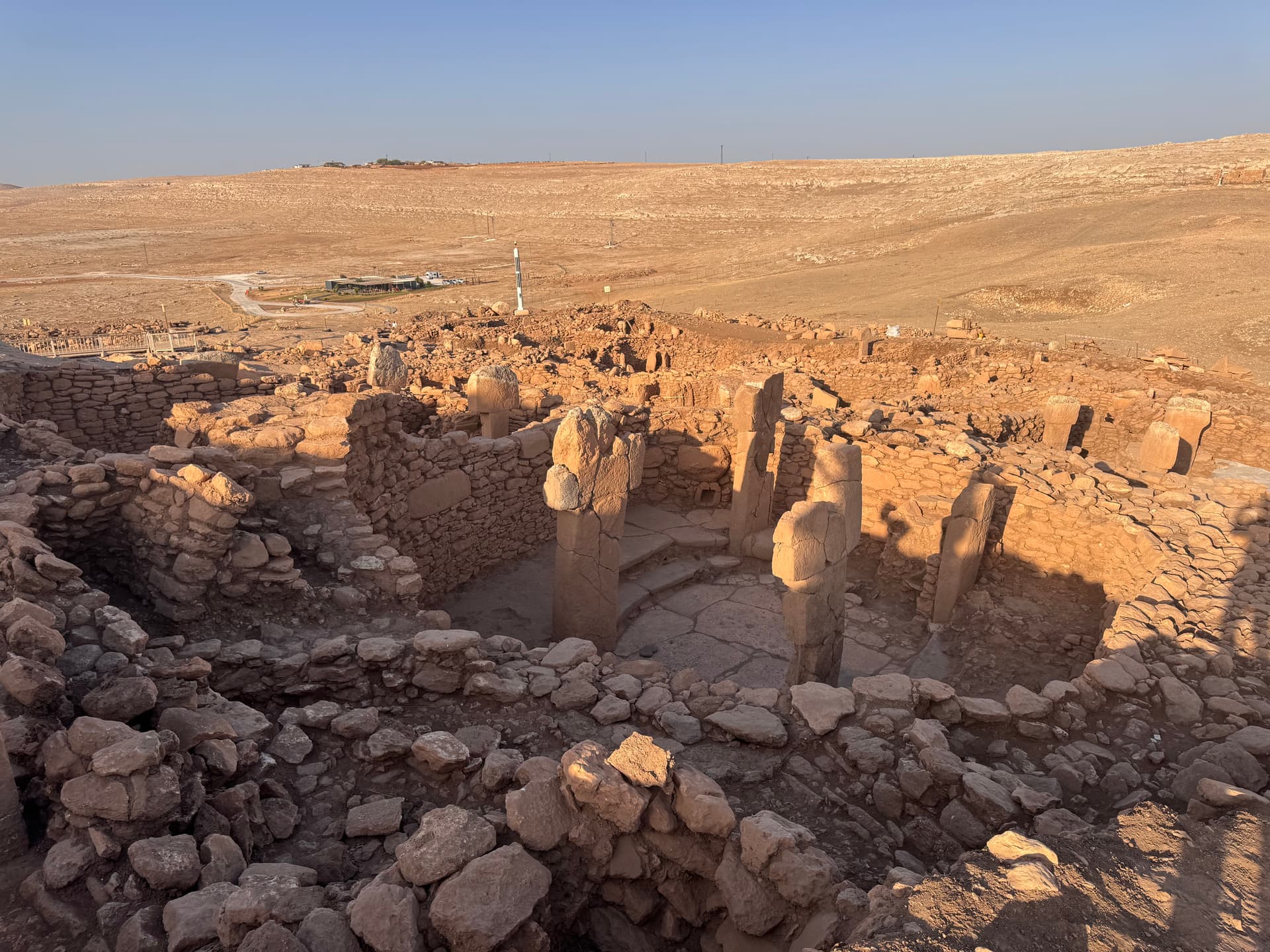
Visitors arrive at Göbekli Tepe along a paved road that crests the ridge at the modern visitor centre, and the first encounter with the site tends to happen as a visual shock: a shallow hilltop of exposed limestone, ringed by protective shelters, with the landscape of the Harran Plain spreading south toward Syria. The scale is quieter than most people expect.
Göbekli Tepe is not Stonehenge in its drama — the enclosures are semi-subterranean, which means the pillars rise from below, and the walkways carry visitors above them rather than among them.
Descend in attention toward the excavated enclosures. Enclosure D is the most elaborately carved and the most instructive: look for the belt and hands carved near the base of the central pillars — these are what confirm their anthropomorphic intent, the moment when stone becomes figure. The animal reliefs on the lateral pillars are not narrative but indexical: each creature seems to represent a quality or force rather than to tell a story.
A vulture carrying what appears to be a severed head. A scorpion. A row of cranes in flight. They accumulate into a vocabulary whose full meaning remains open.
Visit early morning if possible. The low angle of morning light rakes across the stone surfaces and makes the carvings legible in ways that afternoon light flattens. The shelters over the excavated enclosures mean the light quality inside them is dim and diffused — closer to interior space than open-air exposure. Late afternoon, as the crowds thin and the shadow of the ridge lengthens across the plain, the site takes on a quality of stillness that repays extended attention.
Allow time simply to stand and look. The site rewards attention more than movement.
Approaching from Şanlıurfa, the site is signposted from the main road 15 km northeast of the city. The visitor centre has a cafe, toilets, and a covered terrace with views. Elevated wooden walkways connect the main excavated areas. The on-site museum shelter protects the most significant pillar groupings. Guided tours depart from the visitor centre and are strongly recommended for first visits — the visual experience without context is richer but less coherent.
Allow at minimum 2–3 hours and pair the visit with the Şanlıurfa Archaeological Museum, where the moveable finds (sculpture, ornaments, tools) are held.
Context and lineage
There is no written account of why Göbekli Tepe was built. Archaeology permits inference, not certainty. What we know is that, beginning around 9500 BCE, communities of mobile hunter-gatherers who occupied the hills and plains of what is now southeastern Turkey began to quarry limestone pillars from the bedrock and to carve them into the distinctive T-shape that appears at many sites across the region.
These pillars were then transported and erected in circular enclosures, each containing a pair of larger central figures and a ring of smaller pillars around the inner wall.
The site sits on a high ridge visible from a great distance across the Harran Plain, and its topographic prominence suggests it was chosen as a gathering place precisely because it was visible — a landmark that mobile communities could orient themselves toward. The animal carvings on the pillars encode a cosmological vocabulary that may relate to celestial constellations, seasonal transitions, or the spiritual qualities attributed to different wild animals.
The two central T-shaped pillars in each enclosure, with their carved hands, belts, and humanoid proportions, are understood as representations of anthropomorphic beings — possibly ancestors, possibly something closer to what later traditions would call gods.
Around 8000 BCE, possibly coinciding with the consolidation of agricultural practice in the region, the enclosures were deliberately filled with rubble and the site was effectively sealed. Whether this was an act of burial, of closure, or of preservation is unknown. The hill was farmed and grazed for millennia without anyone knowing what lay beneath. A Kurdish shepherd and a German archaeologist would change that in 1994.
Göbekli Tepe belongs to the Pre-Pottery Neolithic (PPN) cultural complex of the Fertile Crescent, a horizon of human development characterised by semi-sedentary or mobile communities who shared a ritual symbolic vocabulary before developing agriculture.
It is the most monumental and the oldest known expression of this tradition, but it is part of a wider network of sites — now grouped under the Taş Tepeler ('Stone Hills') project — that includes Karahantepe, Harbetsuvan, Karahan Tepe, Sayburç, and others within the Şanlıurfa region. These sites collectively document a ritual landscape spanning hundreds of square kilometres and possibly thousands of years of shared cosmological practice.
Traditions and practice
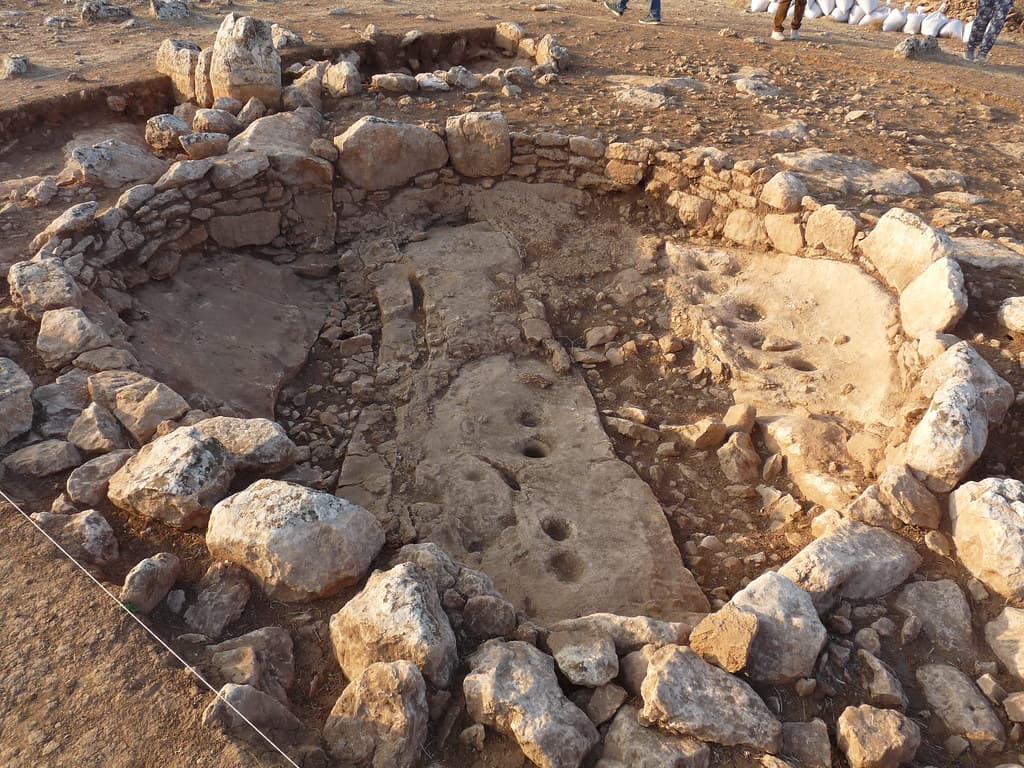
The evidence for ancient practice at Göbekli Tepe is archaeological. Large accumulations of wild animal bones — primarily gazelle, aurochs, and wild boar — indicate communal feasting on a significant scale. The enclosures themselves, with their pairs of central anthropomorphic pillars and decorated peripheral walls, were clearly spaces of gathering and ceremony rather than habitation. There is no evidence of permanent domestic occupation at the site.
Current interpretation holds that mobile communities converged here seasonally — possibly at particular astronomical moments — for ceremonies whose elements included feasting, the maintenance of the pillar enclosures, and possibly initiation rites or ancestor veneration. The deliberate interment of the enclosures around 8000 BCE was itself a ritual act, perhaps marking the conclusion of an era or a cosmological shift associated with the transition to agriculture.
No religious ceremonies occur at Göbekli Tepe today. The site is managed as an archaeological heritage site and receives over 700,000 visitors annually. The Şanlıurfa region has positioned itself as a global destination for what might be called archaeological pilgrimage — the site draws people seeking not devotional practice but a direct encounter with the evidence of humanity's earliest spiritual impulse.
Walk the elevated walkways slowly, particularly during morning or late afternoon when the light is oblique and the carvings read clearly. Descend attention toward the enclosures rather than attempting panoramic comprehension — the detail of individual carvings repays sustained looking. In Enclosure D, locate the carved hands and belt on the central pillars and hold your gaze there long enough for the figure to become present.
Notice the scale: a pillar that weighs ten tonnes, carried here and raised without wheel or metal. Sit at the edge of the walkway and let the plain spread south. Consider what this hill looked like when the communities who built this arrived for their seasonal gatherings — the absence of any other built structure, the wind, the noise of their arrival.
What they were making was the idea of a sacred place — the first draft of what would become temples, cathedrals, shrines. Spend time not understanding. The gaps in our knowledge of this site are not failures of scholarship; they are the space where the ancient builders remain private.
Pre-Pottery Neolithic ritual practice
HistoricalGöbekli Tepe is the oldest known purpose-built sanctuary on earth, demonstrating that hunter-gatherer communities organised large-scale communal ceremonies — including monumental architecture, elaborate symbolic carving, and probable feasting rites — millennia before agriculture, writing, or permanent urban settlement.
Construction and deliberate arrangement of T-shaped limestone monoliths within circular enclosures; communal feasting involving gazelle, aurochs, and wild boar; probable seasonal gatherings for cosmological ceremony, social renewal, and possibly initiation or ancestor veneration; deliberate ritual burial of the entire site complex around 8000 BCE.
Contemporary archaeological and spiritual heritage tourism
ActiveSince its emergence as an internationally recognised site in the 1990s–2000s and UNESCO inscription in 2018, Göbekli Tepe has become a destination for a new kind of secular-spiritual pilgrimage — people seeking to encounter the physical evidence of humanity's earliest organised spiritual impulse.
Guided tours, contemplative visits, academic study tours, photography, and pilgrimage-style individual reflection.
Perspectives and open questions
Göbekli Tepe sits at the intersection of multiple interpretive frameworks — scientific, mythological, theological, and alternative — and no single lens captures the full weight of what the site presents.
Scholarly perspective
Current scholarly consensus holds that Göbekli Tepe was a Pre-Pottery Neolithic ritual centre used c. 9500–8000 BCE by mobile hunter-gatherer communities for seasonal communal ceremonies. The T-shaped pillars are understood as anthropomorphic figures, likely representing supernatural beings, ancestors, or cosmological forces. The animal carvings may encode a seasonal calendar, a bestiary of spiritual significance, or a cosmological narrative system. The deliberate burial of the enclosures around 8000 BCE remains unexplained but is interpreted as a ritual act of closure.
Less than 5% of the site has been excavated, meaning current understanding is necessarily preliminary. The site definitively challenges the 'agriculture-first' model of civilisational development: monumental sacred architecture here demonstrably preceded domesticated agriculture in the same region.
Living and traditional perspectives
No living indigenous tradition maintains a direct devotional relationship with Göbekli Tepe. Local Kurdish and Turkish communities recognise the site as a site of profound national and global heritage. Some religious communities in the region connect the site to the general landscape of Abrahamic origins — the Şanlıurfa region is traditionally associated with the prophet Abraham (Urfa was known as 'the city of the prophets') — though no specific theological claim links Göbekli Tepe to Abrahamic tradition.
The site has attracted increasing pilgrimage-like visits from spiritual seekers who treat it as a site of connection with primordial human consciousness.
Alternative interpretations
Alternative researchers have proposed connections between Göbekli Tepe and Atlantis, the biblical Garden of Eden (the Şanlıurfa region matches several geographical criteria from Genesis 2), or technologically advanced pre-agricultural civilisations. The astronomer Graham Hancock has written extensively about the site as evidence of a pre-flood civilisation. Mainstream archaeology does not support these interpretations but acknowledges that the site does genuinely overturn earlier assumptions about when and why humans began organising society around shared symbolic systems.
The Eden hypothesis specifically is treated as speculative but not entirely dismissible given the geographical proximity.
Open questions
Why was the site deliberately buried? What cosmological system did the full vocabulary of animal carvings represent? Were the two central pillars in each enclosure depictions of specific ancestral figures or cosmological entities? What was the relationship between Göbekli Tepe and the dozen or more comparable Taş Tepeler sites in the region — were they built by the same communities, visited in sequence, or maintained by different groups?
What concluded around 8000 BCE that necessitated the ritual burial of something so elaborate? The site's most important questions remain open.
Plan your visit
Access and arrival
15 km northeast of Şanlıurfa city centre, accessible by rental car, taxi (roughly 20–25 minutes from city), or guided tour. No direct public bus service. A paved access road leads to a visitor centre with car parking, toilets, a cafe, and a covered terrace. Elevated walkways are broadly accessible for visitors with mobility considerations, though some sections may be uneven. Open daily approximately 08:30–17:30 (check seasonally); admission fee applies.
Şanlıurfa offers the full range of accommodation, from international business hotels to small family guesthouses. The old city near the Balıklıgöl (Pool of Sacred Fish) is recommended for atmosphere. Comfortable day trips to Göbekli Tepe from Şanlıurfa are standard. Multi-site Taş Tepeler itineraries are best based in Şanlıurfa for 2–3 nights.
Respectful visit
No religious dress code applies. Sturdy walking shoes are essential on the rocky paths and elevated wooden walkways. In summer, sun protection (hat, high-SPF sunscreen, light long sleeves) is important as the hilltop offers no shade. In winter the site can be cold and windy.
Photography for personal use is permitted throughout visitor-accessible areas. Flash photography may be restricted inside the protective enclosures — check signage. Drone photography is generally prohibited without prior permit from Turkish authorities.
No offerings of any kind are permitted at this archaeological site.
Remain on designated paths and walkways. Do not touch, scratch, or attempt to trace the pillar carvings. Do not enter active excavation zones. No smoking within the site perimeter. No picnicking at the archaeological site itself, though the visitor centre has a cafe area.
Stay on designated walkways at all times. Do not attempt to touch, lean against, or photograph the pillars at close range by reaching over barriers. Active excavation zones are demarcated and must not be entered. The site is on a hilltop exposed to full sun and wind — carry water and sun protection regardless of season.
Current practical details
Address
Örencik, 63290 Haliliye/Şanlıurfa, Türkiye
Phone
Hours
Hours, fees, and access can change — verify on the official source before you travel. Practical details last checked Jun 2026.
Location
Map loads as you approach this section.
Pilgrim reflections
A portrait of encounter, not a score
Pilgrims describe what they felt, how present they could become, and whether the place would shape a journey. There are no stars and no ranking of traditions.
No reviewed reflections yet
The first pilgrims can help describe the character of being here.
Share a reflection
Available after an account-backed “Been there.” Every reflection is reviewed before publication.
Nearby sacred places
Explore other sacred places in the region. Proximity does not establish access or travel time; check each place’s guidance.

References
Sources consulted for this page. Source categories describe the publication, not a guarantee that every claim is verified. Traditional accounts and outside interpretations may differ.
- 01Göbekli Tepe – Wikipedia — Wikipedia contributorsencyclopediaComprehensive overview; regularly updated
- 02Göbekli Tepe – UNESCO World Heritage Centre — UNESCOofficialInscribed on WHL 2018, outstanding universal value statement
- 03Göbekli Tepe – World History Encyclopedia — World History EncyclopediaencyclopediaPeer-reviewed editorial board
- 04Echo from the Past: How Göbekli Tepe is Reshaping Our Understanding of the Neolithic — Popular ArchaeologyacademicScience journalism with academic sourcing
- 05Göbekli Tepe: The Mysterious Site Older Than Stonehenge — HISTORYguidePopular history outlet with scholarly citations
- 06New Possible Astronomic Alignments at the Megalithic Site of Göbekli Tepe, Turkey — Lorenzis, OrofinoacademicPeer-reviewed but alignment hypotheses are preliminary
- 07How to Visit Göbekli Tepe: Complete Visitor Guide 2026 — gobekli-tepe.comguideCurrent practical visitor info
- 08Gobeklitepe excavation season concludes with major discoveries — Daily SabahSource contextTurkish news outlet covering ongoing excavation seasons
Photo gallery
3 curated photos
Share a photo
Help visitors recognize Göbekli Tepe. Every submission is reviewed before publication.