Soğmatar
A landscape arranged as a cosmogram, where seven hills mirror seven planetary spheres
Understand sacred places, explore living traditions, and learn how to engage respectfully with Pilgrim Map.
Access has not been verified. Check current local guidance before planning a visit.
Şanlıurfa, Turkey
Read the sources
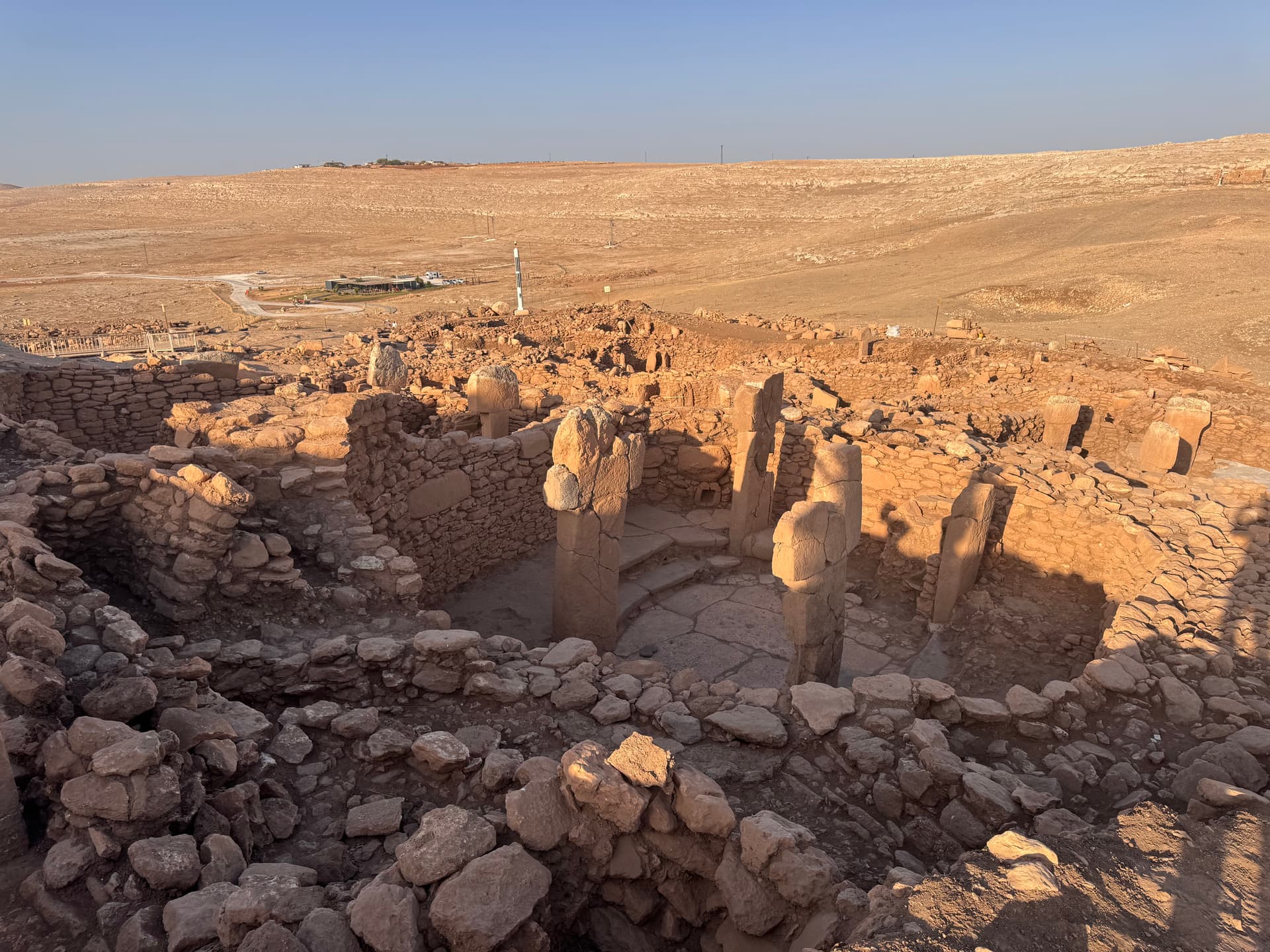
Image of Soğmatar. Image source
Visit essentials
A quick read before you go
- Duration
- 2–4 hours for a thorough visit including the Sacred Hill, Pognon Cave, necropolis, and at least…
- Access
- Located 60 km southeast of Şanlıurfa and 53 km from Harran in the Tektek Mountains.
Overview
Soğmatar is a sacred territory rather than one temple. Sabian devotees of Sin, the Mesopotamian moon god, shaped this remote mountain valley as the seven planetary spheres: a separate ritual installation on each surrounding hill for Sin, Shamash, and the five visible planets, with the main cave sanctuary on Sacred Hill. Movement among them formed a cosmological journey.
Deep roots link it to Harran's great moon-temple forty kilometres away and onward to Sumerian Ur, a lunar-devotion thread across millennia. Use began by the third millennium BC; surviving Syriac inscriptions are from the second and third centuries AD. Discovery in 2025 of a 3,000-year-old Iron Age complex confirms landscape-scale cosmic intentions predated the Sabians by a millennium. For seekers of archaic sky religion and persistent pre-Islamic Mesopotamian tradition, Soğmatar remains among the most intact planetary cosmologies encoded in land.
Why this place is sacred
At Soğmatar, the thin quality arises not from a single sacred object or structure but from the landscape's deliberate totality. The Sabians understood the seven planets as governing forces — Sin the moon over fertility and the tides, Shamash the sun over justice, the remaining planets over their respective domains — and they arranged this valley to make those forces physically present and accessible.
To stand on the Sacred Hill is to stand at the centre of a cosmological map that is also a real place, where rock-cut shrines, inscribed dedications, and the geometry of the hills themselves enact a theology rather than merely represent it. The isolation of the Tektek Mountains intensifies this: there is no modern construction to interrupt the relationship between the sacred topography and the sky.
Visitors consistently report a quality of stepping outside ordinary time — the sense that the night sky, which Sabian astronomers tracked with great care, and the earth beneath one's feet are not two things but one continuous sacred document. The moon's movement over these hills was not observed from outside but participated in from within.
A multi-planetary cult centre and sacred landscape where the Sabian community of Harran conducted seasonal rituals at shrines dedicated to each of the seven Mesopotamian planetary deities, with the moon god Sin as the supreme object of veneration.
From at least the third millennium BC as a site of sacred use; formalised as a Sabian planetary cult centre by the second century AD, as attested by Syriac inscriptions; continued through late antiquity under Roman and then Sasanian Persian rule; ended with the Islamisation of the region in the 13th century AD. A 2025 discovery of an Iron Age cosmic sanctuary within the complex suggests a formal sacred function predating the documented Sabian period by a thousand years.
Experience and orientation
Arriving at Soğmatar, the first task is spatial orientation. The site is not a ruin that can be read at a glance; it is a dispersed landscape requiring movement. Begin at the Sacred Hill — a 50-metre natural rise with rock-cut cave shrine at its heart. Climb to the summit before approaching the cave, so that the positions of the seven surrounding hills become visible in relation to each other.
In that view, the cosmological programme of the site becomes apparent: each hill holding its shrine, the whole arrangement constituting the world-diagram of Mesopotamian astronomy. Enter the Pognon Cave slowly. The carving of the moon god within — along with Syriac inscriptions recording dedications made by named individuals — is intimate in scale but astonishing in its survival. These inscriptions are not historical data; they are the direct voices of devotees writing to their god.
From the cave, descend through the necropolis: 120 or more rock-cut tombs spanning the Early Bronze Age through the Roman period. The accumulated weight of burial here — millennia of the dead placed in this terrain — deepens the atmosphere considerably. In afternoon light, the rock surfaces acquire a particular quality: the warm limestone takes on colour and the carvings stand out more legibly.
Early morning offers silence and the chance to encounter the site before other visitors arrive, though traffic is usually light. The outlying tumuli and satellite shrines reward those willing to walk; they are less dramatic individually but their spatial relationship to the Sacred Hill is what gives the site its meaning.
Begin at the Sacred Hill summit for landscape orientation before descending to the cave shrine. Then walk the necropolis perimeter. Allocate time to identify at least two or three of the outlying satellite shrines — the site does not fully reveal itself from a single vantage point.
Context and lineage
Soğmatar's sacred use stretches back to at least the third millennium BC, when early communities in the Tektek Mountains began using this valley's distinctive topography for ritual purposes. The Sabians — a religious community centred on nearby Harran and devoted to the moon god Sin — formalised the landscape into a systematic planetary cult centre during the second century AD, a date confirmed by Syriac inscriptions in the Pognon Cave.
These inscriptions, recording dedications to Sin by named individuals, represent the textual layer of a tradition whose physical layer is far older. Sin himself was the supreme deity of a tradition stretching back to the moon-temple at Ur in ancient Sumer — the Sabians of Harran and Soğmatar preserving an unbroken thread of lunar devotion across three millennia.
A 2025 archaeological discovery identified an Iron Age cosmic sanctuary within the Soğmatar complex, dated to approximately 3,000 years ago, indicating that the site's explicit cosmological function predates the Sabian inscriptions by a thousand years. The Sabian tradition survived Alexander, Rome, and Byzantine Christianity before Islamic conquest in the 13th century finally ended organised practice at the site.
Mesopotamian planetary religion (3rd millennium BC) → Sabian moon worship centred on Harran (documented from at least 2nd century AD) → end of organised practice under Islamic conquest (13th century AD)
Traditions and practice
Sabian ritual at Soğmatar centred on the cave sanctuaries, with the Pognon Cave as the primary shrine of Sin. Inscriptions in Syriac record votive dedications — individuals placing their names and intentions before the moon god. Ceremonial processions moved between the seven satellite shrines, each dedicated to a different planetary deity, constituting a physical enactment of the Sabian cosmology. Offerings were made at each shrine. The moon's phases regulated the ritual calendar, as at Harran.
Rock-cut tombs in the necropolis suggest that the dead were placed within the sacred landscape itself, maintaining a relationship with the planetary powers that had governed their lives.
None. The site has been without active religious use since the 13th century. Visits are archaeological and contemplative.
The site rewards methodical spatial engagement. Walk the perimeter of the hill before entering any structure — the landscape's full meaning becomes available only when you can see the relationships between the Sacred Hill and its surrounding satellites. At the cave entrance, pause before entering: allow your eyes to adjust and your pace to slow. The Syriac inscriptions inside are small; bring good light.
Walk the necropolis with the knowledge that these tombs span from the Early Bronze Age to the Roman period — different eras of the same intention, to place the dead within this planetary terrain. If visiting in the late afternoon, the westward-facing rock faces receive the best light for reading carvings.
Visit at least one outlying satellite shrine to feel the spatial logic of the site — the relationship between a peripheral shrine and the Sacred Hill at the centre is the site's primary geometry.
Sabian Moon Worship
HistoricalSoğmatar was the primary cult centre for the Sabians, devotees of the moon god Sin whose spiritual capital was nearby Harran. The site's seven circular shrines on surrounding hills represent the seven planetary deities of Mesopotamian cosmology — Sin (Moon), Shamash (Sun), and five visible planets.
Ritual worship at cave shrines, rock-cut sanctuaries dedicated to Sin and planetary deities. Inscriptions from the 2nd century AD record dedications to Sin in Syriac. Offerings and ceremonies were conducted at the Sacred Hill and at seven outlying satellite shrines.
Archaeological and Scholarly Study
ActiveAn important site for understanding the persistence of pre-Islamic Mesopotamian religion in the Tektek Mountains, and for Syriac epigraphy. The 120+ rock-cut tombs span the Early Bronze Age through the Roman period, indicating multi-millennium sacred use.
Ongoing archaeological research; site included in heritage inventories of the Şanlıurfa region. The 2025 Iron Age cosmic sanctuary discovery has initiated a new phase of scholarly investigation.
Perspectives and open questions
Soğmatar sits at the intersection of Mesopotamian planetary religion, Syriac epigraphy, and the long history of astral religion in the ancient Near East. Scholars, practitioners of comparative religion, and those interested in archaic cosmology each bring different questions.
Scholarly perspective
The scholarly consensus identifies Soğmatar as a satellite cult centre of the Harran moon-god complex, functioning as a sacred landscape with explicit planetary associations. The Syriac inscriptions, dated to the 2nd–3rd centuries AD, provide direct epigraphic confirmation of active Sabian use and constitute an important corpus for the study of Syriac epigraphy and late antique Mesopotamian religion. The site's tombs span from the Early Bronze Age to the Roman period, confirming multi-millennium sacred use of this terrain.
The 2025 identification of an Iron Age cosmic sanctuary within the complex extends scholarly interest backward considerably: the site now appears to have had an explicitly cosmological function for at least three thousand years.
Living and traditional perspectives
For the Sabians, Soğmatar was not a monument to a religion but its living body — a terrain that literally enacted the relationship between the celestial and earthly orders. The persistence of their tradition across successive conquests by Alexander, Rome, Persia, Byzantium, and the early Islamic caliphates testifies to the depth at which this religion was rooted in local consciousness. The moon god Sin was not merely worshipped at Soğmatar; the landscape was, in Sabian understanding, his domain on earth.
Alternative interpretations
Researchers drawn to the site's astronomical dimensions propose that the seven-shrine arrangement encodes precise astronomical knowledge, possibly predating the Sabian period. The 2025 Iron Age discovery lends credibility to the idea that the cosmological programme of the site was established well before its textual documentation. Some scholars in the archaeoastronomy tradition see Soğmatar as part of a broader pattern of deliberate celestial landscaping in the ancient Near East.
Open questions
The full Bronze Age sacred function of the site remains uncharted — the 2025 Iron Age discovery has opened rather than closed this question. The relationship between Soğmatar's cult and the great Harran moon-temple is not fully understood; whether Soğmatar was subordinate to Harran or an independent centre of parallel prestige is debated. The builders of the earliest rock-cut shrines are unknown.
Plan your visit
Access and arrival
Located 60 km southeast of Şanlıurfa and 53 km from Harran in the Tektek Mountains. Private vehicle is essential — no public transport. After visiting Şuayb Ancient City (15 km before Soğmatar), continue on the same road. The final stretch is unpaved. Entry is free. GPS coordinates: 36.993°N, 39.338°E.
No facilities at the site. Şanlıurfa (60 km) offers the full range of accommodation options, from budget guesthouses near the old city to international hotels. Harran has basic guesthouses in traditional beehive houses. Most visitors base themselves in Şanlıurfa and make a day trip combining Harran and Soğmatar.
Respectful visit
No religious dress code. Practical clothing for rocky, uneven terrain; sun protection essential in summer.
Permitted throughout the site. Low-angle light (early morning, late afternoon) produces better results on the rock-cut reliefs.
Not applicable to an archaeological site.
Do not touch the Syriac inscriptions, rock carvings, or tomb surfaces. Do not remove any stones or artefacts. The site has no formal entrance gate; standard heritage site ethics apply.
The final approach road is unpaved and may be impassable in wet conditions. No services, shade, or water at the site; bring sufficient supplies. The cave interiors are dim — bring a torch. Do not touch the Syriac inscriptions or rock carvings.
Location
Map loads as you approach this section.
Pilgrim reflections
A portrait of encounter, not a score
Pilgrims describe what they felt, how present they could become, and whether the place would shape a journey. There are no stars and no ranking of traditions.
No reviewed reflections yet
The first pilgrims can help describe the character of being here.
Share a reflection
Available after an account-backed “Been there.” Every reflection is reviewed before publication.
Nearby sacred places
Explore other sacred places in the region. Proximity does not establish access or travel time; check each place’s guidance.



References
Sources consulted for this page. Source categories describe the publication, not a guarantee that every claim is verified. Traditional accounts and outside interpretations may differ.
- 01Soğmatar Kült Merkezi ile ilgili Yeni Öneriler (New Proposals Regarding the Soğmatar Cult Centre)academicAcademic paper on cult centre interpretations (Turkish)
- 02Harran ve Soğmatar'da Sin Kültünün Varlığı (Presence of the Sin Cult in Harran and Soğmatar)academicAcademic study on the Sin moon-god cult in the region
- 03Sumatar Harabesi - Syriaca.orgacademicScholarly gazetteer entry with coordinates
- 04Sumatar Harabesi - WikipediaencyclopediaGood overview of site, inscriptions, and Sabian moon worship
- 05Stumbling Upon Sogmatar: Ancient City of the Moon GodguideFirst-hand travel account with useful site descriptions
- 063,000-Year-Old Cosmic Sanctuary Discovered in Sogmatar, TurkeySource contextRecent (2025) coverage of Iron Age complex discovery
- 07Soğmatar, Şuayb & the Bazda Caves: Adventures in ŞanlıurfaguidePractical visitor information and personal account
- 08Sumatar Harabesi - ArchiqooSource contextSite overview with images
Share a photo
Help visitors recognize Soğmatar. Every submission is reviewed before publication.