Karahantepe
The Pillar Shrine with the oldest carved human face — where skull rituals shaped a 12,000-year-old cosmology
Understand sacred places, explore living traditions, and learn how to engage respectfully with Pilgrim Map.
Access has not been verified. Check current local guidance before planning a visit.
Şanlıurfa, Turkey
Read the sources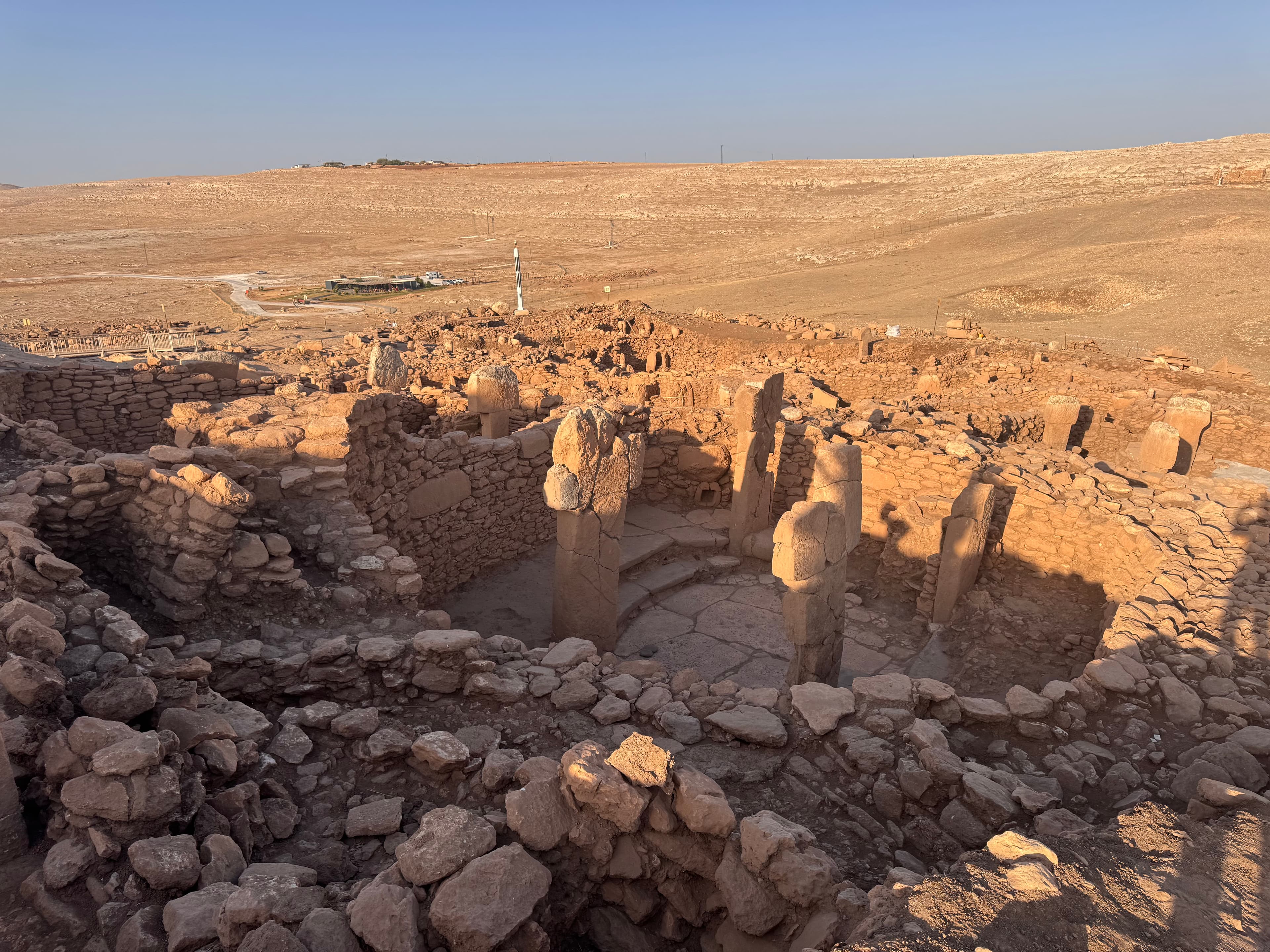
Image of Karahantepe. Image source
Visit essentials
A quick read before you go
- Duration
- Allow 2–3 hours at Karahantepe.
- Access
- 60 km east of Şanlıurfa city, near Yağmurlu Village within Tektek Mountains National Park.
Overview
Karahantepe lies 60 kilometres east of Şanlıurfa in Tektek Mountains National Park. Dr. Bahattin Çelik identified it in 1997; systematic excavation began in 2019 under Prof. Necmi Karul.
Its semi-subterranean Pillar Shrine places 11 T-shaped pillars around a central anthropomorphic figure. The arrangement parallels Göbekli Tepe while differing enough to suggest parallel development or an older source. Chronological precedence remains open, though some evidence may place Karahantepe several centuries earlier, toward 10,000 BCE.
In 2025, excavators announced a T-shaped pillar with a clearly carved human face, identified as the oldest known monumental human face in stone and selected among the year's top ten international archaeological discoveries. Hundreds of deliberate cut marks, controlled burning, and intentional excision on human skulls show that the dead were actively processed, but the practice's meaning remains unresolved.
Why this place is sacred
What Karahantepe makes visible is not simply the antiquity of human spiritual practice but its sophistication. The skull cult is the most confronting element. Hundreds of deliberate cut marks on human skulls — not the cuts of butchery but the cuts of careful, systematic work — followed by controlled burning and what appears to be intentional reincorporation of processed crania into the site's ritual context.
This was not violence; it was a ritual programme, a way of managing the transition from living person to meaningful dead object, a cosmological technology applied to the most charged material available: the human head.
The centrality of the human head in Neolithic symbolic systems has been documented at other sites — the plastered skulls of Jericho, the skull deposits at various PPNB sites — but Karahantepe's evidence is among the earliest and most elaborate.
The T-shaped pillars, with their carved hands and now at least one carved human face, suggest that the skull cult and the pillar cult were related: both centred on the human head as the locus of identity, spiritual power, and after-death presence.
Standing at the edge of the Pillar Shrine and looking down at the semi-subterranean chamber — 11 pillars arranged around a central figure, the oldest known human face carved into one of them — you are looking at the oldest known complete sacred space in which we can still read the arrangement of figures and the human form they assumed.
These are not animal carvings, not abstract symbols, but faces: the faces that the ancient builders understood as presiding over the space.
Karahantepe also raises a question that no site answers more acutely: why descent? The Pillar Shrine is semi-subterranean — builders dug down to create the sacred space, entering by descending rather than ascending. This is a specific theological choice. Going down into the earth to encounter the sacred is a different cosmological statement than going up a mountain or into a hilltop enclosure.
The earth received the dead; to descend into the earth was to enter the domain of whatever presided over death and transformation.
A Pre-Pottery Neolithic ritual and probable early settlement site, featuring a semi-subterranean Pillar Shrine for communal ceremonial gathering, skull cult practices, and the maintenance of over 250 carved T-shaped monoliths. Possibly the oldest known human village and sacred centre.
Established c. 10,000–9,000 BCE. First identified 1997 (Çelik), systematic excavation from 2019 (Karul). Opened to visitors in 2025. Named among the top 10 archaeological discoveries of 2025 for the human-faced T-pillar. Part of the Taş Tepeler Project under the Turkish Ministry of Culture. Active excavation continues; new discoveries are expected each season.
Experience and orientation
Karahantepe opened to visitors in 2025 and the infrastructure remains basic — which is, for many visitors, its most compelling quality. Where Göbekli Tepe now has shelters, elevated walkways, and well-developed visitor facilities that mediate between viewer and stone, Karahantepe is closer to the site as it is being found: raw limestone country, the smell of excavated soil, the occasional presence of archaeologists at work in adjacent trenches.
The visitor path descends toward the Pillar Shrine from the site's upper approach. Begin by walking the perimeter of the excavated area before descending toward the Pillar Shrine itself. The 250-plus T-shaped obelisks scattered across the site — many still partially embedded in the limestone parent rock from which they were carved — give a sense of the scale of the undertaking. These were not imported or transported; many were quarried directly from the bedrock.
The site is, in part, a quarry as well as a sanctuary: the process of making sacred objects and the place where those objects stood were, here, the same landscape.
At the Pillar Shrine, pause at the edge before descending. The semi-subterranean chamber lies below grade, with the 11 pillars arranged around the central figure visible from above. Notice the specific quality of the space: the descent, the arrangement that places the visitor within a circle of standing stone figures, the low threshold that the original community would have crossed to enter.
Locate the pillar with the carved human face if the site permits close approach — as of 2025, this discovery was newly announced, and its presentation to visitors may still be developing.
In the afternoon, when crowds thin and the low sun comes from the west across the limestone hills, the carvings on individual pillars become more legible. The phallic sculptures and seated figures — present at this site as at Göbekli Tepe and Harbetsuvan — are concentrated in certain areas; consult site signage.
Allow time for the view outward from the hilltop: the limestone plateau of the Tek Tek Mountains, the flat terrain of the Harran Plain to the west, and on clear days, the distant ridge where Göbekli Tepe stands.
Located 60 km east of Şanlıurfa near Yağmurlu village in Tektek Mountains National Park. Best accessed by rental car (GPS essential) or guided tour from Şanlıurfa. The route is partially unmarked and unpaved. Open daily 09:00–19:00; free admission. Basic facilities: toilets, visitor centre, water stations. The visitor centre provides introductory context; a guided tour from Şanlıurfa is recommended for first visits to provide iconographic and archaeological background.
Context and lineage
Bahattin Çelik first identified Karahantepe in 1997 during surface surveys of the Şanlıurfa region, when the site was known in early literature as Keçilitepe. It was not systematically excavated until 2019, when Necmi Karul's team — the same team directing excavations at Göbekli Tepe — began the work that would rapidly establish Karahantepe as one of the most significant Neolithic sites in the world.
The Pillar Shrine was one of the earliest major discoveries: a semi-subterranean chamber with 11 T-shaped pillars arranged around a central anthropomorphic figure, the whole forming a gathering space whose deliberate descent below grade and circular arrangement of stone beings speaks a clear architectural language of sacred enclosure.
The skull cult evidence followed — hundreds of cut-marked skulls, evidence of burning — reframing the site from a ritual centre with possible ancestor veneration into something more specifically focused on the processual transformation of the human head.
The 2025 announcement of a T-shaped pillar with a carved human face — the oldest known monumental human face — marked a new chapter in the site's significance. The face is not schematic or symbolic in an abstract way; it is a face, with features, looking out from stone into whatever space its makers intended it to inhabit. It was named among the top ten archaeological discoveries of 2025 internationally.
Karahantepe belongs to the Pre-Pottery Neolithic cultural complex of the Taş Tepeler ('Stone Hills') network in the Şanlıurfa region. It shares T-shaped pillar architecture, anthropomorphic iconography, and probable seasonal communal gathering functions with Göbekli Tepe, Harbetsuvan Tepesi, Sayburç, Sefertepe, and other Taş Tepeler sites. Its skull cult practices are documented at other PPNB sites across the Near East but are among the earliest and most elaborate at Karahantepe. The site may be the oldest node in the Taş Tepeler network.
Traditions and practice
The skull cult is the most archaeologically distinctive element of Karahantepe's ritual life. Human skulls were subjected to deliberate post-mortem treatment: separation from the body, systematic cut-marking (hundreds of cuts per skull), controlled fire exposure, and what appears to be intentional incorporation of the processed skulls into the site's symbolic context. The specific meaning of this practice is debated.
It may represent a form of ancestor veneration, a purification ritual that released the spirit from the body, a method of creating portable ancestor objects, or a practice of accumulating spiritual power associated with the head. What is clear is that the head was understood as the centre of something worth elaborating on after death.
The Pillar Shrine itself — the semi-subterranean chamber with 11 T-shaped pillars and central figure — was clearly a gathering space for communal ceremony. The descent below grade, the circular enclosure of stone figures, and the central anthropomorphic presence suggest a spatial theology of descent and enclosure, an entering into a space presided over by beings carved in stone. This was not a hall or a meeting room; it was a designed encounter with whatever those figures represented.
Communal feasting — gazelle and legumes dominate the faunal and botanical assemblages — was central to community life at the site, as at Göbekli Tepe. The feasting was not merely social: the accumulation of wild animal remains at ritual sites across the Taş Tepeler network suggests that food, wildness, and ceremony were bound together in a practice whose logic we can partially reconstruct.
No religious or spiritual practices occur at Karahantepe. It is managed as an active archaeological and heritage site, open to visitors since 2025.
Before approaching the Pillar Shrine, walk the wider site perimeter to develop a sense of scale. The 250-plus T-shaped obelisks — many still in or near their original positions, others visible in various states of excavation — tell a story of enormous collective effort: the quarrying, carving, and erection of hundreds of limestone monoliths by a community that may have been, at most, a few hundred people. The labour involved argues strongly for deep motivation.
At the Pillar Shrine, descend slowly. Notice the threshold: you are going underground into the sacred space, not climbing up to it. In the chamber, let the arrangement register — 11 pillars surrounding a central figure — before moving toward individual elements. Each pillar is a presence, not merely an object.
The carved hands near the bases of some pillars, the face carved on the 2025-announced pillar, the suggestion of belts and clothing on others: these are beings that the builders understood as occupying this space with them.
For the skull cult: nothing is visible to the casual visitor in the excavated material itself, but the knowledge of what was happening here — the deliberate processing of human remains, the hundreds of cut marks — changes the texture of the space. This was a community with a sophisticated and specific relationship to the fact of death. Standing in their Shrine, you are standing in the space they built to manage that relationship.
Bring water, food, and time. The site has minimal shade. Arriving early and staying until the afternoon light changes is the most complete way to experience a site that is still being discovered.
Pre-Pottery Neolithic Taş Tepeler cult tradition
HistoricalKarahantepe may be the oldest node in the Taş Tepeler sacred network, with ritual architecture, skull cult practices, and monumental carved human-faced pillars constituting one of the most complex known Neolithic ritual systems. Its Pillar Shrine is the oldest known complete sacred gathering space in which the human form appears in monumental stone.
Construction and use of semi-subterranean Pillar Shrines with T-shaped pillars including at least one with a carved human face; skull cult practices involving deliberate excision, systematic cut-marking (hundreds of cuts), and ritual burning of human skulls; communal feasting centred on gazelle and legumes; phallic and seated male figurative sculpture; maintenance of over 250 T-shaped carved obelisks; probable seasonal communal gathering from a wider regional catchment.
Contemporary archaeological heritage tourism
ActiveSince opening to visitors in 2025, Karahantepe has rapidly become one of Turkey's most significant new heritage destinations, drawing international visitors as the 'sister site' of Göbekli Tepe and as the site where the oldest carved human face in monumental stone was found.
Guided tours, visitor centre engagement, self-guided walks along designated paths, photography, and contemplative visits.
Perspectives and open questions
Karahantepe is one of the most contested interpretive frontiers in contemporary prehistoric archaeology — a site whose discoveries are outpacing the frameworks available to explain them.
Scholarly perspective
Current scholarly consensus recognises Karahantepe as a Pre-Pottery Neolithic site of extraordinary significance, potentially predating Göbekli Tepe (10,000–9,500 BCE), with ritual architecture, skull cult practices, and monumental human-faced carved pillars that demonstrate the complexity of Neolithic spiritual life. The skull cult evidence — deliberate cut-marking, controlled burning, and apparent ritual incorporation of processed skulls — is among the most elaborate documented anywhere in the Pre-Pottery Neolithic. The human-faced T-pillar (2025) is the oldest known monumental human face in stone.
The Pillar Shrine's semi-subterranean architecture represents a deliberate theological choice of descent as the mode of access to the sacred. The site is part of the Taş Tepeler network, and the relationship between Karahantepe and Göbekli Tepe — whether one preceded the other, or whether they developed in parallel — is an active research question.
Living and traditional perspectives
No living indigenous tradition maintains a direct relationship with Karahantepe. Local Kurdish and Turkish communities regard it as a site of profound national and global heritage. The site's emergence as one of Turkey's most significant heritage destinations has increased local awareness and pride, particularly in Şanlıurfa province.
Alternative interpretations
The human-faced T-pillar and skull cult have attracted alternative interpretations connecting Karahantepe to lost civilisations or pre-flood cultures referenced in later mythological traditions. The combination of phallic iconography, skull processing, and human-faced monoliths has generated speculation about dualistic cosmologies centred on creation and death. Mainstream archaeology does not support these interpretations but acknowledges that the site's complexity exceeds current explanatory frameworks.
Open questions
What did the carved human face represent — an ancestor, a deity, a cosmological being, or the community's own projected face? What is the full spatial extent of a site with over 250 T-shaped obelisks — how much remains unexcavated? What drove the skull cult: purification, accumulation of spiritual power, ancestral veneration, or something else entirely? What is the cosmological significance of the semi-subterranean Pillar Shrine — why descend?
How does Karahantepe's skull cult relate to similar practices at other PPNB sites across the Near East? Was Karahantepe older than Göbekli Tepe, and if so, what are the implications for the direction of transmission of the Taş Tepeler symbolic vocabulary?
Plan your visit
Access and arrival
60 km east of Şanlıurfa city, near Yağmurlu Village within Tektek Mountains National Park. Best accessed by rental car (GPS required; route includes unmarked turns) or guided tour from Şanlıurfa. The final section of road is partially unpaved. Open daily 09:00–19:00; free admission. Facilities: visitor centre, toilets, water stations. The site has no cafe.
Şanlıurfa is the standard base for Karahantepe visits — comfortable hotels in the old city, 60 km from the site. Budget 2–3 nights in Şanlıurfa to visit Göbekli Tepe, Karahantepe, and the Archaeological Museum without rushing. Guided multi-site tours from Şanlıurfa can be arranged through GoTürkiye Taş Tepeler programme.
Respectful visit
No religious dress code. Practical outdoor clothing; sturdy footwear essential on rocky limestone terrain. Sun protection (hat, sunscreen, light layers) is important — the site is fully exposed at elevation.
Photography permitted throughout visitor-accessible areas. Some visitors may find the phallic sculptures culturally sensitive; exercise discretion. As of 2025, restrictions around the newly discovered human-faced T-pillar may be in development — check current site guidance.
Not applicable at this archaeological site.
Stay on designated visitor paths at all times. Do not touch, trace, or lean against carved pillars. Do not enter active excavation zones. Do not climb on architectural features. No smoking in the excavation area.
Active excavation zones are clearly marked and must not be entered. Do not touch pillars or carved elements. The terrain is uneven limestone — sturdy footwear is essential. The site is in full sun with minimal shade; sun protection is necessary in all but winter months. The access road is partially unpaved; a vehicle with reasonable ground clearance is recommended.
Location
Map loads as you approach this section.
Pilgrim reflections
A portrait of encounter, not a score
Pilgrims describe what they felt, how present they could become, and whether the place would shape a journey. There are no stars and no ranking of traditions.
No reviewed reflections yet
The first pilgrims can help describe the character of being here.
Share a reflection
Available after an account-backed “Been there.” Every reflection is reviewed before publication.
Nearby sacred places
Explore other sacred places in the region. Proximity does not establish access or travel time; check each place’s guidance.


References
Sources consulted for this page. Source categories describe the publication, not a guarantee that every claim is verified. Traditional accounts and outside interpretations may differ.
- 01Karahan Tepe – Wikipedia — Wikipedia contributorsencyclopediaComprehensive overview with academic citations
- 02A Human Face Was Carved Into This Stone Pillar in Turkey 11,000 Years Ago — Smithsonian MagazineguideSmithsonian coverage of 2025 discovery of human-faced T-pillar
- 03Discovery of Turkish 11,400-year-old village challenges ideas of when and why humans first settled down — The Art NewspaperguideMajor international arts and culture press
- 04Fire, Ritual and the Human Skull: What Karahantepe Skeletons Reveal About Neolithic Beliefs — karahan-tepe.com (based on peer-reviewed publications)academicCovers skull cult and ritual treatment of remains
- 05Karahan Tepe: The Stunning Sister Of Göbekli Tepe Is Just As Mysterious — IFLScienceguideScience journalism with strong editorial standards
- 06Neolithic Turkish site of Karahantepe named among top 10 archaeological discoveries of 2025 — Anadolu AgencySource contextConfirms 2025 international recognition of human-faced T-pillar discovery
- 07Karahantepe: The Prehistoric Site Rewriting Human History — karahan-tepe.comguideDedicated site with good synthesis of scholarly publications
- 08How to Visit Karahan Tepe: Travel Tips, Tours, and What to Expect — karahantepe.netguideCurrent visitor practical information
Share a photo
Help visitors recognize Karahantepe. Every submission is reviewed before publication.