Harbetsuvan Tepesi
A Neolithic hilltop cult centre with sight lines to Göbekli Tepe — a node in a 10,000-year-old sacred landscape
Understand sacred places, explore living traditions, and learn how to engage respectfully with Pilgrim Map.
Access has not been verified. Check current local guidance before planning a visit.
Şanlıurfa, Turkey
Read the sources
Visit essentials
A quick read before you go
- Duration
- A half-day visit, most productively combined with Karahantepe (7 km away) for a full day, and…
- Access
- 53 km east of Şanlıurfa in the Tek Tek Mountains region.
Overview
Harbetsuvan Tepesi is a 95-by-80-meter site at 740 meters in the limestone Tek Tek Mountains, known through three excavation seasons from 2017 to 2019. Its hilltop sees both Göbekli Tepe, 35 kilometers northwest, and Karahantepe, 7 kilometers northeast—the region's two largest known cult centers. Researchers interpret this intervisibility and the wider Şanlıurfa clustering as deliberate Taş Tepeler sight-line planning.
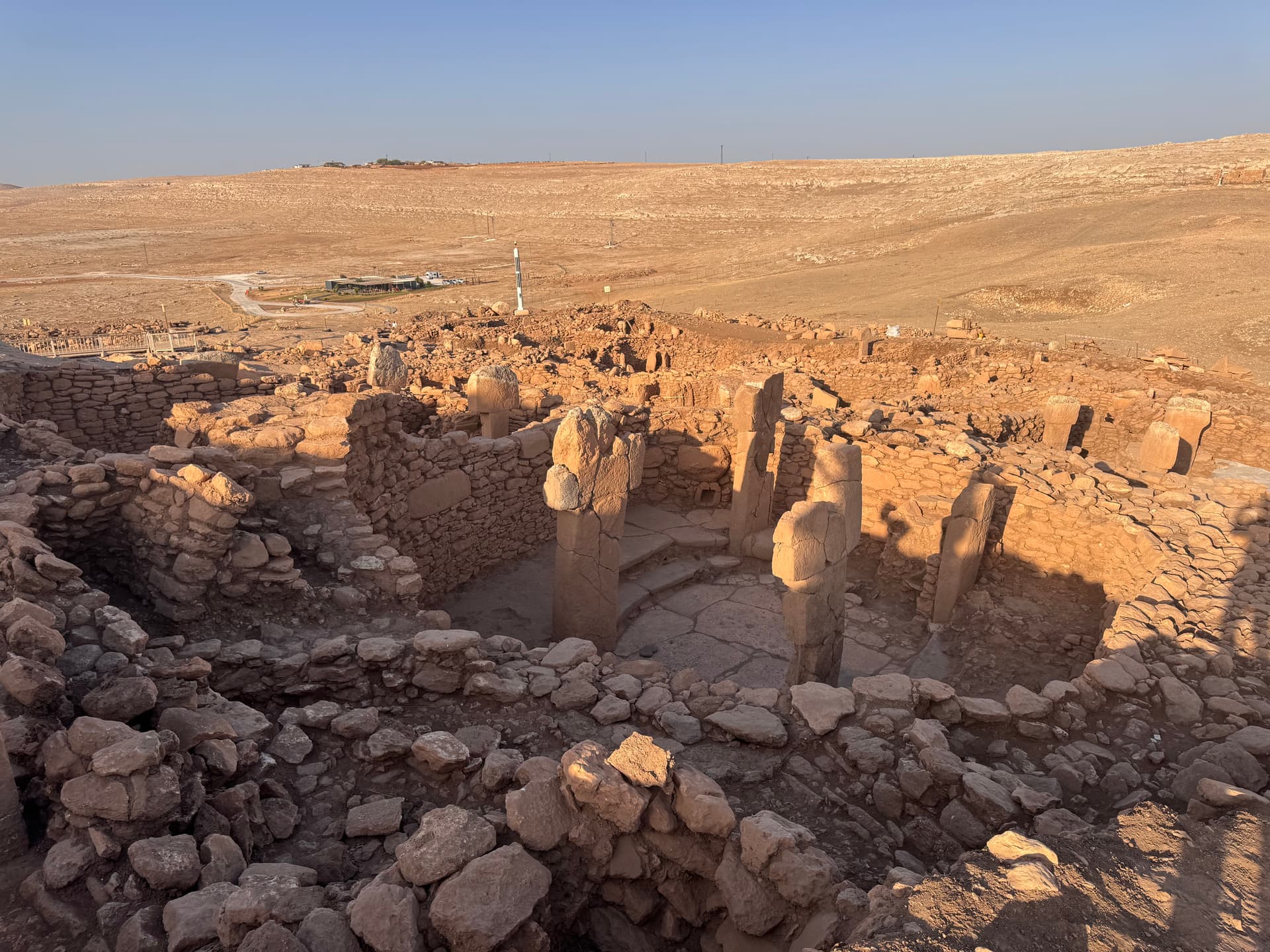
Excavated buildings held paired T-shaped pillars like those at the larger centers, a seated male sculpture with parallel phallic iconography, and finger reliefs reinforcing the pillars' anthropomorphic interpretation. Harbetsuvan was a smaller node in a network of shared sacred meaning, using the same figures, cosmological language, and separation from ordinary life at a scale that may indicate a satellite or seasonal gathering place rather than a primary ritual center.
Why this place is sacred
The concept of a sacred landscape — a network of sites whose meaning is constituted by their relationships with each other as much as by what happens within each individually — is often thought of as a feature of sophisticated, literate religious traditions. Harbetsuvan Tepesi pushes this concept back twelve thousand years.
The deliberate intervisibility between Harbetsuvan, Göbekli Tepe, and Karahantepe suggests that the Taş Tepeler communities understood their landscape theologically — as a territory whose sacred geography had been shaped by act as well as nature. Each hilltop cult centre was positioned to see and be seen by others. Whether this created a ritual network of seasonal visitation, a system of signal fires, a cosmological map expressed in geography, or something else entirely is not known.
What is clear is that these sites were not isolated; they participated in each other's meaning.
The seated male sculpture found at Harbetsuvan — paralleling figures at Göbekli Tepe and Karahantepe — suggests the transmission not merely of building techniques but of iconography, cosmology, and symbolic vocabulary across the network. The same figures, the same T-shaped pillar form, the same architectural language: this is not convergence but communication, the evidence of a shared tradition maintained across a large geographical area over a significant span of time.
For contemporary visitors, standing on the Harbetsuvan hilltop with awareness of what lies in the landscape below — two of the world's oldest sanctuaries, visible on a clear day from where you stand — produces a particular quality of recognition: that the human impulse to organise the sacred landscape was already sophisticated, already relational, already thinking in networks, twelve thousand years ago.
A small-scale PPNB cult centre functioning as a node within the broader Taş Tepeler ritual landscape; probable site of communal gathering using rectangular buildings with T-shaped pillar pairs, sharing symbolic vocabulary with Göbekli Tepe and Karahantepe.
Active approximately 9000–8500 BCE. Excavated 2017–2019 by a Şanlıurfa Museum team under Bahattin Çelik. Now managed as part of the Taş Tepeler heritage tourism programme under the Turkish Ministry of Culture, positioned alongside Göbekli Tepe and Karahantepe as a destination for visitors exploring the broader Neolithic sacred landscape of southeastern Anatolia.
Experience and orientation
The approach to Harbetsuvan Tepesi begins with the landscape itself. The Tek Tek Mountains in southeastern Anatolia are not dramatic in the way of high alpine terrain, but they have a quality of exposure — dry limestone hills with long views, sparse vegetation, the sense of a terrain that has not been substantially altered by anything that happened after the Neolithic.
The road from Şanlıurfa passes through agricultural land and small villages before the track toward the site begins to climb.
At 740 metres, the hilltop opens onto a panorama that justified this particular position to whoever chose it. On a clear day, the Harran Plain spreads west and south, with Göbekli Tepe's characteristic ridge discernible to the northwest. Karahantepe is closer, 7 kilometres northeast, its own hilltop visible.
To stand here and know this — to understand that you are at a site placed with conscious awareness of those two others — transforms the experience from a visit to an isolated ruin into something more like reading a text whose words are spread across the landscape.
The excavated area is modest: rectangular buildings, the positions of T-shaped pillar pairs, the ghost-footprint of a Neolithic cult space reduced to its lowest courses of stone. The site does not have the preserved height of Göbekli Tepe's enclosures. What it has is position. Spend time on the hilltop edge, facing northwest toward where Göbekli Tepe lies, and then turn to the northeast toward Karahantepe. Let the geometry of the sacred landscape register.
The builders of this site knew that geometry too.
Harbetsuvan Tepesi is located 53 km east of Şanlıurfa, within the Tek Tek Mountains region, reachable by private vehicle or guided tour from Şanlıurfa. The site is part of the official Taş Tepeler tourism programme; access arrangements and current opening status should be verified through the GoTürkiye Taş Tepeler programme before visiting. As of 2024–2025, visitor infrastructure was in development.
The site is best combined with Karahantepe (7 km distant) as a single day visit, with Göbekli Tepe as a separate day or combined with an early start.
Context and lineage
Harbetsuvan Tepesi was identified in 2014 during a surface survey by Şanlıurfa Museum. No previous academic attention had been paid to the site, though its hilltop position with views across the Harran Plain had presumably made it visible throughout historical periods.
Excavations in three seasons (2017–2019) under Bahattin Çelik of Iğdır University revealed rectangular buildings with paired T-shaped stone pillars, a seated male sculpture with phallic iconography, finger reliefs on pillars confirming anthropomorphic interpretation, and a material assemblage of flint and obsidian tools, ground stones, incised stone objects, and stone beads.
The seated male sculpture is particularly significant: it belongs to a category of finds now documented at multiple Taş Tepeler sites — Göbekli Tepe, Karahantepe, and Harbetsuvan — suggesting not isolated local invention but a shared iconographic tradition that used the same symbolic figure across the network of sites.
Harbetsuvan belongs to the Pre-Pottery Neolithic B cultural complex of the Şanlıurfa region, sharing building forms, pillar iconography, and sculpture types with Göbekli Tepe and Karahantepe. It is part of the Taş Tepeler ('Stone Hills') project, a Turkish Ministry of Culture initiative grouping approximately a dozen Neolithic sites in the Şanlıurfa region as a coherent heritage landscape.
Traditions and practice
The rectangular buildings with paired T-shaped pillars at their centres were not domestic structures; their architecture, like that of the enclosures at Göbekli Tepe, was organised for gathering rather than habitation. The seated male sculpture with phallic iconography found within one of the buildings suggests ritual use involving symbolic or cosmological figures associated with generative or creative force.
The finger reliefs on the T-shaped pillars, paralleling those found at other Taş Tepeler sites, indicate that the pillars were understood as anthropomorphic presences — beings that inhabited the building rather than merely structural elements. Communities may have gathered at Harbetsuvan seasonally, possibly in coordination with gatherings at Göbekli Tepe or Karahantepe, sharing a ritual calendar and cosmological framework across the landscape.
No active religious or spiritual practices occur at the site. It is managed as a heritage tourism destination within the Taş Tepeler programme.
Arrive at Harbetsuvan knowing where you are in the landscape. Before examining the excavated structures, orient yourself on the hilltop and locate Göbekli Tepe to the northwest and Karahantepe to the northeast. This geographical orientation is the primary interpretive key to the site — it tells you that you are not at an isolated ruin but at a node in a network, positioned by its builders with deliberate awareness of the sacred landscape they were constructing.
Then examine the building outlines. The T-shaped pillars no longer stand to their original height here, but their positions can be traced. Stand at the approximate centre of a building where a pillar pair would have stood and consider what it meant to enter a space with those figures present — not statues, not furniture, but presences that the builders understood as occupying the same interior as the living community gathered around them.
Finally, face the view. The Harran Plain, the limestone hills, the dry air of southeastern Anatolia in spring or autumn: this is the landscape that 10,000-year-old communities organised their sacred life within. It has changed less than almost any other feature of the scene.
Pre-Pottery Neolithic B cultic tradition (Taş Tepeler regional complex)
HistoricalHarbetsuvan Tepesi functioned as a small-scale PPNB cultic node within the Taş Tepeler ritual landscape, sharing architectural forms, iconographic vocabulary, and likely cosmological frameworks with Göbekli Tepe and Karahantepe. Its deliberate placement with intervisibility to both larger centres suggests it was positioned as part of a geographically organised sacred system.
Construction of rectangular buildings with paired central T-shaped pillars; probable ritual use of a seated male sculpture with phallic iconography; use of flint, obsidian, and ground stone tools; stone beads as personal ornament. Communal gathering in pillar-pair buildings following the same spatial logic as the larger enclosures at Göbekli Tepe.
Perspectives and open questions
Harbetsuvan Tepesi is best understood not in isolation but within the interpretive frame of the Taş Tepeler landscape, where its position and finds gain their full significance.
Scholarly perspective
The scholarly characterisation of Harbetsuvan as a 'small-scale cult centre' (Çelik's designation) reflects both its modest physical size and its clear participation in the symbolic vocabulary of the larger Taş Tepeler sites. The intervisibility network between Taş Tepeler sites is emerging as a significant research area — the deliberate placement of cult centres with sight lines to each other suggests a spatially organised ritual system that predates any other comparable landscape of sacred geography.
Harbetsuvan's contribution to this interpretation is primarily positional: its location confirms the network's deliberate logic.
Living and traditional perspectives
No living indigenous tradition is directly associated with Harbetsuvan Tepesi. The broader Turkish and Kurdish communities of the Şanlıurfa region recognise the Taş Tepeler sites collectively as a heritage landscape of global importance.
Alternative interpretations
The phallic sculpture and male figurative iconography at multiple Taş Tepeler sites have attracted interpretations involving fertility cults, male creator deities, or a gendered cosmological dualism (male creative force, female earth). Mainstream archaeology regards the iconography as evidence of anthropomorphic cosmological belief systems without assigning specific theological content.
Open questions
What was the specific functional relationship between Harbetsuvan and the larger centres at Göbekli Tepe and Karahantepe? Did communities travel between them seasonally? What specific rituals occurred in the central-pillar rooms? Why was intervisibility — the ability to see and be seen from other cult centres — apparently a criterion for site selection across the Taş Tepeler network?
Plan your visit
Access and arrival
53 km east of Şanlıurfa in the Tek Tek Mountains region. Accessible by private vehicle (GPS required) or guided tour from Şanlıurfa. Check the Taş Tepeler official programme (tastepeler.org or GoTürkiye) for current access arrangements and opening status, as visitor infrastructure was in development as of 2024–2025.
Şanlıurfa is the base for all Taş Tepeler sites. The old city offers atmospheric accommodation near the Balıklıgöl (Pool of Sacred Fish). Budget 2–3 nights to visit the major sites in the network without rushing.
Respectful visit
No religious dress code. Sturdy footwear for rocky hill terrain; sun protection is important on the exposed hilltop.
Photography generally permitted; verify current restrictions with Taş Tepeler programme, particularly regarding sculptural finds.
Not applicable at this archaeological site.
Stay on designated paths. Do not touch architectural remains, sculptural elements, or pillar positions. Respect any excavation zone boundaries.
Verify access arrangements through the Taş Tepeler programme before visiting, as infrastructure was developing. The site is on a hilltop with exposed terrain; carry sun and wind protection. The access road requires a suitable vehicle.
Location
Map loads as you approach this section.
Pilgrim reflections
A portrait of encounter, not a score
Pilgrims describe what they felt, how present they could become, and whether the place would shape a journey. There are no stars and no ranking of traditions.
No reviewed reflections yet
The first pilgrims can help describe the character of being here.
Share a reflection
Available after an account-backed “Been there.” Every reflection is reviewed before publication.
Nearby sacred places
Explore other sacred places in the region. Proximity does not establish access or travel time; check each place’s guidance.


References
Sources consulted for this page. Source categories describe the publication, not a guarantee that every claim is verified. Traditional accounts and outside interpretations may differ.
- 01Harbetsuvan – Taş Tepeler Official Project — Taş Tepeler ProjectofficialOfficial project website for the Taş Tepeler initiative under Turkish Ministry of Culture
- 02A small-scale cult centre in Southeast Turkey: Harbetsuvan Tepesi — Bahattin ÇelikacademicPrimary academic publication by excavation director
- 03A New Cult Centre: Harbetsuvan Tepesi — Bahattin ÇelikacademicPeer-reviewed publication; definitive scholarly characterisation
- 04Excavation Study of Harbetsuvan Tepesi in 2018 — Karadeniz International Scientific JournalacademicSeason report covering 2018 excavations
- 05Harbetsuvan Tepe: The 10,000-Year-Old Neolithic Acropolis of Taş Tepeler — ArkeonewsguideArchaeological news site with good sourcing
- 06Harbetsuvan Archaeological Site Guide – Go Türkiye — GoTürkiye (Turkish Tourism Promotion Board)officialOfficial Turkish tourism authority content
- 07Harbetsuvan Tepesi Ancient Village or Settlement – The Megalithic Portal — Megalithic PortalSource contextCoordinates and basic site data
Share a photo
Help visitors recognize Harbetsuvan Tepesi. Every submission is reviewed before publication.