Great Pyramid of Giza
InsideGiza Necropolis
Humanity's oldest standing monument to the hope of eternal life—2.3 million blocks defying death for 4,500 years
Understand sacred places, explore living traditions, and learn how to engage respectfully with Pilgrim Map.
Access has not been verified. Check current local guidance before planning a visit.
Giza, Giza, Egypt
Read the sources
Visit essentials
A quick read before you go
- Duration
- Allow 1-2 hours for interior visit including queuing and exploration.
- Etiquette
- Conservative dress respects Egyptian culture.
Overview
The Great Pyramid of Giza is the only surviving structure of the Seven Wonders of the Ancient World. Built around 2560 BCE during the reign of Pharaoh Khufu, it originally stood 481 feet tall and required approximately 2.3 million stone blocks, some weighing up to 80 tonnes, transported from quarries hundreds of miles away.
What the pyramid meant to its builders is partially lost to us. No contemporary inscription explains its purpose. The ancient Egyptians called it Akhet Khufu—'Horizon of Khufu'—suggesting it was the place where the divine pharaoh would ascend to join the sun god. The pyramid shape itself represented the Benben stone, the primordial mound that emerged from chaos at the beginning of creation. To build a pyramid was to re-enact creation and ensure eternal rebirth.
Yet the man for whom this monument was built remains largely unknown. The only surviving image of Khufu is a three-inch ivory statuette. His mummy has never been found. The granite sarcophagus in the King's Chamber, when first entered by Arab explorers around 820 CE, was already empty. Whether Khufu was ever interred there, whether the pyramid served purposes beyond burial, whether its hidden chambers hold secrets still undiscovered—these questions remain open.
Sites inside
Why this place is sacred
The Great Pyramid offers a particular kind of thinness: not the delicate permeability of a Celtic holy well or a mountain shrine, but the overwhelming presence of something built to outlast time itself. Several factors combine to create this effect.
First, there is scale. The human mind did not evolve to comprehend 2.3 million stone blocks, 6 million tonnes of limestone, a base covering 13 acres leveled to within an inch of perfect horizontal. Standing at the pyramid's base, looking up at courses of stone disappearing toward the apex, visitors often report a visceral disorientation. This is not a human-scaled space. It belongs to another order of intention.
Second, there is precision. The base aligns to the cardinal directions with an error of less than four arc-minutes. The proportions encode mathematical constants—the ratio of perimeter to height equals 2π with remarkable accuracy, while the ratio of the apothem to half the base approximates the golden ratio. Whether these relationships were intentional or emergent from practical construction methods remains debated, but their presence suggests builders who understood their monument as connected to cosmic order.
Third, the interior's sequence of compression and expansion culminates in the King's Chamber: complete darkness when lights are extinguished, profound silence, the weight of millions of tonnes above, and air that seems thick with significance.
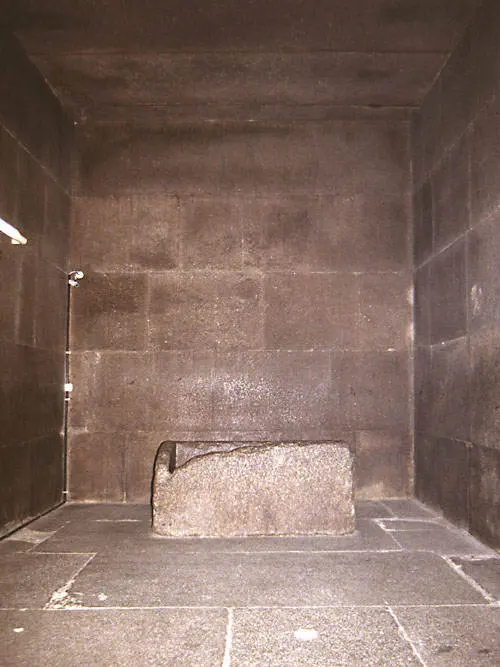
Finally, there is the empty sarcophagus. This lidless granite box, too large to have been brought through the passages, must have been installed during construction. But it contained nothing when first explored. No mummy, no treasure, no inscription. The absence invites projection: what was this for? What did it hold? What does it mean that the pyramid's central chamber centers on emptiness?
Archaeological consensus holds that the pyramid was built as Khufu's tomb—his 'Mansion of Eternity' designed to preserve his body and facilitate his transformation into a divine being. The pharaoh was understood as the living embodiment of Horus and, after death, as Osiris. His continued existence was essential to the cosmic order. The pyramid ensured his body's preservation, housed his ka (vital essence), and provided passages through which his ba (mobile soul) could travel between the burial chamber and the sky.
The mortuary temple on the east face served an ongoing cult that sustained the deceased pharaoh through offerings.
The pyramid's meaning has transformed across time as the civilization that built it receded into antiquity. In the New Kingdom (c. 1550-1070 BCE), Egyptians already regarded the Giza pyramids as ancient monuments from a golden age. Greeks and Romans visited as tourists, marveling at their scale. Arab explorers forced entry seeking treasure and found only the empty sarcophagus. Medieval Europeans speculated the pyramids were Joseph's granaries.
The modern era brought systematic archaeology—Howard Vyse's dynamite-assisted explorations in 1837, Flinders Petrie's precise measurements in the 1880s, the discovery of the workers' city in the 1990s. Simultaneously, alternative traditions emerged: pyramidology in the 19th century claimed the pyramid encoded prophecy; the 20th century brought Edgar Cayce's Atlantean theories, Robert Bauval's Orion correlation, and Christopher Dunn's power plant hypothesis.
Experience and orientation
The experience of the Great Pyramid begins before entrance, with the approach across the Giza Plateau. From a distance, the pyramid appears geometric and clean. Closer, its true scale becomes apparent—and with scale comes roughness. The polished white casing that once made the pyramid gleam is almost entirely gone, stripped for Cairo's medieval buildings.
What remains is the stepped core: course upon course of limestone blocks, weathered and irregular, rising to a truncated apex where the original capstone has been lost.
Entering the pyramid through the tourist entrance—a forced tunnel created around 820 CE by workers under Caliph al-Ma'mun—visitors begin a physical transformation. The passage is cramped, requiring a hunched posture. The air grows warm and thick. After negotiating this constricted space, the Grand Gallery opens with sudden drama: a corbelled corridor rising 26 feet high and stretching 157 feet at a steep angle toward the King's Chamber. The change from compression to expansion affects visitors viscerally.
The King's Chamber itself measures 34 feet by 17 feet, entirely constructed from red granite transported over 500 miles from Aswan. Blocks weighing up to 80 tonnes form the ceiling. The room is stark, undecorated, containing only the granite sarcophagus at its western end. When tour groups depart and lights are extinguished, the darkness is absolute. Sound deadens. Some visitors report tingling sensations, alterations in perception, visions. Others feel only the heat and the weight of stone.
The sarcophagus draws attention. Lidless, empty, it was too large to fit through the passages and therefore must have been placed during construction. What it originally contained—if anything—is unknown. Some visitors sit beside it in meditation. Others stand at a respectful distance. A few lie inside, seeking whatever experience the original occupant was meant to receive. The pyramid offers no commentary on these approaches.
It simply presents itself: stone, darkness, silence, and an empty box where a god-king may once have lain.
Begin with the exterior, walking around the pyramid's base to appreciate its scale—755 feet per side. Enter through the north face tourist entrance. The ascending passage requires crouching; take your time. The Grand Gallery rewards the effort with its dramatic height. In the King's Chamber, if conditions permit, request a moment of silence with lights extinguished. The sarcophagus is at the west end.
For those interested in the pyramid's astronomical alignments, the north and south 'air shafts' originally pointed toward specific stars, though visitors cannot access them. Exit via the same route. The descent is easier than the ascent.
Context and lineage
The pyramid emerged from a tradition already centuries old by Khufu's time. The Step Pyramid of Djoser at Saqqara, built around 2670 BCE, represented the first monumental stone construction in history. Subsequent pharaohs experimented with the form—the Bent Pyramid at Dahshur shows a mid-course correction when the original angle proved too steep. By Khufu's reign, the true pyramid form had been perfected, and the resources of a unified Egypt stood ready to create something unprecedented.
According to the ancient Egyptian worldview, the pharaoh was divine: the living Horus, son of Ra, maintainer of cosmic order (ma'at). His death was not ending but transformation. The pyramid ensured this transformation would be eternal. The shape represented both the Benben stone—the primordial mound of creation—and the rays of the sun descending to earth.
Building a pyramid was creating a machine for resurrection, a place where death could be defeated and the king could join the circumpolar stars that never set.
The logistics required were extraordinary. Mark Lehner's excavation of the workers' city revealed a well-organized community with bakeries, breweries, and medical facilities. Workers were fed beef and fish, indicating high status. The Diary of Merer, written by an inspector named Merer during construction, documents the transport of white limestone blocks from Tura quarries across the Nile to Giza. This papyrus, the oldest ever found, provides remarkable confirmation that the pyramid was indeed built by Khufu.
The Great Pyramid stands at the apex of pyramid-building tradition. It was preceded by Djoser's Step Pyramid (c. 2670 BCE), the Meidum Pyramid, and the Bent and Red Pyramids at Dahshur. After Khufu, his son Khafre built the second Giza pyramid, and his grandson Menkaure built the third. Later pharaohs continued building pyramids, but never again at this scale. The New Kingdom pharaohs (c. 1550-1070 BCE) abandoned pyramid burial for rock-cut tombs in the Valley of the Kings.
In the modern era, the pyramid has generated its own lineage of interpretation: scientific archaeology (Petrie, Lehner), pyramidology (Smyth, Davidson), and esoteric theory (Cayce, Bauval, Dunn).
Khufu (Cheops)
Hemiunu
Merer
Mark Lehner
Traditions and practice
In antiquity, the Great Pyramid was the center of an elaborate mortuary cult. At the adjacent mortuary temple on the east face, priests conducted daily rituals to sustain the ka (vital essence) of the deceased pharaoh. Offerings of food, drink, and incense were presented. The Opening of the Mouth ceremony would have been performed on Khufu's mummy to restore his senses for the afterlife.
Pyramid Texts from later pyramids suggest spells were recited to protect the deceased and guide his journey through the underworld and his ascension to join the stars.
The Queen's Pyramids to the south served as burials for Khufu's queens or daughters. Solar barques—ritual boats for the pharaoh's celestial journey—were buried in pits near the pyramid. One, discovered in 1954 and reconstructed, measured 143 feet long and was built of cedar imported from Lebanon. The complex formed an integrated system for ensuring the pharaoh's eternal life.
No formal religious ceremonies continue at the Great Pyramid. The site is administered as cultural heritage and tourist destination. However, contemporary spiritual seekers engage in personal practices, particularly meditation inside the King's Chamber. Visitors report heightened states of consciousness, visions, tingling sensations, and profound stillness. Whether these experiences reflect the pyramid's geometric properties, the weight of psychological expectation, or some other factor remains a matter of interpretation.
Tour operators offer 'meditation tours' and 'spiritual experiences' with private access to the pyramid, typically at sunrise before general opening. Some groups conduct ceremonies drawing on various traditions—New Age, neo-Egyptian, or eclectic spirituality. These practices exist outside any officially recognized tradition and represent individual or small-group seeking rather than transmitted religious knowledge.
For those seeking meaningful encounter rather than touristic experience, preparation matters. Research the pyramid's history and the questions surrounding it before arrival. Arrive at opening time (7am) to avoid the worst crowds and heat. Purchase the interior access ticket if your budget allows. Inside, move through the passages mindfully rather than rushing. In the King's Chamber, if conditions permit, request a moment of silence. The darkness and stillness, even briefly, create a different quality of attention.
If meditation is part of your practice, the King's Chamber offers a unique environment. Some visitors sit beside the sarcophagus; others stand at the chamber's center. The reported effects vary widely—from nothing unusual to profound altered states. Approach without fixed expectations. The pyramid has outlasted countless interpretations. Your experience will be your own.
Ancient Egyptian Religion
HistoricalThe pyramid was Khufu's 'Mansion of Eternity'—a sacred machine designed to facilitate the pharaoh's transformation from mortal ruler to divine being. The pyramid shape represented the Benben stone, the primordial mound of creation, and the rays of the sun descending to earth. The pharaoh, as divine intermediary between gods and humanity, required an eternal dwelling befitting his cosmic role. The pyramid ensured preservation of his body, sustenance of his ka, and passage for his ba to join the imperishable stars.
An elaborate mortuary cult conducted daily rituals at the adjacent mortuary temple. Priests presented offerings of food, drink, and incense to sustain the ka of the deceased pharaoh. The Opening of the Mouth ceremony restored his senses for the afterlife. Pyramid Texts from later pyramids suggest spells were recited to protect the deceased and guide his celestial journey.
New Age/Pyramid Power
ActiveSince the 1970s, the Great Pyramid has been central to 'pyramid power' beliefs claiming the pyramid's shape concentrates cosmic or Earth energies. Proponents point to mathematical constants (pi, phi) embedded in the proportions as evidence of sacred geometry. Some theorists propose the pyramid was an ancient power plant generating energy from Earth's vibrations. The Orion correlation theory links it to star alignments at 10,500 BCE. These narratives position the pyramid as evidence of lost advanced knowledge.
Contemporary spiritual seekers meditate inside the King's Chamber, often reporting altered states of consciousness, visions, tingling sensations, and profound stillness. Tour operators offer 'meditation tours' and 'spiritual experiences' inside the pyramid. Practitioners of pyramid meditation worldwide use model pyramids, believing the shape alone conveys benefits. Some groups conduct ceremonies drawing on various spiritual traditions.
Perspectives and open questions
The Great Pyramid has inspired interpretation for millennia. Archaeological evidence supports its function as Khufu's tomb. Ancient Egyptian texts present it as a machine for the pharaoh's transformation. Alternative theories propose older dating, power generation, or connection to lost civilizations. These perspectives are not equivalent in evidentiary support, but each addresses genuine features of the monument—its precision, its scale, its mysteries.
Holding them without premature resolution allows engagement with the pyramid as it actually is: extraordinarily sophisticated, incompletely understood, stubbornly resistant to definitive explanation.
Scholarly perspective
The archaeological consensus, supported by extensive evidence, holds that the Great Pyramid was constructed c. 2560-2540 BCE as the tomb of Pharaoh Khufu. The Diary of Merer (2013) provides contemporary documentation of construction logistics. Mark Lehner's excavation of the workers' city demonstrates the workforce was skilled and well-compensated, not enslaved. The pyramid represents the pinnacle of a pyramid-building tradition that began with Djoser's Step Pyramid and continued through the Middle Kingdom.
Recent discoveries continue to refine understanding. The ScanPyramids project discovered a 'Big Void' above the Grand Gallery in 2017 and a hidden corridor behind the original entrance in 2023. Neither has been fully explored. The purpose of the 'air shafts' remains debated—they do not actually reach the exterior and may have served symbolic rather than practical functions.
Alternative theories proposing older dating, Atlantean construction, or power generation lack archaeological support and are rejected by professional Egyptologists. The precision of the pyramid, while remarkable, is explainable through sophisticated but practical engineering methods using technologies available in the Old Kingdom.
Living and traditional perspectives
Ancient Egyptian understanding of the pyramid is preserved in later texts and artifacts. The pyramid was Akhet Khufu—'Horizon of Khufu'—the place where the king would rise eternally like the sun. The pyramid shape represented the Benben stone, the primordial mound emerging from chaos at creation. Building a pyramid was creating a machine for resurrection.
The pharaoh was divine: the living Horus, who in death became Osiris and joined the imperishable circumpolar stars. His body required preservation through mummification. His ka (vital essence) needed sustenance through offerings. His ba (mobile soul) could travel between the burial chamber and the sky, possibly through the 'air shafts' that originally pointed toward specific stars. The precision of alignment reflected the Egyptian understanding of cosmos as ordered (ma'at) and their desire to connect the earthly tomb with celestial patterns.
This worldview seems foreign to modern sensibilities, but it represents sophisticated thinking about death, transformation, and cosmic order. The pyramid was not merely a tomb but a technology of transcendence.
Alternative interpretations
Since the 19th century, alternative theories have proposed meanings beyond tomb. Charles Piazzi Smyth's pyramidology (1864) claimed the pyramid encoded prophetic information in its measurements. Edgar Cayce's readings (1930s) connected it to Atlantean refugees preserving their knowledge. Robert Bauval's Orion correlation theory (1990s) proposes the three Giza pyramids mirror Orion's Belt as it appeared in 10,500 BCE. Christopher Dunn's power plant theory (1998) argues the pyramid generated energy through acoustic and chemical processes.
These theories, while rejected by mainstream Egyptology, address genuine features: the mathematical precision, the acoustic properties of the chambers, the sophistication that seems to exceed what we assume about ancient technology. They represent a tradition of engaging with the pyramid's mysteries, even if their conclusions lack evidentiary support. For many contemporary seekers, these alternative narratives provide frameworks for understanding experiences at the pyramid that conventional archaeology does not address.
Open questions
Despite millennia of study, significant mysteries remain. The 'Big Void' discovered in 2017 by the ScanPyramids project measures at least 100 feet long, similar in scale to the Grand Gallery, but has not been accessed or explained. A hidden corridor discovered in 2023 behind the original entrance has not been fully explored. Khufu's mummy has never been found—was he ever buried here? The original contents of the sarcophagus are unknown.
The 'air shafts' do not actually reach the exterior; their true purpose remains debated. Why this pyramid has three chambers when later pyramids have one is unexplained. The mathematical constants embedded in its proportions may be intentional design or emergent from practical construction methods—we cannot be certain.
Perhaps the deepest mystery is phenomenological: why does this particular pile of stones, damaged and stripped of its casing, exercise such power over human imagination? The pyramid offers no answer. It simply stands, as it has stood for 4,500 years, waiting for questions it will not answer.
Plan your visit
Access and arrival
The Giza area offers accommodations ranging from the historic Marriott Mena House (directly adjacent to the plateau, with pyramid views) to budget options further from the site. Staying in Giza is advantageous for early morning visits. Central Cairo hotels are 30-60 minutes away depending on traffic. For those prioritizing the opening-time experience, nearby accommodation is recommended.
Respectful visit
Cover shoulders and knees out of respect for Egyptian culture. Comfortable walking shoes with good grip essential for the ascending and descending passages. Light, loose clothing recommended for the hot interior. Bring water—facilities inside are nonexistent. Sun protection needed for exterior exploration.
Photography permitted on exterior. Interior policies vary—sometimes prohibited, sometimes allowed without flash. Verify current rules on arrival. Video recording typically prohibited inside. Professional photography requires permits. Respect other visitors' space when photographing.
No offering tradition continues at the pyramid. The site is administered as cultural heritage rather than active worship site. Those who wish to make symbolic gestures might consider donations to legitimate Egyptian archaeological or cultural preservation organizations.
No climbing on the pyramid exterior—this was common historically but is now prohibited and enforced. Interior access limited by ticket availability and additional fee. No touching interior walls or sarcophagus. Follow guide instructions and time limits. Some areas (Queen's Chamber, Subterranean Chamber) normally closed to public—VIP tours may include access. Respect barriers and posted rules.
The pyramid's interior is hot, poorly ventilated, and physically demanding to navigate. Claustrophobia affects many visitors in the ascending passage. Bring water. Wear comfortable shoes with good grip. Those with heart conditions, respiratory issues, or severe claustrophobia should consider whether interior access is appropriate. The descent is easier than the ascent but still requires care.
Be aware of unofficial guides and scam attempts both outside and inside the pyramid. Verify credentials before accepting assistance.
Current practical details
Buy the general Giza Plateau ticket on Egypt's official Ministry of Tourism & Antiquities portal (egymonuments.com) or at the gate; add the separate interior ticket as an extra if you want to go inside.
Entering the Great Pyramid and climbing to the King's Chamber requires a SEPARATE extra ticket (~1,500 EGP) on top of the plateau ticket — daily numbers are strictly limited, so add it in advance or it may sell out at the gate. Most Egyptian sites are card-only.
Buy / book ticketsAddress
Al Haram, Nazlet El-Semman, Al Haram, Giza Governorate 3512201, Egypt
Hours
Hours, fees, and access can change — verify on the official source before you travel. Practical details last checked Jun 2026.
Location
Map loads as you approach this section.
Pilgrim reflections
A portrait of encounter, not a score
Pilgrims describe what they felt, how present they could become, and whether the place would shape a journey. There are no stars and no ranking of traditions.
No reviewed reflections yet
The first pilgrims can help describe the character of being here.
Share a reflection
Available after an account-backed “Been there.” Every reflection is reviewed before publication.
Watch deeper
Films, episodes, and recorded talks for visitors who want more context before or after a visit. Speculative and alternative-history entries are labelled as perspectives, not as sources for established claims.
Streaming episode
Alternative-history media
Ancient Apocalypse: Legacy of the Sages
Graham Hancock's Giza/Sphinx-focused episode in Ancient Apocalypse season 1.
Perspective note: Highly contested by mainstream archaeology; included as a perspective, not as evidence.
Open on NetflixVideo resource
Alternative-history media
The Revelation of the Pyramids (La Revelation des Pyramides)
Influential 2010 French documentary on pyramid geometry, alignments, and ancient-site pattern claims.
Perspective note: Controversial and not a source for established archaeological claims.
Open on JustWatch MegalithomaniaUK / YouTube
Alternative-history media
Revelations Beneath Khafre's Pyramid FULL UPDATE
Gaia panel discussion connected to Ancient Civilizations and claims beneath Khafre's Pyramid.
Perspective note: Very speculative; pair with mainstream context before treating any claim as factual.
Open on MegalithomaniaUK / YouTubeNearby sacred places
Explore other sacred places in the region. Proximity does not establish access or travel time; check each place’s guidance.



References
Sources consulted for this page. Source categories describe the publication, not a guarantee that every claim is verified. Traditional accounts and outside interpretations may differ.
- 01Pyramids of Giza | History, Location, Age, Interior, & Facts — Encyclopaedia BritannicaencyclopediaAcademic-level summary
- 02How were the Pyramids of Giza built? — National GeographicSource contextConstruction methods coverage
- 03Pyramid of Khufu — SmarthistoryacademicArt historical perspective
- 04Secrets of the Seven Wonders - Great Pyramid of Giza — Archaeology MagazineacademicRecent archaeological coverage
- 05Hidden Chamber Revealed Inside Great Pyramid of Giza — Smithsonian Magazineacademic2017/2023 discoveries
- 06Great Pyramid of Giza — Wikipedia contributorsencyclopediaComprehensive overview with extensive citations
- 07ScanPyramids — Wikipedia contributorsencyclopediaRecent scanning discoveries
- 08Great Pyramid: King's Chamber — Ancient Egypt OnlineSource contextDetailed interior descriptions
- 09Giza Pyramids Ticket Price 2025 — Discovery Tours EgyptguideCurrent practical visitor information
- 10Pyramidology — Wikipedia contributorsencyclopediaDocuments alternative theories with critical assessment
- 11The Great Pyramid: Myths and Legends of the Ancient Wonder — Egypt MythologySource contextReligious and mythological context
- 12Meditation Experience In The Great Pyramids — Veronika's AdventureblogFirst-person visitor experience
Photo gallery
3 curated photos
Share a photo
Help visitors recognize Great Pyramid of Giza. Every submission is reviewed before publication.