The Great Sphinx
Part ofGiza Necropolis
The silent witness—guardian of the dead, keeper of mysteries, gazing east toward the rising sun for 4,500 years
Understand sacred places, explore living traditions, and learn how to engage respectfully with Pilgrim Map.
Access has not been verified. Check current local guidance before planning a visit.
Giza, Giza, Egypt

Visit essentials
A quick read before you go
- Duration
- Allow 30-60 minutes for viewing the Sphinx itself, including time at different viewing angles.
- Etiquette
- Conservative dress respects Egyptian culture and Islamic traditions.
Overview
The Great Sphinx of Giza is among earth's most recognizable yet fundamentally unknowable monuments. Carved around 2500 BCE from the Giza Plateau's living limestone, the single sculpture rises 66 feet and stretches 240 feet. Its makers left no contemporary record of its name or purpose. When Pharaoh Thutmose IV excavated its sand-buried body around 1400 BCE, it was already mysterious, speaking to him in a dream as Horemakhet, 'Horus of the Horizon.'
The damaged face — missing nose, fallen beard, and weathered paint — deepens what the monument conceals. Some interpret its human-lion form as the pharaoh's dual nature: human intelligence joined to animal power, a mortal ruler embodying divine authority. Others believe secret chambers lie beneath its paws. Archaeology supports the former interpretation but has found no evidence for the latter; the Sphinx remains silent.
Why this place is sacred
What makes a place thin—where the membrane between ordinary experience and something deeper becomes permeable? The Sphinx embodies several qualities that create this effect.
First, there is the question of time. Standing before the Sphinx means standing before something that has endured for at least 4,500 years. The workers who carved it from bedrock lived closer in time to the extinction of the woolly mammoth than to us. Every civilization known to history—Babylonian, Greek, Roman, Arab, European—has found the Sphinx already ancient upon arrival.
This depth of time can destabilize ordinary consciousness, prompting the question: what is the scale of a human life against such permanence?
Second, there is the threshold quality. The Sphinx crouches at the edge of the Giza necropolis, facing away from the pyramids toward the rising sun and the Nile valley. It guards the passage between the world of the living and the carefully prepared resting places of the dead.
Ancient Egyptians understood death not as ending but as transformation, and the Sphinx—with its lion body suggesting power and protection, its human face suggesting consciousness and wisdom—embodied the possibility of crossing between states of being.
Third, there is the silence. Unlike temples covered with hieroglyphic texts proclaiming the deeds of pharaohs and the attributes of gods, the Sphinx bears no original inscription. We do not know what its creators called it or what rituals they performed before it. This absence of explanation creates space for encounter without mediation. The Sphinx does not tell visitors what to think or feel. It simply presents itself.
Finally, there is the damage. The missing nose, the fallen beard, the weathered surface—these wounds of time humanize the monument. It has suffered. It has endured. For some visitors, this vulnerability makes the Sphinx more approachable than any perfect artifact could be.
Archaeological evidence suggests the Sphinx served as a guardian figure for the Giza necropolis, protecting the eternal rest of the pharaohs buried in the adjacent pyramids. Most scholars attribute construction to Pharaoh Khafre around 2500 BCE, noting the Sphinx's alignment with his pyramid complex and mortuary temple. The lion body represented power and protection in ancient Egyptian iconography, while the human face—likely portraying the pharaoh himself—represented divine wisdom and royal authority.
The adjacent Sphinx Temple, built from limestone quarried during the Sphinx's creation, suggests the monument was incorporated into solar worship rituals from an early date.
The Sphinx's meaning has transformed across millennia. In the Old Kingdom, it likely functioned as a royal guardian and solar symbol. By the New Kingdom (c. 1550-1070 BCE), it had become Horemakhet—'Horus of the Horizon'—a deity in its own right, capable of prophetic communication as recorded in Thutmose IV's Dream Stele. Greeks and Romans knew it as Harmachis and incorporated it into their own mythological frameworks, though they distinguished the Egyptian monument from their own female, winged, riddle-posing sphinx.
In Islamic Egypt, it was called Abu al-Hawl, 'Father of Terror.' In the modern era, it has become both scientific subject and esoteric symbol—the focus of archaeological excavation and alternative theories about lost civilizations. Through all these transformations, the Sphinx has maintained its essential character: ancient, mysterious, silent.
Experience and orientation
The experience of visiting the Sphinx begins before arrival, shaped by a lifetime of images. Nearly everyone has seen photographs. The actual encounter often starts with disorientation: the Sphinx appears smaller than expected, more intimate. Tour guides sometimes joke that visitors seem disappointed. But the scale becomes apparent when approaching the viewing platforms—66 feet of height, 240 feet of length, carved from a single piece of bedrock.
What photographs cannot convey is the solidity, the presence of limestone that has held its shape for millennia.
The face draws attention first. The missing nose creates an asymmetry that makes the expression harder to read. What emotion does the Sphinx wear? Serenity? Vigilance? Neither? The weathered surface shows what time does to stone, yet the essential features remain: the nemes headdress of royalty, the uraeus (cobra) that once rose from the forehead, the outlines of eyes that face directly toward the equinox sunrise. Standing before this face, visitors often fall silent.
What can be said to something so ancient?
The viewing experience depends heavily on timing. Early morning—arriving at the 8am opening—offers relative solitude, soft light, and cooler temperatures. By mid-morning, tour buses have arrived and the commercial atmosphere intensifies. Vendors hawk souvenirs. Guides call for attention. The crowd noise can make contemplation difficult. Yet even amid the bustle, moments of stillness occur. A visitor finds a quiet corner. The noise fades.
For an instant, it is just human and Sphinx, as it has been for countless others across the centuries.
Many visitors report emotional responses they did not anticipate: tears, profound peace, a sense of their own smallness that is not crushing but freeing. Others feel frustration at the crowds, the heat, the difficulty of accessing the transcendent amid the commercial. Both responses are valid. The Sphinx offers no guarantees. It simply waits, as it has always waited, for those who come to it.
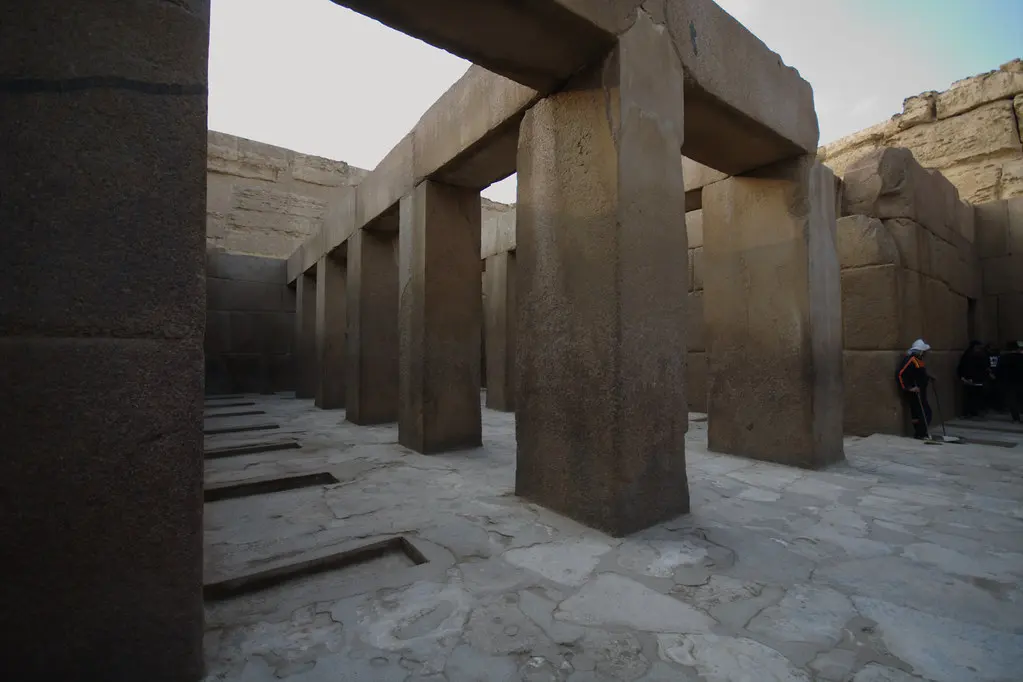
Begin at the viewing platform directly in front of the Sphinx for the classic encounter with its face. Notice the east-facing orientation toward the rising sun. Walk to the southern viewing area for a profile view that reveals the lion body's proportion to the human head. If possible, find a moment of stillness before the crowds thicken. The adjacent Sphinx Temple and Valley Temple of Khafre provide context for the monument's role in the necropolis complex.
Allow the damaged face to draw your attention—the wounds of time are part of the experience.
Context and lineage
The Sphinx's creation remains partially mysterious—no contemporary Old Kingdom inscription describes its construction or names its builder. Archaeological evidence points to Pharaoh Khafre (c. 2558-2532 BCE) as the most likely patron. The monument aligns with his pyramid complex, and the style of the nemes headdress matches Fourth Dynasty iconography. Some scholars argue for his father Khufu instead, based on subtle differences in the headdress design.
What seems clear is the method: workers carved the Sphinx from a natural limestone outcrop that remained after quarrying stone for the nearby pyramids. The bedrock itself became sculpture. Geologist Farouk El-Baz has suggested that a natural yardang—a wind-sculpted ridge of rock—may have resembled a reclining lion, inspiring the form. The 'moat' surrounding the Sphinx was quarried out to allow creation of the full body.
The Sphinx was originally painted, though only traces of pigment remain. It wore a long braided beard, fragments of which now reside in the British Museum and the Egyptian Museum. A cobra (uraeus) rose from its forehead—symbol of royal authority and divine protection. What we see today is diminished from the original, yet the essential form endures.
The Sphinx stands at the intersection of multiple lineages. In the archaeological record, it represents the pinnacle of Old Kingdom monumental sculpture—a form that would be echoed in countless smaller sphinx figures throughout Egyptian history. In religious terms, it evolved from a royal guardian into the deity Horemakhet, influencing New Kingdom solar theology. The Greeks encountered it as Harmachis and transmitted knowledge of the monument throughout the Mediterranean world, though they distinguished it from their own sphinx tradition.
In the modern era, the Sphinx has generated both scientific study and esoteric speculation. Archaeologists like Auguste Mariette and Mark Lehner have excavated and mapped the monument, while figures like Edgar Cayce and Robert Schoch have proposed alternative histories. Both lineages continue: each year brings new archaeological analysis and new metaphysical interpretation. The Sphinx accommodates both without comment.
Khafre (Chephren)
Thutmose IV
Mark Lehner
Edgar Cayce
Traditions and practice
In the New Kingdom, following Thutmose IV's excavation and the erection of the Dream Stele, the Sphinx was worshiped as Horemakhet—'Horus of the Horizon.' A cult center developed, and the pharaohs of the Eighteenth Dynasty in particular showed the monument special devotion. The adjacent Sphinx Temple suggests solar worship rituals connected to the monument's east-facing orientation. Offerings would have been made, prayers spoken, and ceremonies conducted according to the rhythms of the religious calendar.
However, specific ritual details are not fully documented in surviving texts.
The Dream Stele records one particular practice: incubation. Prince Thutmose slept in the shadow of the Sphinx and received a prophetic dream. This suggests the monument was believed capable of communication with those who approached it properly—though whether such dream incubation was common practice or exceptional occurrence remains unclear.
No formal religious ceremonies continue at the Sphinx. The site is administered as cultural heritage rather than active sacred space. However, contemporary spiritual seekers engage in personal practices that draw on various traditions. Some meditation tour groups conduct sunrise sessions facing the Sphinx, seeking 'intuitive downloads' or connection with what they perceive as ancient energies. Individual visitors may engage in silent prayer or contemplation.
Practitioners of Kemetic reconstructionism—modern revivals of ancient Egyptian religion—may include the Sphinx in their spiritual landscape, though the site's tourist infrastructure makes formal ritual difficult.
These contemporary practices exist outside any officially recognized tradition. They represent individual or small-group spiritual seeking rather than transmitted religious knowledge. The Sphinx, characteristically, neither endorses nor rejects these engagements.
For those seeking meaningful encounter rather than routine tourism, consider arriving at opening time (8am) when crowds are minimal and light is soft. Find a position where you can see the Sphinx's face clearly. Rather than immediately photographing, spend time simply looking. Notice the damage, the weathering, the endurance. The monument has witnessed the full span of recorded human history. What would it say if it could speak? What does its silence communicate?
If meditation is part of your practice, the Sphinx's east-facing orientation offers a natural focus for sunrise contemplation. The equinox alignments—when the sun rises directly in the Sphinx's gaze—have particular significance for those attuned to solar symbolism. Even without formal practice, allowing time for stillness before moving on creates space for whatever the encounter might offer.
Ancient Egyptian Religion
HistoricalThe Sphinx served as a guardian of the Giza necropolis, protecting the pharaohs' eternal rest. Its lion body represented power and protection; its human face, likely portraying the ruling pharaoh, represented divine wisdom. The fusion embodied the Egyptian understanding of kingship as mediating between human and divine realms. By the New Kingdom, the Sphinx had become Horemakhet—'Horus of the Horizon'—a solar deity associated with dawn and the daily cycle of death and rebirth.
New Kingdom worship included offerings and prayers at the Sphinx temple complex. The Dream Stele records dream incubation: Prince Thutmose slept in the Sphinx's shadow and received prophetic communication. Specific ritual details are not fully documented, but the monument's integration with solar temples suggests ceremonies connected to sunrise and the sun's daily journey.
New Age/Western Esotericism
ActiveSince Edgar Cayce's readings in the 1930s, the Sphinx has been central to esoteric narratives about Atlantis and lost civilizations. Cayce claimed the monument was built by Atlantean refugees around 10,500 BCE and conceals a 'Hall of Records' containing their preserved wisdom. This narrative places the Sphinx as a time capsule awaiting discovery by those spiritually prepared to receive its secrets.
Contemporary spiritual seekers conduct meditation facing the Sphinx, often at sunrise. Some report 'intuitive downloads' or connection with ancient energies. Tour operators offer 'spiritual and meditation tours' combining the Sphinx with other Giza sites. Believers in the Hall of Records view pilgrimage to the Sphinx as connection with hidden knowledge, even if the physical chamber remains undiscovered.
Graeco-Roman Tradition
HistoricalGreeks and Romans encountered the Sphinx as Harmachis (their rendering of Horemakhet) and integrated it into their knowledge of Egypt's ancient wonders. They distinguished it from their own sphinx—a female, winged creature who posed deadly riddles—while recognizing its great antiquity and sacred character. The Greek name 'sphinx' may derive from Egyptian 'shesep-ankh' meaning 'living image.'
Greek and Roman travelers made pilgrimages to Giza throughout antiquity. Writers including Herodotus, Strabo, and Pliny described the monument. Greek and Roman graffiti on the Sphinx complex testifies to centuries of visitation. Whether formal worship continued under Greek or Roman administration is uncertain.
Perspectives and open questions
The Great Sphinx has inspired interpretation for millennia, generating scholarly analysis, religious veneration, and esoteric speculation in roughly equal measure. No single perspective captures the monument fully. Archaeological evidence supports conclusions that conflict with alternative theories, while the Sphinx's fundamental mysteries—its original name, its precise purpose, the identity of its builder—remain unsolved. Holding multiple perspectives without forcing premature resolution allows the fullest engagement with what the Sphinx actually is: an ancient, damaged, silent witness to human history.
Scholarly perspective
The archaeological consensus places the Sphinx's creation around 2500 BCE during Egypt's Fourth Dynasty, most likely under Pharaoh Khafre. This conclusion rests on multiple lines of evidence: the monument's alignment with Khafre's pyramid complex and mortuary causeway, the style of the nemes headdress matching Fourth Dynasty iconography, and the discovery of the workers' settlement where those who built the Giza monuments lived and worked.
Mark Lehner's comprehensive mapping project in the 1980s, followed by excavation of the workers' city, provides the most detailed archaeological framework.
The Sphinx functioned as a guardian figure, protecting the sacred necropolis and embodying the fusion of human and animal qualities that characterized pharaonic ideology. Its east-facing orientation connected it to solar worship and the daily cycle of death and rebirth. The adjacent temple complex suggests formal rituals were performed there, though specific practices are not documented in contemporary sources.
Alternative dating theories—particularly Robert Schoch's water erosion hypothesis arguing for a pre-10,000 BCE date—are rejected by mainstream Egyptology based on contextual evidence, ceramic sequences, and geological reanalysis. Test drilling beneath the Sphinx, prompted by Edgar Cayce's 'Hall of Records' claims, found only natural fissures in the bedrock.
Living and traditional perspectives
Ancient Egyptian understanding of the Sphinx evolved across time. The original Old Kingdom conception is lost—no contemporary inscription names the monument or explains its purpose. By the New Kingdom, the Sphinx had become Horemakhet, 'Horus of the Horizon,' a manifestation of the sun god at the moment of rising. Thutmose IV's Dream Stele (c.
1400 BCE) presents the Sphinx as an oracular presence capable of prophetic communication, promising the sleeping prince the throne in exchange for clearing the sand that engulfed its body.
The New Kingdom identification connected the Sphinx to multiple solar deities: Horemakhet himself, but also Atum (the primeval creator), Khepri (the rising sun), and Re (the sun at zenith). The Sphinx temple complex suggests these identifications involved actual ritual practice, not merely theological speculation. Greeks and Romans later knew the monument as Harmachis, adapting the Egyptian name while distinguishing the creature from their own sphinx traditions.
Alternative interpretations
Since the 1930s, the Sphinx has been central to esoteric narratives about lost civilizations and hidden knowledge. Edgar Cayce's trance readings claimed that refugees from Atlantis, fleeing their civilization's destruction around 10,500 BCE, built both the Sphinx and the Great Pyramid to preserve their records for future discovery. According to Cayce, a 'Hall of Records' containing this Atlantean wisdom lies beneath the Sphinx's right paw, awaiting discovery at a destined time.
Robert Schoch's water erosion hypothesis, first proposed in 1990, offered geological support for a pre-Dynastic date. Schoch argued that erosion patterns on the Sphinx and its enclosure could only have been produced by sustained rainfall, placing the monument's creation before the Sahara's desertification—potentially as early as 9700 BCE or earlier. Though rejected by Egyptologists, this theory has influenced popular alternative history.
Graham Hancock and Robert Bauval's 'Orion correlation theory' further developed these themes, linking the Giza complex to stellar alignments at 10,500 BCE and proposing a lost civilization contemporary with the end of the last Ice Age. These alternative views, while lacking archaeological support, address genuine mysteries—the Sphinx's missing original name, the lack of contemporary inscriptions, the sophistication of its construction—that mainstream archaeology has not fully explained.
Open questions
Despite millennia of attention, the Sphinx retains genuine mysteries. Its original Old Kingdom name remains unknown—'Sphinx' is Greek, 'Horemakhet' is New Kingdom. No contemporary Fourth Dynasty inscription mentions the monument at all, which is strange given its scale and the abundant inscriptions on nearby structures. Whether this reflects lost records, deliberate silence, or evidence that challenges the conventional dating remains debated.
The cause of the nose damage is uncertain. Medieval Arab historians attributed it to iconoclasm; others suggest weathering or accident. The original painted appearance can only be imagined from traces of pigment. Whether tunnels or chambers exist beneath the monument has been investigated repeatedly—ground-penetrating radar has shown anomalies, but test drilling has found only natural fissures. Whether the Sphinx was ever completed, or was abandoned partially finished, remains unclear.
Perhaps the deepest mystery is phenomenological: why does this particular monument, damaged and silent, exercise such power over human imagination? The Sphinx does not answer. It simply endures, inviting each generation to project meaning onto its inscrutable face.
Plan your visit
Access and arrival
The Giza area offers accommodations ranging from luxury hotels with pyramid views to budget options. The Marriott Mena House, directly adjacent to the plateau, provides the most convenient access. Central Cairo hotels are 30-60 minutes away depending on traffic. For those prioritizing early morning arrival, staying near Giza is advantageous.
Respectful visit
Cover shoulders and knees out of respect for Egyptian culture. Comfortable walking shoes are essential for the uneven terrain. Sun protection—hat, sunscreen, sunglasses—is necessary given the exposed plateau. Bring water, as facilities are limited.
Photography is permitted throughout the public areas. The viewing platform offers the classic frontal view; the southern area provides profile angles. Early morning light is optimal. Drones require special permits obtained in advance. Be aware that others are also trying to photograph—courtesy and patience go far.
No offering tradition continues at the Sphinx. The monument is administered as cultural heritage rather than active worship site. Those who wish to make symbolic gestures might consider donations to legitimate Egyptian archaeological or cultural organizations.
No touching or climbing on the Sphinx or its enclosure walls. Stay within designated viewing areas. No littering. Respect other visitors' space and experience. Do not engage with unofficial guides or accept offers of special access. Verify that any guide has official credentials.
The Sphinx is a major tourist destination, and the commercial atmosphere can intrude on contemplative experience. Be prepared for crowds, vendors, and noise, especially mid-morning through afternoon. Those seeking spiritual engagement should arrive early or visit during low season. Also be aware of unofficial 'guides' who may approach with offers of special access or esoteric knowledge—these are typically scams. Respect the barriers that prevent touching or climbing on the monument; these protect an irreplaceable artifact.
Finally, recognize that the Sphinx belongs to Egyptian heritage. Approaching with respect for its cultural context, rather than imposing foreign spiritual frameworks, honors both the monument and the people who created it.
Current practical details
Address
Al Haram, Giza Governorate 3512201, Egypt
Hours
Hours, fees, and access can change — verify on the official source before you travel. Practical details last checked Jun 2026.
Location
Map loads as you approach this section.
Pilgrim reflections
A portrait of encounter, not a score
Pilgrims describe what they felt, how present they could become, and whether the place would shape a journey. There are no stars and no ranking of traditions.
No reviewed reflections yet
The first pilgrims can help describe the character of being here.
Share a reflection
Available after an account-backed “Been there.” Every reflection is reviewed before publication.
Watch deeper
Films, episodes, and recorded talks for visitors who want more context before or after a visit. Speculative and alternative-history entries are labelled as perspectives, not as sources for established claims.
Streaming episode
Alternative-history media
Ancient Apocalypse: Legacy of the Sages
Graham Hancock's Giza/Sphinx-focused episode in Ancient Apocalypse season 1.
Perspective note: Highly contested by mainstream archaeology; included as a perspective, not as evidence.
Open on NetflixVideo resource
Alternative-history media
The Revelation of the Pyramids (La Revelation des Pyramides)
Influential 2010 French documentary on pyramid geometry, alignments, and ancient-site pattern claims.
Perspective note: Controversial and not a source for established archaeological claims.
Open on JustWatch MegalithomaniaUK / YouTube
Alternative-history media
Revelations Beneath Khafre's Pyramid FULL UPDATE
Gaia panel discussion connected to Ancient Civilizations and claims beneath Khafre's Pyramid.
Perspective note: Very speculative; pair with mainstream context before treating any claim as factual.
Open on MegalithomaniaUK / YouTubeNearby sacred places
Explore other sacred places in the region. Proximity does not establish access or travel time; check each place’s guidance.


Share a photo
Help visitors recognize The Great Sphinx. Every submission is reviewed before publication.