Pyramid of Khafre
The son's answer to the father—rising on higher ground to match the greatest pyramid ever built
Understand sacred places, explore living traditions, and learn how to engage respectfully with Pilgrim Map.
Access has not been verified. Check current local guidance before planning a visit.
Giza, Giza, Egypt
Read the sources
Visit essentials
A quick read before you go
- Duration
- Allow 30-60 minutes for interior visit including passage navigation and time in the burial…
- Etiquette
- Conservative dress respects Egyptian culture.
Overview
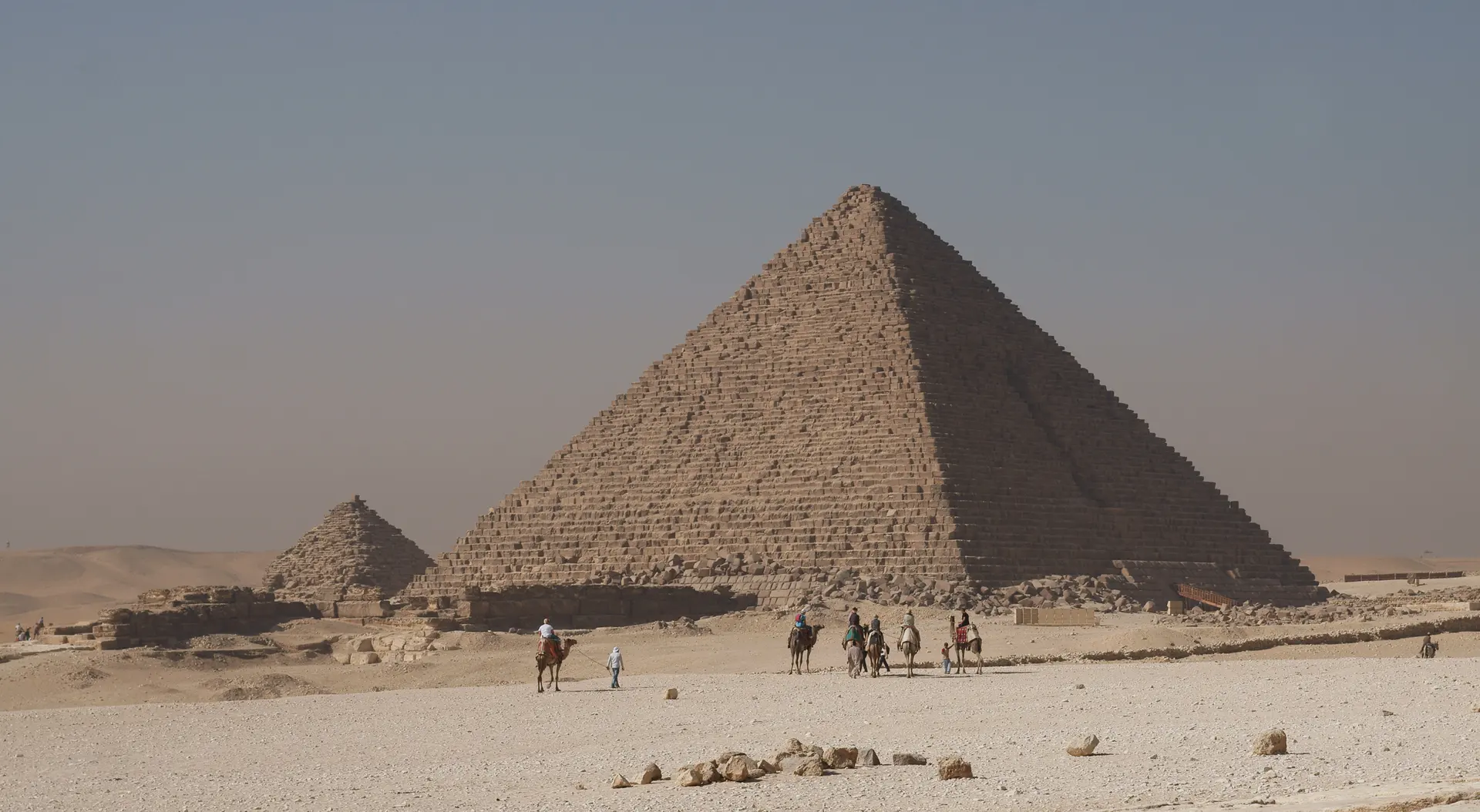
Khafre's pyramid stands second at Giza in size and chronology, built by a son to honor and perhaps rival his father. It is 136 meters high today, originally 143.5, just below Khufu's Great Pyramid; elevated bedrock nevertheless makes it appear taller from many angles. Whether competition or practical engineering produced this effect remains unknown.
The Great Sphinx almost certainly belongs to Khafre's complex: it was carved from the quarry that supplied his Valley Temple, stands beside his causeway, and bears a face many scholars identify as the pharaoh's. One of the best-preserved Old Kingdom structures, the Valley Temple shows that these monuments were stations in a journey from death to divine transformation, not isolated tombs.
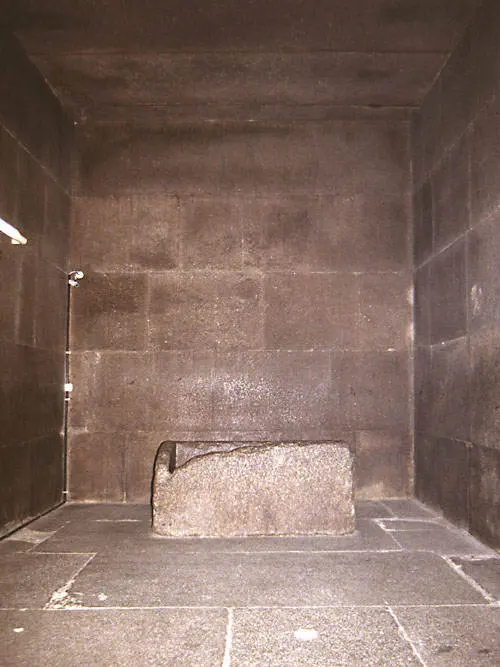
Unlike the Great Pyramid's labyrinth, Khafre's interior leads to one bedrock burial chamber and granite sarcophagus. Giovanni Belzoni entered in 1818 and found it empty except for scattered animal bones—possibly bull remains, offerings, or later intrusions. Its simplicity leaves one chamber, one sarcophagus, and one question about what remains of a divine king.
Why this place is sacred
The Pyramid of Khafre creates a particular quality of thinness through several intersecting factors.
First, there is the question of succession. Khafre was son of Khufu, builder of the largest pyramid ever constructed. He succeeded his brother Djedefre, whose pyramid at Abu Rawash lies to the north. Returning the royal necropolis to Giza, Khafre faced a challenge: how to honor his father while asserting his own divine status. The solution was architectural: positioning on higher ground, a steeper 53-degree angle, and near-equal scale.
Standing before Khafre's pyramid means standing before a meditation on inheritance, ambition, and the weight of parental achievement.
Second, there is the preserved casing. At the apex of Khafre's pyramid, original Tura limestone casing still clings to the structure—the only such survival among the Giza pyramids. This fragment reveals what all these monuments once were: gleaming white peaks catching the Egyptian sun, visible for miles, transforming the desert plateau into a landscape of artificial mountains. The contrast between preserved apex and stripped lower courses makes time visible.
Fourteen centuries ago, Ramesses II's workers removed casing stones for use elsewhere. The damage teaches what the monument once was.
Third, there is the Sphinx connection. Most scholars attribute the Great Sphinx to Khafre. It sits beside his causeway. Its core blocks came from the same quarry that provided material for his Valley Temple. The face, scholars argue, represents the pharaoh. If this attribution is correct, Khafre created the most recognizable sculpture in human history as part of his funerary complex—a guardian for his eternal journey.
Finally, there is the interior's simplicity. Where Khufu's pyramid contains multiple chambers, passages, and the mysterious Grand Gallery, Khafre's offers a single burial chamber carved from bedrock. This focus concentrates the encounter. There is no question of exploring further passages or wondering about hidden rooms. There is simply the chamber, the sarcophagus, and the presence of 4,500 years of time.
The pyramid was Khafre's 'Mansion of Eternity'—the permanent dwelling for his transformed divine self. Ancient Egyptian funerary theology understood the pharaoh as a living god who, after death, would join the imperishable circumpolar stars and sail across the sky with Ra. The pyramid ensured his body's preservation, his ka's (vital essence) sustenance through offerings, and his ba's (mobile soul) freedom to travel between burial chamber and heavens.
The entire complex—valley temple, causeway, mortuary temple, and pyramid—formed an integrated machine for resurrection.
Khafre's complex established the canonical form for later Egyptian royal tombs. His mortuary temple was the first to include all five standard elements: entrance hall, columned court, five statue niches, five storage chambers, and inner sanctuary. This template would be repeated for centuries. The pyramid itself was probably looted during the First Intermediate Period, when central authority collapsed. During the Nineteenth Dynasty (c. 1200 BCE), Ramesses II ordered casing stones stripped for his own temple at Heliopolis.
By the time Arab writers encountered the monument, it had become an object of mystery and treasure-hunting speculation. Giovanni Belzoni's 1818 entry initiated modern archaeological study, followed by Auguste Mariette's 1853 discovery of the Khafre statue in the Valley Temple—providing the key evidence linking the complex to its builder.
Experience and orientation
The experience of Khafre's pyramid begins with visual comparison. Standing on the plateau, looking across the three main pyramids, Khafre's appears largest. The preserved limestone casing at its apex catches light differently than the exposed core stone below—a glimpse of original splendor. This visual dominance, achieved through positioning rather than actual size, sets a tone of architectural confidence.
Approaching from the northeast, the causeway that once connected mortuary and valley temples is visible as a trace across the sand. The Great Sphinx crouches beside this route, facing east. Whether Sphinx, causeway, and pyramid were conceived together as a unified vision remains probable but unproven. The spatial relationships feel deliberate: the guardian watching the sunrise, the pharaoh's eternal dwelling rising behind.
Entering the pyramid requires descending through one of two passages—either the original entrance 11.5 meters up the north face or a lower forced entrance at base level. The passages are offset from the pyramid's centerline by 12 meters, which distinguishes them from Khufu's more centrally positioned interior. The descending passage, carved entirely from bedrock, leads to the burial chamber.
The burial chamber itself measures approximately 14 by 5 meters, oriented east-west. The roof consists of gabled limestone beams supporting the weight above. At the chamber's western end sits Khafre's sarcophagus—black granite, sunk partially into the floor, lidless and empty since Belzoni's entry in 1818. What it originally contained is unknown. Belzoni found only scattered animal bones, possibly bull, possibly offerings, possibly later intrusions.
The experience differs from the Great Pyramid in significant ways. There is no equivalent to the Grand Gallery's soaring height. There is no mystery of multiple chambers. The simplicity concentrates attention: one room, one stone box, one absent king. Many visitors find this focus conducive to contemplation. The reduced crowds (the Great Pyramid draws the majority of interior visitors) allow longer moments of stillness.
Begin by viewing Khafre's pyramid from outside, noting the preserved limestone casing at the apex. Approach via the northeast to see the relationship with the Sphinx and causeway. If entering, the descent is less demanding than the Great Pyramid's ascending passage. The burial chamber lies at the end of a relatively straightforward route. The sarcophagus occupies the western end. For those visiting both pyramids, notice the contrast: Khufu's complex interior versus Khafre's focused simplicity.
The Valley Temple, 494 meters east via the causeway, contains the famous Khafre statue and reveals how the complex originally functioned.
Context and lineage
Khafre inherited a kingdom at the height of its power. His father Khufu had demonstrated what centralized authority and organized labor could achieve. Khafre's task was continuation and perhaps surpassing. The name of his pyramid, Wer-Khafre ('Khafre is Great'), suggests ambition. The decision to position it on elevated bedrock, creating the appearance of greater height, may have been deliberate.
Construction methods followed established Fourth Dynasty practices: local limestone for the core, white Tura limestone for the casing, granite from Aswan for the burial chamber and sarcophagus. The steeper angle—53°08' compared to Khufu's 51°50'—gave the pyramid a more pronounced profile. The interior was simpler: a single burial chamber carved from bedrock rather than built within the structure, with no equivalent to Khufu's multiple chambers and passages.
The Valley Temple reveals the care Khafre took with his complex. Built from megalithic limestone blocks sheathed in granite, its walls once held over fifty life-size statues of the pharaoh. The famous diorite statue discovered by Mariette—showing Khafre seated with Horus protecting his head—demonstrates the sculptural mastery of the period. From this temple, the body would have traveled along a 494-meter causeway to the mortuary temple beside the pyramid.
Khafre's pyramid occupies the center of a three-generation family necropolis. To the northeast rises his father Khufu's Great Pyramid. To the southwest stands his son Menkaure's pyramid. This concentration of Fourth Dynasty royal monuments at Giza represents the apex of pyramid building in ancient Egypt. Later pharaohs would continue the tradition, but never again at this scale. Khafre's complex also established the canonical form for mortuary temples, influencing Egyptian royal architecture for centuries.
The attribution of the Great Sphinx to Khafre makes his legacy even more distinctive—he may have created history's most recognizable sculpture as part of his eternal dwelling.
Khafre (Chephren)
Giovanni Belzoni
Auguste Mariette
Luis Alvarez
Traditions and practice
Khafre's funeral would have followed established Fourth Dynasty practice, beginning at the Valley Temple. Priests received the royal body and began purification rituals using oils, incense, and resins believed to have spiritual power. The Opening of the Mouth ceremony—performed using special implements—restored the king's senses for the afterlife, enabling him to see, hear, speak, and eat in the divine realm.
After these initial rites, the body processed along the 494-meter causeway to the mortuary temple beside the pyramid. Here, final offerings and prayers prepared the king for interment. The pyramid's burial chamber received the mummified body in its granite sarcophagus. An ongoing mortuary cult then maintained daily offerings at the mortuary temple, sustaining the ka of the deceased pharaoh.
Khafre's mortuary temple established the template for future royal complexes, containing all five standard elements: entrance hall, columned court, five statue niches for images of the king in different forms, five storage chambers for offerings and implements, and an inner sanctuary for the most sacred rites.
No formal religious ceremonies continue at Khafre's pyramid. The site is administered as cultural heritage, with the Egyptian Ministry of Tourism and Antiquities overseeing access and preservation. Individual visitors may engage in private contemplation inside the burial chamber, but this is personal practice without connection to transmitted tradition. The reduced visitor numbers compared to the Great Pyramid allow for quieter, more meditative visits.
For those seeking meaningful encounter, begin at the Valley Temple rather than the pyramid itself. This structure, one of the best-preserved from the Old Kingdom, reveals how the complex originally functioned. The famous Khafre statue (now in the Egyptian Museum, Cairo) was discovered here. Understanding the journey from valley temple through causeway to mortuary temple and pyramid contextualizes what the pyramid meant.
If entering the pyramid's interior, allow time in the burial chamber for stillness. The simplicity—one room, one sarcophagus—focuses attention. Notice that the sarcophagus is partially sunk into the floor. Consider what it means that this chamber, designed to house a divine king for eternity, has been empty for over four millennia.
Ancient Egyptian Religion
HistoricalThe pyramid was Khafre's gateway to eternal life—the dwelling place of his transformed divine self. The pyramid shape represented the sun's rays, guiding the king's soul to join Ra. The steep 53-degree angle may have symbolized a more direct ascent to the heavens. The entire complex—valley temple, causeway, mortuary temple, and pyramid—formed an integrated machine for resurrection, ensuring Khafre's eternal existence and thereby preserving cosmic order.
Khafre's funeral began at the Valley Temple with purification rituals using oils, incense, and resins. The Opening of the Mouth ceremony restored his senses for the afterlife. The body processed along the causeway to the mortuary temple for final rites before interment. An ongoing mortuary cult sustained his ka through daily offerings.
Perspectives and open questions
Khafre's pyramid invites interpretation primarily through its relationship to surrounding monuments—the father's pyramid to the northeast, the son's to the southwest, the Sphinx beside the causeway. Archaeological evidence establishes Khafre as builder and provides context for understanding the complex's function. Alternative theories typically focus on the Great Pyramid rather than Khafre's, leaving this monument more securely in the realm of mainstream Egyptology. The simplicity of its interior—one chamber, one sarcophagus—allows the pyramid to pose its questions directly.
Scholarly perspective
The scholarly consensus identifies Khafre's pyramid as constructed c. 2558-2532 BCE for Pharaoh Khafre, son of Khufu. The attribution rests on multiple lines of evidence: the famous diorite statue discovered by Mariette in the Valley Temple (showing Khafre protected by Horus), the architectural integration with the Great Sphinx and causeway, and the pyramid's position between Khufu's and Menkaure's monuments. The construction on elevated bedrock made the pyramid appear taller than its actual dimensions.
Luis Alvarez's 1960s muon imaging project searched for hidden chambers but found none. The interior appears to be as simple as visible: one burial chamber, one subsidiary chamber (possibly a serdab for the ka statue), two entrance passages. This simplicity contrasts with the Great Pyramid's multiple chambers and has not been satisfactorily explained—why did the son build a simpler interior than the father?
Living and traditional perspectives
Ancient Egyptian understanding of Khafre's pyramid aligned with broader funerary theology. The pyramid was the pharaoh's 'Horizon'—the place of ascent to join the sun god Ra and the imperishable stars. The steeper 53-degree angle may have symbolized a more direct path to the heavens. The pyramid shape represented both the Benben stone (primordial mound of creation) and the sun's descending rays. The mortuary cult's daily offerings at the mortuary temple sustained the king's ka for eternity.
The integration with the Great Sphinx—if Khafre indeed commissioned it—adds another dimension. The Sphinx as Horemakhet ('Horus of the Horizon') connected to solar worship and the daily journey of the sun. Khafre's complex may have represented a comprehensive theology of death and rebirth, with the Sphinx as eternal guardian.
Alternative interpretations
Alternative theorists have paid less attention to Khafre's pyramid than to the Great Pyramid. The Orion correlation theory (Bauval) includes Khafre's pyramid as part of the three-pyramid alignment supposedly mirroring Orion's Belt, but the detailed speculation about power plants, hidden chambers, and lost civilizations focuses primarily on Khufu's monument. Khafre's pyramid remains, by alternative theory standards, relatively conventional—a tomb for a pharaoh, built by Egyptians, during the Old Kingdom.
Open questions
Despite extensive study, genuine mysteries remain. Why did Khafre choose a steeper angle than his father's pyramid? Why is the interior simpler despite similar exterior scale—was this economics, theology, or something else? What did the sarcophagus originally contain? What explains the animal bones Belzoni found—offerings, later intrusions, or something connected to original burial practices? The relationship between Khafre and the Sphinx, while widely accepted, lacks the direct textual confirmation scholars would prefer.
And perhaps most fundamentally: what did it mean to Khafre himself to build so close in scale to his father? Was it tribute, competition, or something beyond modern categories?
Plan your visit
Access and arrival
The Giza area offers accommodations ranging from the historic Marriott Mena House (adjacent to the plateau with pyramid views) to budget options. For early morning visits, staying near Giza is advantageous. Central Cairo hotels are 30-60 minutes away depending on traffic.
Respectful visit
Cover shoulders and knees out of respect for Egyptian culture. Comfortable walking shoes essential for interior passages. Light, breathable clothing recommended due to interior heat. Bring water and sun protection for exterior exploration.
Exterior photography freely permitted. Interior photography policies vary—sometimes prohibited, sometimes allowed without flash. Verify current rules when purchasing tickets. Video recording typically requires additional permits.
No offering tradition continues. The site is administered as cultural heritage rather than active worship site.
No climbing on the pyramid exterior. Interior access requires separate ticket. No touching the sarcophagus or interior walls. Follow posted rules and guide instructions. Time limits may be enforced during busy periods.
The interior is less demanding to navigate than the Great Pyramid but still requires physical capability. Claustrophobia may affect some visitors in the passages. The burial chamber can be warm and stuffy. Bring water. Be aware that the Valley Temple is a separate site and may not be included in all tours. Verify current access policies before planning your visit.
Current practical details
Address
X4GJ+99V, Al Haram, Giza Governorate 3512201, Egypt
Hours
Hours, fees, and access can change — verify on the official source before you travel. Practical details last checked Jun 2026.
Location
Map loads as you approach this section.
Pilgrim reflections
A portrait of encounter, not a score
Pilgrims describe what they felt, how present they could become, and whether the place would shape a journey. There are no stars and no ranking of traditions.
No reviewed reflections yet
The first pilgrims can help describe the character of being here.
Share a reflection
Available after an account-backed “Been there.” Every reflection is reviewed before publication.
Watch deeper
Films, episodes, and recorded talks for visitors who want more context before or after a visit. Speculative and alternative-history entries are labelled as perspectives, not as sources for established claims.
Streaming episode
Alternative-history media
Ancient Apocalypse: Legacy of the Sages
Graham Hancock's Giza/Sphinx-focused episode in Ancient Apocalypse season 1.
Perspective note: Highly contested by mainstream archaeology; included as a perspective, not as evidence.
Open on NetflixVideo resource
Alternative-history media
The Revelation of the Pyramids (La Revelation des Pyramides)
Influential 2010 French documentary on pyramid geometry, alignments, and ancient-site pattern claims.
Perspective note: Controversial and not a source for established archaeological claims.
Open on JustWatch MegalithomaniaUK / YouTube
Alternative-history media
Revelations Beneath Khafre's Pyramid FULL UPDATE
Gaia panel discussion connected to Ancient Civilizations and claims beneath Khafre's Pyramid.
Perspective note: Very speculative; pair with mainstream context before treating any claim as factual.
Open on MegalithomaniaUK / YouTubeNearby sacred places
Explore other sacred places in the region. Proximity does not establish access or travel time; check each place’s guidance.


References
Sources consulted for this page. Source categories describe the publication, not a guarantee that every claim is verified. Traditional accounts and outside interpretations may differ.
- 01Khafre | Old Kingdom, Pyramid Builder, & Pharaoh — Encyclopaedia BritannicaencyclopediaAcademic-level summary
- 02Pyramid of Khafre and the Great Sphinx — SmarthistoryacademicArt historical analysis
- 03Pyramid Complex of Khafre (Khefren) — Egypt Ministry of Tourism and AntiquitiesofficialOfficial Egyptian government source
- 04Uncovering Secrets of the Sphinx — Smithsonian MagazineacademicArchaeological context of Khafre-Sphinx connection
- 05Pyramid of Khafre — Wikipedia contributorsencyclopediaComprehensive overview with citations
- 06Khafre — Wikipedia contributorsencyclopediaBiography of the pharaoh
- 07Pyramid of Khafre at Giza — Ancient Egypt OnlineSource contextDetailed interior descriptions
- 08Giza Pyramids Ticket Price 2025 — Discovery Tours EgyptguideCurrent practical visitor information
Share a photo
Help visitors recognize Pyramid of Khafre. Every submission is reviewed before publication.