King's Chamber
InsideGreat Pyramid of Giza
At the heart of humanity's largest precision monument—an empty room that has outlasted everything
Understand sacred places, explore living traditions, and learn how to engage respectfully with Pilgrim Map.
Access has not been verified. Check current local guidance before planning a visit.
Giza, Giza, Egypt
Read the sources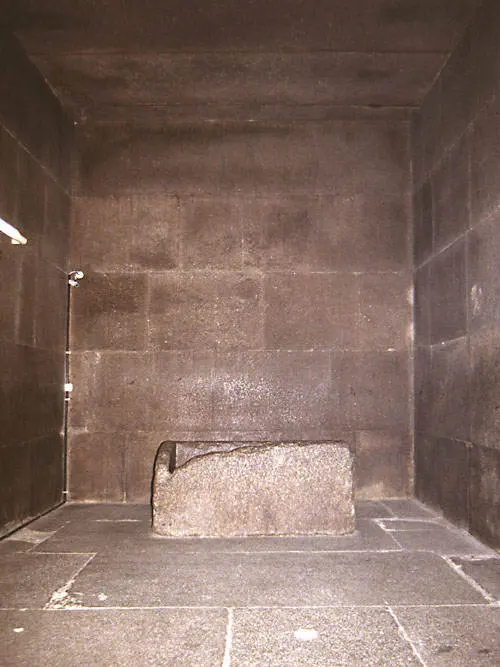
Visit essentials
A quick read before you go
- Duration
- The interior experience takes approximately 30-45 minutes, including ascent, time in the…
- Access
- The King's Chamber is located within the Great Pyramid of Giza on the Giza Plateau,…
Overview
Deep within the Great Pyramid of Giza, past narrow ascending passages that demand physical commitment, lies the King's Chamber—a room lined entirely with pink granite transported 900 kilometers from Aswan. The dimensions are precise: 10.45 by 5.20 meters, 5.80 meters high. Nine massive ceiling slabs support the weight of the pyramid above, their pressure distributed through five hidden relieving chambers that builders never intended anyone to see.
The chamber contains a single object: a red granite sarcophagus, undecorated and roughly finished with visible saw marks. Its lid is missing. No mummy, no grave goods, no inscriptions have ever been found inside. Whether Pharaoh Khufu was ever buried here remains unknown. Whether this was ever a tomb in the conventional sense is still debated.
Two narrow shafts extend from the chamber toward the pyramid's exterior. Their purpose is contested—ventilation, astronomical alignment with stars like Thuban and Orion, or passages for the pharaoh's soul to ascend to join the circumpolar stars that never set. What is certain is that 4,600 years after construction, people still climb through darkness to stand in this room.
The chamber that was built to ensure one man's eternity has become a space where anyone can contemplate what endures and what is lost.
Why this place is sacred
The thinness of the King's Chamber operates through paradox. This is one of the most precisely engineered spaces in ancient architecture—granite blocks cut and fitted with millimeter accuracy, massive ceiling slabs balanced to support hundreds of tons, the entire structure calculated to stand for millennia. Yet the chamber is empty. The sarcophagus holds nothing. Whatever was intended to rest here is gone, and we do not know where, or when, or why.
This emptiness creates a particular quality of presence. Standing in the King's Chamber, visitors confront both human ambition at its most monumental and the ultimate failure of human intention to control the future. Khufu, whoever he was, intended to secure eternity. His body is lost. His grave goods are lost. Even certainty about whether he was ever buried here is lost. What remains is the room itself—and the fact that people still come.
The journey to the chamber intensifies its effect. Visitors climb through the Grand Gallery, a steeply ascending passage with corbelled walls that narrow toward the ceiling. Then they crouch through the antechamber and emerge into the chamber itself. This progression from constriction to openness, from effort to arrival, mirrors the ancient Egyptian understanding of death as a transformative passage. The deceased descended into the underworld, navigated its passages, and emerged transformed. The pyramid recreated this journey in stone.
The chamber's acoustic properties add another dimension. The granite walls create resonance; voices return strange and amplified. Some researchers suggest the chamber was designed with specific frequencies in mind—around 117 Hz—though whether this served religious, practical, or purposes we cannot guess remains unknown. Sound behaves differently here. The space responds.
The King's Chamber was constructed as the burial chamber for Pharaoh Khufu of the Fourth Dynasty, intended to house his mummified body and ensure his eternal existence among the gods. The pyramid as a whole may have represented the primordial mound that rose from the waters of chaos at creation, or the rays of the sun god Ra descending to earth. The chamber's granite walls created an imperishable inner sanctum.
The air shafts may have been designed to allow the pharaoh's ba—his soul or animated essence—to ascend to the heavens and join the circumpolar stars that never set, known to Egyptians as the 'imperishable ones.' From this chamber, the transformed pharaoh would rule eternally in the celestial realm.
The chamber was sealed after construction and the presumed burial of Khufu, intended never to be entered again. By the 9th century CE, the caliph al-Ma'mun reportedly forced entry through the pyramid, though whether he was the first to breach the chamber is uncertain. In 1765, Nathaniel Davison discovered the first of the relieving chambers above the King's Chamber.
In 1837, Colonel Howard Vyse blasted through to reveal four additional relieving chambers, finding quarry marks and Khufu's cartouche that confirmed the pyramid's attribution. Modern visitors have entered since the 19th century, though access has been increasingly restricted to preserve the monument. Today, the chamber functions as a site of cultural pilgrimage, attracting those who seek connection to ancient achievement, contemplation of mortality, or—for some—spiritual experience in a space whose acoustic and geometric properties they believe hold power.
Experience and orientation
The experience of the King's Chamber begins long before entering it. First comes the Giza Plateau itself—the three pyramids arranged on the desert edge, the Great Pyramid rising 146 meters above the sand. Then the entrance, on the north face, descending into darkness. The original entrance leads to a descending passage; modern visitors typically enter through al-Ma'mun's tunnel, cut in the 9th century.
The ascending passage is where the journey becomes demanding. The passage rises at a 26-degree angle through the pyramid's core. The height is low—about one meter—requiring visitors to crouch or crawl while climbing upward. Heat increases with each step. The passages are not air-conditioned, and body heat from preceding visitors accumulates. In the narrowness and darkness, the outside world recedes.
The Grand Gallery follows: a sudden opening into a corbelled passage 47 meters long and 8.6 meters high, with walls that step inward seven times to create a false arch. This transition from constriction to vertical space creates an almost theatrical effect, a release of pressure before the final approach.
Beyond the gallery, visitors pass through the antechamber—once blocked by three granite portcullis slabs, now empty—and emerge into the King's Chamber itself. The walls are pink granite, smooth and precisely fitted. The ceiling is flat, its nine massive slabs seamless. At the western end stands the sarcophagus: a simple granite box, open, its interior empty. There is nothing else.
Visitors report surprise at the chamber's size—smaller than photographs suggest. They report the acoustic quality: voices resonate, footsteps echo, the room responds to sound. They report the heat, the stillness, the sense of immense weight pressing above. And they report, despite knowing the facts, something like disappointment that the room is empty—followed by the recognition that the emptiness is the point. Whatever was meant to be here is gone. The chamber remains.
The King's Chamber lies within the Great Pyramid of Giza on the Giza Plateau, approximately 15 kilometers southwest of central Cairo. The chamber is positioned roughly one-third of the way up the pyramid's height, accessible only through the pyramid's interior passages. Access requires purchasing both general Giza Plateau admission and a separate Great Pyramid interior ticket, which are limited to approximately 300 per day.
The chamber is located at the end of the ascending passage system, beyond the Grand Gallery and antechamber. Two narrow air shafts exit the chamber's north and south walls, extending to the pyramid's exterior.
Context and lineage
The Great Pyramid was built during the reign of Khufu, second pharaoh of the Fourth Dynasty, around 2580-2560 BCE. According to the prevailing understanding, Khufu mobilized enormous resources—skilled workers, quarried limestone and granite, organizational systems—to construct his eternal house. The King's Chamber represents the innermost sanctum of this project.
Granite for the chamber was quarried at Aswan, 900 kilometers south, and transported by boat on the Nile. Blocks weighing up to 80 tons were raised to the pyramid's heart and fitted with precision that still impresses modern engineers. Above the chamber, five relieving chambers distribute the weight of the masonry, preventing the ceiling from collapsing. This engineering feat remained hidden until 1765 and 1837, when explorers discovered the upper chambers and found quarry marks containing Khufu's name.
Alternative theories question whether the pyramid was ever a tomb. The chamber's air shafts have been connected to stellar alignments—the southern shaft allegedly pointed toward Orion's Belt, the northern toward the pole star Thuban. Robert Bauval's Orion Correlation Theory proposed that the three Giza pyramids mirror the stars of Orion's Belt. Whether these alignments are intentional, coincidental, or miscalculated remains debated.
What is certain is that the chamber was designed with extraordinary care for purposes that mattered profoundly to its builders.
The King's Chamber represents the culmination of Egyptian pyramid development that began with the Step Pyramid of Djoser at Saqqara around 2670 BCE. Earlier royal tombs were underground; the step pyramid placed the burial above ground within a monumental structure. Sneferu, Khufu's father, experimented with pyramid form at Meidum and Dahshur, producing the Bent Pyramid and Red Pyramid. Khufu's Great Pyramid perfected the true pyramid form.
After Khufu, the technology persisted through his son Khafre and grandson Menkaure, whose pyramids stand nearby at Giza, though neither matched the Great Pyramid's scale. The Old Kingdom pyramid tradition declined by the Fifth Dynasty as resources diminished and priorities shifted. The King's Chamber remains the most sophisticated burial chamber of this era.
Khufu (Cheops)
Pharaoh and builder
Second pharaoh of the Fourth Dynasty, reigned approximately 2589-2566 BCE. The Great Pyramid was constructed as his eternal house. Despite the pyramid's fame, surprisingly little is known about Khufu himself. The only confirmed image of him is a small ivory figurine found at Abydos. His mummy has never been found.
Howard Vyse
Explorer
British army officer who conducted aggressive explorations of the Great Pyramid in 1837. Using gunpowder to blast through stone, he discovered the upper relieving chambers and found quarry marks containing Khufu's cartouche—evidence that confirmed the pyramid's attribution to Khufu.
Nathaniel Davison
Explorer
British diplomat who discovered the first relieving chamber above the King's Chamber in 1765. This chamber now bears his name: Davison's Chamber.
Traditions and practice
The ancient rituals associated with the King's Chamber would have centered on Khufu's burial and transformation. The Opening of the Mouth ceremony—performed on the mummy to restore the deceased's senses and allow them to eat, drink, and speak in the afterlife—would have occurred before the body was placed in the sarcophagus. Priests would have recited spells from the Pyramid Texts, though these texts are not found in the Great Pyramid itself but in later Fifth and Sixth Dynasty pyramids.
After the burial, the chamber was sealed, the ascending passage blocked with granite plugs, and ongoing offerings and rituals transferred to the mortuary temple on the pyramid's east side. The chamber itself was never meant to be entered again.
The King's Chamber functions today as a site of cultural tourism and, for some visitors, contemplative practice. While no official religious ceremonies occur, some individuals attempt meditation within the space, believing the chamber's geometry, acoustics, and accumulated significance create unique conditions for inner experience. Private access has occasionally been arranged for groups seeking to conduct ceremonies or extended meditation, though this is exceptional and subject to Egyptian antiquities regulations.
Most visitors experience the chamber briefly as part of a tour, their time limited by the need to accommodate others.
Visitors seeking contemplative experience should arrive at the first entry time when the chamber is least crowded and least hot. Allow the journey itself—the narrow passages, the physical effort, the darkness—to prepare awareness for arrival. Upon entering the chamber, pause before approaching the sarcophagus. Notice the acoustics: how sound returns from the granite walls. If possible, spend time simply standing in the space rather than immediately photographing. The chamber has held attention for 4,600 years; it rewards patience.
The emptiness is not absence but invitation—space for whatever questions you bring.
Ancient Egyptian Funerary Religion
HistoricalThe King's Chamber was constructed as the burial chamber for Pharaoh Khufu, intended to ensure his eternal existence among the gods. The chamber represents the culmination of Old Kingdom pyramid building and funerary theology. Positioned at the heart of the pyramid, surrounded by granite walls and protected by five relieving chambers, it was designed as an imperishable sanctum. The air shafts may have provided passages for the pharaoh's ba to ascend to the circumpolar stars—the 'imperishable ones' that never set below the horizon. This was not metaphor but mechanism: the pyramid was built to accomplish transformation.
The Opening of the Mouth ceremony would have been performed on Khufu's mummy before placement in the sarcophagus, restoring the deceased's senses for the afterlife. After burial, the chamber was sealed permanently. Ongoing offerings and rituals occurred in the mortuary temple on the pyramid's east side, not in the chamber itself, which was never intended to be entered again.
Contemporary Esoteric Practice
ActiveSince the 19th century, the King's Chamber has attracted those who believe the pyramid's geometry creates unique energetic or spiritual properties. The chamber's precise dimensions, granite construction, and position within the pyramid are thought by some to amplify consciousness, facilitate meditation, or enable mystical experiences. The acoustic properties of the chamber—particularly its resonant frequency around 117 Hz—have been connected to altered states of consciousness and healing practices.
Some visitors attempt meditation or contemplation within the chamber, believing the space holds accumulated power from millennia of human attention. Private access has occasionally been arranged for groups seeking to conduct ceremonies or extended meditation. Lying in or near the sarcophagus is believed by some to enhance spiritual experiences, though this is discouraged by site regulations.
Perspectives and open questions
The King's Chamber invites interpretation through multiple lenses: as archaeological artifact, as engineering achievement, as theological statement, and as site of contemporary pilgrimage. Each perspective illuminates different dimensions without exhausting the chamber's capacity to prompt reflection on mortality, ambition, and what outlasts us.
Scholarly perspective
Egyptologists generally accept that the King's Chamber was built as Khufu's burial chamber. The discovery of quarry marks and Khufu's cartouche in the relieving chambers in 1837 confirmed the pyramid's attribution. The chamber's engineering—granite walls, relieving chambers, precise dimensions—demonstrates Fourth Dynasty technical capabilities at their height. Questions remain about the roughly finished sarcophagus (in contrast to the chamber's precision), the absence of any mummy or grave goods, and the function of the air shafts.
Whether these gaps reflect ancient robbery, deliberate deception, or purposes we do not understand remains debated.
Living and traditional perspectives
For ancient Egyptians, the pyramid was a resurrection machine. The King's Chamber was the innermost sanctum where the pharaoh's transformed body would rest eternally while his ba traversed the heavens. The granite walls created an imperishable space; the air shafts may have connected this chamber to specific stars—the circumpolar stars that never set, home of the 'imperishable ones.' The pyramid's shape may have represented the primordial mound of creation or the rays of Ra descending to earth.
From this chamber, the deceased king would rule eternally in the celestial realm, ensuring cosmic order for his people.
Alternative interpretations
Alternative researchers propose the chamber served purposes beyond or instead of burial. Some suggest it functioned as an initiation space where priests underwent transformative experiences. The chamber's acoustic properties—particularly its resonant frequency around 117 Hz—have led to speculation about sound-based practices or technologies we no longer understand. The Orion Correlation Theory proposes the air shafts aligned with specific stars, creating cosmic corridors.
Some question whether the Great Pyramid was ever a tomb at all, noting the absence of mummy, grave goods, and inscriptions. These interpretations remain outside academic consensus but express genuine uncertainty about the chamber's ultimate purpose.
Open questions
Several aspects of the King's Chamber remain beyond scholarly consensus. The sarcophagus is roughly finished with visible saw marks, in stark contrast to the chamber's precision—why? The air shafts' purpose remains contested: ventilation seems insufficient explanation for such precise construction; stellar alignment theories face mathematical challenges. No mummy or grave goods have been found, and no inscriptions appear in the chamber itself. Was Khufu ever buried here?
Did ancient robbers thoroughly empty the space, or was there never anything to take? The crack in the ceiling slabs near the south wall raises questions about stress and stability that remain unanswered. The chamber preserves its mysteries.
Plan your visit
Access and arrival
The King's Chamber is located within the Great Pyramid of Giza on the Giza Plateau, approximately 15 kilometers southwest of central Cairo. Access requires two tickets: general Giza Plateau admission and a separate Great Pyramid interior ticket. Interior tickets are limited to approximately 300 per day, split between morning and afternoon sessions, and sell out quickly during peak season. Purchase interior tickets as early as possible, ideally at opening.
The physical requirements include climbing through narrow passages with low ceilings (about one meter in the ascending passage) and steep gradients. Not suitable for those with claustrophobia, mobility issues, or respiratory conditions.
Giza and Cairo offer accommodation at all price points. Many visitors base themselves in Cairo and visit Giza as a day trip. Those wishing to enter the Great Pyramid's interior should stay near the plateau to reach the ticket office early.
Respectful visit
Comfortable, modest clothing suitable for physical exertion. The climb through the passages generates considerable body heat. Closed-toe shoes with good grip are essential for the steep, smooth-worn passages. Avoid loose items that could be dropped or catch on stone surfaces.
Photography regulations vary and should be confirmed at time of visit. Flash photography is typically prohibited to protect ancient surfaces. Be aware that photographing in low-light conditions is challenging and may distract from direct experience of the space.
Not applicable. This is an archaeological site, not an active temple. Do not leave objects in the chamber.
Do not touch the sarcophagus or walls. Do not climb into the sarcophagus, regardless of what you may have seen others do in photographs. Stay on designated paths. Time inside may be limited depending on visitor volume. The passages are not suitable for those with claustrophobia, mobility limitations, or respiratory conditions.
The passages to the King's Chamber are narrow, steep, and hot. Those with claustrophobia, mobility limitations, or respiratory conditions should carefully consider whether entry is advisable. The experience can be physically demanding and psychologically intense. Time inside is limited, and the chamber is shared with other visitors—private contemplative experience is not guaranteed.
Current practical details
Address
Al Haram, Nazlet El-Semman, Al Haram, Giza Governorate 3512201, Egypt
Hours
Hours, fees, and access can change — verify on the official source before you travel. Practical details last checked Jun 2026.
Location
Map loads as you approach this section.
Pilgrim reflections
A portrait of encounter, not a score
Pilgrims describe what they felt, how present they could become, and whether the place would shape a journey. There are no stars and no ranking of traditions.
No reviewed reflections yet
The first pilgrims can help describe the character of being here.
Share a reflection
Available after an account-backed “Been there.” Every reflection is reviewed before publication.
Watch deeper
Films, episodes, and recorded talks for visitors who want more context before or after a visit. Speculative and alternative-history entries are labelled as perspectives, not as sources for established claims.
Streaming episode
Alternative-history media
Ancient Apocalypse: Legacy of the Sages
Graham Hancock's Giza/Sphinx-focused episode in Ancient Apocalypse season 1.
Perspective note: Highly contested by mainstream archaeology; included as a perspective, not as evidence.
Open on NetflixVideo resource
Alternative-history media
The Revelation of the Pyramids (La Revelation des Pyramides)
Influential 2010 French documentary on pyramid geometry, alignments, and ancient-site pattern claims.
Perspective note: Controversial and not a source for established archaeological claims.
Open on JustWatch MegalithomaniaUK / YouTube
Alternative-history media
Revelations Beneath Khafre's Pyramid FULL UPDATE
Gaia panel discussion connected to Ancient Civilizations and claims beneath Khafre's Pyramid.
Perspective note: Very speculative; pair with mainstream context before treating any claim as factual.
Open on MegalithomaniaUK / YouTubeNearby sacred places
Explore other sacred places in the region. Proximity does not establish access or travel time; check each place’s guidance.


References
Sources consulted for this page. Source categories describe the publication, not a guarantee that every claim is verified. Traditional accounts and outside interpretations may differ.
- 01King's Chamber — Encyclopaedia BritannicaencyclopediaAuthoritative reference
- 02The Great Pyramid — Egypt Ministry of Tourism and AntiquitiesofficialOfficial Egyptian government documentation
- 03How were the Pyramids of Giza built? — National GeographicacademicReputable source on construction
- 04Great Pyramid of Giza — Wikipedia contributorsencyclopediaComprehensive overview with academic citations
- 05Great Pyramid: King's Chamber — Ancient Egypt OnlineacademicDetailed architectural and historical analysis
- 06Hidden Chambers and Meaning: Is the Great Pyramid for a King or Priests? — Ancient OriginsspiritualAlternative interpretations presented
Share a photo
Help visitors recognize King's Chamber. Every submission is reviewed before publication.