Giza Necropolis
The only surviving Wonder of the Ancient World—humanity's most ambitious response to mortality, 4,500 years standing
Understand sacred places, explore living traditions, and learn how to engage respectfully with Pilgrim Map.
Access has not been verified. Check current local guidance before planning a visit.
Giza, Giza, Egypt
Read the sources
Visit essentials
A quick read before you go
- Duration
- Allow minimum 4-6 hours for a comprehensive visit including at least one pyramid interior, the…
- Etiquette
- Standard heritage site protocols apply.
Overview
At Giza, three pharaoh generations shaped a sacred landscape: Khufu's Great Pyramid, the largest ever built; his son Khafre's monument on higher ground, appearing its equal; and his grandson Menkaure's smaller, more elaborate pyramid. The Great Sphinx, with its lion body and human face, has faced sunrise at the plateau's east for 4,500 years. Cardinal, stellar, and seasonal alignments placed the complexes purposefully in the Western Desert, realm of the dead in Egyptian cosmology.
The Nile once reached the plateau's base, bringing royal bodies by boat for their transformation. Valley temples received them, causeways carried them upward, mortuary temples held final rites, and pyramids became eternal dwellings; buried solar boats would carry kings across the sky with Ra. The design pursued immortality and, in preserving Khufu, Khafre, and Menkaure's names through monuments older than any peer structures, profoundly achieved it.
The only surviving Wonder of the Ancient World still connects visitors to this deep past.
Places within this site
Why this place is sacred
The Giza Necropolis exists at a scale that resists comprehension. The Great Pyramid alone contains 2.3 million blocks weighing on average 2.5 tons each—some granite beams in the King's Chamber weigh 80 tons. The base covers 13 acres and was leveled to within 2.1 centimeters across its entire expanse. For nearly 4,000 years it remained the tallest building on Earth. Yet scale is only part of what makes Giza thin. The complex functions as an integrated cosmology in stone.
The pyramids rise from the Western Desert—where the sun sets, where Egyptians located the realm of the dead. The Great Sphinx faces due east, greeting the equinoctial sunrise with its lion body and human face. The pyramids align to within 3/60th of a degree of true north, a precision that still challenges explanation.
The so-called air shafts in Khufu's pyramid point toward specific stars: Orion's Belt (associated with Osiris) and the circumpolar stars that never set (the imperishable ones the pharaoh hoped to join). Whether these alignments were intentional and what they meant remains debated, but they demonstrate that the builders worked with astronomical knowledge that shaped the complex's design.
The thinness emerges from the accumulation: not one pyramid but three, built by successive generations of the same family; not structures alone but an entire landscape engineered for transformation. The Western Cemetery contains hundreds of mastaba tombs for royals and officials who wanted to spend eternity near the divine kings. The workers' village at Heit el-Ghurab housed the thousands who built the monuments—skilled laborers, not slaves, buried in their own cemetery when they died.
The whole plateau became a city of the dead, a permanent address for those who had passed from mortal existence to eternal life.
The Giza Necropolis was designed to ensure the resurrection and eternal existence of the pharaohs buried within. Ancient Egyptians believed the pharaoh was a divine intermediary between gods and humans; his successful transition to the afterlife maintained cosmic order (ma'at) for the entire kingdom. The pyramid shape represented the primordial mound of creation, the sun's rays descending to earth, or a stairway to heaven—scholars debate which meaning was primary, and the Egyptians may have held all three simultaneously.
The complex functioned as a machine for transformation: the body arrived at the valley temple for purification, processed along the causeway to the mortuary temple for final rites, and entered the pyramid for eternal residence. Ka statues received offerings to maintain the royal life force; solar boats transported the king across the sky with Ra; the mortuary cult performed daily rituals for generations. Every element served the single purpose of defeating death.
The Giza Necropolis remained active and sacred for millennia after the Fourth Dynasty. Later pharaohs built subsidiary structures; officials sought burial near the divine kings. Around 1400 BCE, Prince Thutmose (later Thutmose IV) recorded a dream in which the Sphinx promised him the throne if he cleared the sand engulfing its body—the Dream Stele still stands between its paws.
During the New Kingdom and later periods, the Sphinx was worshipped as Horemakhet ('Horus of the Horizon') and a Temple of Isis was established near the pyramids. Medieval Arab writers marveled at the structures; Caliph al-Ma'mun entered the Great Pyramid in 820 CE, finding passages and chambers but no treasure. Napoleon's 1798 expedition brought scientific study; subsequent excavations by Vyse, Mariette, Petrie, Reisner, and others revealed the complex's full extent.
The 1990 discovery of the workers' tombs overturned the slave labor myth. In 2017, ScanPyramids discovered a previously unknown void in the Great Pyramid—evidence that after 4,500 years, Giza still holds secrets.
Experience and orientation
The first encounter with Giza often comes from a distance—the pyramids visible above Cairo's sprawl, geometric forms rising from urban chaos. Up close, the scale becomes visceral. The Great Pyramid's base stretches 756 feet per side; standing at its corner, neither end is visible. The blocks are not small bricks but massive stones, each weighing tons, fitted together across 4,500 years of settling without mortar.
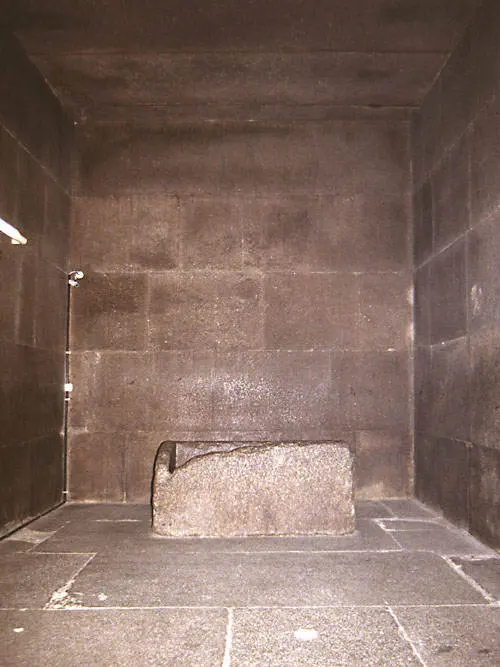
Looking up, the structure rises to a height that was not surpassed for nearly four millennia. Inside, the experience shifts. The passages are narrow, steep, and hot. Claustrophobia is common. The Grand Gallery ascends at 26 degrees for 153 feet, its corbeled walls narrowing above. The King's Chamber is lined with red granite transported 500 miles from Aswan; the empty sarcophagus sits against the western wall. The chamber absorbs sound in ways that seem strange.
Some visitors report heightened states of consciousness; others feel only the weight of stone above. The Sphinx offers a different encounter—not entering but approaching. From the plateau above, its scale is difficult to grasp. Descending to the viewing platform, the full dimensions become clear: 73 meters long, 20 meters high, carved from a single outcrop of limestone. The face gazes east toward the rising sun, worn by millennia of wind and sand but still recognizable.
The relationship between Sphinx, Valley Temple, and pyramids becomes visible from this vantage—the sacred landscape as integrated whole rather than separate monuments. Walking the plateau takes hours. The mastaba cemeteries east and west of the Great Pyramid contain hundreds of tombs, their entrance chapels and offering chambers still visible. The three queens' pyramids south of Menkaure's pyramid, the boat pits, the scattered remains of mortuary temples—each element deepens understanding of the complex as a functioning city of the dead.
Begin at the Great Pyramid while energy and attention are fresh. If entering the interior (separate ticket required), do so early before heat builds and crowds intensify. Afterward, approach the Sphinx via the Valley Temple of Khafre—this was the ancient processional route, and it provides context for understanding the structures' relationships. Walk among the mastaba tombs in the Western Cemetery, less visited than the main monuments.
End at the panorama point on the plateau's western edge, where the three pyramids align and the entire sacred landscape becomes visible at once. Allow time as the day progresses for the changing light to transform the monuments—the golden hour before sunset is particularly striking, though crowded. Consider returning at different times if staying nearby; dawn and dusk offer different qualities of encounter.
Context and lineage
The Giza Necropolis emerged from a building program spanning three generations. Khufu, second king of the Fourth Dynasty, chose the Giza Plateau for his eternal monument around 2560 BCE. His father Sneferu had built pyramids at Dahshur—the Bent Pyramid and Red Pyramid—advancing the technology that made Giza possible. Khufu's Great Pyramid surpassed everything before: 2.3 million blocks, 6 million tons of stone, 481 feet of height.
His architect Hemiunu oversaw a workforce of tens of thousands, housed in a village excavated in 1990. Recent discoveries including the Diary of Merer—papyri describing limestone transport—reveal organized labor, not slavery. When Khufu died, his son Khafre built immediately adjacent, choosing higher ground to make his slightly smaller pyramid appear equal to his father's. Most scholars attribute the Great Sphinx to Khafre as well, its face perhaps representing him, its body carved from limestone quarried for the Valley Temple.
Khafre's son Menkaure completed the trio with the smallest but most elaborately decorated pyramid. After Menkaure, pyramid construction continued but never at this scale. His successor Shepseskaf built only a mastaba. The Fifth and Sixth Dynasty pyramids at Saqqara and Abusir were smaller, eventually deteriorating to mudbrick. Giza remained forever unmatched.
The Giza Necropolis represents the apex of a pyramid-building tradition that began with Djoser's Step Pyramid at Saqqara (c. 2670 BCE) and evolved through Sneferu's experiments at Dahshur. Giza's three pyramids mark the form's perfection and its end. After Menkaure, no pharaoh achieved comparable scale. The Fifth Dynasty built smaller pyramids with Pyramid Texts—the first written funerary literature. By the Middle Kingdom, pyramids were constructed in mudbrick rather than stone.
The New Kingdom pharaohs abandoned pyramids entirely for hidden rock-cut tombs in the Valley of the Kings. Giza thus represents a unique moment: the resources, organization, and religious motivation that could produce such monuments existed for perhaps a century and never returned. The complex remains the defining image of ancient Egypt and the clearest evidence of what the civilization could achieve.
Khufu (Cheops)
Khafre (Chephren)
Menkaure (Mycerinus)
Hemiunu
Traditions and practice
The necropolis functioned as an integrated resurrection system. When a pharaoh died, the body was transported by boat from the capital at Memphis to the valley temple, where priests performed purification rituals. The Opening of the Mouth ceremony, conducted with specialized implements, restored the royal senses for afterlife existence. The body processed along the causeway—a covered passage decorated with reliefs depicting the king's achievements—to the mortuary temple at the pyramid's base.
Final rites occurred there before interment in the pyramid's burial chamber. Solar boats were sealed in pits to transport the king across the sky with Ra. Ka statues in temples received daily offerings of food, drink, and incense to maintain the royal life force. Mortuary cults performed these rituals for generations; evidence suggests some continued for centuries after the pharaoh's death. During later periods, the Sphinx was worshipped as Horemakhet, and a Temple of Isis attracted pilgrims to the plateau.
No formal religious ceremonies continue at the Giza Necropolis. The site is administered as cultural heritage by Egypt's Ministry of Tourism and Antiquities. However, the pyramids continue to draw spiritual seekers who experience them as repositories of ancient wisdom or sites of heightened consciousness. Group meditations and spiritual tours are organized, particularly during equinoxes and solstices when astronomical alignments are highlighted.
Some visitors report unusual experiences inside the pyramid chambers—heightened awareness, emotional release, or a sense of connection to deep time. Whether these experiences reflect the site's inherent qualities, the power of expectation, or the profound strangeness of standing inside a structure 4,500 years old cannot be determined.
The Giza Necropolis rewards different approaches depending on what you seek. For contemplation of mortality and human achievement, spend time with individual monuments: the overwhelming scale of the Great Pyramid, the preserved interior of Khafre's Valley Temple, the empty burial chamber of Menkaure where the sarcophagus was lost at sea. For understanding the complex as sacred landscape, walk the plateau's full extent, noting how elements relate: Sphinx facing sunrise, pyramids aligned to cardinal directions, causeways connecting valley to mortuary temples.
If seeking meditative experience, the quieter areas—Western Cemetery mastabas, the panorama point at day's end—offer space unavailable around the main monuments. Whatever your approach, allow time. The site cannot be absorbed quickly. Return visits at different times of day reveal different qualities.
Ancient Egyptian Religion
HistoricalThe Giza Necropolis represented the most ambitious attempt in human history to ensure resurrection and eternal life. The pyramids were not merely tombs but cosmic machines designed to transform dead pharaohs into divine beings who would join the sun god Ra in his daily journey across the sky. The complex embodied the Egyptian worldview: the Nile to the east (life), the Western Desert (death and rebirth), the pyramids as stairways or sunrays connecting earth to heaven. Each element—pyramids, temples, causeways, boat pits, Ka statues—served the single purpose of achieving immortality. The pharaoh's successful resurrection was not merely personal but cosmic; it maintained ma'at (order) for the entire kingdom and ensured the sun would continue to rise.
Upon a pharaoh's death, the body was transported by boat to the valley temple for purification rituals and mummification. The Opening of the Mouth ceremony, performed with specialized implements, restored the royal senses for afterlife existence. The body processed along the causeway to the mortuary temple for final rites before interment in the pyramid. Solar boats were buried to transport the pharaoh across the sky with Ra. Ka statues in temples received daily offerings of food, drink, and incense to maintain the royal life force. Mortuary cults continued these practices for generations, with evidence suggesting some endured for centuries.
New Age/Western Esotericism
ActiveSince the 19th century, the pyramids have attracted esoteric and metaphysical interpretations that continue to draw seekers today. The Orion Correlation Theory proposes that the three main pyramids mirror Orion's Belt, connecting the complex to stellar mythology and potentially dating it to 10,500 BCE. 'Pyramid power' theories suggest the geometric form concentrates energy for healing, meditation, or preservation. Some believe the pyramids encode advanced knowledge from a lost civilization that transmitted wisdom to later Egyptians. While rejected by mainstream Egyptology, these interpretations shape how many contemporary visitors experience the site—as a repository of ancient wisdom rather than simply an archaeological complex.
Contemporary spiritual seekers visit for meditation, energy work, and connection to perceived ancient wisdom. Some report heightened states of consciousness, particularly inside the pyramid chambers. Group meditations and spiritual tours are organized, especially during equinoxes and solstices when astronomical alignments are highlighted. The experience is often framed as pilgrimage rather than tourism—a journey to a sacred site where contact with something greater is possible.
Perspectives and open questions
The Giza Necropolis invites interpretation as tomb, as resurrection machine, as astronomical monument, as engineering achievement, and as ongoing mystery—each perspective illuminating different aspects of what the complex was and means.
Scholarly perspective
Mainstream Egyptology dates the Giza pyramids to c. 2600-2500 BCE, built during the Fourth Dynasty by successive pharaohs Khufu, Khafre, and Menkaure. The pyramids functioned as royal tombs designed to ensure resurrection and eternal life within the Egyptian religious framework. Construction employed tens of thousands of skilled laborers organized through a system of corvée labor and housed in a workers' village excavated in 1990. The discovery of the workers' tombs definitively disproved the slave labor myth popularized by Herodotus.
The pyramids align to within 3/60th of a degree of true north, demonstrating sophisticated astronomical and surveying knowledge. The complex represents the apex of pyramid construction; no subsequent pharaoh achieved comparable scale, suggesting either cultural shift or resource depletion. Recent research continues to reveal new information: the 2013 discovery of the Diary of Merer papyri describes limestone transport operations, while the 2017 ScanPyramids Big Void discovery demonstrates that even the most-studied monuments hold surprises.
Living and traditional perspectives
Ancient Egyptians understood the pyramids as functional structures for resurrection—machines transforming mortal kings into divine beings. The pyramid shape represented multiple concepts that may have been held simultaneously: the primordial mound of creation that first emerged from chaos, the sun's rays descending to earth, or a stairway by which the pharaoh's soul ascended to heaven. The ka (life force) and ba (personality) required the preserved body and tomb provisions to survive eternally.
The Western Desert, where the sun sets, was the realm of the dead; the pyramids rose from this liminal landscape as permanent links between earth and sky, mortality and eternity. The pharaoh's successful resurrection maintained cosmic order (ma'at) for the entire kingdom. Building the pyramid was thus not merely honoring a king but participating in the maintenance of reality itself.
Alternative interpretations
Since the 19th century, alternative interpretations have proposed various meanings for the Giza complex. The Orion Correlation Theory (Robert Bauval, 1989) suggests the three main pyramids mirror Orion's Belt, with the Nile representing the Milky Way, dating the alignment to 10,500 BCE and proposing it encodes astronomical knowledge from a lost civilization. Graham Hancock extends this to propose a global network of ancient wisdom.
Other theories include the pyramids as power plants (Christopher Dunn), repositories of sacred geometry, or structures designed to focus cosmic energy. These interpretations are rejected by mainstream archaeology, which notes that the Orion correlation is imprecise and requires inverted orientation, and that all archaeological evidence dates the pyramids to the Fourth Dynasty. Nevertheless, these theories have shaped how many visitors experience the site, approaching it as a repository of ancient wisdom rather than simply a cemetery.
Open questions
Genuine mysteries remain. The exact construction methods—how 2.3 million blocks were quarried, transported, and lifted—continues to be debated despite many proposed solutions. The purpose of the Big Void discovered in the Great Pyramid in 2017 is unknown; it may be a construction feature, a sealed chamber, or something else entirely. The function of the so-called 'air shafts' in Khufu's and Khafre's pyramids remains uncertain; they do not reach the exterior and may have served ritual rather than practical purposes.
No royal mummies have been found in the Giza pyramids; whether they were removed in antiquity or never placed there is unknown. The precision of astronomical alignment—how Old Kingdom Egyptians achieved accuracy we would struggle to match today—challenges explanation. The site continues to generate new discoveries and new questions after 4,500 years of human attention.
Plan your visit
Access and arrival
The Marriott Mena House, located at the plateau's base, offers luxury accommodation with pyramid views from rooms and gardens, plus early access to the site. Budget and mid-range options are available in central Cairo with taxi or tour transport to Giza. Staying near the plateau allows for multiple visits at different times and the evening Sound and Light Show.
Respectful visit
Conservative dress is recommended out of respect for Egyptian culture. Comfortable shoes are essential for walking on uneven terrain and climbing pyramid passages. Light, breathable clothing helps with desert heat; layers are useful for cooler pyramid interiors. Hats and sunglasses provide necessary sun protection.
Photography is permitted throughout most of the complex. Interior photography may require additional payment or be restricted in certain areas—verify at ticket purchase. Flash is often prohibited inside pyramids. Drones are not permitted. Be courteous about photographing other visitors. The site photographs dramatically at golden hour before sunset, but this is also the most crowded time.
No offering tradition continues at the site. Unlike active temples or shrines, leaving offerings is not expected or appropriate.
Climbing on the pyramids is strictly prohibited and enforced. Do not enter restricted areas or attempt to approach the Sphinx beyond designated viewing platforms. Do not touch or remove any stones or artifacts. Follow all instructions from site staff. Be cautious with unofficial guides and vendors who may approach with services or goods.
The pyramid interiors are narrow, steep, and hot. Claustrophobia is common. Those with cardiac conditions or mobility limitations should consider carefully before entering. The plateau is exposed; bring water, sun protection, and wear comfortable shoes. Be alert for unlicensed guides and aggressive vendors. The site draws millions of visitors annually; crowds can overwhelm, particularly at peak hours and seasons.
Current practical details
Address
Al Haram, Giza Governorate 3512201, Egypt
Hours
Hours, fees, and access can change — verify on the official source before you travel. Practical details last checked Jun 2026.
Location
Map loads as you approach this section.
Pilgrim reflections
A portrait of encounter, not a score
Pilgrims describe what they felt, how present they could become, and whether the place would shape a journey. There are no stars and no ranking of traditions.
No reviewed reflections yet
The first pilgrims can help describe the character of being here.
Share a reflection
Available after an account-backed “Been there.” Every reflection is reviewed before publication.
Watch deeper
Films, episodes, and recorded talks for visitors who want more context before or after a visit. Speculative and alternative-history entries are labelled as perspectives, not as sources for established claims.
Streaming episode
Alternative-history media
Ancient Apocalypse: Legacy of the Sages
Graham Hancock's Giza/Sphinx-focused episode in Ancient Apocalypse season 1.
Perspective note: Highly contested by mainstream archaeology; included as a perspective, not as evidence.
Open on NetflixVideo resource
Alternative-history media
The Revelation of the Pyramids (La Revelation des Pyramides)
Influential 2010 French documentary on pyramid geometry, alignments, and ancient-site pattern claims.
Perspective note: Controversial and not a source for established archaeological claims.
Open on JustWatch MegalithomaniaUK / YouTube
Alternative-history media
Revelations Beneath Khafre's Pyramid FULL UPDATE
Gaia panel discussion connected to Ancient Civilizations and claims beneath Khafre's Pyramid.
Perspective note: Very speculative; pair with mainstream context before treating any claim as factual.
Open on MegalithomaniaUK / YouTubeNearby sacred places
Explore other sacred places in the region. Proximity does not establish access or travel time; check each place’s guidance.


References
Sources consulted for this page. Source categories describe the publication, not a guarantee that every claim is verified. Traditional accounts and outside interpretations may differ.
- 01Memphis and its Necropolis – the Pyramid Fields from Giza to Dahshur — UNESCO World Heritage CentreofficialOfficial UNESCO World Heritage listing
- 02Pyramids of Giza | History, Location, Age, Interior, & Facts — Encyclopaedia BritannicaencyclopediaAcademic-level summary
- 03Ancient Egyptian religious life and afterlife — SmarthistoryacademicArt historical analysis of religious beliefs
- 04How were the Pyramids of Giza built? — National GeographicacademicConstruction and workforce information
- 05Giza Plateau — Egypt Ministry of Tourism and AntiquitiesofficialOfficial Egyptian government source
- 06Giza pyramid complex — Wikipedia contributorsencyclopediaComprehensive overview of the entire complex
- 07Orion correlation theory — Wikipedia contributorsencyclopediaOverview of alternative theory and its critiques
- 08Visiting the Pyramids of Giza: Everything You Need to Know in 2025 — Egyptian StreetsguideCurrent practical visitor information
Share a photo
Help visitors recognize Giza Necropolis. Every submission is reviewed before publication.