Aperlai
A Lycian city half-swallowed by the sea — reached only by boat, known for the purple that colored emperors
Understand sacred places, explore living traditions, and learn how to engage respectfully with Pilgrim Map.
Access has not been verified. Check current local guidance before planning a visit.
Antalya, Turkey
Read the sources
Visit essentials
A quick read before you go
- Duration
- 2–4 hours for a sailing stop with time to walk the hillside ruins thoroughly.
- Access
- No road access.
Overview
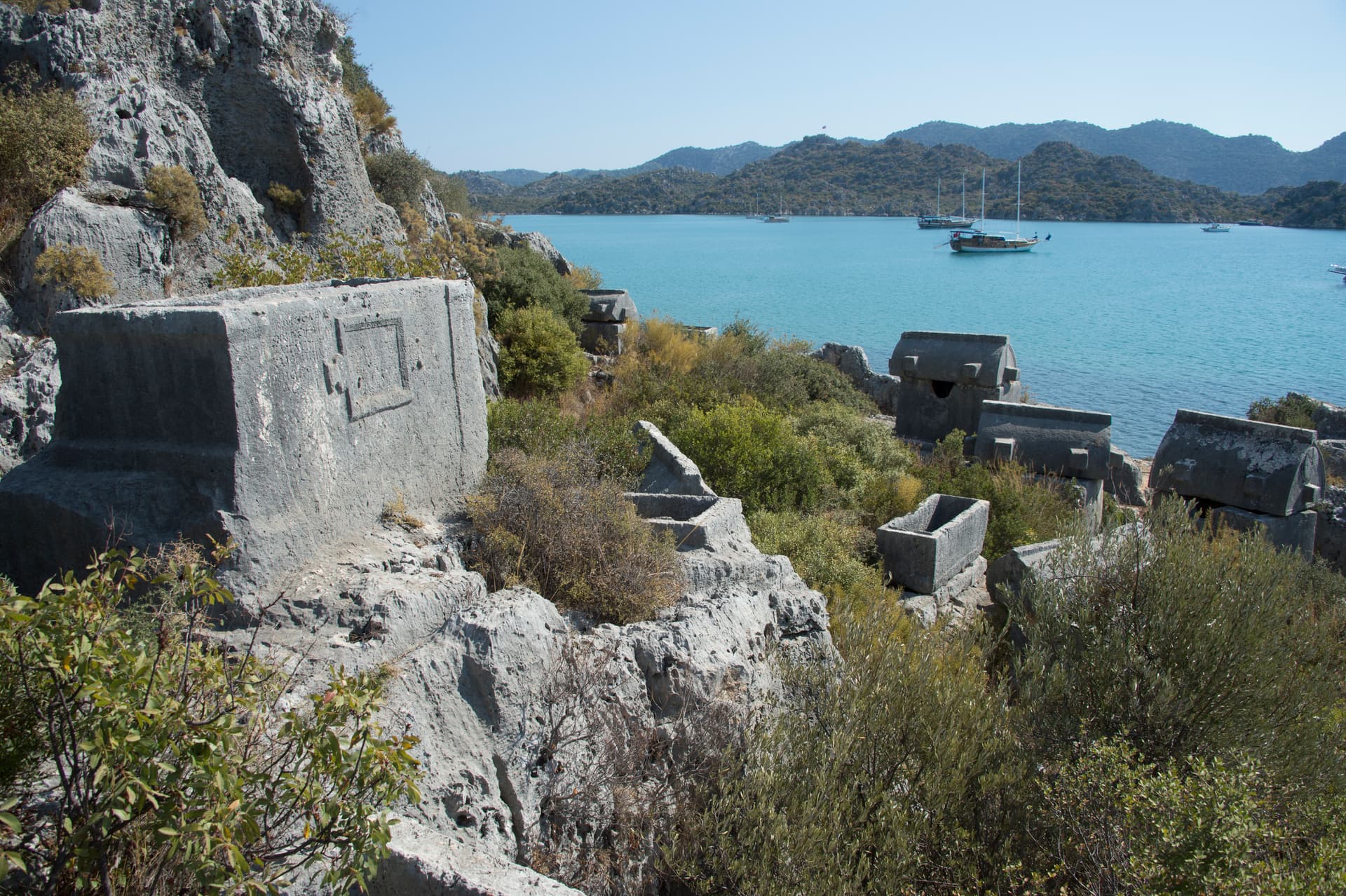
No road reaches Aperlai; visitors arrive by boat, as everyone once did, to Lycian and Roman stone above transparent water covering walls and staircases. Submerged shoreline workshops processed murex snails into Tyrian purple, antiquity's costliest pigment, eventually restricted by imperial decree to the Roman emperor. One gram required thousands of snails and weeks of work, and the workshops' smell was infamous. Yet the dye signified divinity, royalty, and sacred authority from the Phoenician coast to the Byzantine court.
The earthquake that submerged parts of the neighbouring coast also swallowed these workshops, making myth visible. Looking through the bay at ancient harbour infrastructure offers a rare Mediterranean encounter with a past felt without interpretation.
Why this place is sacred
Tyrian purple was not merely a color. In the ancient world, purple was power, divinity, and legitimacy made visible. The Phoenicians refined the process; the Romans codified its use; the Byzantine emperors reserved it entirely for themselves — to be 'born in the purple' was to be born to rule. The raw material was the murex snail, and the processing was arduous, malodorous, and enormously skilled. Aperlai was one of the sites of this production.
The murex workshops discovered by underwater archaeologist Robert Hohlfelder beneath Aperlai's waterline represent what may be the best-preserved example of this industry in the eastern Mediterranean. They are submerged because the earthquake that struck the Kekova coast in the 2nd century AD — the same earthquake that pushed large sections of the neighboring Dolichiste island below the surface — lowered the coastline here as well.
The result is a palimpsest in water: the ancient harbor infrastructure visible as shadow and shape through the Aegean clarity, inhabited now only by fish and light. The symbolic resonance of this particular submersion is difficult to avoid.
A city built on the production of the most sacred pigment of the ancient world now lies at the threshold of the visible and the lost, accessible only by sea, seen most clearly when the water is still and the light comes at an angle that makes the past legible from above. Whether that resonance was intended by the sea is not a question that archaeology answers.
Lycian harbor city and commercial center; hub of murex purple-dye production and trade; member of the Kekova sympoliteia alongside Simena, Isinda, and Apollonia.
From Lycian settlement (5th–6th century BC) through Lycian League membership to Roman-era commercial peak; partial submersion by earthquake; Byzantine Christian occupation of the four churches; gradual abandonment and subsumption by the Kekova Special Protection Area.
Experience and orientation
The boat rounds a headland and the bay opens. There is no village, no dock infrastructure, no sound except water and birds. The hillside ahead rises steeply, covered with scrub and the stone of walls that have been standing since the Lycian period. Tie up or anchor and take a moment before stepping ashore. The quality of the bay's silence — its remoteness from the sailing-route crowds only a few kilometers away — is part of what Aperlai is.
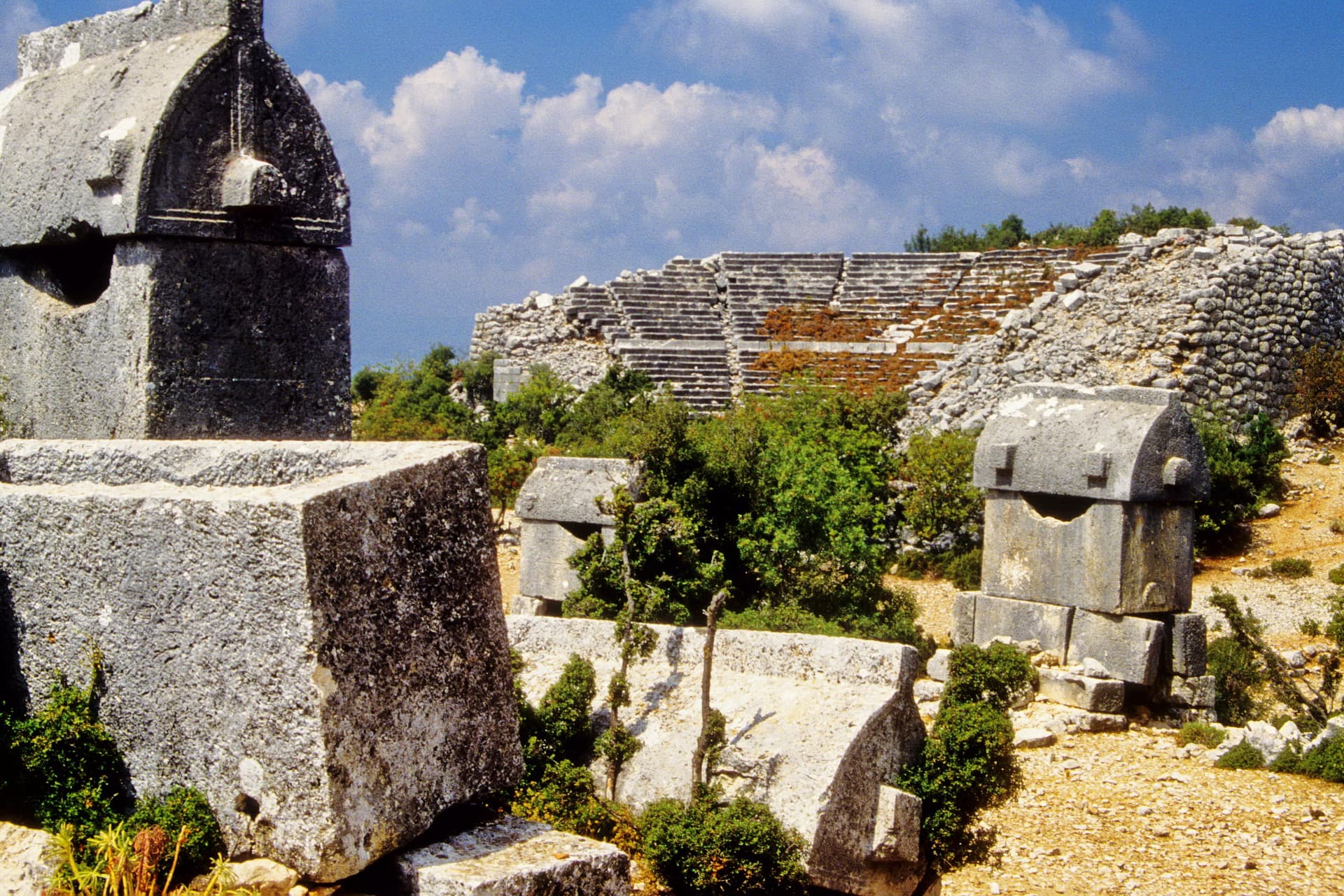
Walk up from the shore. The lower walls of the fortification are among the most impressive in the region: courses of Hellenistic stonework ascending the ridge, still complete in places to significant height. Towers punctuate the circuit at intervals. As you climb, sarcophagi appear in the vegetation — Roman-era inscribed stone coffins, some toppled, some upright, some still legible. The four Byzantine church sites are scattered across the upper city, identifiable by their apsed plans in the undergrowth.
When you reach a point with a clear view of the bay below, stop and look down. In calm conditions, in good light, the submerged harbor works are visible from the shore: staircase-edges, cistern outlines, wall-sections catching the light through the water. The murex tanks documented by Hohlfelder's team are underwater and cannot be approached by swimming — this is a protected area — but their presence below the surface is felt rather than seen.
Give the site more time than you think it needs. Aperlai is one of those places where the significance arrives slowly, through accumulated quiet.
Access is by boat only from Kaş (30–45 minutes by gulet) or from Üçağız (shorter). Day-sailing excursions from Kaş visit regularly as part of coastal touring routes. No fixed dock. Anchor or tie to shore.
Context and lineage
Aperlai's origins are confirmed by numismatic evidence: coins from the 5th or 6th century BC attest to the city's early political identity. It led a sympoliteia — a formal federal union — with three neighboring small cities: Simena, Isinda, and Apollonia. This shared polity collectively held a single vote in the Lycian League, the ancient confederation that governed the region.
The arrangement was practical for communities too small to maintain independent League status, but it required a sustained mutual identity across centuries. The sympoliteia persisted for roughly 1,300 years, through Lycian independence, Persian oversight, Hellenistic reorganization, and Roman provincial integration. Aperlai's position as the leading city of the four gave it a disproportionate importance within this small coastal federation.
The city sustained itself commercially through maritime trade and, critically, through the production and export of Tyrian purple from the murex workshops documented in and around its harbor.
Lycian (5th–6th century BC); Lycian League sympoliteia leader; Roman provincial commercial city; Early Christian community (4th–7th century AD); gradual abandonment following Byzantine period.
Robert Hohlfelder
University of Colorado underwater archaeologist who discovered and documented the submerged murex-processing workshops at Aperlai's harbor
Traditions and practice
Lycian civic and funerary practice at Aperlai followed the regional pattern: monumental sarcophagi constructed as permanent dwellings for the dead, with legal protections inscribed for their defense. The city's participation in the Lycian League through the sympoliteia gave it a communal religious and political identity shared with Simena, Isinda, and Apollonia. The murex workshops — though an industrial operation — produced a substance that carried sacred and imperial weight across the entire ancient world.
Whether the workers themselves participated in any ritual dimension of the work is not known. Four Byzantine-era churches document a significant Christian community in the late antique period.
No active religious ceremonies are associated with the site. The Kekova region's designation as a Special Environmental Protection Area means that archaeological monitoring and conservation are ongoing. The site is a regular stop on Blue Voyage sailing routes from Kaş.
The best approach is to arrive early on a sailing excursion and stay longer than the group tour schedule typically allows. Walk from shore to the top of the fortification walls, pausing at each sarcophagus encountered on the way. Find a position with a clear downward view of the bay in calm conditions and spend time with the underwater shapes visible through the water.
Do not attempt to swim to the submerged structures — this is both illegal and unnecessary; the view from shore or from a stationary boat in calm water is its own reward. The hillside scrub hides structures that reward slow exploration.
Lycian Maritime Trade and Sympoliteia
HistoricalAperlai led a formal federal union with Simena, Isinda, and Apollonia, sharing a single Lycian League vote and a communal civic identity. This arrangement persisted for over a millennium, reflecting the political and cultural unity of small coastal Lycian communities whose individual scale could not sustain independent representation.
Communal governance across four cities; shared coinage; collective representation in the Lycian League; maritime trade and murex-dye production as the economic foundation of the federation.
Early Christian
HistoricalFour churches have been identified within the city walls, indicating a substantial Christian community during the late antique period (4th–7th century AD). The number of churches relative to the city's size suggests significant religious activity.
Christian liturgy and community life; construction and maintenance of multiple church buildings within the city walls.
Archaeological and Scholarly Heritage
ActiveThe underwater murex-processing workshops discovered by Robert Hohlfelder represent a unique industrial archaeology site of global significance for understanding ancient purple-dye production. Archaeological monitoring continues within the Kekova Special Protection Area.
Underwater archaeology, surface survey, architectural documentation, environmental protection monitoring.
Perspectives and open questions
Aperlai can be understood as a lost commercial city, as a monument to a single extraordinary industry, or as a landscape where the boundary between the present and the past has become a water surface. Each reading is partial; none is wrong.
Scholarly perspective
Aperlai was a small but economically significant Lycian port city that thrived for approximately 1,300 years, sustained by maritime trade and murex purple-dye production. The sympoliteia structure with Simena, Isinda, and Apollonia — sharing a single Lycian League vote — is well-documented in League records and local coin finds. The underwater murex-processing workshops documented by Robert Hohlfelder represent one of the most significant industrial archaeology finds in the Lycian region, offering direct material evidence of purple-dye production at scale.
Living and traditional perspectives
The Lycian community at Aperlai participated in the broader Lycian cultural sphere, including ancestor veneration through monumental tomb construction and communal political representation through the sympoliteia. The production of purple dye — associated with royalty and divinity across the ancient world — may have lent the city's principal industry a quality of sacred craft, though no textual evidence explicitly frames the work in religious terms.
Alternative interpretations
The partial submersion of Aperlai's harbor is sometimes read as a symbolic threshold — a city that crossed between the visible and the lost, accessible only to those willing to come by water, its most significant feature legible only through the surface of the sea. This reading draws on a global tradition of submerged cities as portals to the past, and while it exceeds what the evidence supports, it reflects something genuine about what the place feels like.
Open questions
The full extent of the underwater site has not been comprehensively mapped. The relationship between the murex workshops and any specific cult or ritual practice remains unknown. Whether Aperlai had a sacred precinct beyond the four Byzantine churches has not been established.
Plan your visit
Access and arrival
No road access. Accessible by boat from Kaş (30–45 minutes by gulet or motor boat) or from Üçağız (shorter). Day-trip sailing excursions from Kaş and Kekova operators include Aperlai as a stop on coastal routes. No formal dock; boats anchor or moor to shore. No entry fee documented, but the site is within the protected zone. Mobile signal is unreliable at the site; Kaş town (30–45 min away by boat) is the nearest point with consistent signal.
For emergencies, your boat captain is the primary resource.
No accommodation at Aperlai. Overnight options are at Kaş (well-developed tourism infrastructure) or Üçağız (small fishing village with basic pansiyons). Blue Voyage gulets that overnight in the Kekova region may anchor in or near Aperlai bay. Check with Kaş sailing operators for current Blue Voyage itineraries.
Respectful visit
No specific dress code. Sun protection is essential on the exposed hillside. Sturdy footwear for the rough terrain.
Permitted on land throughout the site. Underwater photography near the submerged structures is subject to the Kekova Special Protection Area rules — verify what is currently permitted with your boat operator.
Not applicable to contemporary visit.
Do not enter or disturb underwater archaeological zones. Diving without permission is prohibited within the protected area. Do not remove artifacts, including sarcophagus fragments. Do not climb on tomb structures. Active excavation areas, if present, are off-limits.
Swimming and diving near the submerged ruins are regulated within the Kekova Special Protection Area; check current restrictions before entering the water. The hillside is steep and the path informal — wear appropriate footwear. Bring water; there are no facilities on site. Sun exposure on the open hillside is intense in summer months.
Location
Map loads as you approach this section.
Pilgrim reflections
A portrait of encounter, not a score
Pilgrims describe what they felt, how present they could become, and whether the place would shape a journey. There are no stars and no ranking of traditions.
No reviewed reflections yet
The first pilgrims can help describe the character of being here.
Share a reflection
Available after an account-backed “Been there.” Every reflection is reviewed before publication.
Nearby sacred places
Explore other sacred places in the region. Proximity does not establish access or travel time; check each place’s guidance.


References
Sources consulted for this page. Source categories describe the publication, not a guarantee that every claim is verified. Traditional accounts and outside interpretations may differ.
- 01Aperlae – Pleiades Ancient World Mapping CenteracademicAuthoritative geospatial and scholarly resource; provides confirmed coordinates
- 02Ancient Lycian City of Aperlai – Lycian MonumentsacademicDetailed architectural, sympoliteia, and purple-dye data
- 03Aperlai: Ancient port city built on slopes of Lycia – Daily SabahSource contextOverview of sunken ruins and architectural features
- 04Aperlai Bay: Heart of Royal Purple Dye and Sunken Ancient Lycia – Med GuletsguideGood description of murex industry and coastal access
- 05Aperlai – Heart of Amazing Lycian Purple – Tours Around TurkeyguideDescribes the purple-dye workshops and cultural significance
- 06Aperlai – All About TurkeyguideOverview of history and visitor access
- 07The History of Kekova – Kekova SailingSource contextRegional context for Aperlai within the Kekova Lycian federation
Share a photo
Help visitors recognize Aperlai. Every submission is reviewed before publication.