Chōsen-in
Chichibu #29 — the 'Stone Tablet Hall' of the Urayama valley
Understand sacred places, explore living traditions, and learn how to engage respectfully with Pilgrim Map.
Access has not been verified. Check current local guidance before planning a visit.
Chichibu, Saitama Prefecture, Japan
Read the sources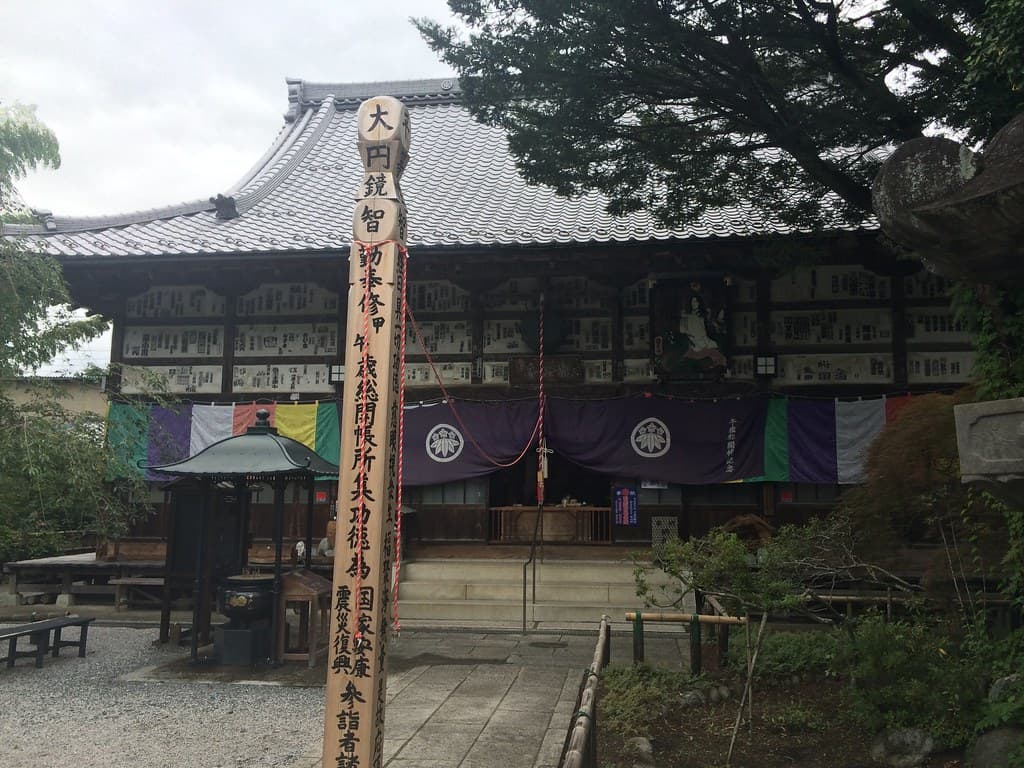
Image of Chōsen-in (長泉院). Image source
Station 29 of 34
Chichibu 34 Kannon PilgrimageVisit essentials
A quick read before you go
- Duration
- 30–45 minutes for a focused visit.
- Access
- Approach the temple by crossing the Shojō Bridge over the Urayama River from the central…
Overview
Chōsen-in stands across the Urayama River from central Chichibu, at the foot of Mount Sasado, approached over Shojō Bridge with the 156-metre Urayama Dam visible upstream. It is the 29th (#29) of the 34 Chichibu Kannon fudasho and a Sōtō Zen temple under the mountain name Sasado-san. Its principal image is Shō Kannon—Sacred Avalokiteśvara—a roughly 55 cm standing wooden hibutsu (secret Buddha), opened only at the once-every-twelve-years sōkaichō.
The Bunsei-era main hall (1818–1830) contains a cherry-blossom transom panel locally attributed to Katsushika Hokusai, a popular claim that remains unverified in available scholarship. Outside, centuries-old stone votive tablets crowd the precinct, materialising generations of pilgrim prayer. At this threshold to the route's most physically demanding stretch, many pilgrims pause before continuing through Hōun-ji (#30), Kannon-in (#31), Hōshō-ji (#32), and toward the kechigan-jo at Suisen-ji (#34).
Why this place is sacred
Chōsen-in's quality of thinness rests on three layered registers. The first is the stone-tablet accumulation. The temple's nickname — 'Ishifuda-dō', Stone Tablet Hall — reflects the dense cluster of sekisatsu (stone votive tablets) that fill the precinct. Pilgrims have left tablets here for centuries; the legend of the 1234 thirteen founding monks reaches into the temple's deepest layer, and successive generations have continued the practice. The visual effect is direct: the precinct is materially saturated with prayer.
A pilgrim who adds an osamefuda or simply stands among the tablets is layered onto centuries of earlier offerings.
The second register is the position. Chōsen-in sits at the threshold of the Chichibu route's most physically demanding section. Pilgrims arrive here after the limestone-cave passage of Hashidate-dō (#28) — for many, the somatic climax of the route — and from #29 the path turns toward the long western mountain stretch: Hōun-ji (#30) at Shiraku, the steep 296-step climb at Kannon-in (#31), the cliff-built Kannon-dō at Hōshō-ji (#32), the moral-painting precinct at Kikusui-ji (#33), and the kechigan-jo at Suisen-ji (#34).
The temple's relative quiet, the simple Zen garden flanked by stone lanterns, and the small Shō Kannon image together produce a felt sense of pause: a place to take stock before the climb begins.
The third register is the layered legendary narrative. The 990 CE founding tradition — mysterious lights at the foot of the mountain, a dragon-maiden apparition, and a cave-enshrined Kannon — places the temple in mid-Heian devotional imagination. The 1234 stone-tablet narrative places it in the foundational moment of the Chichibu route as a whole. The Bunsei-era main hall (1818–1830) places it in the late-Edo high tide of pilgrim traffic.
The transom-panel painting locally attributed to Katsushika Hokusai, depicting cherry blossoms above the altar, places it in early-19th-century popular pilgrim culture. The temple holds these layers without forcing them into a single chronology, and pilgrims who pause here often find that the layered quality of the precinct mirrors the layered quality of the route itself.
Experience and orientation
Crossing Shojō Bridge over the Urayama River gives a distinctive approach, with a view upstream toward the 156-metre Urayama Dam before the road climbs gently to the san-mon. Inside, stone lanterns line a quiet path to the Bunsei-era main hall and small Zen garden, while the dense sekisatsu create the precinct's defining visual texture.
Pilgrims light incense, offer coins, and recite the Heart Sutra (Hannya Shingyō) and Kannon mantra. The roughly 55 cm standing Shō Kannon is hidden except during the once-every-twelve-years sōkaichō. Above the altar, a cherry-blossom transom panel is locally, but not independently, attributed to Katsushika Hokusai. A focused visit usually takes thirty to forty-five minutes, longer when combined with #28 Hashidate-dō and #26 En'yū-ji.
From the recommended En'yū-ji-Daien-ji-Hashidate-dō walking segment, cross the Shojō Bridge over the Urayama River and continue on the road climbing gently toward Mount Sasado. Bow at the san-mon (mountain gate), walk past the stone lanterns and the dense sekisatsu (stone votive tablets), and approach the Bunsei-era main hall. Light incense, offer at the saisen box, and recite the Heart Sutra or the Kannon mantra. Note the transom-panel cherry-blossom painting locally attributed to Katsushika Hokusai.
Receive the goshuin at the temple office. Continue westward toward Hōun-ji (#30) and the mountain section that follows.
Context and lineage
Two strands of legendary narrative attach to Chōsen-in. The first, recorded in Japanese-language sources, places the founding in 990 CE (mid-Heian period). Mysterious lights are said to have appeared at the foot of the mountain. Pilgrim monks were guided by villagers to a cave on the slope, where a Kannon statue was discovered and the first hall was raised to enshrine it. The temple's mountain name, Sasado-san, is associated with this founding-era setting.
The second strand links the temple to 1234 — the date traditionally given for the founding of the Chichibu pilgrimage as a whole. According to local tradition, thirteen founding monks (sometimes identified as the originators of the Chichibu fudasho route) left stone tablets at this site, giving the temple its 'Ishifuda-dō' (Stone Tablet Hall) nickname. The dense sekisatsu accumulation in the precinct is read locally as continuous with this foundational practice.
Documentary evidence for both narratives is legendary; academic studies (USC Scalar) date the documentable formation of the 34-temple Chichibu route to the late 15th century, with peak pilgrim traffic in the Bunka-Bunsei era (1804–1830) of the late Edo period. The current main hall dates from this peak era; the Bunsei-period building (1818–1830) is the structure that surviving pilgrim accounts describe.
Inside the hall, a transom-panel painting depicting cherry blossoms is locally attributed to Katsushika Hokusai — a popular claim in Japanese-language sources that has not been independently verified in available scholarship.
Chōsen-in is a Sōtō Zen temple under the mountain name Sasado-san, part of the broader pattern in which roughly twenty of the thirty-four Chichibu fudasho came under Sōtō administration during the late medieval period. The temple combines Zen monastic discipline with the Japanese Kannon-devotion tradition that gives the Chichibu pilgrimage its character. The Shō Kannon devotion at the heart of the precinct is older than the surviving structures.
The 990 CE legendary founder (unnamed)
Founder in legendary tradition
Per local tradition, mysterious lights appeared at the foot of Mount Sasado, leading villagers to guide pilgrim monks to a cave where a Kannon statue was discovered. The first hall was built to enshrine the image. Specific names are not recorded; the founding is dated traditionally to 990 CE without contemporary documentary support.
The thirteen founding monks of the Chichibu pilgrimage (legendary, 1234)
Originators of the Chichibu fudasho route
Per a separate tradition, thirteen monks who founded the Chichibu pilgrimage in 1234 left stone tablets at this site, giving the temple its 'Ishifuda-dō' (Stone Tablet Hall) nickname. The narrative is legendary; academic studies date the documentable formation of the 34-temple route to the late 15th century.
Katsushika Hokusai (1760–1849) — local attribution
Cherry-blossom transom panel
A transom-panel painting in the main hall depicting cherry blossoms is locally attributed to Hokusai. The attribution is popular in Japanese-language sources but has not been independently verified in available scholarship; whether or not it is Hokusai's work, the panel is part of the temple's late-Edo cultural fabric.
The Bunsei-era builders of the present main hall (1818–1830)
Late-Edo reconstructors
Builders of the current main hall, built during the late-Edo Bunsei era — coinciding with the peak of pilgrim traffic on the Chichibu route. Specific names are not recorded in available English-language sources.
Resident Sōtō Zen clergy
Contemporary stewards
The Sōtō community responsible for daily ritual, pilgrim hospitality, the issuance of goshuin, and stewardship of the precinct's stone-tablet accumulation, the Bunsei-era main hall, and the small Shō Kannon principal image.
Traditions and practice
The temple follows Sōtō Zen ritual forms, with a strong Kannon-devotion overlay. Pilgrims arriving at the main hall light incense, offer coins at the saisen box, and recite the Heart Sutra (Hannya Shingyō) and the Kannon mantra. Standard Chichibu observances also include bowing at the san-mon, water purification at the temizuya, leaving an osamefuda (name slip) inside the hall, and receiving the goshuin temple stamp at the office.
The dense accumulation of sekisatsu (stone votive tablets) in the precinct is part of the working practice: pilgrims pause among the tablets to recognise their own offerings as part of a centuries-long material continuity.
Pilgrims arrive year-round for the Chichibu #29 nōkyō and goshuin, which are issued at the temple office. Many pilgrims walk the recommended day-trip segment from #26 En'yū-ji through #27 Daien-ji and #28 Hashidate-dō to #29 Chōsen-in, a route of roughly 6.4 km. The 12-yearly Chichibu sōkaichō (year-of-the-horse total unveiling) opens from 18 March 2026 and runs through the year, bringing a major upsurge in pilgrim and visitor traffic and the rare opportunity to view the principal Shō Kannon image directly.
Allow thirty to forty-five minutes for a focused visit, longer if combining the recommended walking segment from #26 onward. Pause among the sekisatsu before approaching the main hall: the dense accumulation of stone tablets, against the simple Zen garden and stone lanterns, gives the precinct its distinctive character. Inside, take a moment with the transom-panel cherry-blossom painting locally attributed to Hokusai.
Many pilgrims use Chōsen-in as a place of consolidation — a quiet stop to take stock before the long mountain section that begins at #30 Hōun-ji.
Buddhism
ActiveChōsen-in is an active Sōtō Zen temple under the mountain name Sasado-san (笹戸山). It belongs to the Sōtō dominance of approximately twenty of the thirty-four Chichibu fudasho — a pattern that took shape across the late medieval period. The principal image is Shō Kannon (Sacred Avalokiteśvara), a standing wooden statue roughly 55 cm tall, kept as a hibutsu (secret Buddha) in the main hall. The temple is widely known among pilgrims as 'Ishifuda-dō' (石札堂, 'Stone Tablet Hall') for the dense accumulation of sekisatsu (stone votive tablets) that crowd the precinct — read locally as continuous with the foundational 1234 narrative of the thirteen monks who first walked the Chichibu route. The current main hall dates from the late-Edo Bunsei era (1818–1830), the peak of pilgrim traffic on the Chichibu circuit. Inside, a transom-panel painting depicting cherry blossoms is locally attributed to Katsushika Hokusai (a popular but unverified attribution).
Chichibu 34 Kannon Pilgrimage
Active29th station of the Chichibu Kannon pilgrimage and component of the Japan 100 Kannon (Hyakkannon) supersystem. Sits at the threshold of the route's most physically demanding section — the long western stretch through Hōun-ji (#30), the steep mountain temples Kannon-in (#31) and Hōshō-ji (#32), Kikusui-ji (#33), and the kechigan-jo at Suisen-ji (#34). Reached by crossing the Shojō Bridge over the Urayama River, with views upstream toward the 156-metre Urayama Dam.
Perspectives and open questions
Chōsen-in is a temple where a Heian-era founding legend, a 13th-century pilgrimage origin narrative, a late-Edo main hall, and centuries of accumulated stone tablets share a single Sōtō Zen precinct. Holding the layers open is the most honest way to read the site.
Scholarly perspective
Academic studies of the Chichibu pilgrimage (USC Scalar) date the documentable formation of the 34-temple route to the late 15th century, with most fudasho — including Chōsen-in — taking on their pilgrimage identities as the route stabilised. The peak of pilgrim traffic was in the Bunka-Bunsei era (1804–1830) of the late Edo period; the present main hall dates from this peak era. The 990 CE founding tradition is legendary without contemporary documentary support, as is the 1234 thirteen-monks narrative.
The transom-panel cherry-blossom painting locally attributed to Hokusai has not been independently verified in available scholarship.
Living and traditional perspectives
Local Sōtō Zen tradition holds Chōsen-in's founding to 990 CE and emphasises the dragon-maiden apparition and the cave-enshrined Kannon. The 'Ishifuda-dō' identity links the temple directly to the foundational 1234 narrative of the Chichibu pilgrimage's thirteen originating monks. The dense sekisatsu accumulation in the precinct is read locally as continuous with this founding practice — every tablet a small materialisation of pilgrim prayer, layered onto centuries of earlier offerings.
Alternative interpretations
Some popular accounts associate the temple's stone-tablet practice with merit-transfer cosmology (ekō) — the idea that prayers inscribed in stone continue to radiate benefit indefinitely, accumulating across pilgrim generations. The temple's role as a place of consolidation before the route's most demanding mountain section is also a working part of its alternative reading: a quiet hinge in a difficult journey.
Open questions
{"The exact provenance and carving date of the principal Shō Kannon statue (~55 cm standing wooden image) are not securely recorded","The 990 CE founding date and the 1234 thirteen-monks narrative are legendary without contemporary documentary support","The attribution of the transom-panel cherry-blossom painting to Katsushika Hokusai has not been independently verified in available scholarship","The current head priest and full pilgrim-office hours are not exhaustively retrieved"}
Plan your visit
Access and arrival
Approach the temple by crossing the Shojō Bridge over the Urayama River from the central Chichibu walking route. Nearest rail stations are on the Chichibu Railway (Urayamaguchi area). The full walking segment from #26 En'yū-ji through #27 Daien-ji and #28 Hashidate-dō to #29 Chōsen-in is roughly 6.4 km and is a popular guided section. From Tokyo, take the Seibu Ikebukuro Line to Seibu-Chichibu, transfer at Ohanabatake to the Chichibu Railway. Standard temple hours: roughly 8:00–17:00 (March–October), 8:00–16:00 (November–February).
Mobile phone signal is reliable on all major Japanese carriers in the Urayama valley.
Chichibu City offers a wide range of accommodations, from small ryokan in the valley to mid-range hotels around Seibu-Chichibu Station. Pilgrims walking the popular En'yū-ji-to-Chōsen-in segment commonly stay one or two nights in central Chichibu.
Respectful visit
Modest, comfortable clothing; sturdy walking shoes for the gently climbing approach. Pilgrim attire — oizuru, sugegasa, kongō-zue — welcome.
External photography is generally permitted in the precincts. Photography of enshrined images and inside the main hall may be restricted, particularly during the 12-yearly sōkaichō unveiling. Check posted signs.
Coin offerings (saisen) at the main-hall offertory box; incense and candles. Pilgrims leave osamefuda name slips. Goshuin fee typically ¥300–¥500.
Step over, not on, the threshold of the san-mon | Do not move, lean against, or rearrange the sekisatsu (stone votive tablets) in the precinct | Speak quietly inside the hall and within the san-mon | Do not enter areas marked off to lay visitors | Avoid disturbing meditators or services in progress
Speak quietly inside the hall and within the san-mon. Do not move or rearrange the stone tablets in the precinct — they are votive offerings, not decorative features. Photography of enshrined images and inside the main hall may be restricted, particularly during the 12-yearly sōkaichō unveiling; check posted signage. The road approach from the Shojō Bridge climbs gently and is generally easy walking, but icy conditions in winter make footing unreliable.
Current practical details
Address
557 Arakawakamitano, Chichibu, Saitama 369-1802, Japan
Phone
Hours, fees, and access can change — verify on the official source before you travel. Practical details last checked Jun 2026.
Location
Map loads as you approach this section.
Pilgrim reflections
A portrait of encounter, not a score
Pilgrims describe what they felt, how present they could become, and whether the place would shape a journey. There are no stars and no ranking of traditions.
No reviewed reflections yet
The first pilgrims can help describe the character of being here.
Share a reflection
Available after an account-backed “Been there.” Every reflection is reviewed before publication.
Nearby sacred places
Explore other sacred places in the region. Proximity does not establish access or travel time; check each place’s guidance.


References
Sources consulted for this page. Source categories describe the publication, not a guarantee that every claim is verified. Traditional accounts and outside interpretations may differ.
- 0129番 長泉院 – 秩父札所 (Official Chichibu Fudasho Association) — Chichibu Fudasho AssociationofficialOfficial pilgrimage website. Confirms Sōtō Zen affiliation, mountain name Sasado-san, principal image.
- 02Chichibu 34 Kannon Pilgrimage: Suggested Day Trip Route — Chichibu Omotenashi Tourism OrganizationofficialTourism authority. Mentions stone tablet (sekisatsu) tradition originating with a 1234 holy man's visit.
- 03Pilgrimages — Canton to Chichibu: The Chichibu 34 Fudasho Kannon Pilgrimage—An Introduction — USC Scalar (academic platform)academicAcademic overview of pilgrimage history. Notes that the pilgrimage's documented origins trace to the late 15th century, with peak Bunka–Bunsei (1804–1830) popularity.
- 04札所29番 笹戸山 長泉院 - 秩父市 (Chichibu City Government) — Chichibu CityofficialMunicipal government cultural-property page.
- 05Chichibu 34 Kannon Sanctuary - Wikipedia — Wikipedia contributorsofficialGeneral reference; cross-checked against official sources.
- 06長泉院 (秩父市) - Wikipedia (Japanese) — Wikipedia contributorsofficialJapanese Wikipedia. Records dragon-maiden legend, 990 founding tradition, 55cm Shō Kannon statue, Hokusai 'Cherry Blossoms' transom panel.
- 07The Temple Guy: The Chichibu 34 Kannon Route — James Baquet (The Temple Guy)guideDetailed pilgrim's first-hand account of all 34 temples; notes Chōsen-in is also called Ishifuda-dō (Stone Tablet Hall).
Pilgrim glossary
- Kannon
- The bodhisattva of compassion, central to many East Asian pilgrimage routes.
- Sutra
- A canonical Buddhist scripture, often chanted as part of practice.
- Mantra
- A sound, word, or phrase repeated as part of meditation or ritual.
- Zen
- A Japanese Buddhist school emphasizing seated meditation and direct insight.
Share a photo
Help visitors recognize Chōsen-in. Every submission is reviewed before publication.