Kyūshō-ji
Otehan-dera, where pilgrims hold a stone seal against the underworld
Understand sacred places, explore living traditions, and learn how to engage respectfully with Pilgrim Map.
Access has not been verified. Check current local guidance before planning a visit.
Chichibu, Saitama Prefecture, Japan
Read the sources
Station 25 of 34
Chichibu 34 Kannon PilgrimageVisit essentials
A quick read before you go
- Duration
- 30–45 minutes for prayer, lotus pond, Jizō pavilion, and goshuin.
- Access
- Address 〒368-0053 Kuna 2315, Chichibu, Saitama.
Overview
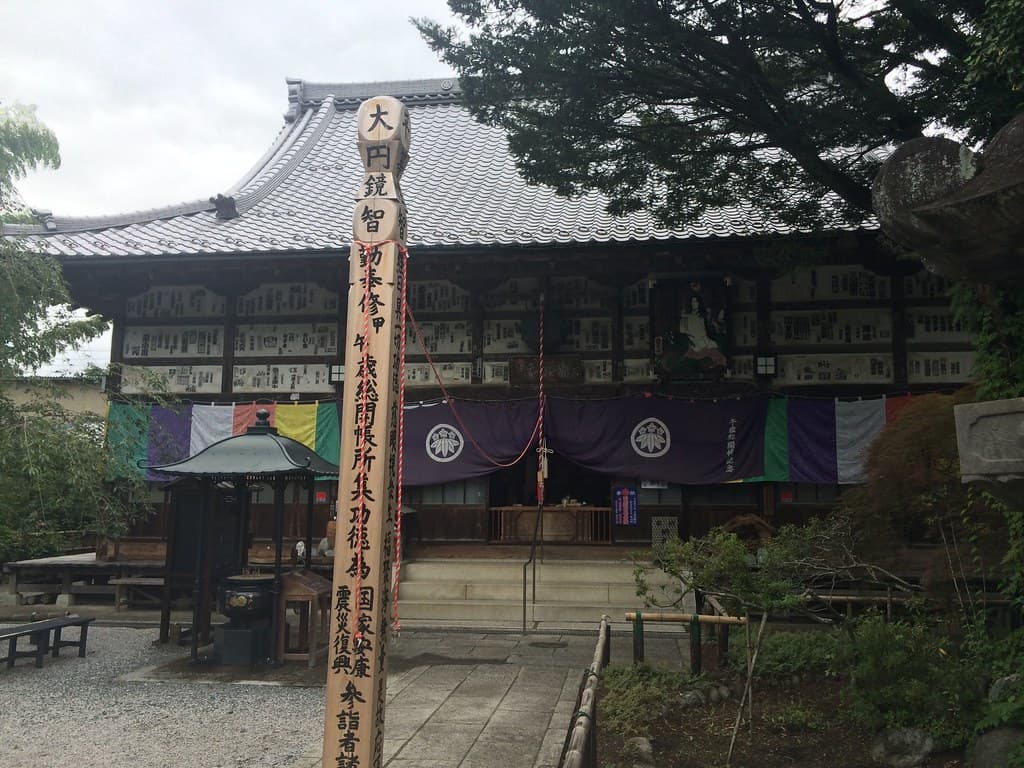
Kyūshō-ji marks the endpoint of the Nagaone-michi, the historic walking section that begins at Iwanoue-dō (#20). Pilgrims who arrive on foot have spent most of a day in the surrounding hills, and the approach across Benten-ike pond — with summer lotus blooming in late June through early August — gives the precinct an unmistakably Pure Land quality. The temple's full name is Iwaya-zan Kyūshō-ji (岩谷山 久昌寺), and its principal image is Shō Kannon, the Sacred Kannon.
The temple is widely known as Otehan-dera, 'Hand-Seal Temple,' for one of the most consequential legends of the entire Chichibu pilgrimage. Tradition holds that the monk Shōku, one of the thirteen founders of the Chichibu route, journeyed to the afterlife and received from King Enma a stone seal — otehan, お手判 — as proof that pilgrims who completed the Chichibu 34 would not be sent to hell.
Shōku enshrined the seal at this site, and the temple's nickname has held ever since.
The Jizō pavilion sharpens the otehan promise into a practical teaching. Inside it stands a striking statue of Datsueba, the underworld grandmother who strips souls of their clothing at the Sanzu River, the boundary between this world and the next. Datsueba is unsettling in a way few precinct figures are; she turns the temple, briefly, into a small theatre of the death-and-rebirth cycle.
The boundary stone at the gate, inscribed with the traditional monastic prohibition on bringing strong-smelling food or alcohol into the precincts, is itself a small reminder of the threshold quality of the place.
Why this place is sacred
Kyūshō-ji's threshold quality is structured around afterlife crossing. The otehan tradition explicitly frames the temple as a boundary site between this world and the next — a place where a stone seal received from King Enma functions as a kind of pilgrim's passport. The Datsueba statue in the Jizō pavilion makes that crossing physically present in the precinct: the underworld grandmother stripping souls' clothing at the Sanzu River.
The Benten-ike pond, with summer lotus, doubles the imagery in a Pure Land register. The pond, the hall, the seal, and the underworld figure together turn the temple into a compact theatre of the death-and-rebirth cycle, with the pilgrim cast briefly as the soul about to cross.
By tradition, established by the monk Shōku of the thirteen Chichibu pilgrimage founders to enshrine the otehan stone seal received from King Enma. Specific pre-Edo institutional history is not documented in available sources.
The current Kannon hall is documented as built in 1721, mid-Edo period. Sōtō Zen administration has held through the post-Meiji period. The lotus pond, Jizō pavilion with Datsueba, and boundary stone at the gate together preserve a layered Edo-era programme that frames the temple as an afterlife threshold.
Experience and orientation
Pilgrims walking from #20 reach Kyūshō-ji as the last station before the route turns toward #26. The approach crosses Benten-ike pond, where lotus blooms from late June through early August. Read the boundary stone at the gate: it inscribes the traditional prohibition on bringing strong-smelling food or alcohol into the precincts, a small but specific reminder that the precinct asks for sensory cleanliness. Inside, the 1721 Kannon hall sits in a quiet valley setting.
Light incense, recite the Heart Sutra before the Shō Kannon, and request goshuin. Then walk to the Jizō pavilion. The Datsueba statue is unsettling and instructive in equal measure — the underworld grandmother stripping souls' clothing at the Sanzu River.
Pilgrims who have walked the full Nagaone-michi often arrive at this image with the weight of a long day in their legs, and the contrast between the cumulative effort of the walk and the sudden exposure to the death-and-rebirth iconography is the temple's particular gift.
The goshuin desk staff will explain the otehan tradition to pilgrims who ask.
The temple sits in Kuna district, Chichibu, at the end of the Nagaone-michi walking section. Hōsen-ji (#24) lies to the south on the same road; En'yū-ji (#26) is the next station to the north.
Context and lineage
Founding date is not specified in available sources. Tradition links the temple's origin to the monk Shōku, one of the thirteen legendary founders of the Chichibu pilgrimage, who is said to have journeyed to the afterlife and received from King Enma a stone hand-seal (otehan) as proof that pilgrims who completed the Chichibu 34 would not be sent to hell. Shōku enshrined the seal at this site, and the temple has been called Otehan-dera, 'Hand-Seal Temple,' since.
The current Kannon hall is documented as built in 1721. Pilgrimage scholarship treats the otehan story as devotional rather than historical, while recognising it as one of the most consequential legends on the route.
Sōtō Zen Buddhism.
The monk Shōku (legendary)
One of the thirteen legendary founders of the Chichibu pilgrimage; received the otehan stone seal from King Enma in the afterlife and enshrined it at this site, by tradition. Historicity uncertain.
King Enma
Buddhist judge of the dead in East Asian cosmology; the legendary issuer of the otehan stone seal that exempts Chichibu pilgrims from hell.
Datsueba
The underworld grandmother enshrined in the Jizō pavilion; she strips souls of their clothing at the Sanzu River boundary between this world and the next.
The Shō Kannon honzon
Principal image of the hall.
The 1721 hall builders
Builders of the current mid-Edo Kannon hall. Specific identities unknown.
Traditions and practice
Heart Sutra recitation before the Shō Kannon. Goshuin reception at the nōkyōjo. Quiet contemplation at the Datsueba statue and the otehan reliquary. The boundary stone's prohibitions on strong-smelling food and alcohol within the precinct are observed. The once-every-twelve-years umadoshi (Year of the Horse) general unveiling — 2026 is one such year — exposes the inner sanctum from spring through late autumn.
Year-round Chichibu pilgrimage. The 2026 umadoshi unveiling year increases pilgrim traffic dramatically. The lotus pond at Benten-ike is at its peak from late June through early August.
Walk the Nagaone-michi from #20 if possible; arriving on foot is part of the otehan teaching. At the gate, read the boundary stone before entering. After incense and sutra recitation, walk to the Jizō pavilion and stand briefly with the Datsueba statue. Ask at the goshuin desk about the otehan tradition; the staff will often explain. The lotus pond rewards a slow walk back across after the visit.
Sōtō Zen Buddhism
ActiveKyūshō-ji is the 25th temple of the Chichibu 34 Kannon Pilgrimage, a Sōtō Zen temple enshrining Shō Kannon. Its identity is shaped by the otehan tradition — the legend that a stone seal from King Enma guarantees pilgrims who complete the Chichibu 34 will not be condemned to hell — and by the Datsueba statue in the Jizō pavilion that makes underworld iconography physically present in the precinct.
Otehan / King Enma legend (devotional)
ActiveThe otehan tradition gives the cumulative effort of the Chichibu 34 a specific soteriological meaning. The temple is widely known by its nickname Otehan-dera ('Hand-Seal Temple'), and the goshuin desk staff routinely explain the legend to pilgrims who ask. The story is treated as devotional rather than historical but functions as a living frame for pilgrim practice.
Perspectives and open questions
Kyūshō-ji asks pilgrims to hold an unusual idea in mind — that the act of walking the Chichibu 34 has soteriological consequence, that the cumulative journey itself functions as protection in the next life. The Datsueba statue and the otehan stone seal are paired teachings about what is stripped away and what is carried through.
Scholarly perspective
Kyūshō-ji is securely documented as #25 of the Chichibu pilgrimage, with a 1721 Kannon Hall. Its otehan story is treated as devotional rather than historical; it nevertheless functions as one of the most cited legends of the Chichibu route and is central to the temple's identity in pilgrimage scholarship and local devotion alike. General web search sometimes confuses this Kyūshō-ji with an Oda-clan-associated temple of the same name; only the Chichibu Fudasho official source describes the actual #25.
Living and traditional perspectives
For local pilgrims, the otehan is the moral heart of the Chichibu pilgrimage — the explicit promise that the journey is also an afterlife insurance. The Datsueba is taken seriously as a memento mori, and the temple's role at the endpoint of the Nagaone-michi gives the legend a physical anchor in the day's walking.
Alternative interpretations
Some readings interpret the Datsueba and the otehan as a paired teaching: one strips, the other authorises. The pilgrim is shown both that nothing carries through to the next life and that the journey itself can carry through. The lotus pond completes the imagery in a Pure Land register, with the precinct read as a small map of crossing.
Open questions
Whether the otehan stone is a specific physical object preserved on site or a purely narrative relic; the original founding date and pre-1721 hall history; the precise institutional arrangement under which Sōtō Zen administration consolidated.
Plan your visit
Access and arrival
Address 〒368-0053 Kuna 2315, Chichibu, Saitama. Approximately 25 minutes' walk from Chichibu Railway Urayamaguchi Station; reachable on foot from Hōsen-ji (#24) along the Nagaone-michi.
Minshuku and small hotels around Seibu-Chichibu and Urayamaguchi Stations; pilgrim-oriented inns can be booked through the Chichibu Fudasho Renraku Kyōgikai or city tourism office.
Respectful visit
Modest dress.
Permitted in precincts. The Datsueba statue is generally photographable, but ask before photographing inside the Jizō pavilion.
Saisen, incense, osamefuda.
No strong-smelling food (raw garlic, leeks) or alcohol within the precincts, per the boundary stone at the gate.
Observe the boundary-stone restrictions: no strong-smelling food (raw garlic, leeks) or alcohol within the precincts.
Current practical details
Address
2315 Kuna, Chichibu, Saitama 368-0053, Japan
Phone
Hours, fees, and access can change — verify on the official source before you travel. Practical details last checked Jun 2026.
Location
Map loads as you approach this section.
Pilgrim reflections
A portrait of encounter, not a score
Pilgrims describe what they felt, how present they could become, and whether the place would shape a journey. There are no stars and no ranking of traditions.
No reviewed reflections yet
The first pilgrims can help describe the character of being here.
Share a reflection
Available after an account-backed “Been there.” Every reflection is reviewed before publication.
Nearby sacred places
Explore other sacred places in the region. Proximity does not establish access or travel time; check each place’s guidance.


References
Sources consulted for this page. Source categories describe the publication, not a guarantee that every claim is verified. Traditional accounts and outside interpretations may differ.
- 01Kyusho-ji Temple — Chichibu Fudasho — Chichibu Omotenashi Tourism OrganizationofficialOfficial temple page. Source for full name 岩谷山 久昌寺, Sōtō Zen sect, Shō Kannon principal image, monk Shōku tradition with King Enma stone seal (otehan), 1721 Kannon Hall, Datsueba statue in the Jizō pavilion, address Kuna 2315.
- 02The Chichibu 34 Fudasho Kannon Pilgrimage — An Introduction — USC ScalaracademicScholarly framing of Chichibu pilgrimage.
- 03Chichibu 34 Kannon Pilgrimage: Suggested Day Trip Route — Chichibu Omotenashi Tourism OrganizationofficialDay-trip itinerary positioning Kyūshō-ji as the end-point of the Nagaone-michi walk.
- 04Chichibu 34 Kannon Sanctuary — Wikipedia contributorsacademicConfirms Kyūshō-ji #25 with Shō Kannon principal image.
- 05Kyushoji Kannondo, Chichibu (reviews and notes) — WanderlogguideVisitor reports confirm Sōtō Zen affiliation, Benten-ike pond with lotus, and Shō Kannon enshrinement.
- 0634 Chichibu Temple Tours — Rural JapanguidePilgrimage walker's notes for the Nagaone-michi section culminating at #25.
Pilgrim glossary
- Kannon
- The bodhisattva of compassion, central to many East Asian pilgrimage routes.
- Sutra
- A canonical Buddhist scripture, often chanted as part of practice.
- Pure Land
- A Buddhist tradition focused on rebirth in Amida Buddha's western paradise through devotional practice.
- Zen
- A Japanese Buddhist school emphasizing seated meditation and direct insight.
Share a photo
Help visitors recognize Kyūshō-ji. Every submission is reviewed before publication.