Hashidate-dō
Chichibu #28 — the only Bato Kannon temple on the route, with a limestone rebirth cave
Understand sacred places, explore living traditions, and learn how to engage respectfully with Pilgrim Map.
Access has not been verified. Check current local guidance before planning a visit.
Chichibu, Saitama Prefecture, Japan
Read the sources
Station 28 of 34
Chichibu 34 Kannon PilgrimageVisit essentials
A quick read before you go
- Duration
- 60–90 minutes including the Kannondō prayer, cave traversal, and goshuin (when in season).
- Access
- Address: 〒369-1872 Kamikagemori 675, Chichibu, Saitama.
Overview
Hashidate-dō stands directly beneath the western edge of Mt. Bukō, on a quiet rural road between the Chichibu Railway stations of Kagemori and Urayamaguchi.
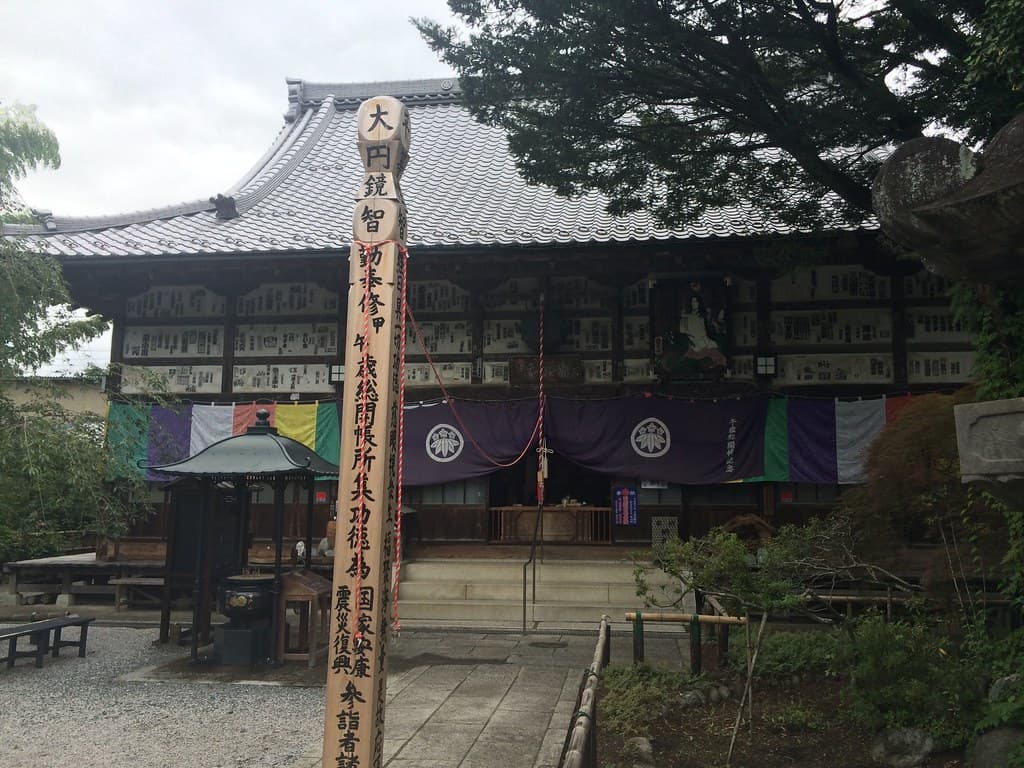
The setting is the most geomorphologically dramatic on the Chichibu route: an eighty-metre limestone cliff rises behind a crimson-lacquered Edo-period Kannon Hall (built in 1707), and immediately beside the hall is the entrance to the Hashidate Shōnyūdō — the only tourist-accessible limestone cave in Saitama Prefecture, designated a prefectural natural monument and counted among the longer show caves of central Honshu at roughly 140 metres.
The temple is unique on the Chichibu circuit in two ways. Its principal image is Bato Kannon (馬頭観音 / Hayagrīva, the Horse-Headed Kannon), a wrathful, multi-armed bodhisattva with a horse's head set into the crown — the protector of horses, livestock, travellers, and (in esoteric Buddhist understanding) of those crossing perilous paths. Every other Chichibu fudasho enshrines either Shō Kannon, Senju Kannon, Nyoirin Kannon, or another standard form; Hashidate-dō alone holds Bato Kannon as honzon.
The image itself is a Kamakura-period (12th–14th c.) wooden statue. Pilgrims and travellers historically led their actual horses up to the temple to pray for safe travel and animal welfare, and ema (votive plaques) at the precinct still carry horse and horseshoe motifs.
The second uniqueness is the cave. The Hashidate Shōnyūdō was a Shugendō yamabushi training site before the Buddhist hall was built — its tight passages and vertical shaft used for mountain ascetic practice. After the formalisation of the temple by 1707, the cave traversal continued as a lay pilgrim 'passage of rebirth': visitors enter through a low opening, climb the narrow shaft past stalactites and slick limestone, and emerge through the exit into daylight.
The geomorphology and the iconography reinforce each other — Bato Kannon as the fierce protector of those who must cross dangerous ground, and the cave as a literal enactment of crossing-and-emerging.
From the second Monday of December through the end of February, the temple is unattended for the winter and Daien-ji (#27) issues the Hashidate-dō goshuin during that period. 2026 is the once-every-twelve-years umadoshi (Year of the Horse) general unveiling — particularly resonant here, since Bato Kannon is iconographically the horse-headed Kannon, and Hashidate-dō is the route's natural focus for the Year of the Horse.
Why this place is sacred
Hashidate-dō's quality of thinness operates on three reinforcing registers. The first is geomorphological. The eighty-metre limestone cliff rising behind the Kannon Hall is a working part of the precinct's devotional reading: the cliff is the body of the mountain made visible, and the temple is built into its base rather than against it. The cave behind is the inside of the same body.
Pilgrims who enter the limestone passage move from the lighted forest precinct into a tight, cool, dark interior; the geological time signature of the cave (formed across hundreds of thousands of years of dripwater action on Cretaceous limestone) compresses the visit into a different kind of duration. The Chichibu Geopark designation of the formation makes the geological reading explicit; the Buddhist reading layers on top of it without displacing it.
The second register is the unique iconography. Of the thirty-four Chichibu fudasho, only Hashidate-dō enshrines Bato Kannon as its principal image. Where the route's many Shō Kannon halls present the bodhisattva as gentle compassionate presence, Bato Kannon is wrathful — a horse's head in the crown, an open mouth, multiple arms holding implements of fierce protection.
In esoteric Buddhist iconography, Bato Kannon is the Kannon who attends to the animal realm and to those whose journeys take them through danger: bandits, wild animals, and the perils of travel itself. Worshippers historically led their actual horses up to the temple, and the Kamakura-period wooden image continues to receive horse-and-horseshoe ema.
For 2026, the umadoshi (Year of the Horse) sōkaichō at Hashidate-dō has a structural resonance no other temple on the route can match: the horse-headed Kannon opened to view in the year of the horse.
The third register is the cave traversal as ritual rebirth. The Hashidate Shōnyūdō begins as a low, tight entrance and rises through narrow vertical sections — chains and footings provided in tighter passages — past stalactites and slick limestone. The exit, in turn, opens onto daylight at a different level of the cliff.
Pilgrims who treat the traversal as practice, not sightseeing, often describe it as the somatic climax of the entire Chichibu route: the literal squeezing-through-and-emerging that the rest of the pilgrimage symbolises. The pre-Buddhist Shugendō reading of the same passage as yamabushi mountain training is preserved, in lay form, in this contemporary practice.
Experience and orientation
Reaching Hashidate-dō is straightforward. The temple is roughly fifteen minutes' walk from Daien-ji (#27) along the same valley road, and reachable directly on foot from Urayamaguchi Station on the Chichibu Railway. From greater Tokyo, the temple is typically reached by the Seibu Ikebukuro Line to Seibu-Chichibu, then a short transfer to the Chichibu Railway at Ohanabatake.
The approach is rural and quiet. The crimson-lacquered Kannondō (1707) stands at the foot of the eighty-metre limestone cliff, the Bato Kannon enshrined inside, and the cliff face — pale limestone shot through with dark crevices — rising directly behind. Pilgrims light incense at the offering box, recite the Heart Sutra and the Bato Kannon mantra, and leave their osamefuda.
Some pilgrims and travellers leave horse- or horseshoe-shaped ema, in keeping with Bato Kannon's role as protector of horses, livestock, and travellers.
The Hashidate Limestone Cave entrance is a few steps from the Kannondō, with a separate small admission fee paid in cash at the cave booth. The traversal — roughly 140 metres in total length — passes through tight horizontal sections and narrow vertical climbs, with chains and footings in the tighter sections and lit illumination throughout. Stalactites, dripwater pools, and slick limestone walls give the passage a distinct geological texture; the air is consistently cool, even in summer.
Pilgrims who treat the traversal as devotion rather than sightseeing often pause near the tightest sections to gather attention before continuing through. Cave hours are commonly 9:00–16:30, with the last entry at 16:00; closures occur in heavy rain or snow. From the second Monday of December through the end of February the temple itself is unattended; goshuin for #28 are issued at #27 Daien-ji during this period.
From Urayamaguchi Station on the Chichibu Railway, walk along the valley road to the temple precinct beneath the limestone cliff. Bow at the gate. Light incense at the crimson Kannondō (1707), offer at the saisen box, and recite the Heart Sutra and the Bato Kannon mantra before the Kamakura-period principal image. Pay the small cash admission at the cave booth and traverse the 140-metre Hashidate Limestone Cave — including tight vertical sections — as the pilgrim's 'passage of rebirth'.
Receive the goshuin at the temple office (March through early December); in winter, collect it at #27 Daien-ji.
Context and lineage
The cliff and cave were a Shugendō (mountain-ascetic) sacred site before the Buddhist hall was built. Yamabushi practitioners used the limestone passage and the surrounding cliff face for mountain training — sutra recitation, austerity, and the embodied ordeal of squeezing through narrow rock. The pre-Buddhist phase is locally remembered but lightly documented in English-language sources.
Local devotion to a Bato Kannon image at the cave site formalised by 1707, when the present crimson-lacquered Kannondō was raised. The principal image — a wooden Bato Kannon (horse-headed, multi-armed, wrathful) — is described in official Chichibu Fudasho materials as Kamakura-period (12th–14th c.); the specific carver and provenance are not securely recorded. The image's role on the Chichibu circuit is unique: every other one of the thirty-four fudasho enshrines a Shō Kannon, Senju Kannon, or other standard form.
Pilgrims and travellers historically led their horses up to the precinct, and the temple's role as protector of livestock and travellers has been continuous since at least the early Edo period.
The Hashidate Limestone Cave was designated a Saitama Prefectural natural monument in the modern period. It is the only tourist-accessible limestone cave in Saitama Prefecture, with a length given variously as roughly 140 metres depending on whether the public-traverse passage or the full karst system is measured.
Hashidate-dō is a Sōtō Zen temple under the mountain name Sekiryū-zan ('Stone-Dragon Mountain'). Sōtō administers approximately twenty of the thirty-four Chichibu fudasho — a dominance that took shape across the late medieval and early modern periods. Beneath the Sōtō institutional layer, the cliff-and-cave precinct retains the imprint of an older Shugendō mountain-ascetic milieu, preserved today in the lay-pilgrim cave traversal.
Pre-Buddhist Shugendō yamabushi
Earliest known practitioners at the site
Mountain-ascetic practitioners who used the limestone cliff and cave for training before the Buddhist hall was built. The 'passage of rebirth' use of the cave preserves a Shugendō understanding of geographical features as embodied spiritual exercises. Their names are not recorded; their practice is preserved in the cave's contemporary devotional reading.
The unrecorded carver of the Kamakura-period Bato Kannon
Sculptor of the principal image
The principal image — a Kamakura-period (12th–14th c.) wooden Bato Kannon with a horse's head in the crown — is the focal point of veneration. The specific carver is not securely recorded. The image is unique on the Chichibu route: the only Bato Kannon honzon among the thirty-four fudasho.
The 1707 builders of the present Kannondō
Edo-period reconstructors
Builders of the crimson-lacquered Edo-period Kannon Hall set against the limestone cliff. Built in 1707 (Hōei 4), the hall has continued to enshrine the Bato Kannon image. Specific builders' names are not securely recorded.
Resident Sōtō Zen clergy
Contemporary stewards
The Sōtō community responsible for daily ritual at the Kannondō, pilgrim hospitality during the March–early December open season, the issuance of goshuin (transferred to #27 Daien-ji in winter), and stewardship of the cave-and-cliff precinct as a working pilgrimage site.
Saitama Prefecture conservation authorities
Modern conservators of the limestone cave
Prefectural natural-monument designation of the Hashidate Limestone Cave preserves the formation under protective regulation. The cave is the only tourist-accessible limestone cave in Saitama Prefecture; conservation involves controlled access, stabilised path-and-chain infrastructure, and weather-dependent closures.
Traditions and practice
The temple's liturgy follows Sōtō Zen forms, with strong Kannon-devotion overlay. Pilgrims arriving at the Kannondō light incense, offer coins at the saisen box, and recite the Heart Sutra (Hannya Shingyō) and the Bato Kannon mantra. Bato Kannon's traditional role as protector of horses, livestock, travellers, and those crossing perilous paths shapes the kinds of intentions brought here: prayers for safe travel, for animals (companion and working), and for crossing through difficult passages of life.
Ema bearing horse and horseshoe motifs are commonly left. The cave traversal — roughly 140 metres through tight horizontal and narrow vertical sections — is treated by many pilgrims as a 'passage of rebirth' (umare-kawari): a literal enactment of the death-and-rebirth structure that pervades Bato Kannon and Shugendō devotion.
Pilgrims arrive year-round during the March–early-December open season for the Chichibu #28 nōkyō and goshuin. From the second Monday of December through the end of February the temple is unattended; goshuin are issued at #27 Daien-ji during this period. Cave hours are commonly 9:00–16:30, last entry 16:00; the cave closes in heavy rain or snow.
The 12-yearly Chichibu sōkaichō (year-of-the-horse total unveiling) opens from 18 March 2026 — a year of unusual significance for Hashidate-dō, since Bato Kannon is iconographically the horse-headed Kannon and the Year of the Horse is the temple's signature celebration year.
Allow sixty to ninety minutes for a focused visit including the Kannondō prayer, the cave traversal, and the goshuin. Pilgrims who intend the cave as practice rather than sightseeing should leave time to pause in the tightest sections, gather attention, and emerge unhurried. Bring sturdy, non-slip footwear (limestone is slick); a small flashlight in addition to the cave's lighting is sometimes useful.
For pilgrims working the umadoshi 2026 sōkaichō, this temple is a natural longer stop: the unveiled image, the horse-headed iconography, and the cave traversal form a particularly resonant sequence in the Year of the Horse.
Buddhism
ActiveHashidate-dō is an active Sōtō Zen temple under the mountain name Sekiryū-zan (石龍山, 'Stone-Dragon Mountain'). It is the only one of the thirty-four Chichibu fudasho to enshrine Bato Kannon (馬頭観音 / Hayagrīva, the Horse-Headed Kannon) as its principal image — a wrathful, multi-armed bodhisattva with a horse's head set into the crown, traditional protector of horses, livestock, travellers, and those crossing perilous paths. The principal image is a Kamakura-period (12th–14th c.) wooden statue. The current Kannon Hall, a crimson-lacquered Edo-period structure, was built in 1707 (Hōei 4) at the foot of an 80-metre limestone cliff. The adjacent Hashidate Limestone Cave — the only tourist-accessible limestone cave in Saitama Prefecture, ~140 metres long, designated a Saitama Prefectural natural monument and a Chichibu Geopark site — has been pilgrim-traversed for centuries as a 'passage of rebirth'. The temple's unique iconography gives it a different valence from the route's many Shō Kannon halls: compassion not as gentle presence but as fierce protection of those on the road.
Shugendō (heritage)
HistoricalBefore the Buddhist hall was built, the towering limestone cliff and the cave system were sacred to Shugendō yamabushi practitioners as a place of mountain ascetic training. The Edo-period (1872) Meiji-era ban on Shugendō ended formal practice here, but the lay-pilgrim 'passage of rebirth' use of the cave preserves a Shugendō-style understanding of geographical features as embodied spiritual exercises.
Chichibu 34 Kannon Pilgrimage
Active28th station of the Chichibu Kannon pilgrimage and component of the Japan 100 Kannon (Hyakkannon) supersystem — the only fudasho on the entire 100 Kannon route to enshrine Bato Kannon as principal image. Widely reported by pilgrims as one of the most viscerally affecting stops on the Chichibu circuit, owing to the cliff, the cave traversal, and the unique iconography.
Perspectives and open questions
Hashidate-dō is a temple where unique Buddhist iconography, pre-Buddhist mountain asceticism, and dramatic limestone geology converge on a single precinct beneath an eighty-metre cliff. Holding all three open is the most honest way to read the site.
Scholarly perspective
Hashidate-dō is securely documented as Chichibu #28 with Bato Kannon as the unique principal image among the thirty-four fudasho. The 1707 (Hōei 4) Kannon Hall date and the Kamakura-period dating of the wooden Bato Kannon image are accepted by the official Chichibu Fudasho. The Hashidate Limestone Cave is a designated Saitama Prefectural natural monument and is part of the Chichibu Geopark.
The pre-Buddhist Shugendō use of the cliff and cave is generally accepted in local historiography but is lightly documented in surviving English-language sources. The administrative arrangement under which #27 Daien-ji issues #28's goshuin during the December–February winter closure is well-attested in current pilgrimage literature.
Living and traditional perspectives
Local Sōtō Zen and pilgrim tradition treat the cave as a 'passage of rebirth' (umare-kawari): the entry, narrow squeeze, and emergence enacting the death-and-rebirth structure that animates Bato Kannon devotion. Bato Kannon is read as the Kannon who attends to those crossing dangerous ground — bandits, wild animals, the perils of travel — and as the protector of horses and livestock.
The Year of the Horse (umadoshi) sōkaichō has special weight at Hashidate-dō because of the horse-headed iconography; pilgrims commonly identify the temple as the route's natural focus for the Year of the Horse.
Alternative interpretations
Esoteric Buddhist readings interpret Bato Kannon as the Kannon who reaches into the animal realm — the horse's head signifying that compassion penetrates even into animal incarnations. The cave's vertical descent and re-emergence enacts a rebirth-realm crossing in body. Geological readings, in turn, treat the limestone cliff and cave as a Cretaceous karst formation older than human history; the Geopark designation makes that reading explicit alongside the devotional one without displacing it.
Open questions
{"Specific carver and commissioning circumstances of the Kamakura-period Bato Kannon are not securely recorded","Pre-1707 history of any earlier hall on the same site is not securely documented","Full extent of pre-Buddhist Shugendō use of the cave remains lightly documented in English","Cave length is given variously as roughly 140 metres depending on whether the public-traverse passage or the full karst system is measured"}
Plan your visit
Access and arrival
Address: 〒369-1872 Kamikagemori 675, Chichibu, Saitama. Reachable on foot from Urayamaguchi Station on the Chichibu Railway; about fifteen minutes' walk from #27 Daien-ji. From Tokyo, take the Seibu Ikebukuro Line to Seibu-Chichibu, transfer at Ohanabatake to the Chichibu Railway, alight at Urayamaguchi. Cave admission is paid separately in cash at the cave booth (commonly ¥200–¥400 adults). Mobile phone signal is reliable on all major Japanese carriers in the valley; signal inside the cave itself is limited.
Chichibu City offers a wide range of accommodations, from small ryokan to mid-range hotels around Seibu-Chichibu Station. Pilgrims doing the En'yū-ji-Daien-ji-Hashidate-dō walking segment commonly stay one or two nights in central Chichibu.
Respectful visit
Modest, comfortable clothing; sturdy non-slip footwear for the cave; warm clothing in cooler months as the cave is consistently cool. Pilgrim attire — oizuru, sugegasa, kongō-zue — welcome at the Kannondō.
Permitted in the precincts and at the cave entrance. Flash photography inside the cave may be restricted; interior photography of the Bato Kannon may be limited, especially during the 12-yearly sōkaichō unveiling. Check posted signage.
Saisen, incense, candles, osamefuda. Some pilgrims leave horseshoe-shaped or horse-themed ema for Bato Kannon. Goshuin fee typically ¥300–¥500.
Do not touch stalactites or limestone formations in the cave — protected as a prefectural natural monument | Stay on the marked path inside the cave; use the chains and footings as provided | Cave closes in heavy rain or snow; check before travelling in unstable weather | Winter closure: temple unattended from second Monday of December through end of February; goshuin issued at #27 Daien-ji
The cave's tight passages, narrow vertical sections, and slick limestone may not suit visitors with mobility limitations or claustrophobia. The cave closes in heavy rain or snow. Speak quietly inside the Kannondō and the cave; sound carries. Do not touch stalactites or formations in the cave — they are protected as a Saitama Prefectural natural monument.
Photography of the principal Bato Kannon image inside the hall may be restricted, particularly during the 12-yearly sōkaichō unveiling; flash photography in the cave may also be restricted, depending on signage.
Current practical details
Address
675 Kamikagemori, Chichibu, Saitama 369-1872, Japan
Phone
Hours, fees, and access can change — verify on the official source before you travel. Practical details last checked Jun 2026.
Location
Map loads as you approach this section.
Pilgrim reflections
A portrait of encounter, not a score
Pilgrims describe what they felt, how present they could become, and whether the place would shape a journey. There are no stars and no ranking of traditions.
No reviewed reflections yet
The first pilgrims can help describe the character of being here.
Share a reflection
Available after an account-backed “Been there.” Every reflection is reviewed before publication.
Nearby sacred places
Explore other sacred places in the region. Proximity does not establish access or travel time; check each place’s guidance.



References
Sources consulted for this page. Source categories describe the publication, not a guarantee that every claim is verified. Traditional accounts and outside interpretations may differ.
- 01Hashidate-do Temple — Chichibu Fudasho — Chichibu Omotenashi Tourism OrganizationofficialOfficial page. Source for full name 石龍山 橋立堂, Sōtō Zen sect, Bato Kannon principal image (only Chichibu temple with Bato Kannon as honzon), 1707 Kannon Hall, vertical 'passage of rebirth' cave, December–February closure with #27 handling goshuin.
- 02Chichibu 34 Kannon Pilgrimage: Suggested Day Trip Route — Chichibu Omotenashi Tourism OrganizationofficialDay-trip itinerary including #28.
- 03The Chichibu 34 Fudasho Kannon Pilgrimage — An Introduction — USC ScalaracademicScholarly framing of the route.
- 04Chichibu 34 Kannon Sanctuary — Wikipedia contributorsacademicConfirms Hashidate-dō #28 with Bato Kannon (Hayagrīva) as principal image — distinct from the Shō Kannon enshrined at #22–#27.
- 05Hashidate Limestone Cave (Visiting Hours, Tickets, Travel Guide) — AudialaguideCave open 9:00–16:30 (last entry 16:00); admission ¥200–400 adults; weather-dependent closures.
- 06Show Caves of Japan: Hashidate Shōnyūdō — ShowCaves.comguideSpecialist show-cave reference: ~140 m limestone cave on the western edge of Mt. Bukō; the only tourist cave in Saitama Prefecture.
- 07Chichibu: A Hidden Gem Awaits You — Heartland Japanguide75-meter limestone cliff backdrop, Hashidate cave next to the temple, Shugen mountain-asceticism history.
- 08Hashidate Cave (TripAdvisor) — TripAdvisorguideVisitor reviews of the cave's tight passages and stalactites; supplementary.
Pilgrim glossary
- Honzon
- The principal Buddhist deity enshrined as a temple's central object of worship.
- Kannon
- The bodhisattva of compassion, central to many East Asian pilgrimage routes.
- Bodhisattva
- An enlightened being who postpones full nirvana to help others toward awakening.
- Sutra
- A canonical Buddhist scripture, often chanted as part of practice.
- Mantra
- A sound, word, or phrase repeated as part of meditation or ritual.
- Zen
- A Japanese Buddhist school emphasizing seated meditation and direct insight.
Share a photo
Help visitors recognize Hashidate-dō. Every submission is reviewed before publication.