Daien-ji
Chichibu #27 — a healing-spring temple beneath a 15-metre white Gokoku Kannon
Understand sacred places, explore living traditions, and learn how to engage respectfully with Pilgrim Map.
Access has not been verified. Check current local guidance before planning a visit.
Chichibu, Saitama Prefecture, Japan
Read the sources
Station 27 of 34
Chichibu 34 Kannon PilgrimageVisit essentials
A quick read before you go
- Duration
- 30–60 minutes for a focused visit including the Tsukikage-dō, the Enmeisui spring, and the climb…
- Access
- Address: 〒369-1872 Kamikagemori 411, Chichibu, Saitama.
Overview
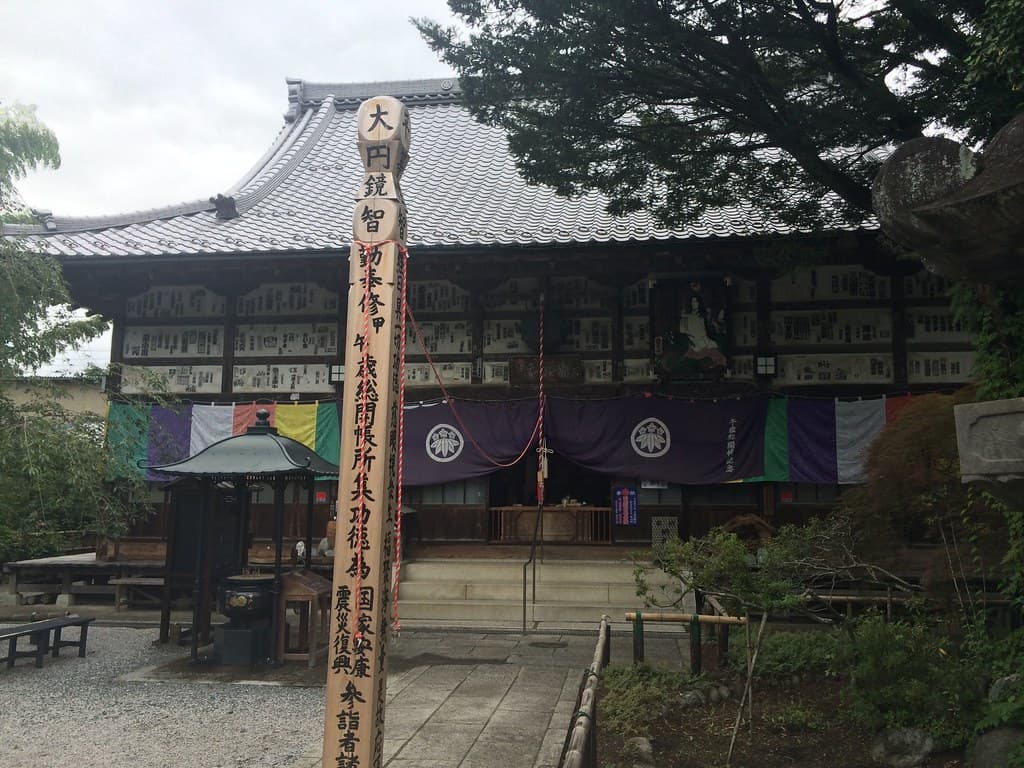
Daien-ji stands on a wooded slope at Mt. Bukō's foot in Kamikagemori valley, between Kagemori and Urayamaguchi on the Chichibu Railway. The Sōtō Zen Ryūga-zan (竜河山, 'Dragon-River Mountain') is the 27th of the 34 Chichibu Kannon fudasho. Its precinct joins valley-floor Tsukikage-dō ('Moonshadow Hall'), a hilltop white Gokoku Kannon (護国観音, 'Nation-Protecting Kannon') about fifteen metres above the trees, and approach-side Enmeisui ('life-extending water').
Tradition says sustained prayer to the Kannon image healed a wandering monk's leg disease, prompting the first hall. The honzon is Shō Kannon—Sacred Avalokiteśvara, simplest and earliest of six classical Kannon forms. Counted popularly among Kantō's 'three Kannon,' the protective hilltop figure bears an unusual sword rather than a lotus.
Official English Chichibu Fudasho materials give no founding date. A railway spark burned the original Tsukikage-dō in 1919; today's main hall dates to 1996. Third-party sources cautiously cite 1935 for Gokoku Kannon, absent from the official page. From December's second Monday through February's end, Daien-ji issues winter goshuin for unattended Hashidate-dō (#28), marking the route's hinge before #28's limestone cliffs and the long mountain section.
Why this place is sacred
Daien-ji's quality of thinness rests on three layered registers. The first is the healing tradition. The temple's origin story tells of a wandering monk cured of a leg disease through prayer to a Kannon image at this site — a small narrative that has shaped the temple's working theology ever since. Pilgrims with physical complaints, and those praying for the recovery of others, recognise the precinct as a place where Kannon's compassion has long been understood as physical restoration.
The Enmeisui spring at the foot of the slope concretises the same idea: a small pool of clear water with a tradition that drinking it adds 33 days of life. The number is symbolic — 33 is also the count of Kannon's classical manifestations and the number of fudasho on the route — and the practice of taking a drink during the visit links bodily wellbeing to the iconography of the bodhisattva.
The second register is visual. The hilltop Gokoku Kannon, a white Hakui ('white-robed') Kannon roughly fifteen metres tall, is visible from the Chichibu Railway and from many points across the basin. Pilgrims arriving by train often see the figure long before they arrive at the temple; the visual approach itself becomes part of the practice.
The statue's iconography is unusual: it holds a sword rather than a lotus, marking it as 'Nation-Protecting Kannon', a 20th-century devotional form continuous with older mountain-top Kannon colossi but expressing a modern concern with collective rather than purely personal salvation. The figure's whiteness against the green slope and its position near a panoramic viewpoint over the Chichibu basin give the climb a distinctive register.
The third register is the precinct's own continuity through disruption. The 1919 fire that destroyed the original Tsukikage-dō was caused by a spark from the early Chichibu Railway — a moment when modern infrastructure literally consumed the temple. The 1996 reconstruction is, in that sense, the latest in a long pattern of rebuilding that runs through Japanese temple history.
Pilgrims arriving in 2026 — the umadoshi (Year of the Horse) of the once-every-twelve-years general unveiling — encounter a hall that is younger than they may expect, holding an image whose devotional life predates the building by centuries.
Experience and orientation
Reaching Daien-ji is among the easier approaches on the Chichibu route. From Kagemori Station on the Chichibu Railway, the temple is roughly ten minutes' walk along the valley road; Urayamaguchi Station is a comparable distance from the other direction, and the segment between #26 En'yū-ji, #27 Daien-ji, and #28 Hashidate-dō is one of the most popular walking sections on the entire pilgrimage.
From greater Tokyo, the temple is typically reached by the Seibu Ikebukuro Line to Seibu-Chichibu, then a short transfer to the Chichibu Railway at Ohanabatake.
The approach passes through a quiet residential and forested stretch, with the white Gokoku Kannon visible above the trees from several points along the path. At the precinct, the small Tsukikage-dō stands at the valley floor — a 1996 reconstruction of the hall lost to the 1919 railway-spark fire. Pilgrims light incense at the offering box, recite the Heart Sutra (Hannya Shingyō) and the Kannon mantra, and leave their osamefuda name slips.
The Enmeisui spring runs at the side of the path; a small dipper allows visitors to take the 'life-extending water' that local tradition says adds 33 days to one's life.
From the precinct, a steeper trail climbs through forest to the Gokoku Kannon viewpoint. The white Hakui Kannon — roughly fifteen metres tall, holding a sword rather than the more common lotus — stands on the slope above, looking south across the Chichibu basin toward Mt. Bukō. The climb takes ten to fifteen minutes at a moderate pace, and the viewpoint offers one of the most expansive panoramas on the route.
Bandō office hours are commonly 8:00–17:00; in winter (second Monday of December through end of February) the temple also issues goshuin for #28 Hashidate-dō, which is unattended in the cold months.
From Kagemori Station on the Chichibu Railway, walk roughly ten minutes along the valley road toward the temple. Bow at the precinct entrance, light incense at the Tsukikage-dō, offer at the saisen box, and recite the Heart Sutra or the Kannon mantra. Take a small drink from the Enmeisui spring beside the path. Climb the trail through the forest to the Gokoku Kannon viewpoint and pause at the panoramic view of the Chichibu basin and Mt. Bukō.
Receive the goshuin at the temple office; in winter (second Monday of December through end of February), Daien-ji also handles the #28 Hashidate-dō goshuin.
Context and lineage
Local tradition tells of a wandering monk afflicted with leg disease who came to this site and was cured through sustained prayer to a Kannon image kept here. In gratitude, he or his community raised the first hall and formally enshrined the image. From this beginning the temple developed its working identity as a healing-Kannon site — an identity that persists through the Enmeisui spring's 'life-extending water' tradition.
No founding date is given in the official Chichibu Fudasho materials available in English; the documentary record begins much later. In 1919, a spark from a passing Chichibu Railway train ignited the wooded slope and destroyed the original Tsukikage-dō (Moonshadow Hall). The current main hall is a 1996 reconstruction, retaining the original name and the Shō Kannon principal image.
The hilltop Gokoku Kannon — a roughly fifteen-metre white Hakui Kannon holding a sword in place of the more usual lotus — is a 20th-century devotional addition. Some travel sources give 1935 for the statue's erection; the date appears in third-party publications but is not stated on the official temple page, and is treated here with corresponding caution.
The figure is sometimes counted among the 'three Kannon of Kantō', a regional grouping of large modern Kannon statues understood as a triangulated protective net over eastern Japan.
Daien-ji is a Sōtō Zen temple under the mountain name Ryūga-zan. Sōtō administers approximately twenty of the thirty-four Chichibu fudasho — a dominance that took shape across the late medieval and early modern periods as Sōtō expanded into eastern Japan from its Echizen and Kantō centres. The Kannon devotion enshrined here belongs to the broader Japanese tradition of Kannon-and-Zen pairing: an exoteric devotional cult absorbed into a Zen institutional setting.
The wandering healing-monk (legendary)
Founder of the original devotion
Per temple tradition, a wandering monk afflicted with leg disease was cured through prayer to a Kannon image at this site. The first hall was raised to enshrine the image. The figure's name is not recorded; the legend functions as the foundation of the temple's healing-Kannon identity.
The 1919 fire and the lost Tsukikage-dō
Disruptive event in the documentary record
A spark from a passing Chichibu Railway train ignited the wooded slope in 1919, destroying the original Tsukikage-dō (Moonshadow Hall). The fire is the earliest event in the temple's modern documentary record and frames the present hall as a 1996 reconstruction.
The 1996 builders of the present Tsukikage-dō
Modern reconstructors
Local builders responsible for the 1996 reconstruction of Tsukikage-dō, retaining the original name and continuing to enshrine the Shō Kannon principal image. Specific names are not recorded in available English-language sources.
Resident Sōtō Zen clergy
Contemporary stewards
The Sōtō community responsible for daily ritual, pilgrim hospitality, the issuance of goshuin (including those of #28 Hashidate-dō during the December-through-February winter closure), and stewardship of the Enmeisui spring and the Gokoku Kannon viewpoint.
Traditions and practice
The temple follows Sōtō Zen ritual forms. Pilgrims arriving at the Tsukikage-dō light incense, offer coins at the saisen box, and recite the Hannya Shingyō and the Kannon mantra ("on arorikya sowaka").
The Enmeisui spring — a small flow at the side of the approach — is taken with a wooden dipper and a brief intention; local tradition holds that drinking the spring water adds thirty-three days to one's life, a number that mirrors the count of Kannon's classical manifestations and the fudasho route itself. Devotion to the hilltop Gokoku Kannon involves the climb to the viewpoint and a moment of standing prayer at the foot of the colossal white figure.
Pilgrims arrive year-round for the Chichibu #27 nōkyō and goshuin, which are issued at the temple office. From the second Monday of December through the end of February, Daien-ji also issues the goshuin for #28 Hashidate-dō, which is unattended for the winter — a small role that nonetheless places the temple at the practical centre of this pair of fudasho.
The 12-yearly Chichibu sōkaichō (year-of-the-horse total unveiling) opens from 18 March 2026 and runs through the year, bringing a major upsurge in pilgrim and visitor traffic.
Allow thirty to sixty minutes for a focused visit, including the Tsukikage-dō, the Enmeisui spring, and the climb to the Gokoku Kannon viewpoint. Pilgrims walking the segment from #26 En'yū-ji to #28 Hashidate-dō often take a slow lunch in the precinct or at the viewpoint. Pause at the spring with a small intention rather than a hurried sip.
At the colossal Gokoku Kannon, stand long enough for the figure's scale to register; the white Hakui form against the green slope reads differently when given time.
Buddhism
ActiveDaien-ji is an active Sōtō Zen temple under the mountain name Ryūga-zan (竜河山, 'Dragon-River Mountain'), part of the Sōtō dominance of approximately twenty of the thirty-four Chichibu fudasho. The principal image is Shō Kannon (Sacred Avalokiteśvara) enshrined in the Tsukikage-dō ('Moonshadow Hall'). Per local tradition, a wandering monk afflicted with leg disease was cured through prayer at this site, and the first hall was raised in gratitude — establishing the temple's enduring identity as a healing-Kannon precinct. The original Tsukikage-dō was destroyed in 1919 by a spark from a passing Chichibu Railway train; the present hall is a 1996 reconstruction. The Enmeisui ('life-extending water') spring at the side of the approach carries a tradition that drinking the water adds thirty-three days to one's life. Above the precinct rises the Gokoku Kannon (護国観音, 'Nation-Protecting Kannon') — a roughly 15-metre white Hakui Kannon holding a sword in place of the more common lotus — counted among the 'three Kannon of Kantō' and visible across the Chichibu basin.
Chichibu 34 Kannon Pilgrimage
Active27th station of the Chichibu Kannon pilgrimage and component of the Japan 100 Kannon (Hyakkannon) supersystem. Daien-ji sits at the hinge of the popular Kagemori-Urayamaguchi walking section linking #26 En'yū-ji, #27 Daien-ji, and #28 Hashidate-dō. From the second Monday of December through the end of February, Daien-ji issues the goshuin for #28 Hashidate-dō, which is unattended for the winter — an administrative role that places the temple at the working centre of this pair of fudasho.
Perspectives and open questions
Daien-ji is a temple where a healing-monk legend, a 20th-century colossus, and a small longevity spring share a single wooded slope. Holding all three open is the most honest way to read the precinct.
Scholarly perspective
The temple's founding date is not given in available English-language Chichibu Fudasho materials. What is documented: Sōtō Zen affiliation under the mountain name Ryūga-zan; a Shō Kannon principal image; a 1919 fire of the original Tsukikage-dō caused by a Chichibu Railway spark; and a 1996 reconstruction of the present hall.
The Gokoku Kannon statue is a 20th-century devotional addition; some travel publications cite 1935 for its erection, but the date does not appear on the official Chichibu Fudasho temple page and should be cited with caution. The administrative arrangement under which #27 issues goshuin for #28 during the winter closure is well-attested in current pilgrimage literature.
Living and traditional perspectives
Local Sōtō Zen tradition holds Daien-ji as a healing-Kannon site rooted in the wandering-monk legend. Devotion concentrates on the Shō Kannon at the Tsukikage-dō, the Enmeisui spring (with its 33-day longevity tradition), and the hilltop Gokoku Kannon. The temple's 1996 rebuilding after fire is read locally as a small act of communal restoration — Kannon's compassion expressed in the rebuilt hall as much as in the principal image.
Alternative interpretations
The 'three Kannon of Kantō' grouping — pairing the Gokoku Kannon with two other large Kannon statues elsewhere in eastern Japan — is sometimes interpreted as a triangulated protective net over the region, a 20th-century devotional geography continuous with older mountain-top Kannon traditions. The unusual sword in the Gokoku Kannon's hand (in place of the more standard lotus) is read by some commentators as a marker of the post-war 'nation-protecting' devotional impulse from which the statue arose.
Open questions
{"The temple's founding date is not specified in available English-language sources","The 1935 erection date for the Gokoku Kannon statue appears in third-party travel publications but is not corroborated by the official Chichibu Fudasho temple page","The historicity of the wandering-monk healing legend and the identity of the original founder are unverifiable from contemporary documentation","The original carving date and provenance of the principal Shō Kannon image are not securely recorded"}
Plan your visit
Access and arrival
Address: 〒369-1872 Kamikagemori 411, Chichibu, Saitama. Roughly ten minutes' walk from Kagemori Station on the Chichibu Railway; Urayamaguchi Station is a comparable distance from the other direction. From Tokyo, take the Seibu Ikebukuro Line to Seibu-Chichibu, transfer at Ohanabatake to the Chichibu Railway, alight at Kagemori. Mobile phone signal is reliable on all major Japanese carriers in the Kagemori valley.
Chichibu City offers a wide range of accommodations, from small ryokan in the valley to mid-range hotels around Seibu-Chichibu Station. The route from #26 to #28 is comfortably walked as a long day-trip from Tokyo or as part of a two-day Chichibu pilgrimage stay.
Respectful visit
Modest, comfortable clothing; sturdy footwear for the climb to the Gokoku Kannon. Pilgrim attire — oizuru, sugegasa, kongō-zue — welcome.
Permitted in the precincts and from the Gokoku Kannon viewpoint. Interior photography of the Shō Kannon image may be restricted, particularly during the 12-yearly sōkaichō unveiling; check signage.
Saisen, incense, candles, osamefuda. Goshuin fee typically ¥300–¥500.
Take only a small drink from the Enmeisui spring; do not bathe or wash items in the basin | Stay on marked paths to the Gokoku Kannon; do not climb onto the statue's plinth | Speak quietly inside the small Tsukikage-dō hall | Avoid the viewpoint climb in icy or snowy conditions
The trail to the Gokoku Kannon viewpoint is steep in places and unsuitable in icy or snowy conditions; check footing in winter. The Enmeisui spring is for drinking in small quantities only — do not bathe or wash items in the basin. Speak quietly inside the Tsukikage-dō; the hall is small and other pilgrims' recitations carry. Photography of the principal Shō Kannon image inside the hall may be restricted, particularly during the 12-yearly sōkaichō unveiling.
Current practical details
Address
411 Kamikagemori, Chichibu, Saitama 369-1872, Japan
Phone
Hours, fees, and access can change — verify on the official source before you travel. Practical details last checked Jun 2026.
Location
Map loads as you approach this section.
Pilgrim reflections
A portrait of encounter, not a score
Pilgrims describe what they felt, how present they could become, and whether the place would shape a journey. There are no stars and no ranking of traditions.
No reviewed reflections yet
The first pilgrims can help describe the character of being here.
Share a reflection
Available after an account-backed “Been there.” Every reflection is reviewed before publication.
Nearby sacred places
Explore other sacred places in the region. Proximity does not establish access or travel time; check each place’s guidance.


References
Sources consulted for this page. Source categories describe the publication, not a guarantee that every claim is verified. Traditional accounts and outside interpretations may differ.
- 01Daien-ji Temple — Chichibu Fudasho — Chichibu Omotenashi Tourism OrganizationofficialOfficial page. Source for full name 竜河山 大渕寺, Sōtō Zen sect, Shō Kannon principal image, traveling-monk healing tradition, 1919 fire of Tsukikage-dō, 1996 reconstruction, Gokoku Kannon statue, Enmeisui spring.
- 02Chichibu 34 Kannon Pilgrimage: Suggested Day Trip Route — Chichibu Omotenashi Tourism OrganizationofficialDay-trip itinerary positioning Daien-ji as #27 between Kagemori and Urayamaguchi stations.
- 03Chichibu-34-Kannon-Temple-Circuit Part 1 (PDF pamphlet) — Chichibu CityguideOfficial illustrated pamphlet.
- 04The Chichibu 34 Fudasho Kannon Pilgrimage — An Introduction — USC ScalaracademicScholarly framing of the pilgrimage.
- 05Chichibu 34 Kannon Sanctuary — Wikipedia contributorsacademicConfirms Daien-ji #27 with Shō Kannon principal image.
- 06Discover More of Saitama: The Chichibu 34 Kannon Temple Circuit — JAPANKURUguide16.5-meter Hakui Kannon nicknamed Gokoku Kannon, holding a sword instead of a lotus, panoramic view; 'three Kannon of Kantō' grouping.
Pilgrim glossary
- Honzon
- The principal Buddhist deity enshrined as a temple's central object of worship.
- Kannon
- The bodhisattva of compassion, central to many East Asian pilgrimage routes.
- Bodhisattva
- An enlightened being who postpones full nirvana to help others toward awakening.
- Sutra
- A canonical Buddhist scripture, often chanted as part of practice.
- Mantra
- A sound, word, or phrase repeated as part of meditation or ritual.
- Zen
- A Japanese Buddhist school emphasizing seated meditation and direct insight.
Share a photo
Help visitors recognize Daien-ji. Every submission is reviewed before publication.