Hōun-ji
Chichibu #30 — the 'Yō-Kihi Kannon' temple, a Rinzai Kenchō-ji branch with a Pure Land pond garden
Understand sacred places, explore living traditions, and learn how to engage respectfully with Pilgrim Map.
Access has not been verified. Check current local guidance before planning a visit.
Chichibu, Saitama Prefecture, Japan
Read the sources
Station 30 of 34
Chichibu 34 Kannon PilgrimageVisit essentials
A quick read before you go
- Duration
- 30–60 minutes for a focused visit including a slow circuit around the pond garden and prayer at…
- Access
- Approximately 1 km uphill from Shiraku Station on the Chichibu Railway (15–20 minutes' walk).
Overview
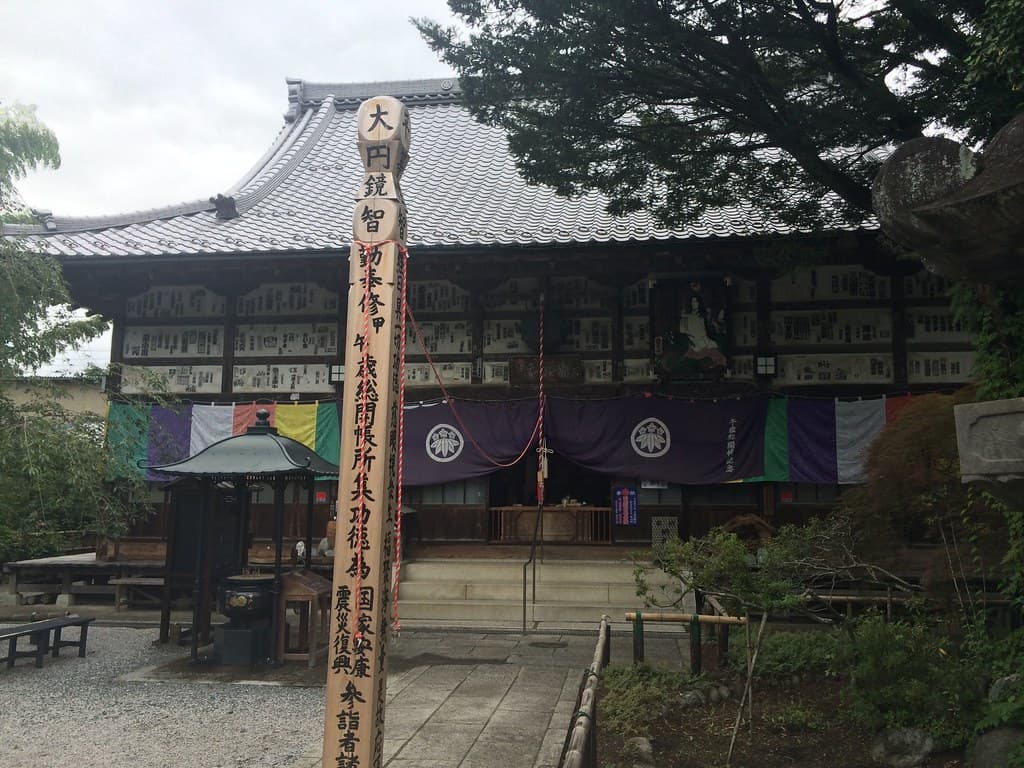
Hōun-ji, Zuiryū-san (“Auspicious Dragon Mountain”), stands in a quiet valley near Shiraku Station around a Pure Land–style pond garden. It is the 30th of the 34 Chichibu Kannon fudasho and one of eleven administered by the Rinzai Kenchō-ji-ha, linking it to Kamakura's Kenchō-ji.
The Kannon-dō houses a seated, six-armed Nyoirin Kannon holding a wish-fulfilling jewel and wheel. One of only two such enshrinements on the route, this hibutsu is unveiled annually on April 18 as well as during the twelve-yearly sōkaichō. The popular name Yō-Kihi Kannon connects the image to the temple's qualified Yang Guifei legend.
Hōun-ji also preserves municipally designated cultural properties known as a “dragon bone,” “tengu's claw,” and “mirror of Yō-Kihi”; their material identities remain legendary, while their status records their longstanding local importance.
Why this place is sacred
Hōun-ji's quality of thinness rests on three layered registers. The first is the iconographic rarity. Of the thirty-four Chichibu fudasho, only two enshrine Nyoirin Kannon — the seated, six-armed bodhisattva holding a wish-fulfilling jewel and a wheel — and Hōun-ji is one of them. The image is a hibutsu (secret Buddha) and is unveiled to public view on April 18 each year, the temple's lay calendar's central date.
For pilgrims working the Hyakkannon (the Japan 100 Kannon supersystem), the rare Nyoirin form deepens the iconographic register of the route — alongside Shō Kannon, Senju Kannon, Bato Kannon, and the other forms encountered on the Chichibu circuit, here is the Kannon who fulfils wishes and turns the Dharma wheel.
The second register is the transnational Yō-Kihi narrative. The Tang dynasty's Emperor Xuanzong lost his consort Yang Guifei (Yō-Kihi, 719–756) to political execution; the grief that followed entered Chinese poetry as a defining episode of imperial mourning, and within East Asian Buddhism the figure of Yang Guifei became one of several beautiful women understood as compassionate manifestations of Kannon.
The temple's tradition holds that Xuanzong commissioned the Nyoirin Kannon image for the repose of Yang Guifei's soul, that the image was brought to Japan, and that Dōin of Kenchō-ji enshrined it here in 1319. The historicity of the import is treated as legend; what holds is the temple's centuries-long association with the Yō-Kihi narrative, the broader East Asian motif of beauty, grief, and compassion held as nondual, and the parallel Yō-Kihi Kannon traditions at sites like Sennyū-ji in Kyoto.
The third register is the garden setting. The Kannon-dō and the Hōjō (abbot's quarters) are arranged around a central pond in a Pure Land–style teien (Jōdo-shiki teien). The form derives from the cosmology of Amitābha's Western Paradise — a paradise garden translated into stone, water, and planting — but Hōun-ji is a Rinzai Zen institution rather than a Pure Land temple.
The juxtaposition is part of the precinct's character: a Pure Land–styled landscape held within a Zen monastic frame, in service of Kannon devotion. The contrast between the still pond and the surrounding mountain forest, often cited by visitors as deeply restful, makes the garden itself a contemplative practice space.
The legendary cultural-property objects preserved at the temple — the 'dragon bone', 'tengu's claw', and 'mirror of Yō-Kihi' — register the temple in late-Edo and earlier popular imagination, where pilgrim wonder and Buddhist legend overlapped.
Experience and orientation
The san-mon opens onto a Pure Land–style pond garden, with the Kannon-dō and Hōjō (abbot's quarters) facing each other across still water that reflects the mountain forest. The silence registers strongly after central Chichibu's busier fudasho, and visitors widely cite Hōun-ji as the quietest late-circuit temple.
Pilgrims light incense, offer coins, and recite the Heart Sutra (Hannya Shingyō) and Kannon mantra. Direct viewing of the hibutsu Nyoirin Kannon is reserved for April 18 and the twelve-yearly sōkaichō. Many make a slow circuit of the pond as a brief Zen walking meditation within a Pure Land–styled space. Pilgrims pairing Hōun-ji with #29 Chōsen-in use road and rail rather than a continuous path.
From Shiraku Station on the Chichibu Railway, walk approximately one kilometre uphill (15–20 minutes) along the road to the temple. Bow at the san-mon. Walk slowly around the Pure Land pond garden once before approaching the Kannon-dō. Light incense, offer at the saisen box, and recite the Heart Sutra or the Kannon mantra. The principal Nyoirin Kannon is unveiled annually on April 18 — the most significant date for direct viewing outside the 12-yearly sōkaichō.
Receive the goshuin at the temple office; the temple is sometimes closed for lunch 12:00–12:30.
Context and lineage
Hōun-ji was founded in 1319 CE (Genō era), in the late Kamakura period, by the Zen monk Dōin — also rendered Dōon — of Kenchō-ji in Kamakura. Dōin's institutional affiliation places the founding within the Kamakura-Muromachi expansion of Rinzai Zen into eastern Japan, and Hōun-ji has continued under Kenchō-ji-ha (Kenchō-ji branch) administration ever since.
Local tradition holds that Tang Emperor Xuanzong (685–762), grief-stricken after the political execution of his consort Yang Guifei (Yō-Kihi, 719–756) in 756 CE, commissioned a Nyoirin Kannon statue for the repose of her soul. The image was eventually brought to Japan, and Dōin enshrined it at this Chichibu mountain valley in 1319.
Historians treat the Tang-Chinese provenance as Buddhist legend rather than a historical claim about a verified Tang import; what is clear is that the temple has held the Yang Guifei narrative for centuries and that the principal image is identified locally as 'Yō-Kihi Kannon'.
The temple preserves several objects designated as Chichibu municipal cultural properties — among them a 'dragon bone' (ryūkotsu), a 'tengu's claw', and a 'mirror of Yō-Kihi'. The material identity of these objects is treated as legendary; their cultural-property status records their longstanding role in the temple's local identity rather than asserting their literal description.
Late-Edo woodblock prints in the Kunisada II / Hiroshige II 'Miracles of Kannon' (Kannon reigenki) Chichibu series include a depiction of Hōun-ji as 'Hōunji Temple in Mt. Zuiryūsan' — securing the temple's prominence in 19th-century pilgrim popular culture.
Hōun-ji is a parish temple of the Kenchō-ji-ha branch of Rinzai Zen — one of the eleven Chichibu fudasho under Rinzai administration, with the other twenty-plus mostly under Sōtō. The Kenchō-ji-ha lineage runs from the Kamakura mother temple Kenchō-ji (founded 1253), making Hōun-ji a direct expression of the Kamakura Zen institutional expansion into the Chichibu mountains.
Dōin (Dōon), monk of Kenchō-ji
Founder (1319 CE)
Late Kamakura-period Zen monk of Kenchō-ji in Kamakura who founded Hōun-ji in 1319 (Genō era). Per temple tradition, Dōin enshrined the Tang-origin Nyoirin Kannon image at this Chichibu mountain valley, establishing the temple's long-standing identity as the 'Yō-Kihi Kannon' precinct.
Yang Guifei / Yō-Kihi (719–756)
Tang consort in the temple's founding legend
Tang dynasty consort of Emperor Xuanzong, executed during the An Lushan rebellion in 756 CE. East Asian Buddhist tradition came to identify Yang Guifei as a manifestation of Kannon; the temple's principal image is locally called 'Yō-Kihi Kannon' in keeping with this identification.
Tang Emperor Xuanzong (685–762, r. 712–756)
Patron in the founding legend
Per temple tradition, the grief-stricken emperor commissioned the Nyoirin Kannon statue for the repose of Yang Guifei's soul. The image was eventually brought to Japan and enshrined at Hōun-ji in 1319. The Tang-import provenance is treated by historians as legendary.
Kunisada II / Hiroshige II (active mid-19th c.)
Late-Edo ukiyo-e artists
Mid-19th-century woodblock-print artists who included Hōun-ji as 'Hōunji Temple in Mt. Zuiryūsan' in their 'Miracles of Kannon' (Kannon reigenki) Chichibu series — securing the temple's place in 19th-century pilgrim popular culture.
Resident Rinzai Kenchō-ji-ha clergy
Contemporary stewards
The continuing community responsible for daily Rinzai liturgy, the annual April 18 unveiling of the Nyoirin Kannon, the issuance of goshuin, and stewardship of the Pure Land pond garden, the Kannon-dō, the Hōjō, and the cultural-property objects (the 'dragon bone', 'tengu's claw', and 'mirror of Yō-Kihi').
Traditions and practice
The temple follows Rinzai Kenchō-ji-ha ritual forms — recitation of the Hannya Shingyō, the Kannon-kyō, and Rinzai liturgy in the resident community. Pilgrims arriving at the Kannon-dō light incense, offer coins at the saisen box, and recite the Heart Sutra and the Kannon mantra. The principal Nyoirin Kannon is a hibutsu (secret Buddha) and is unveiled to public view annually on April 18 — the temple's lay calendar's central date — and during the 12-yearly Chichibu sōkaichō.
The Pure Land pond garden is widely used as a contemplative walking space: a slow circuit around the pond, attentive to the reflection and the surrounding forest, is part of many pilgrims' practice.
Pilgrims arrive year-round for the Chichibu #30 nōkyō and goshuin, which are issued at the temple office. The annual April 18 unveiling brings a marked upsurge in pilgrim traffic; the 12-yearly sōkaichō opening from 18 March 2026 (year of the horse) brings an even larger surge across the entire 2026 calendar. The temple does not publicly host large public ceremonies outside the April unveiling and the 12-yearly opening; the pond garden remains open to mindful pilgrim use throughout the year.
Allow thirty to sixty minutes for a focused visit. A slow circuit around the Pure Land pond garden before approaching the Kannon-dō is recommended: the pond's stillness, the surrounding mountain forest, and the contrast between Pure Land paradise-garden form and Rinzai Zen institutional setting register most clearly with attention. Pilgrims combining Hōun-ji with #29 Chōsen-in commonly take rail and short walking transfers between the two.
For those visiting on April 18, allow extra time and arrive early — the unveiling brings significant pilgrim traffic.
Buddhism
ActiveHōun-ji is one of only eleven Chichibu fudasho under Rinzai Zen administration (the other twenty-plus are mostly Sōtō), and its institutional lineage runs through the Kenchō-ji-ha — the Kenchō-ji branch of Rinzai centred on the Kamakura mother temple. Founded in 1319 (Genō era) by the Zen monk Dōin (Dōon) of Kenchō-ji, the temple connects directly to the Kamakura-Muromachi expansion of Zen institutions in eastern Japan. The mountain name is Zuiryū-san (瑞龍山, 'Auspicious Dragon Mountain'). The principal image is a hibutsu Nyoirin Kannon (如意輪観世音菩薩, Wish-Fulfilling Wheel Avalokiteśvara) — a seated, six-armed bodhisattva holding a wish-fulfilling jewel and a wheel — known popularly as 'Yō-Kihi Kannon' (楊貴妃観音) for its legendary association with the Tang consort Yang Guifei. The Kannon-dō, Hōjō, and pond are arranged in a Pure Land–style garden (Jōdo-shiki teien) within the Rinzai Zen institutional frame.
Chichibu 34 Kannon Pilgrimage
Active30th station of the Chichibu Kannon pilgrimage and component of the Japan 100 Kannon (Hyakkannon) supersystem. One of only two Nyoirin Kannon enshrinements on the entire 34-temple route, giving it a distinctive iconographic identity. Marks the transition from the central Chichibu valley toward the western Ogano mountain temples — specifically Kannon-in (#31), some 15 km northwest with no convenient public-transit link.
Perspectives and open questions
Hōun-ji is a temple where a securely documented 1319 Kenchō-ji founding, a transnational Tang-grief legend, and a Pure Land pond garden converge in a quiet mountain valley. Holding the layers open is the most honest way to read the precinct.
Scholarly perspective
Hōun-ji's 1319 founding by Dōin of Kenchō-ji is well-supported by temple records and Japanese-language sources and is consistent with the documented Kamakura-period expansion of Zen institutions into eastern Japan. The temple's Rinzai Kenchō-ji-ha affiliation is securely attested. The Yang Guifei Tang-import provenance of the principal Nyoirin Kannon image is treated by historians as Buddhist legend rather than a historical claim about a verified Tang import.
The 'dragon bone', 'tengu's claw', and 'mirror of Yō-Kihi' are recorded as Chichibu municipal cultural-property objects whose material identity is treated as legendary. The annual April 18 unveiling is well-attested in temple practice.
Living and traditional perspectives
Local devotion centres on the Nyoirin Kannon as 'Yō-Kihi Kannon' — the bodhisattva who responded to Tang imperial grief and now grants wishes (especially for women's concerns, beauty, and the consolation of loss) at this Chichibu sanctuary. The annual April 18 unveiling is the central event in the temple's lay calendar. The Pure Land pond garden, the Hōjō, and the Kannon-dō form a coherent devotional landscape held within a Rinzai Kenchō-ji-ha institutional frame.
Alternative interpretations
The motif of Yang Guifei as a manifestation of Kannon connects Hōun-ji to a wider East Asian tradition (also expressed at Sennyū-ji in Kyoto) in which beauty, grief, and compassion are framed as nondual. Some readings emphasise the Pure Land pond garden as a translation of Amitābha's Western Paradise into the form of a Zen monastic landscape — a syncretic feature found at several Kamakura-derived temples but unusual on the Chichibu route.
The Nyoirin Kannon's six arms, holding the wish-fulfilling jewel and the Dharma wheel, are read as the bodhisattva's response to grief at full capacity.
Open questions
{"The actual material origin of the Nyoirin Kannon image and the historical pathway of its transmission to Japan are not securely established","The identification of the temple's 'dragon bone', 'tengu's claw', and 'mirror of Yō-Kihi' artefacts is not securely established and remains in the realm of temple tradition","Specific present-day Rinzai Kenchō-ji-ha liturgical schedule beyond the April 18 unveiling is not exhaustively retrieved","Names of the original Pure Land pond garden's designer and the date of its laying out are not securely recorded"}
Plan your visit
Access and arrival
Approximately 1 km uphill from Shiraku Station on the Chichibu Railway (15–20 minutes' walk). From Tokyo, take the Seibu Ikebukuro Line to Seibu-Chichibu Station, transfer at Ohanabatake to the Chichibu Railway, alight at Shiraku. Standard hours: 8:00–17:00 (March–October), 8:00–16:00 (November–February), often closed for lunch 12:00–12:30. Mobile phone signal is reliable on all major Japanese carriers in the Shiraku area.
Chichibu City offers a wide range of accommodations, from small ryokan in the valley to mid-range hotels around Seibu-Chichibu Station. Pilgrims working the late-circuit Chichibu temples (#29–#34) commonly stay one or two nights in central Chichibu and use rail plus local bus or taxi for the western mountain section.
Respectful visit
Modest, comfortable clothing; walking shoes for the gently uphill approach. Pilgrim attire — oizuru, sugegasa, kongō-zue — welcome.
External photography permitted in the precincts and pond garden. Interior and image photography may be restricted, especially during the April 18 unveiling and the 12-yearly sōkaichō. Check posted signs.
Coin offerings, incense, candles, osamefuda. Goshuin fee typically ¥300–¥500.
Do not step on the threshold of the san-mon | Speak quietly near the main hall and the pond garden | Do not approach the principal Nyoirin Kannon enclosure outside permitted viewing periods | Confirm whether the temple office is closed for lunch (12:00–12:30) before travelling
The temple is sometimes closed for lunch 12:00–12:30; confirm hours before travelling. Photography of the principal Nyoirin Kannon image is restricted, particularly during the April 18 unveiling and the 12-yearly sōkaichō; check posted signage. Speak quietly near the Kannon-dō and the pond. Do not approach the principal image enclosure outside permitted viewing periods. The road from Shiraku Station is gently uphill but generally easy walking; in icy winter conditions footing may be unreliable.
Current practical details
Address
432 Arakawashiroku, Chichibu, Saitama 369-1912, Japan
Phone
Hours, fees, and access can change — verify on the official source before you travel. Practical details last checked Jun 2026.
Location
Map loads as you approach this section.
Pilgrim reflections
A portrait of encounter, not a score
Pilgrims describe what they felt, how present they could become, and whether the place would shape a journey. There are no stars and no ranking of traditions.
No reviewed reflections yet
The first pilgrims can help describe the character of being here.
Share a reflection
Available after an account-backed “Been there.” Every reflection is reviewed before publication.
Nearby sacred places
Explore other sacred places in the region. Proximity does not establish access or travel time; check each place’s guidance.


References
Sources consulted for this page. Source categories describe the publication, not a guarantee that every claim is verified. Traditional accounts and outside interpretations may differ.
- 01Houn-ji Temple - Chichibu Fudasho — Chichibu Omotenashi Tourism OrganizationofficialOfficial pilgrimage page; confirms Rinzai Kenchō-ji-ha sect, Nyoirin Kannon principal image, April 18 annual unveiling.
- 0230番 法雲寺 – 秩父札所 (Official Chichibu Fudasho Association) — Chichibu Fudasho AssociationofficialConfirms Zuiryū-san mountain name, founding by Dōin in 1319, Nyoirin Kannon image legend.
- 03法雲寺 (秩父市荒川白久) - Wikipedia (Japanese) — Wikipedia contributorsofficialRecords 1319 founding, sect (Rinzai Kenchō-ji school), Yang Guifei (楊貴妃) Kannon legend.
- 04The Temple Guy: The Chichibu 34 Kannon Route — James BaquetguideNotes that Hōun-ji is one of two Nyoirin Kannon temples on the route and that the principal images of Chichibu fudasho are typically opened to the public only every 12 years.
- 05Hounji | The Dragon bone that has put down at temple in Chichibu — Magnific Japan (regional travel publication)guideDescribes the temple's legendary treasures: dragon bone, tengu's claw, mirror of Yō-Kihi (Yang Guifei), and the Kannon statue, all designated Chichibu cultural properties.
- 06Yang Guifei - Wikipedia — Wikipedia contributorsacademicBackground on Yang Guifei (719–756), Tang dynasty consort and East Asian Buddhist 'manifestation of Kannon' tradition.
- 07Kunisada II / Hiroshige II — Chichibu Route, Miracles of Kannon No. 30, Hounji-Temple in Mt. Zuiryuzan (ukiyo-e) — Shukado / Japanese-finearts ukiyo-e galleryspiritual19th-century woodblock print depicts the temple as part of the 'Kannon reigenki' (Miracles of Kannon) Chichibu series — evidence of its prominence in late-Edo pilgrim consciousness.
Pilgrim glossary
- Kannon
- The bodhisattva of compassion, central to many East Asian pilgrimage routes.
- Bodhisattva
- An enlightened being who postpones full nirvana to help others toward awakening.
- Sutra
- A canonical Buddhist scripture, often chanted as part of practice.
- Mantra
- A sound, word, or phrase repeated as part of meditation or ritual.
- Dharma
- The teachings of the Buddha; also the universal law underlying them.
- Pure Land
- A Buddhist tradition focused on rebirth in Amida Buddha's western paradise through devotional practice.
- Zen
- A Japanese Buddhist school emphasizing seated meditation and direct insight.
Share a photo
Help visitors recognize Hōun-ji. Every submission is reviewed before publication.