Cathédrale Saint-Lazare d'Autun
A Burgundian pilgrimage cathedral with Gislebertus's signed Last Judgment
Understand sacred places, explore living traditions, and learn how to engage respectfully with Pilgrim Map.
Access has not been verified. Check current local guidance before planning a visit.
Autun, Saône-et-Loire, France
Read the sources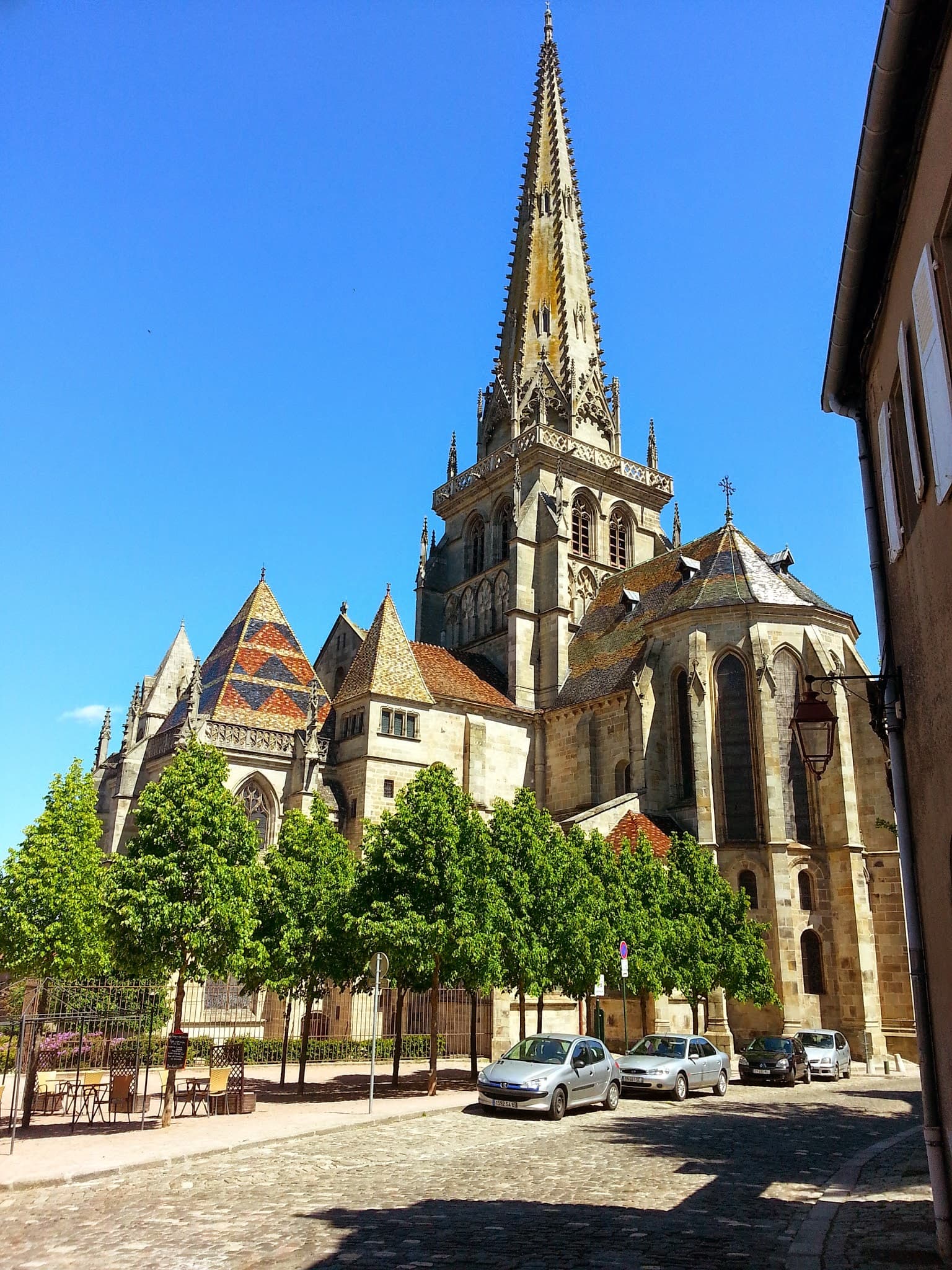
Image of Cathédrale Saint-Lazare d'Autun. Image source · CC-BY-SA-3.0
Visit essentials
A quick read before you go
- Duration
- 60–90 minutes for the cathedral.
- Access
- Central Autun, 5-minute walk from the Place du Champ-de-Mars.
Overview
Saint-Lazare d'Autun is one of those rare buildings where the architecture is also a sermon. Built as a shrine for Lazarus — the man Christ raised from the dead in John 11 — it has above its west door Gislebertus's Last Judgment tympanum, before which pilgrims have stopped for nine hundred years. Its signature, 'Gislebertus hoc fecit' — Gislebertus made this — is one of the earliest by which a medieval sculptor claimed his work by name.
Inside, the nave capitals form one of Europe's richest Romanesque pictorial cycles: the Flight into Egypt, the Magi's dream, the temptation of Eve, the suicide of Judas. The cathedral was consecrated in 1130 by Pope Innocent II. Autun itself is small — a quiet Burgundian town inside Roman walls — and the cathedral of European stature it shelters often takes first-time visitors by surprise.
Why this place is sacred
Autun's thinness is partly cumulative — nine hundred years of Mass, candle, intercession — and partly aesthetic. Romanesque sculpture this early is not usually so coherent. The west tympanum, the capitals, the displaced Eve fragment now in the Musée Rolin, all belong to a single sustained programme by the workshop of Gislebertus.
The pilgrim entering under the Last Judgment passes from the apocalyptic horizon of the tympanum into the more intimate Gospel scenes of the capitals — the building enacts a movement from terror to consolation. The choir holds the shrine of Lazarus, reconstructed after Revolutionary destruction. For Camino pilgrims walking the Vézelay branch, Autun is the moment when the Magdalene-Lazarus story becomes spatially real — kinship to Christ's circle as a physical inheritance walked one footstep at a time.
Built explicitly as a pilgrimage shrine for the relics of Lazarus, translated to Autun in the late 10th or early 11th century. Designed within the Cluniac architectural and sculptural milieu — Cluny III, the great motherhouse 70 km to the south, was at its peak in the same decades — and positioned to receive pilgrims on the Via Lemovicensis route to Santiago.
Consecrated in 1130 while still under construction; finished by 1146. Cardinal Jean Rolin added the Gothic spire and other interventions in the 15th century. The original north portal tympanum was destroyed in the 18th century; its reclining Eve lintel — one of the masterpieces of Romanesque sculpture — survives in the Musée Rolin nearby. The cathedral has remained in continuous Catholic use since consecration, with brief Revolutionary disruption.
Experience and orientation
The cathedral rises on a slight ridge inside the Roman walls of Autun, approached most naturally from the Place du Champ-de-Mars. Stop a long minute under the west portal before entering. The Last Judgment tympanum — Christ enthroned in his almond mandorla, the weighing of souls below — is one of the documented turning points in medieval European sculpture, and the impact reads immediately.
The signature 'Gislebertus hoc fecit' runs along the lintel beneath Christ's feet, though scholars now debate whether 'Gislebertus' was the master sculptor or the patron-donor; the sculptor reading remains dominant. Inside, the nave is Cluniac in proportion — tall, broken-barrel-vaulted, austere — and the real reward of the visit is the capitals. Bring binoculars or use the zoom on a phone camera; the small Gospel and Old Testament scenes are forty feet up.
The Lazarus shrine in the choir was reconstructed after Revolutionary damage. After the cathedral, walk five minutes to the Musée Rolin to see the reclining Eve and several capitals removed during the 18th-century works — pieces too important to leave to weather and tour-group jostle.
South door entrance from the Place du Champ-de-Mars; west tympanum visible from outside; capitals throughout the nave (bring binoculars); Lazarus shrine in the choir; Musée Rolin a 5-minute walk.
Context and lineage
Medieval Provençal tradition holds that after the Crucifixion, Lazarus, Mary Magdalene, Martha, and other disciples were set adrift from Judaea in a boat without oars and landed at Saintes-Maries-de-la-Mer on the Provençal coast. According to this cycle, Lazarus became the first bishop of Marseille and was eventually martyred there. His supposed relics were translated from Marseille to Autun in the late 10th or early 11th century, and the present cathedral was raised in the 1120s to house them.
The medieval Magdalene-Lazarus cycle — Mary Magdalene at Saint-Maximin-la-Sainte-Baume, Martha at Tarascon, Lazarus at Autun and Marseille — is a coherent body of devotional tradition rather than attested 1st-millennium history. Modern Catholic scholarship treats the Provençal arrival narrative as pious legend; an Eastern Orthodox counter-tradition holds that Lazarus went to Cyprus, where his tomb is venerated at Larnaca. The Autun cathedral and its 12th-century construction are, by contrast, securely documented.
Roman Catholic, Latin Rite. Cathedral of the Diocese of Autun, Chalon and Mâcon. Architecturally and culturally within the Cluniac sphere of medieval Burgundy.
Saint Lazarus of Bethany
The man whom Christ raised from the dead (John 11); medieval tradition holds him as first bishop of Marseille, with relics translated to Autun
Bishop Étienne de Bâgé
12th-century bishop of Autun, patron-initiator of the cathedral's building campaign
Gislebertus
Master sculptor of the west tympanum (c. 1130–1135) and many capitals; one of the earliest named medieval artists
Pope Innocent II
Consecrated the cathedral in 1130 while still under construction
Cardinal Jean Rolin
15th-century patron of the Gothic spire and other late additions
Traditions and practice
Stational liturgy on the feast of Saint Lazarus, devotional candles before the Lazarus shrine, and the slow flow of Compostela pilgrims through the cathedral during the summer walking season. Cluniac liturgical influence shaped the building's original devotional rhythms; many traces survive in the local liturgical calendar.
Daily Mass continues; Sacrament of Reconciliation is available in the summer pilgrimage season. The cathedral hosts cultural concerts of Romanesque music and organ recitals outside liturgical hours. The diocese's pilgrim welcome programme runs April through October. Camino pilgrims can have their credencial stamped at the cathedral.
Enter under the west tympanum and stay a long minute before moving. Walk the nave slowly with binoculars — the capitals are the heart of the experience and most visitors miss them. Sit in the choir near the Lazarus shrine for ten quiet minutes. Then walk to the Musée Rolin and spend an unhurried hour with the reclining Eve.
If you can, time the visit for the long afternoon light of May through September, when the west tympanum reads at its best.
Roman Catholic (Latin Rite)
ActiveCathedral built explicitly as a pilgrimage shrine for the relics of Saint Lazarus of Bethany. Sits on the Via Lemovicensis, one of the main French branches of the Camino de Santiago, and forms part of the UNESCO inscription of those routes.
Daily Mass and Divine Office; veneration at the Lazarus shrine in the choir; feast of Saint Lazarus (29 July local / 17 December Roman); reception of Compostela-bound pilgrims and stamping of the credencial.
Perspectives and open questions
Autun's cathedral is a place where art historical certainty (the building, the sculptural programme) and devotional tradition (the Lazarus relic and the wider Provençal arrival cycle) sit at different epistemic levels.
Scholarly perspective
Construction 1120–1146 is well-documented. Gislebertus's signature on the tympanum is genuine, though whether 'Gislebertus' was the master sculptor or the patron-donor was challenged by Linda Seidel in 1999; the sculptor reading remains the scholarly mainstream. The cathedral's place on the UNESCO-inscribed Routes of Santiago de Compostela in France (1998, ref. 868) is officially recognised. The original polychromy of the Romanesque sculpture is partly recoverable from pigment analysis but no full reconstruction has been published.
Living and traditional perspectives
The Catholic Church locally venerates Lazarus as the first bishop of Marseille and Autun as the resting place of his relics. The wider Provençal Magdalene cycle — Mary Magdalene at Saint-Maximin-la-Sainte-Baume, Martha at Tarascon, Lazarus at Autun and Marseille — is held as venerable tradition that gives spiritual coherence to the whole southern French pilgrimage landscape.
Alternative interpretations
A modern esoteric literature (Holy Blood, Holy Grail and its successors) reads the Magdalene-Lazarus arrival in Provence as a bloodline narrative. This is popular fiction with a thin scholarly veneer, not history.
Open questions
The identity of 'Gislebertus' remains partly open. The original colour scheme of the polychromed Romanesque sculpture is partly conjectural. The Provençal arrival tradition itself is not attested in 1st-millennium sources; the Eastern Orthodox counter-tradition placing Lazarus in Cyprus has its own venerable history.
Plan your visit
Access and arrival
Central Autun, 5-minute walk from the Place du Champ-de-Mars. Train to Autun via Étang-sur-Arroux or via Le Creusot TGV (35 minutes by coach). The cathedral is on a slight rise; step-free access via the south door. Free admission. Diocesan website (autun.catholique.fr) publishes current Mass times.
Small-town French hotel infrastructure; pilgrim accommodation is available in summer through the diocesan welcome programme.
Respectful visit
Shoulders and knees covered; hats removed by men inside.
Permitted without flash and without tripod. No photography during Mass. Most of the capitals are too high for casual photographs; a zoom lens or phone with optical zoom helps.
Candle stands and donation boxes; candles benefit cathedral upkeep.
Silence during liturgies and at the Lazarus shrine. Tour groups asked to keep voices low.
Communion reserved to Catholics. The cathedral is unheated; winter visits are quieter but cold. Tour groups asked to schedule visits outside Mass times.
Current practical details
Address
Pl. du Terreau, 71400 Autun, France
Phone
Hours
Hours, fees, and access can change — verify on the official source before you travel. Practical details last checked Jun 2026.
Location
Map loads as you approach this section.
Pilgrim reflections
A portrait of encounter, not a score
Pilgrims describe what they felt, how present they could become, and whether the place would shape a journey. There are no stars and no ranking of traditions.
No reviewed reflections yet
The first pilgrims can help describe the character of being here.
Share a reflection
Available after an account-backed “Been there.” Every reflection is reviewed before publication.
Nearby sacred places
Explore other sacred places in the region. Proximity does not establish access or travel time; check each place’s guidance.

Church of Reconciliation, Taizé
Taizé, Taizé, Saône-et-Loire / Bourgogne-Franche-Comté, France
56.1 km away

Basilica of the Sacred Heart of Jesus, Paray le-Monial
Paray-le-Monial, Saône-et-Loire, France
56.7 km away
Sources of the Seine
Source-Seine, Bourgogne-Franche-Comté, France
67.9 km away
Church of Notre-Dame, Dijon
Dijon, Côte-d’Or, France
69.8 km away
References
Sources consulted for this page. Source categories describe the publication, not a guarantee that every claim is verified. Traditional accounts and outside interpretations may differ.
- 01Routes of Santiago de Compostela in France — UNESCO World Heritage CentreofficialAutun is part of the Vézelay branch (Via Lemovicensis) of the UNESCO-inscribed 'Chemins de Saint-Jacques-de-Compostelle en France' (1998, ref. 868).
- 02Cathédrale Saint-Lazare — Diocèse d'Autun, Chalon et Mâcon — Diocèse d'AutunofficialDiocesan website; liturgical schedule, current Mass times, pastoral information on the cathedral.
- 03Autun Cathedral — Wikipedia — Wikipedia contributorsencyclopediaBuilt 1120–1146 to house the relics of Lazarus; consecrated by Pope Innocent II in 1130. Architecture, sculptural programme, post-medieval history.
- 04Gislebertus — Wikipedia — Wikipedia contributorsencyclopediaThe Romanesque sculptor whose signature ('Gislebertus hoc fecit') appears on the west tympanum — one of the earliest named medieval artists.
- 05Gislebertus, Last Judgment, Tympanum of the Cathedral of St. Lazarus, Autun — Smarthistory / Khan AcademyacademicDetailed iconographic and stylistic analysis of the Last Judgment tympanum (c. 1130–1135), one of the masterpieces of Romanesque sculpture.
- 06Gislebertus, Eve, Saint-Lazare, Autun — Smarthistory / Khan AcademyacademicAnalysis of the famous reclining Eve lintel fragment, originally part of the north portal, now in the Musée Rolin.
- 07Musée Rolin — Sculptures de Gislebertus — Ville d'AutunofficialMunicipal museum housing many of the displaced capitals and the Eve fragment from Saint-Lazare.
- 08Autun — Encyclopædia Britannica — Encyclopædia Britannica editorsencyclopediaTown history; Roman Augustodunum, episcopal seat, Cluniac cultural sphere.
- 09Lazarus of Bethany — Wikipedia — Wikipedia contributorsencyclopediaSummary of biblical Lazarus, Provençal arrival tradition, conflicting Cypriot tradition, and the medieval Autun cult.
- 10La cathédrale Saint-Lazare d'Autun et son décor sculpté — Bulletin Monumental / Société française d'archéologieacademicPeer-reviewed art-historical articles on the construction, sculptural programme, and patronage of Saint-Lazare (multiple volumes accessible via Persée).
Share a photo
Help visitors recognize Cathédrale Saint-Lazare d'Autun. Every submission is reviewed before publication.