Basilique de Vézelay
Where Bernard preached the Crusade, pilgrims sought the Magdalene, and Romanesque sculpture reached its summit
Understand sacred places, explore living traditions, and learn how to engage respectfully with Pilgrim Map.
Access has not been verified. Check current local guidance before planning a visit.
Vézelay, Yonne, France
Read the sources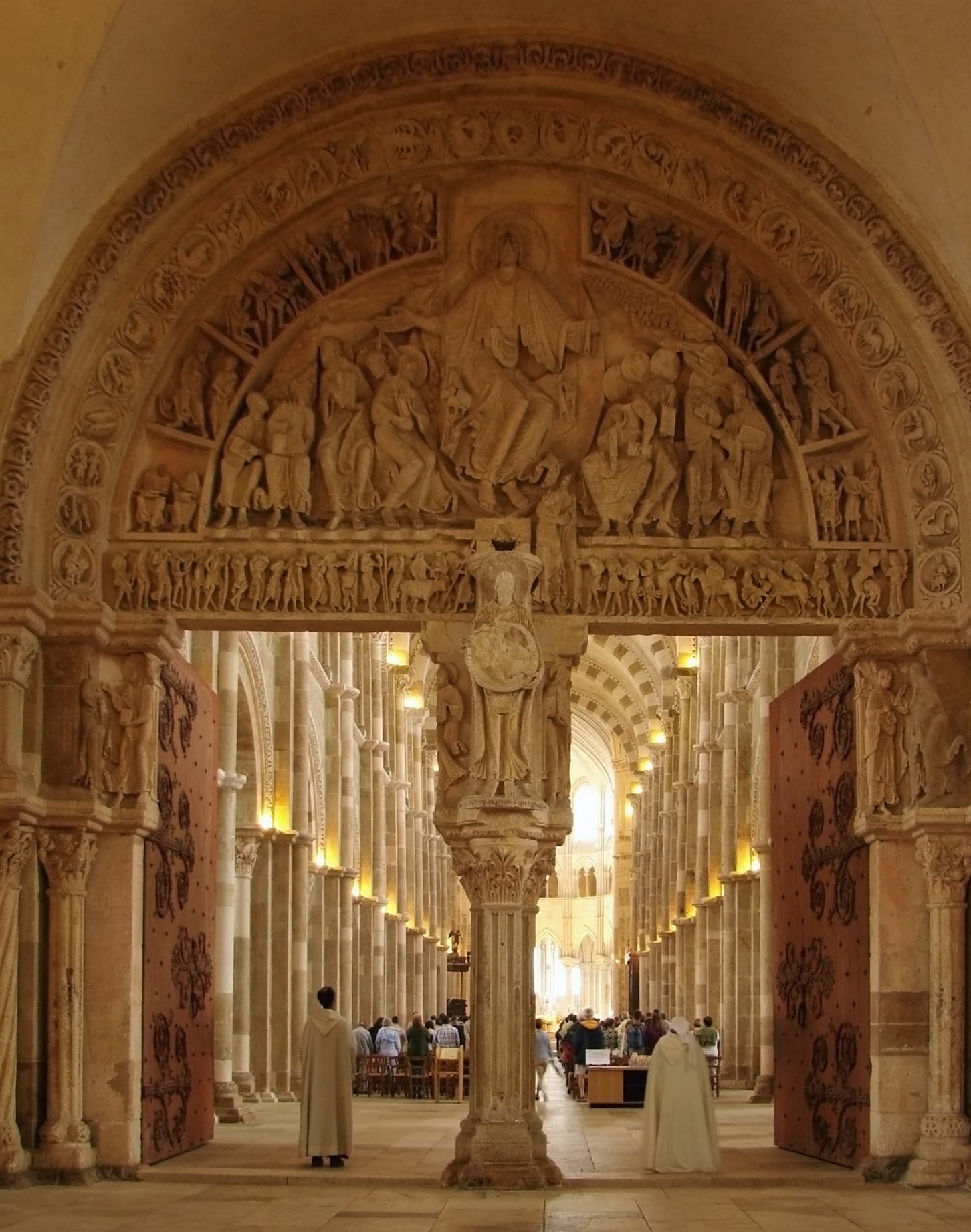
Visit essentials
A quick read before you go
- Duration
- 1-2 hours for basilica and crypt; add time for town exploration
- Access
- Vézelay in Yonne department, Burgundy.
Overview
On a hill above the Burgundian plain, Vézelay drew thousands to Mary Magdalene's claimed relics and became Western Christendom's premier Magdalene shrine until rival Provençal claims emerged in 1279.
In 1146 Bernard of Clairvaux preached before an assembly including King Louis VII and Queen Eleanor of Aquitaine, and knights pledged themselves to the Second Crusade. Richard the Lionheart of England and Philip Augustus of France met here in 1190 before the Third Crusade; in 1217 Francis of Assisi established France's first Franciscan presence on the hill.
The basilica they knew survived near-collapse through the young Eugène Viollet-le-Duc's 19th-century rescue. Its narthex tympanum, among Romanesque art's supreme achievements, shows Christ in glory sending the apostles to convert the nations. Mary Magdalene's relics remain in the crypt after drawing seven centuries of pilgrims, while the ascent from the plain preserves the medieval approach: a climb toward grace.
Why this place is sacred
What makes Vézelay thin is the layering of sacred events upon one place. Mary Magdalene's relics—however disputed—drew centuries of pilgrimage before any crusade was preached. The abbey was already famous when Bernard stood here in 1146, already powerful when kings chose it as departure point for holy war.
The Magdalene herself adds particular dimension. Among Jesus's followers, she witnessed the crucifixion when most apostles fled. She came first to the empty tomb; she was first to see the risen Christ. 'Apostle to the apostles,' tradition calls her—the one who announced resurrection to those who would announce it to the world. Her presence (in relic, in memory, in veneration) makes Vézelay a site of feminine sacred power within patriarchal Christianity.
The tympanum's theology expands the meaning further. The Mission to the Apostles depicts Christ sending his followers to peoples at the ends of the earth—pygmies, giants, dog-headed peoples from medieval legend. This is universal salvation made visible: all peoples, however strange, await the Gospel. Pilgrims passing beneath this portal entered the church already instructed in their faith's global ambition.
Then there is the light. At summer solstice, sunlight through the south windows creates a path of illumination down the center of the nave—either happy accident or intentional sacred engineering, but either way, evidence that architecture and astronomy conspire here.
Benedictine abbey, Magdalene reliquary shrine, pilgrimage church
Founded 9th century. Magdalene relics acquired early. Relics authenticated 1058. Bernard preached Second Crusade 1146. Departure for Third Crusade 1190. Francis founded French Franciscans here 1217. Decline after 1279 Provence claims. Near-collapse 19th century. Viollet-le-Duc restoration 1840-1859. UNESCO World Heritage 1979.
Experience and orientation
Approach as medieval pilgrims approached: from below. The town climbs the hill; the basilica crowns it. This ascent is the pilgrimage—each step lifting you from the plain toward the sacred summit. Park below; walk up.
Before entering, study the narthex tympanum, where the Mission of the Apostles unfolds around Christ in glory—and around them, in the arch, the peoples of the world await. Take time to read the program before you pass beneath it.
Enter the nave. The Romanesque horseshoe arches, their dual-colored voussoirs creating rhythmic pattern, draw the eye forward toward the choir. In summer, watch for the solstice light path that falls down the center aisle when the sun achieves maximum elevation.
Study the capitals. Unlike the great narrative capitals of Autun, Vézelay's carved scenes offer variety: biblical stories, allegorical figures, the four winds, the mystical mill. Each rewards attention; together they compose a theological encyclopedia in stone.
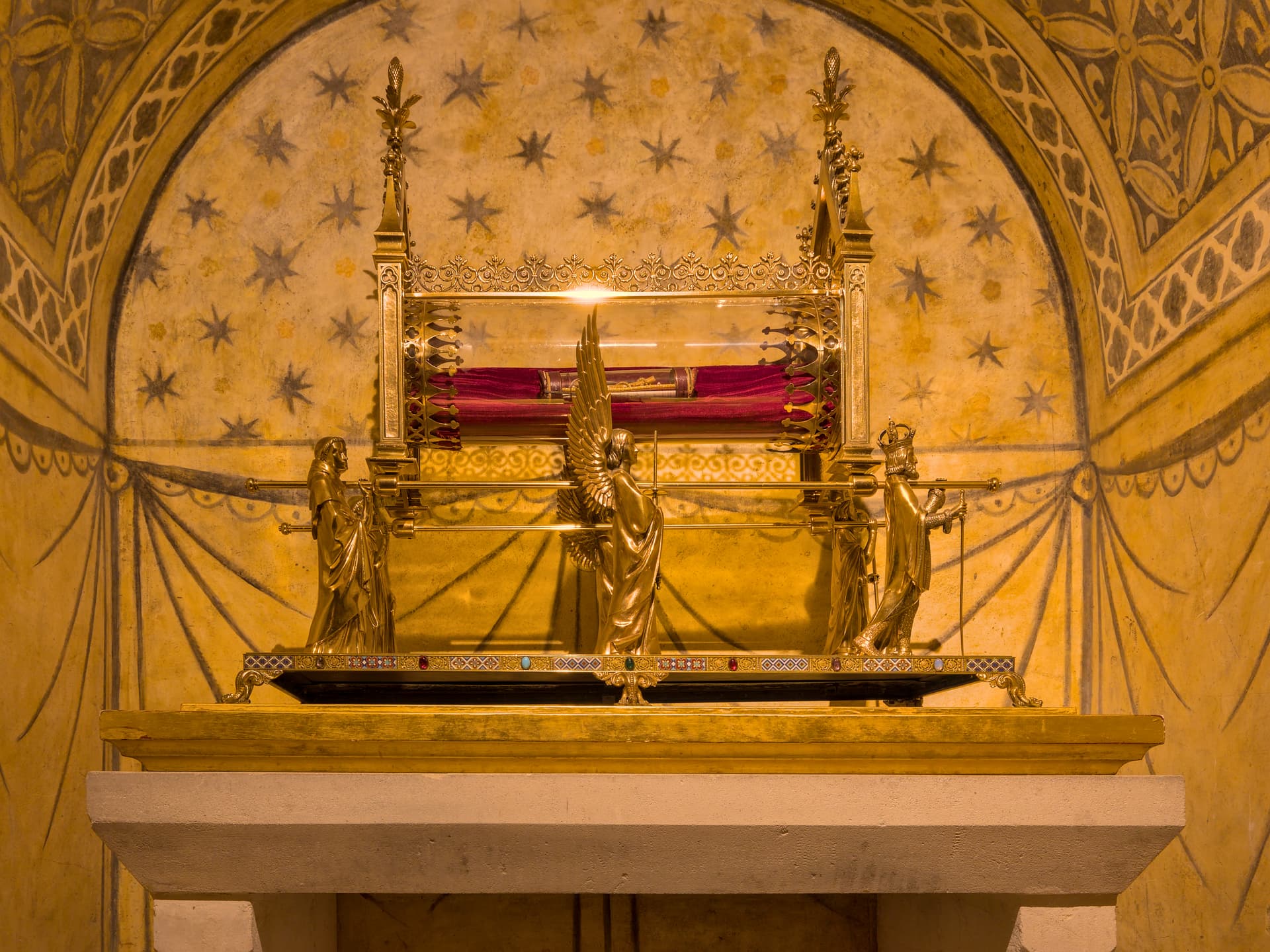
Descend to the crypt, where Mary Magdalene's relics rest in a 19th-century reliquary. Whatever you believe about authenticity, you stand where seven centuries of pilgrims have stood.
Come as pilgrims have come for a millennium—climbing the hill, passing beneath the tympanum, seeking the Magdalene.
Context and lineage
Shortly after its 9th-century founding, the abbey acquired what were claimed to be Mary Magdalene's relics—brought, tradition said, from Provence. In 1058, the Pope declared them authentic. Pilgrims came by thousands; at its height in the 12th century, Vézelay's population reached 8,000-10,000, extraordinary for medieval standards. The basilica we see was built 1120-1150 to accommodate the crowds.
Benedictine/Cluniac foundation. Santiago pilgrimage route. UNESCO World Heritage since 1979. Restored by Viollet-le-Duc who later worked on Notre-Dame de Paris and Mont-Saint-Michel.
Bernard of Clairvaux
Preached Second Crusade here (1146)
Louis VII and Eleanor of Aquitaine
Received Bernard's crusade preaching
Richard Lionheart and Philip Augustus
Met here to launch Third Crusade (1190)
Francis of Assisi
Founded first French Franciscan house here (1217)
Eugène Viollet-le-Duc
Restored collapsing basilica (1840-1859)
Traditions and practice
Magdalene veneration, Santiago pilgrimage, crusade blessings
Pilgrimage to crypt, masses, Santiago route stop, solstice light observation, architectural tourism
Climb the hill on foot. Study the tympanum before entering. Walk the nave slowly, reading the capitals. Descend to the crypt. If visiting near summer solstice, time your visit to see the light path.
Roman Catholicism / Magdalene Veneration
ActivePremier Magdalene shrine 11th-13th centuries. Site of Bernard's Second Crusade preaching (1146). Departure for Third Crusade (1190). First French Franciscan house (1217). UNESCO World Heritage (1979). Romanesque tympanum among finest in existence.
Pilgrimage to crypt, veneration of relics, masses, Santiago route devotion
Perspectives and open questions
Vézelay can be approached as Romanesque masterpiece, Magdalene shrine, crusade history site, or Santiago pilgrimage stop.
Scholarly perspective
UNESCO listing (1979) confirms architectural and historical significance. Tympanum recognized as among finest Romanesque sculptural programs. Relic authenticity disputed since 1279.
Living and traditional perspectives
Catholic tradition venerates relics as authentic, maintaining Vézelay as pilgrimage destination. Mary Magdalene's role as apostle to apostles emphasized in contemporary Magdalene devotion.
Alternative interpretations
Some see Mary Magdalene as representing suppressed feminine sacred in Christianity, possibly carrying hidden teachings. Vézelay becomes site of alternative Magdalene spirituality. Some connect solstice light phenomenon to pre-Christian solar traditions.
Open questions
Actual provenance of relics. Original appearance of medieval treasures. Bernard's exact words at 1146 crusade preaching. Intent of solstice light alignment (design or accident).
Plan your visit
Access and arrival
Vézelay in Yonne department, Burgundy. Town center car-free; park below and climb. Basilica at hilltop. Open daily.
Vézelay village offers hotels and guesthouses; Avallon nearby for more options
Respectful visit
Modest attire
Generally permitted; flash may be restricted; respect services
Donations welcome
Quiet during services; reverence in crypt
Major tourist destination; expect crowds, especially summer. Town center car-free; plan parking.
Current practical details
Address
La Basilique de Vézelay, 24 Rue Saint-Pierre, 89450 Vézelay, France
Phone
Hours
Hours, fees, and access can change — verify on the official source before you travel. Practical details last checked Jun 2026.
Location
Map loads as you approach this section.
Pilgrim reflections
A portrait of encounter, not a score
Pilgrims describe what they felt, how present they could become, and whether the place would shape a journey. There are no stars and no ranking of traditions.
No reviewed reflections yet
The first pilgrims can help describe the character of being here.
Share a reflection
Available after an account-backed “Been there.” Every reflection is reviewed before publication.
Nearby sacred places
Explore other sacred places in the region. Proximity does not establish access or travel time; check each place’s guidance.
References
Sources consulted for this page. Source categories describe the publication, not a guarantee that every claim is verified. Traditional accounts and outside interpretations may differ.
- 01Vézelay, Church and Hill — UNESCOSource contextUNESCO World Heritage listing
- 02Vézelay Abbey — WikipediaSource contextComprehensive history
- 03Visit the Basilica of Saint Mary Magdalene of Vézelay — France.frSource contextOfficial French tourism
- 04Vézelay — World Pilgrimage GuidespiritualPilgrimage context
- 05A closer look at Vézelay's Basilica — Burgundy TourismSource contextArchitectural details
Share a photo
Help visitors recognize Basilique de Vézelay. Every submission is reviewed before publication.