Notre-Dame de Bon-Espoir
InsideChurch of Notre-Dame, Dijon
A medieval Black Madonna credited with saving Dijon twice, still venerated after a millennium
Dijon, Côte-d’Or, France
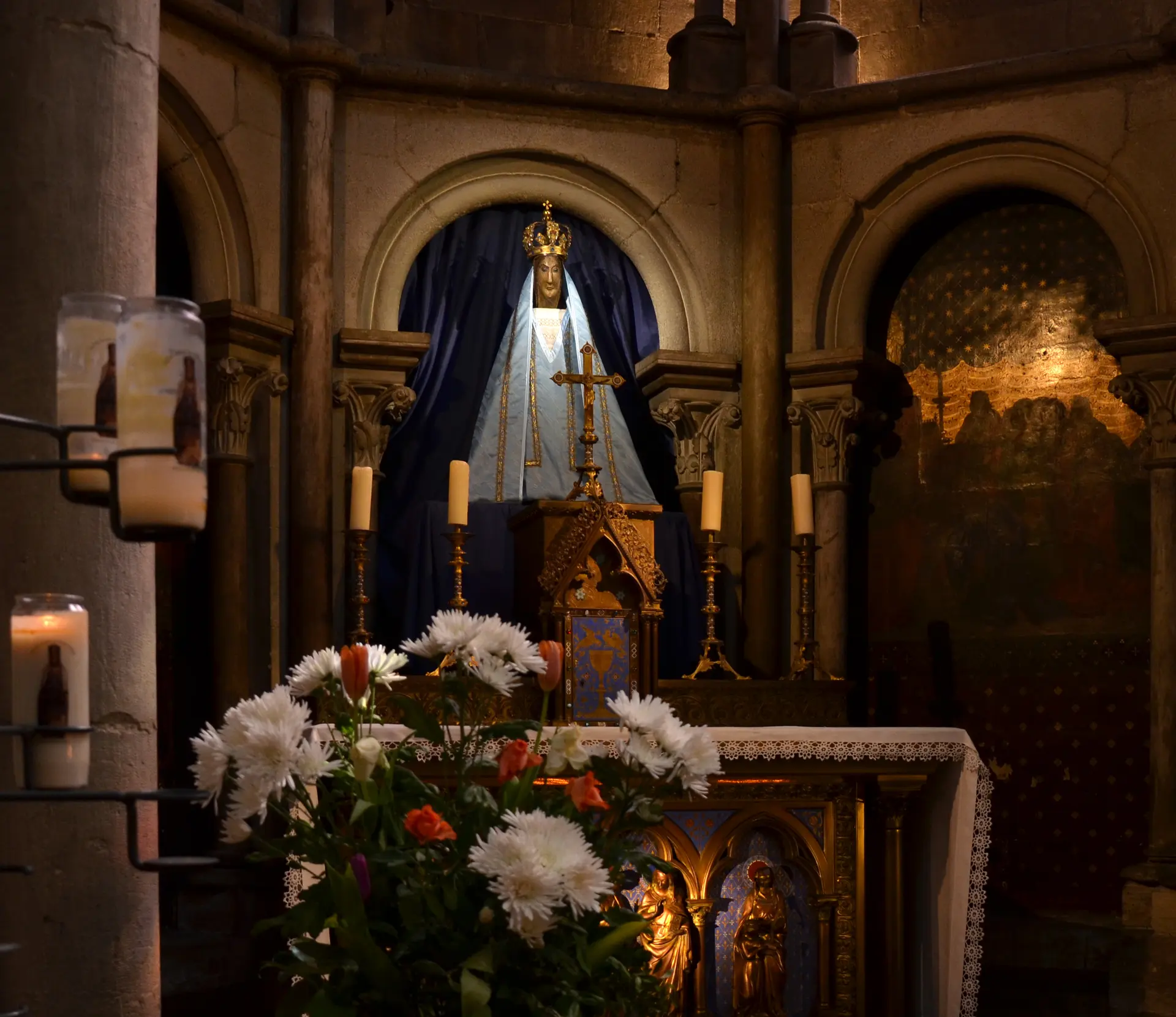
Image of Notre-Dame de Bon-Espoir. Image source · CC-BY-SA-3.0
Visit essentials
Before you go
- Access
- Place Notre-Dame, 21000 Dijon, France.
- Address
- 2 Place Notre Dame, 21000 Dijon, France
- Duration
- Thirty minutes to one hour for a typical visit, including both the church and the statue's…
- Etiquette
- Notre-Dame de Bon-Espoir is an active Catholic church requiring respectful behavior.
Overview
The eleventh- or twelfth-century statue of Notre-Dame de Bon-Espoir predates the Gothic church built around her two centuries later, with its gargoyle-lined facade and Jacquemart clock brought from Flanders as war spoils.
Those who keep her memory credit her with saving Dijon twice. During a Swiss siege in 1513, citizens carried the statue around the walls on September 11; the army withdrew the next day without a final assault—perhaps coincidence, perhaps answered prayer. Under German occupation in 1944, the bishop publicly appealed to Notre-Dame de Bon-Espoir on September 10. The Germans left that night, and French forces entered on September 11, anniversary of the first deliverance.
Once painted black, the statue was venerated for centuries as a Black Madonna until restoration removed the pigment in 1963. Some mourned a loss of mystery; others hold that the Virgin remains a point of hope. Each year the faithful gather for novena prayers during the nine days before September 11, continuing a tradition observed since the fifteenth century.
Why this place is sacred
The church itself commands attention: the remarkable Gothic facade with its three tiers of false arches and fifty-one gargoyles, the Jacquemart clock whose automaton family has marked time since 1382. But the heart of this place lies in a side chapel, where the small wooden statue sits in comparative simplicity.
She represents the Sedes Sapientiae, the Seat of Wisdom, an iconographic tradition that presents Mary as throne for the Christ Child. The infant Jesus was lost during the Revolution, when a young woman named Marthe Launy arranged to hide the statue with a local cobbler. The faithful paid him to pray before it in secret until safety returned.
When Marthe and her aunt finally purchased the statue back and restored it to the church, the procession that accompanied its return echoed the earlier processions that had carried it around the city walls.
The convergence of September 11, 1513 and September 11, 1944 anchors the devotion. In Catholic understanding, such coincidences are not coincidences at all but signs of providence, the divine working through history in patterns that reward attention. Whether one shares that faith or not, the pattern remains: a city threatened, a statue invoked, deliverance on the same day four centuries apart.
The church's modern tapestry, Terribilis, commissioned after the 1944 liberation and woven at the Gobelins Manufactory, commemorates both events. Dom Robert's design depicts the Virgin amid apocalyptic imagery, protecting those who shelter beneath her. It hangs as testimony to a community that understood what had happened as answered prayer.
The statue was created as an object of Marian devotion in a period when such veneration was central to Christian practice. Initially known as Notre-Dame de l'Apport or Notre-Dame du Marche, suggesting association with the marketplace, she became Notre-Dame de Bon-Espoir after the 1513 deliverance. Her role has always been intercessory: a point of access to the divine, a presence believers could approach with their needs and fears.
For centuries, the statue was painted black, entering the tradition of Black Madonnas that dot Europe. Some were darkened by candle smoke; others were deliberately painted. The reason for this statue's blackening remains unknown. Abbot Gaudrillet described her in 1773 as black or rather, a dark brown that looks black. In 1945, the black paint was removed but a black tint reapplied to the face to maintain tradition.
In 1963, even that was removed, and she now appears in her original coloring. For some devotees, particularly those who follow Black Madonna traditions, this was a loss. For the parish, it was restoration.
Experience and orientation
The church demands attention before the chapel reveals itself. Entering from the narrow Place Notre-Dame, the Gothic interior opens with the particular light of medieval stone. The nave is relatively short but proportioned with what Viollet-le-Duc recognized as exceptional architectural intelligence. Light falls through the clerestory, and the eye travels naturally toward the altar.
But to find Notre-Dame de Bon-Espoir, one turns aside. The south apsidiole holds her chapel, smaller and more intimate than the grand nave. Here, the crowds thin. Candles flicker before the ancient wooden figure. Flowers and prayer cards accumulate. The quality of attention shifts from appreciation to devotion.
Visitors often speak of a sense of peace in this chapel that differs from the rest of the church. The accumulated centuries of prayer seem to have impressed themselves on the space. Those who come during the September novena find the atmosphere intensified, as if the community's focused attention creates a temporary deepening of the site's power.
Outside, a different kind of tradition persists. The small owl carved into the church's corner has been rubbed smooth by generations of hands. Touch it with your left hand, they say, while making a wish. The stone is worn to a polish, testament to hope's persistence. The owl was vandalized in 2001 and restored from a Louvre mold, but the tradition continues unbroken.
The church rewards different approaches. Those seeking the architectural masterpiece should take time with the facade, counting the gargoyles, watching for the Jacquemart to strike. Those seeking the sacred heart of the place should proceed directly to the south chapel and sit with the statue. The two experiences are not opposed but complementary. The builders who created this church understood that sacred architecture serves what it contains.
Context and lineage
The statue's origin is lost to time. Dating estimates range from the late tenth to early twelfth century. She appeared in written records already venerated, already ancient. The church built to house her emerged in the thirteenth century, a period of intense Gothic construction across France. The architects created something Viollet-le-Duc would later call a masterpiece of reason: compact, proportioned, the facade a demonstration of what Gothic could achieve within constrained space.
The Jacquemart came later, war booty from Philip the Bold's Flemish campaigns. In 1382, he brought the clock and its automaton striker from Kortrijk, Belgium, installing it on the church tower in 1383. The family grew over centuries: Jacqueline joined in 1651, Jacquelinet in 1714, Jacquelinette in 1884. The automaton family striking the hours became as much a symbol of Dijon as the mustard or the dukes.
The devotion to Notre-Dame de Bon-Espoir has continued without interruption for nearly a millennium, surviving the Reformation, the Revolution, and two world wars. The September commemoration, formalized after 1513, has been maintained annually. The nine-day novena preceding September 11 draws the faithful each year, the Bishop of Dijon celebrating the anniversary Mass. This continuity of practice is itself remarkable in a country where the Revolution actively sought to destroy religious observance.
The Virgin Mary
deity
The statue represents Mary as Sedes Sapientiae, Seat of Wisdom, throne for the Christ Child. In Catholic understanding, she intercedes for those who approach her, carrying their prayers to her son.
Marthe Launy
historical
A young woman who saved the statue during the Revolution, arranging to hide it with a local cobbler until safety returned. Her devotion preserved the ancient image for future generations.
Bishop of Dijon (1944)
historical
During the German occupation, the bishop made a public plea to Notre-Dame de Bon-Espoir on September 10, 1944. The following day, on the anniversary of the 1513 deliverance, the Germans departed.
Traditions and practice
The 1513 procession established a pattern: carrying the statue around the city walls as protection against threat. While such processions are no longer regular practice, the memory remains central to the devotion. Historical accounts describe the faithful processing with the statue when the city faced danger, entrusting its safety to the Virgin's intercession.
The nine-day novena before September 11 follows a form of repeated prayer and meditation, focusing attention and building toward the anniversary. This practice of extended preparation is common in Catholic devotion, creating space for reflection and deepening of intention.
Regular masses are celebrated in the church throughout the week. Visitors may approach the statue in her chapel, light candles, and pray at any time the church is open. The annual commemoration on September 11 brings the community together for the bishop's Mass of Thanksgiving, remembering the 1513 and 1944 deliverances.
The owl tradition, though not religious, interweaves with the sacred. Visitors touch the worn stone with the left hand while making a wish. The gesture is superstitious rather than sacramental, but it speaks to the same human longing that brings pilgrims to the Virgin's chapel: the hope that something in this place might hear and respond.
Visit during the September novena to experience the devotion at its most concentrated. If you come at other times, approach the south chapel with intention. Light a candle if the practice has meaning for you, or simply sit in the quiet of the space. Let the accumulated weight of centuries of prayer become palpable.
Attend Mass if you are Catholic or comfortable observing. The liturgy, performed in the same space where worshippers have gathered since the fourteenth century, connects present devotion to historical continuity.
On leaving, consider the owl. Whether you make a wish or simply acknowledge the worn stone, you join a different kind of tradition: the folk practice that has coexisted with formal religion for as long as both have existed.
Roman Catholicism
ActiveNotre-Dame de Bon-Espoir is one of the oldest Marian statues in France, with documented veneration spanning nearly a millennium. Catholic teaching holds that Mary, as Mother of God, intercedes for those who ask her help. The statue is credited with miraculous intervention in 1513 and 1944, saving Dijon from destruction during sieges. The annual September 11 commemoration and nine-day novena maintain active devotion within the ongoing life of the parish.
Regular masses throughout the week. Annual novena from September 3-11, with each day devoted to prayer and meditation focused on Mary. Mass of Thanksgiving on September 11 celebrated by the Bishop of Dijon, commemorating the city's deliverances. Veneration of the statue through prayer, candle-lighting, and pilgrimage to her chapel in the south apsidiole.
Black Madonna Veneration
HistoricalFor centuries, the statue was painted black and venerated as a Black Madonna, part of a European tradition that includes such images at Chartres, Rocamadour, and Montserrat. Black Madonnas are sometimes interpreted as connecting to pre-Christian goddess worship, to the dark feminine, or to esoteric Christianity. Notre-Dame de Bon-Espoir was described in 1773 as black or rather, a dark brown that looks black. The tradition ended when the black coloring was removed in 1963.
Historical veneration of the statue in her darkened form. Pilgrimage by those seeking Black Madonna sites across Europe. After 1963, this tradition no longer applies to this particular statue, though Black Madonna devotees continue to recognize her history.
Perspectives and open questions
Notre-Dame de Bon-Espoir invites interpretation from multiple angles: the art historian sees a rare example of Romanesque Marian sculpture; the architect admires the Gothic church; the believer finds a living presence who has protected Dijon through centuries of threat. These perspectives need not compete.
Scholarly perspective
The Church of Notre-Dame is recognized as a masterpiece of thirteenth-century Burgundian Gothic architecture. Viollet-le-Duc's praise, calling it a masterpiece of reason, highlights the architectural intelligence that created such proportional elegance in constrained space. The statue dates to the eleventh or twelfth century and belongs to the Sedes Sapientiae iconographic tradition. The 1513 and 1944 events are historically documented. The interpretive question is whether the outcomes constituted miraculous intervention or fortunate circumstance.
Scholarship describes the events without adjudicating their ultimate meaning.
Living and traditional perspectives
Catholic tradition holds that the Virgin Mary interceded to save Dijon twice, making the statue genuinely miraculous. The timing of the 1944 liberation on the exact anniversary of the 1513 deliverance is understood as divine providence rather than coincidence. For believers, Notre-Dame de Bon-Espoir is not merely an ancient artwork but a living presence who hears and responds to those who approach her.
The continuing devotion, the annual novena, the bishop's Mass of Thanksgiving: all testify to a faith that takes her intercession as fact.
Alternative interpretations
Black Madonna enthusiasts view the former dark pigmentation as significant, potentially connecting the statue to pre-Christian goddess worship or esoteric Marian traditions. The 1963 removal of the black coloring is sometimes seen as a loss of this deeper dimension. From this perspective, Black Madonnas represent a feminine divine that predates Christianity or exists alongside it, and the decision to whiten the statue erased an important symbolic layer.
Open questions
Why the statue was painted black in the sixteenth century remains unknown. The original sculptor and workshop are unidentified. The exact age of the statue varies by source, with estimates ranging from the late tenth to early twelfth century. Whether the 1513 and 1944 events represent coincidence, providence, or something else entirely remains, as such questions always do, a matter of faith rather than proof.
Plan your visit
Access and arrival
Place Notre-Dame, 21000 Dijon, France. Located in the historic city center, a short walk from the Palace of the Dukes of Burgundy. Open 9:00 AM to 6:30 PM (hours may vary). Free entry. The church is accessible on foot from Dijon's central train station (approximately 15 minutes). No dedicated parking; use city center parking facilities.
Numerous hotels and guesthouses in Dijon city center, many within walking distance of the church. Options range from budget to luxury. The city center location allows easy access to restaurants, the Ducal Palace museum, and Dijon's famous mustard shops.
Respectful visit
Modest dress appropriate for a Catholic church. Cover shoulders and knees. No beachwear or revealing clothing. The standard is not strict but should reflect the context.
Photography for personal use is generally permitted throughout the church, without flash. Avoid photographing individuals in prayer. Do not use tripods or professional equipment without prior arrangement. The owl may be photographed freely.
Candles may be lit at designated stands, typically with a small donation. No other physical offerings are expected or appropriate within the church.
Observe silence during services. No food or drink inside the church. No large bags or backpacks may be carried through, though storage is not typically provided. Pets are not permitted except service animals.
This is an active place of worship. Avoid visiting during Mass unless you intend to participate respectfully. Keep voices low and cameras discreet, particularly in the Virgin's chapel where devotees may be in prayer. The church is not a museum, though it contains museum-quality art. Treat it as what it is: a living sacred site.
Current practical details
Address
2 Place Notre Dame, 21000 Dijon, France
Phone
Hours
Hours, fees, and access can change — verify on the official source before you travel. Practical details last checked Jun 2026.
Location
Map loads as you approach this section.
Pilgrim reflections
A portrait of encounter, not a score
Pilgrims describe what they felt, how present they could become, and whether the place would shape a journey. There are no stars and no ranking of traditions.
No reviewed reflections yet
The first pilgrims can help describe the character of being here.
Share a reflection
Available after an account-backed “Been there.” Every reflection is reviewed before publication.
Nearby sacred places
Explore other sacred places in the region. Proximity does not establish access or travel time; check each place’s guidance.


References
Sources consulted for this page. Source categories describe the publication, not a guarantee that every claim is verified. Traditional accounts and outside interpretations may differ.
- 01Église Notre-Dame at DIJON - Tourist Office Dijon Métropole — Dijon Métropole TourismofficialOfficial visitor information and practical details
- 02Neuvaine à Notre-Dame de Bon-Espoir - Diocèse de Dijon — Diocese of DijonSource contextOfficial diocesan information about the annual novena
- 03Church of Notre-Dame of Dijon - Wikipedia — Wikipedia contributorsencyclopediaComprehensive overview with architectural and historical details
- 04Notre Dame de Bonne Espoir - Interfaith Mary Page — Interfaith MaryspiritualDetailed history of the Black Madonna tradition and miracles
- 05Dijon and Our Lady of Good Hope — Dennis AubreyblogPhotography and historical context
- 06Catholic Encyclopedia: Dijon — New AdventspiritualLists Dijon pilgrimage sites
- 07Vierge Notre-Dame de Bon-Espoir - Wikipédia — Wikipédia contributorsencyclopediaFrench Wikipedia with additional local details
- 08Church of Notre Dame – Dijon France — Catholic Shrine BasilicaguidePilgrim-focused travel information
Share a photo
Help visitors recognize Notre-Dame de Bon-Espoir. Every submission is reviewed before publication.