Castabala
A Hittite goddess who survived through fire — her holy city still holds the memory of her priestesses' immunity
Understand sacred places, explore living traditions, and learn how to engage respectfully with Pilgrim Map.
Access has not been verified. Check current local guidance before planning a visit.
Osmaniye, Turkey
Read the sources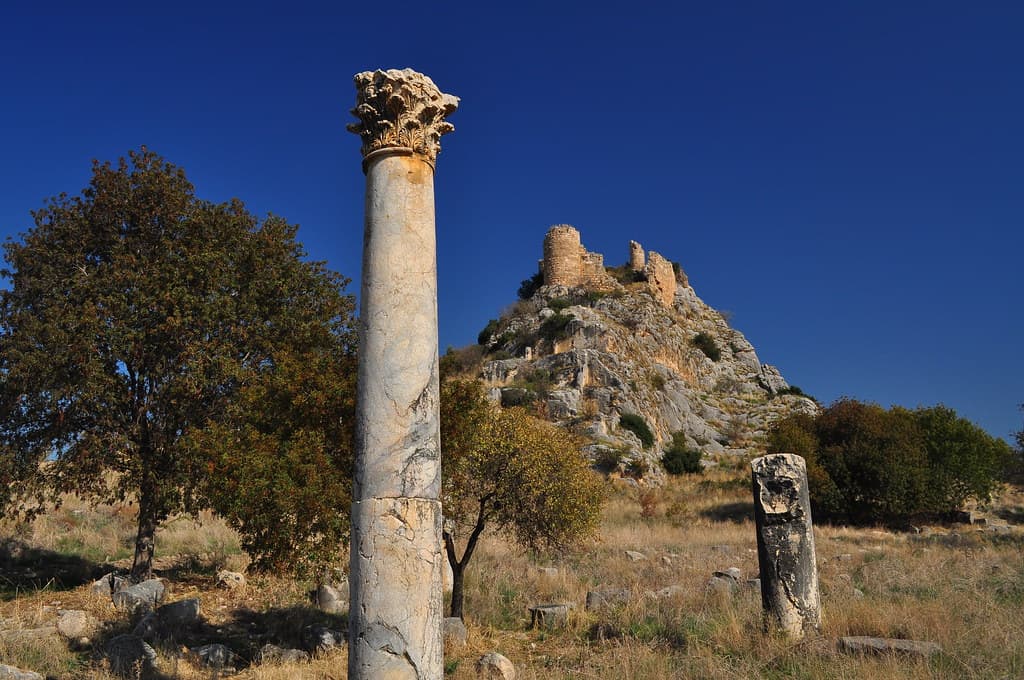
Image of Castabala. Image source
Visit essentials
A quick read before you go
- Duration
- 2–3 hours for lower ruins plus castle hill ascent and descent.
- Access
- Located approximately 5 km northeast of Kırmıtlı, in Osmaniye Province.
Overview
In the ancient world, 'Hieropolis'—holy city—meant not merely a city with a temple but one constituted by divine presence. Antiochos IV Epiphanes gave Castabala this name in the 2nd century BCE, formalizing a holiness older than Seleucid rule.
Since the Hittite period, Kubaba had been worshipped here as an Anatolian mother deity associated with sovereignty and fire; her cult persisted in Luwian successor kingdoms after the Hittite empire. Hellenists reinterpreted her as Artemis Perasia through a Greek theological framework, but the cult retained a distinctly Anatolian character. Strabo recorded Perasia's priestesses walking barefoot in ritual procession across burning coals without injury or visible pain.
Fire immunity in a goddess's service appears in isolated cultures and periods, but Castabala is among very few ancient Mediterranean places where it is documented at a named place and time by a named author. Excavation continues among the holy city's colonnaded streets, theatre, castle hill, and Artemis sanctuary. The fire has been out for two thousand years; the goddess remains present in the idea of what occurred here.
Why this place is sacred
The fire-walking rite of the Perasia priestesses was not spectacle. It was proof. In the theological logic of Castabala's cult, the goddess's power was real, and her reality was verified by the bodies of her servants. Priestesses who walked across burning coals without harm were not performing a trick; they were demonstrating that the divine protection they claimed to receive was operative, physical, and immediate. The fire was a test that the goddess passed through her servants.
This places Castabala in a particular category of sacred site: not a place where the divine was approached through petition, sacrifice, or contemplation, but a place where the divine demonstrated its presence through an act that exceeded the boundaries of what human bodies ordinarily endure. The goddess was named Perasia — the one from beyond, the one from the other side — a name that encodes her transgressive character.
She crossed the line between what fire does to flesh and what flesh can endure. Her priestesses crossed the same line.
The deeper sacred history of the site compounds this character. Kubaba, the Hittite mother goddess, was a deity of considerable antiquity whose cult was associated with sovereignty, war, and elemental power. That her presence in this specific location was continuous enough to be recognized and reinterpreted through multiple cultural regimes — Luwian, Hellenistic, Roman — suggests that the sacred quality of this place preceded any particular divine name and outlasted each.
What a contemporary visitor encounters at Castabala is an open field of ruins where this history is still being uncovered. The fire is not literally present. But the idea of a place where a goddess proved herself through immunity to destruction — and where that proof was repeated, ceremonially, for centuries — has a weight that the ruined columns do not diminish.
Holy city (Hieropolis) organized around the cult of Artemis Perasia, herself a Hellenistic reinterpretation of the ancient Anatolian mother goddess Kubaba; the site of the fire-walking ritual of Perasia's priestesses.
Luwian/Hittite Kubaba cult → Hellenistic Artemis Perasia (renamed Hieropolis under Antiochos IV) → Roman continuation with neokoros status claims → Early Christian bishopric → Byzantine Christianity → Medieval Armenian Christian use → Ruins; ongoing excavation since the modern period.
Experience and orientation
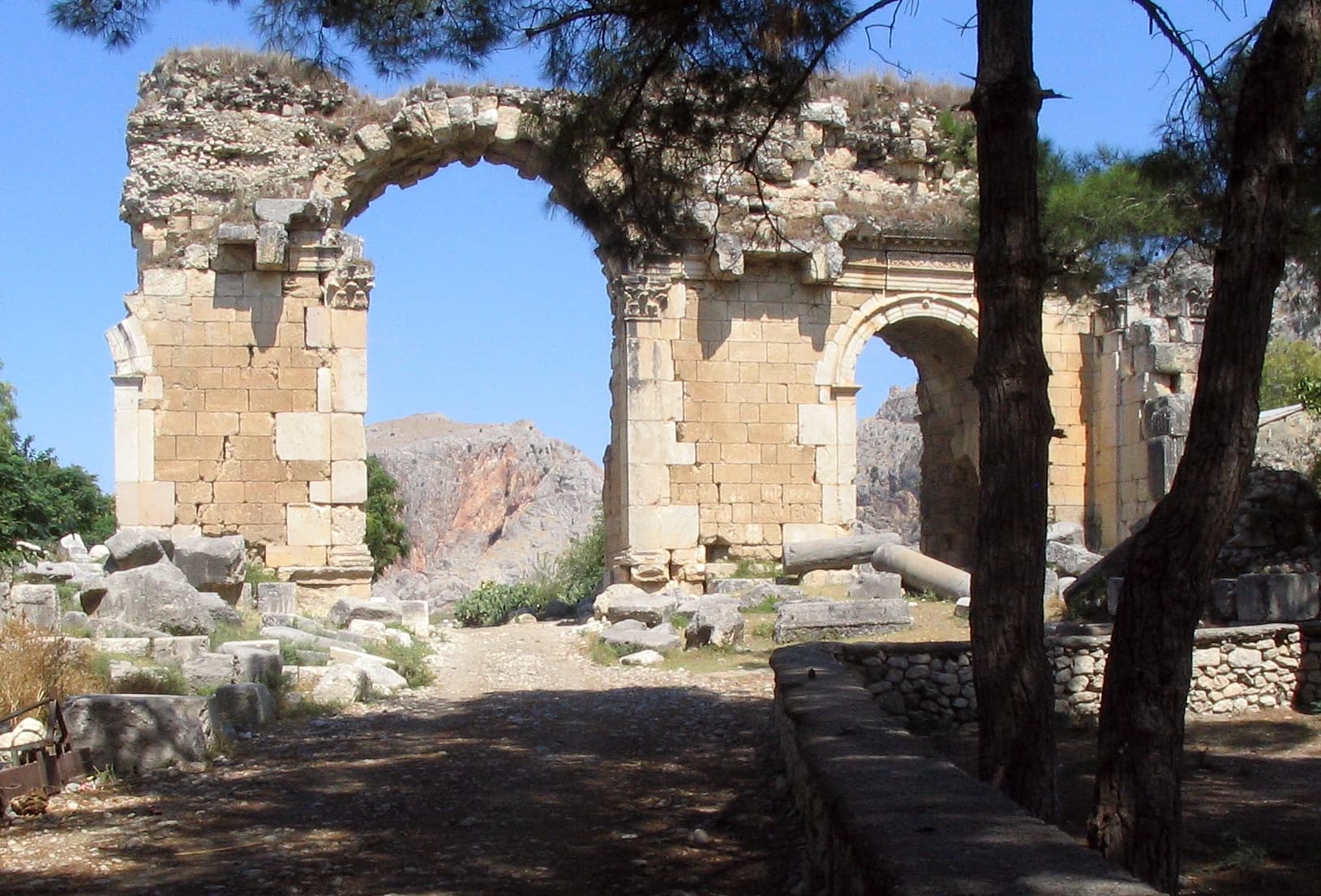
Castabala does not announce itself with reconstructed monuments or interpretive signage. The ruins stretch across open ground near the village of Kırmıtlı in Osmaniye Province — a site whose scale becomes apparent only as you walk it. The colonnaded cardo maximus, the theatre, the remnants of the Artemis sanctuary, the city walls, and the castle hill that rises at the site's edge are all present but require the visitor's active imagination to assemble into the city they once were.
The castle hill is the physical high point of the experience. The climb takes perhaps twenty minutes from the lower ruins, and the view from the top — over the Cilician plain, toward the Amanus Mountains to the east, with the ruins of the city spread below — provides the spatial comprehension that ground-level exploration cannot.
This is how the ancient city read its own landscape: from a fortified height, with the plain extending in every direction, the mountains marking the horizon, the city's sacred precincts organized below the protective elevation.
The ongoing excavations — visible during the field season as roped-off areas with active dig trenches — are a reminder that Castabala is not a concluded story. The 2025 excavation season reportedly recovered Roman-era theatre masks, adding to a growing body of finds that flesh out a city whose written documentation is relatively thin. The experience of visiting an active excavation site is qualitatively different from a finished heritage park: the ground is still giving up what it holds.
Approach from Kırmıtlı, approximately 5 km northeast of the town. No formal entrance; the ruins are spread across open land. Begin with the lower colonnaded street and work toward the castle hill. Allow 2–3 hours. In excavation season (typically spring through early autumn), be aware of roped-off areas.
Context and lineage
The name Castabala is of Luwian origin, placing the settlement firmly in the post-Hittite landscape of ancient Cilicia. The goddess Kubaba was among the most significant deities of the Hittite pantheon and its Luwian successors — a queen of heaven associated with sovereignty, lions, and elemental power.
When the Seleucid king Antiochos IV Epiphanes renamed the city Hieropolis in the 2nd century BCE, he was not creating a sacred city but formalizing in Greek terms a status the city had already held under native tradition. The Hellenistic name for the goddess — Perasia — preserved her transgressive character: the word encodes crossing-over, coming from beyond, the divine that arrives from outside the ordinary boundaries of the world.
Luwian/Hittite Kubaba cult → Hellenistic Artemis Perasia under Seleucid rule → Roman civic religion and ongoing cult → Early Christian bishopric (Diocese of Castabala) → Byzantine continuation → Armenian Christian use (medieval) → Catholic titular see (nominal, present) → Archaeological site under ongoing excavation.
Traditions and practice
The defining practice of the Perasia cult at Castabala was the fire-walking ritual: barefoot priestesses walked across beds of burning coals in ceremonial procession, emerging without injury. Strabo's account is the primary record, and his tone suggests that the practice was widely known in the ancient world and considered an authentic expression of divine power rather than a performance. Alongside this dramatic rite, the cult maintained the standard apparatus of an ancient sanctuary: sacrificial worship, priestly administration, and public festivals.
The dynast Tarcondimotus held civic authority over the city in the 1st century BCE, and the relationship between priestly and dynastic authority during this period reflects the complexity of a holy city's governance under Hellenistic successor states.
None. The site is an open archaeological ruin with no active religious use. Excavations are ongoing during the field season.
Castabala is a site where the central sacred act — fire-walking without harm — cannot be directly recovered or replicated. What it leaves for a contemporary visitor is the question the act was designed to answer: how is it that the divine can protect what should be destroyed? Bring that question to the castle hill and sit with it while looking at the plain below.
The Cilician plain has seen Alexander pass through it, the Battle of Issos fought within sight of it, Armenian kings make it their capital. A site where the sacred has been this persistently claimed, this persistently fought over, this persistently rebuilt and renamed invites reflection on the human need to locate the divine in a specific place and defend that location against displacement.
Ancient Anatolian / Hittite-Luwian
HistoricalCastabala was a cult center of Kubaba, one of the principal deities of the Hittite and Luwian world — a sovereign mother goddess associated with fire and elemental power. The cult's persistence through successive cultural regimes attests to the depth of its local roots.
Sacrificial worship of Kubaba; priestly governance of the sanctuary city.
Ancient Greek / Hellenistic-Roman
HistoricalThe Hellenistic reinterpretation of Kubaba as Artemis Perasia preserved the indigenous cult's essential character while giving it a Greek theological framework. The fire-walking ritual of the Perasia priestesses — documented by Strabo — was unique in the classical Mediterranean world.
Fire-walking ritual by barefoot priestesses across burning coals; sacrificial rites at the temple of Artemis Perasia; civic religious festivals.
Early Christian / Byzantine
HistoricalThe Diocese of Castabala was an active bishopric in Late Antiquity and remains a Catholic titular see. Churches have been excavated at the site.
Christian liturgy and episcopal governance.
Perspectives and open questions
Castabala is approached through the lens of Hittite-Luwian religious continuity, through the specific scholarly study of the Perasia cult, and through the comparative study of fire-walking traditions across world cultures.
Scholarly perspective
Scholarly consensus identifies Castabala as an exceptional instance of religious continuity from the Hittite-Luwian period through the classical world, traceable through both the goddess's name changes and the persistence of the fire-walking rite. The Perasia cult is identified by specialists as a Hellenistic reinterpretation of the indigenous Kubaba tradition, retaining Anatolian characteristics that distinguish it from purely Greek forms of Artemis worship. Recent excavations have added material evidence to the literary record, including the 2025 discovery of Roman-era theatre masks.
The full scope of the Artemis Perasia sanctuary awaits complete excavation.
Living and traditional perspectives
The Luwian community understood Kubaba/Perasia as the sovereign divine protector of the holy city — not a deity approached through intermediaries but one who acted directly in the world through her priestesses' bodies. The fire-walking rite was not theatrical; it was the most literal possible statement of divine protection: the goddess preventing what should have been destruction.
Alternative interpretations
Fire-walking as a spiritual practice appears across an extraordinary range of cultures and historical periods, from ancient India to Polynesia to contemporary New Age contexts. The common thread in scholarly and phenomenological accounts is the connection between fire-walking and altered states of consciousness, in which the practitioner enters a mode of awareness that makes the ordinary rules of physical consequence temporarily inoperative.
Castabala represents the ancient Mediterranean version of this phenomenon, distinctive in its institutional character and its connection to a specific named goddess.
Open questions
The full scope of the fire-walking ritual — its frequency, its preparation, the exact form of the priestess succession, the relationship between the fire and the temple's sacrificial altar — is known only from Strabo's brief account. The complete plan of the Artemis Perasia sanctuary has not been excavated. The Hittite-period remains at the site and their relationship to the later cult are under investigation.
Plan your visit
Access and arrival
Located approximately 5 km northeast of Kırmıtlı, in Osmaniye Province. Approximately 60 km north of İskenderun. Accessible by car from Osmaniye or İskenderun; the road to the site passes through agricultural land. No entry fee outside formal excavation season; no ticket office or facilities. GPS approximately 37.1764°N, 36.1873°E.
Osmaniye city, approximately 20 km southwest, has mid-range hotels. İskenderun, 60 km south, has a wider range. The site itself has no accommodation.
Respectful visit
No formal requirements. Sturdy footwear is essential for the castle hill approach and the uneven terrain of the lower ruins.
Photography is permitted outside active excavation areas. Respect any signage regarding restricted zones during field season.
The fire-walking tradition involved burning coals offered to the goddess; no contemporary offering practice is appropriate or established.
Do not enter active excavation areas. Do not remove any material from the site. The area is under ongoing archaeological investigation.
The castle hill path is steep and loose in places; wear appropriate footwear. Do not enter active excavation zones marked by rope or fencing. No facilities are present at the site — bring water, especially in summer when inland Cilician temperatures are severe.
Location
Map loads as you approach this section.
Pilgrim reflections
A portrait of encounter, not a score
Pilgrims describe what they felt, how present they could become, and whether the place would shape a journey. There are no stars and no ranking of traditions.
No reviewed reflections yet
The first pilgrims can help describe the character of being here.
Share a reflection
Available after an account-backed “Been there.” Every reflection is reviewed before publication.
Nearby sacred places
Explore other sacred places in the region. Proximity does not establish access or travel time; check each place’s guidance.


References
Sources consulted for this page. Source categories describe the publication, not a guarantee that every claim is verified. Traditional accounts and outside interpretations may differ.
- 01Hierapolis/Kastabala — Pleiades Place Resource — Pleiades (Ancient World Mapping Center)academicAuthoritative coordinates and place data: 37.176408, 36.187345
- 02Princeton Encyclopedia of Classical Sites: Hieropolis Castabala — Perseus Digital Library / PrincetonacademicClassical reference for site description and ancient sources
- 03Castabala-Hierapolis — Turkish Archaeological News — Turkish Archaeological NewsacademicCurrent excavation and site news
- 04Local Authority and Civic Hellenism: Tarcondimotus, Hierapolis-Castabala, and the Cult of Perasia — Cambridge University Press / Anatolian StudiesacademicPeer-reviewed study of the Perasia cult and civic authority
- 05Osmaniye Kastabala Archaeological Site — Turkish Museums — Turkish MuseumsofficialOfficial site entry with museum association
- 06Castabala (city) - Wikipedia — Wikipedia contributorsencyclopediaComprehensive overview of history from Hittite through medieval periods
- 07Hierapolis ad Pyramum [Castabala] — Vici.org — Vici.orgacademicAncient site mapping with coordinate data
- 08Ancient City of Castabala — Incirlik AB Turkey — 39th Force Support SquadronguideUS military base nearby; practical visitor guide
Share a photo
Help visitors recognize Castabala. Every submission is reviewed before publication.