Karatepe-Aslantaş
Where a bilingual inscription cracked an ancient script and lion gates still guard a Bronze Age threshold
Understand sacred places, explore living traditions, and learn how to engage respectfully with Pilgrim Map.
Access has not been verified. Check current local guidance before planning a visit.
Osmaniye, Turkey
Read the sources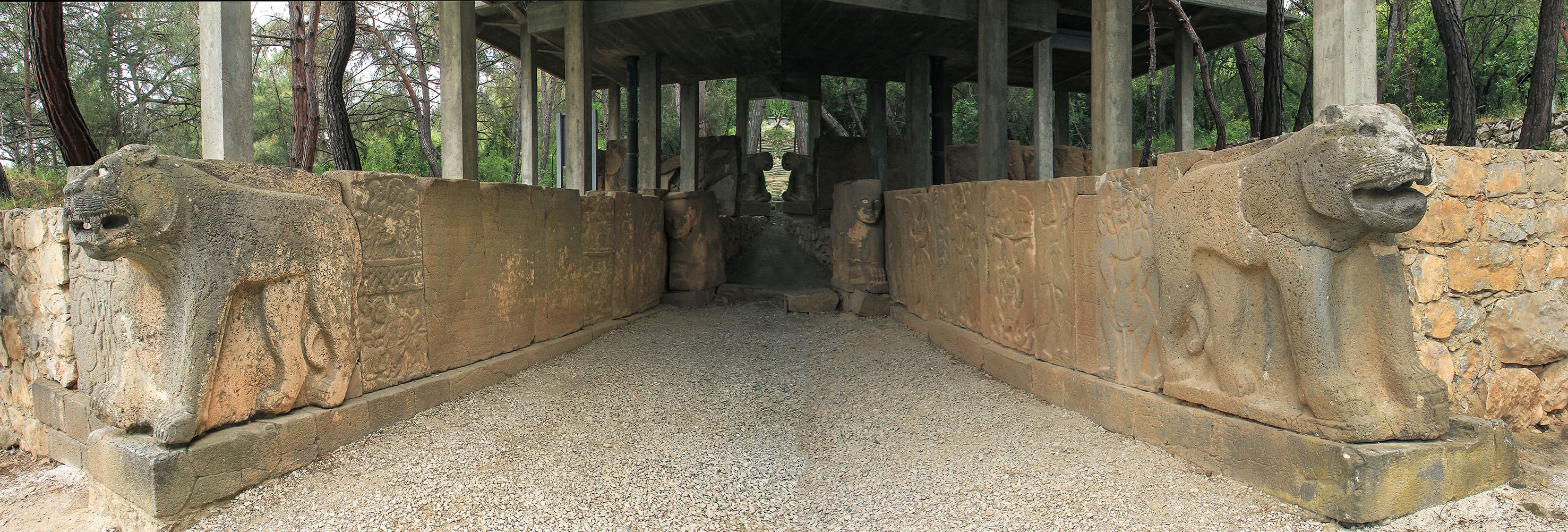
Image of Karatepe-Aslantaş. Image source
Visit essentials
A quick read before you go
- Duration
- 2–4 hours for a thorough visit including both gate complexes, the forest walk between them, and…
- Access
- Located 30 km north of Osmaniye, 23 km southeast of Kadirli, in Osmaniye Province.
Overview
High in the Taurus Mountains above the Ceyhan River, Azatiwataya was built in the late 8th century BCE by Azatiwada, king of the Danunians, as a sacred fortress-city. Lions, sphinxes, and the Egyptian god Bes guarded its gates, while its founding inscription invoked Luwian, Semitic, and Egyptian deities.
Carved in Hieroglyphic Luwian and Phoenician, that bilingual inscription became one of the great discoveries of 20th-century archaeology and the key to deciphering Anatolian hieroglyphs after nearly three thousand years of silence, paralleling the Rosetta Stone's role. Turkey's first open-air museum, established around the site in 1946 under pioneering archaeologist Halet Çambel, preserves the orthostats and gate statuary in situ. Visitors can still read the complete sacred threshold as ancient builders placed it: guardians, figural reliefs, and royal words together.
Why this place is sacred
The gates of Azatiwataya were conceived as sacred thresholds. In the ancient Luwian world, gates were not merely practical openings in walls — they were liminal zones where the boundary between the ordered human world and the chaos outside was enforced by divine power. The flanking lions at Karatepe's gates are not decorative elements: they are apotropaic guardians, embodiments of divine protective force that deterred malevolent spirits from crossing the threshold.
The sphinxes that accompany them are composite beings — part human, part lion, part bird — whose hybrid nature marked them as belonging simultaneously to multiple realms of existence, and therefore capable of mediating between them. The Egyptian god Bes, who appears prominently in the reliefs, traveled here through Phoenician trade networks from the Nile valley: a protective deity of thresholds and childbirth, squat and leonine, whose image had the power to frighten away evil.
The founder Azatiwada understood his city as protected by all of this divine power simultaneously — Luwian storm gods and solar goddesses, Semitic Baal and El, Egyptian Bes. His founding inscription is a kind of comprehensive divine insurance policy, covering every tradition he knew.
This cosmopolitan sacred architecture is itself a form of revelation about the ancient world: that people at the frontier of multiple civilizations did not choose between their divine traditions but invoked them all, understanding that completeness of divine protection required breadth of sacred commitment. The mountain setting reinforces these qualities.
At 638 meters above sea level, with the Ceyhan River visible below and the Taurus peaks surrounding the site, Karatepe occupies the kind of high place that, across nearly every ancient tradition, was understood as the zone where human and divine realms came into contact. The ancient Luwians built their temples on elevations; their storm god was conceived as dwelling in mountain cloud. Azatiwada chose this hilltop deliberately, not only for military advantage but for theological alignment.
Late Iron Age fortress-city of Azatiwataya, built by Azatiwada as a royal foundation with sacred gates, divine invocations, and protective imagery; administrative and military center of the Danunian kingdom
Built c. 800–720 BCE; abandoned after Assyrian conquest of the region in the late 8th century BCE; rediscovered in 1946 by Bossert and Halet Çambel; designated Turkey's first open-air museum; now part of Karatepe-Aslantaş National Park; on UNESCO World Heritage Tentative List
Experience and orientation
Karatepe-Aslantaş is among the most rewarding ancient sites to visit in Turkey because the balance between preservation and accessibility has been struck unusually well. The drive up through the national park's pine forest already begins to prepare the senses — you leave the flat agricultural plains behind and climb into a different quality of air and light.
The site sits on a wooded ridge above the Ceyhan River, and the combination of ancient stone, Mediterranean forest, and moving water below creates an environment of considerable power. The two gate complexes — the North Gate and the South Gate — are the heart of the experience. Both are partially covered by modern protective shelters, which allow close examination of the carved basalt orthostats without the weathering that open-air exposure would cause.
This is a meaningful gift: you can stand a meter from a relief carving of a protective deity, a banqueting scene, a procession of figures, and look at the tool marks left by an 8th-century BCE sculptor. The scale of the figures is human — not monumental but personal, the height of a standing adult. The reliefs were carved to be seen by people standing in the gateway, and their scale reflects that original relationship.
The Karatepe Bilingual inscription occupies panels near the gates, its columns of Hieroglyphic Luwian and Phoenician characters visible as distinct scripts side by side. If you know that this text unlocked the decipherment of Luwian hieroglyphs — that scholars worked from this double inscription to read, for the first time in three millennia, the religious and historical texts of an entire civilization — standing before it carries a particular quality of intellectual vertigo.
The forest walk between the two gate complexes takes about 20 minutes at a contemplative pace, along a path that passes through pine and oak above the river. The Ceyhan below can be heard before it is seen; its presence is a constant acoustic baseline to the visit.
Karatepe-Aslantaş Open-Air Museum is located within a national park, approximately 30 km north of Osmaniye. The site has a small entrance gate with a fee, clear paths between the two gate complexes, and parking at the base. Comfortable walking shoes are adequate — the terrain is well maintained.
Context and lineage
The founding inscription of Karatepe-Aslantaş, preserved in the gate reliefs in both Hieroglyphic Luwian and Phoenician, is one of the most self-conscious acts of royal foundation in the ancient world. Azatiwada, king of the Danunians (Adanawa), built the city to protect the plain of Adana, to prosper his people under divine blessing, and to extend the power of his overlord, the Phrygio-Cilician king Awariku.
His text invokes blessings on the city and curses on anyone who would destroy the inscriptions — a prescient act, since the inscriptions have indeed survived nearly three thousand years. The mixed divine pantheon in the inscription — Baal, El, the sun-goddess of Arinna, Reshef, Tarhuntas — reflects the cosmopolitan frontier position of Azatiwataya, where Luwian Anatolian, Phoenician Levantine, and Egyptian religious streams converged in a single royal theology.
Late Iron Age Neo-Hittite Luwian tradition; Phoenician religious influence; Egyptian apotropaic tradition; abandoned after Assyrian conquest; rediscovered and designated Turkey's first open-air museum 1946
Traditions and practice
The gates of Karatepe were ceremonial spaces as much as military ones. Ancient Near Eastern gate complexes functioned as venues for justice, commerce, official proclamation, and sacred ritual. The elaborate apotropaic imagery — lions, sphinxes, the dwarf god Bes — was understood as actively protective, not merely symbolic. To pass through the gate under the gaze of these guardian figures was to pass through a spiritually defended threshold.
The Bes reliefs are particularly notable: the Egyptian god of thresholds and protection, here absorbed into a Luwian-Phoenician sacred context, suggests active ritual engagement with his protective power. The banquet scenes carved in the reliefs likely depict divine or royal feasts — the ceremonial consumption of food and drink in the presence of the gods that was a central ritual act across the ancient Near East.
The foundation inscription itself was a ritual act: to carve the king's words in both Luwian and Phoenician, to invoke the gods by their names in both languages, was to bind the city to its divine protectors through the permanence of stone.
Heritage tourism; archaeological research; national park hiking and picnicking; guided museum visits. The site draws a modest but engaged international visitor base interested in ancient Near Eastern history and the history of decipherment.
Enter the site from the parking area and take a few minutes to orient yourself with the national park map before approaching the gates. The two gate complexes are connected by a forest walk, and the site is best experienced as a circuit rather than a destination.
At the North Gate, approach the bilingual inscription first — find the two columns of script, Hieroglyphic Luwian and Phoenician side by side, and spend time with the visible difference in the two writing systems before reading any translation. This direct encounter with the scripts as visual objects — before the semantic layer — allows you to experience something of what the ancient viewer encountered: two different written traditions joined in a single act of royal speech.
Then move to the figural reliefs. Stand at the level of the carved figures, which were designed for standing viewers, and attend to what the sculptor chose to depict: protective deities, feasting scenes, musicians, hunting, mythological animals. These images are not illustrations — they are an iconographic program designed to maintain divine protection of the threshold through the power of representation. At the South Gate, the sphinxes are among the finest surviving examples of Neo-Hittite monumental sculpture.
On the forest walk between the gates, the Ceyhan River below provides continuous sound; this acoustic continuity with the landscape the ancient inhabitants experienced is one of the most unmediated sensory connections the site offers.
Neo-Hittite Luwian Religion
HistoricalAzatiwataya's founding inscription invokes Baal, El, the sun-goddess of Arinna, Reshef, and the Storm God Tarhuntas. The gate sculptures embody a coherent apotropaic theology: lions and sphinxes guard the threshold, divine and mythological scenes maintain cosmic order. This is the full expression of Neo-Hittite Luwian sacred kingship.
Royal prayer and invocation, apotropaic gate rites, temple ceremonies for state protection, royal foundation inscriptions as acts of divine binding
Phoenician Religious Tradition
HistoricalThe bilingual Phoenician-Luwian inscription demonstrates the syncretism of Luwian and Levantine religious traditions at this frontier site. The Phoenician text's invocation of Baal and El was also the key that unlocked the decipherment of Luwian hieroglyphs.
Semitic deity invocations, royal foundation ceremonies, divine legitimization of rulership
Egyptian-Influenced Apotropaic Tradition
HistoricalBes reliefs at Karatepe demonstrate how Egyptian protective religious imagery traveled through Phoenician networks to reach the Taurus Mountains. The Egyptian dwarf god of thresholds and protection here served the same apotropaic function as in Nile valley domestic and temple contexts.
Use of Bes imagery as threshold guardian; apotropaic relief carving integrated with Luwian and Semitic gate imagery
Archaeological / Scholarly
ActiveKaratepe-Aslantaş is Turkey's first open-air museum and a landmark of 20th-century archaeology. Halet Çambel's decades of work here established the model for in-situ preservation of ancient sculpture in Turkey.
Ongoing excavation, conservation of reliefs under protective shelters, heritage education, national park management
Perspectives and open questions
Karatepe-Aslantaş is important to several distinct communities of interest — historians of ancient writing, scholars of Neo-Hittite art and religion, visitors drawn to the national park, and those interested in the history of archaeological discovery in Turkey.
Scholarly perspective
Karatepe-Aslantaş is one of the most significant Neo-Hittite sites in Turkey and a landmark in the history of decipherment. The bilingual inscription provided the key to reading Anatolian hieroglyphs in the same way the Rosetta Stone provided the key to Egyptian demotic and hieroglyphic script. The in-situ preservation of the reliefs, initiated by Halet Çambel and maintained to the present, makes Karatepe one of the most important field laboratories for understanding Neo-Hittite iconography and religious art.
Living and traditional perspectives
No surviving community with direct religious continuity claims connection to the site. The region is administered as part of Turkey's national cultural heritage. The Adana region preserves later Islamic, Byzantine, and Crusader-era monuments, but Karatepe's Iron Age traditions have no living descendant community.
Alternative interpretations
The site's position on a mountain above a river, its invocation of gods from three separate civilizations, and the miraculous survival of its inscriptions through nearly three millennia have been interpreted by some as evidence that Azatiwada chose a location of inherent natural power. The Luwian sacred tradition held that certain high places — mountains, river confluences — were the dwelling places of gods; the site's natural features align with these theological criteria.
Open questions
The full religious practice program at Azatiwataya — whether it included oracular functions, pilgrimage, or ritual beyond the gate-guardian ceremonies suggested by the reliefs — remains unknown. The precise political relationship between Azatiwada and his Phrygio-Cilician overlords, and how the city functioned within the regional political economy, are partially understood but not fully resolved.
Plan your visit
Access and arrival
Located 30 km north of Osmaniye, 23 km southeast of Kadirli, in Osmaniye Province. Nearest airport: Adana Şakirpaşa (ADN), approximately 125 km away. Best accessed by private car or organized tour from Adana or Osmaniye. A small entry fee applies. Accommodation available in Kadirli and Osmaniye; Adana provides the most comprehensive options.
Kadirli (25 km) and Osmaniye (30 km) offer guesthouses and small hotels. Adana (125 km) provides the widest range of accommodation and is a natural base for visiting the region's multiple ancient sites.
Respectful visit
No religious dress requirements. Comfortable outdoor clothing for walking on a wooded hillside. Sun protection and water recommended.
Photography is generally permitted throughout the open-air museum. The in-situ reliefs under shelters photograph well without flash.
Not applicable.
Do not touch the ancient reliefs. Stay on designated paths within the museum area. The protective shelters are part of the conservation infrastructure and should not be leaned on or accessed beyond visitor areas.
Do not touch the ancient reliefs — even dry skin oils accelerate weathering of ancient stone. Stay on designated paths within the museum area. The hilltop can be warm in summer; water is available at the entrance.
Location
Map loads as you approach this section.
Pilgrim reflections
A portrait of encounter, not a score
Pilgrims describe what they felt, how present they could become, and whether the place would shape a journey. There are no stars and no ranking of traditions.
No reviewed reflections yet
The first pilgrims can help describe the character of being here.
Share a reflection
Available after an account-backed “Been there.” Every reflection is reviewed before publication.
Nearby sacred places
Explore other sacred places in the region. Proximity does not establish access or travel time; check each place’s guidance.


References
Sources consulted for this page. Source categories describe the publication, not a guarantee that every claim is verified. Traditional accounts and outside interpretations may differ.
- 01The Fortress Azatiwatas: Karatepe-Aslantaş — Koç University Library Digital CollectionsacademicDigital exhibition on the fortress and its inscriptions from Koç University
- 02Karatepe-Aslantaş Archaeological Site - UNESCO World Heritage CentreofficialOfficial UNESCO Tentative List entry
- 03Karatepe-Aslantaş Open-Air Museum - WikipediaencyclopediaComprehensive Wikipedia article on the site, discoveries, and significance
- 04Karatepe bilingual - WikipediaencyclopediaArticle specifically on the bilingual Phoenician-Luwian inscription
- 05Karatepe-Aslantaş | Turkish Archaeological NewsacademicArchaeological news aggregator entry with scholarly references
- 06The Bilingual Citadel: The Sculpted Legacy of Karatepe-AslantaşguideDetailed overview of the sculpted reliefs and inscriptions
- 07Karatepe-Aslantaş Open-Air Museum | Lonely PlanetguidePractical visitor information
- 08Karatepe Aslantaş National Park and Open Air MuseumguideDetailed visitor guide with access and practical information
Share a photo
Help visitors recognize Karatepe-Aslantaş. Every submission is reviewed before publication.