Zincirli
Where an Iron Age official inscribed his belief in the soul's persistence — the ancient city from which the biblical concept of nephesh may have emerged
Understand sacred places, explore living traditions, and learn how to engage respectfully with Pilgrim Map.
Access has not been verified. Check current local guidance before planning a visit.
Gaziantep, Turkey
Read the sources
Visit essentials
A quick read before you go
- Duration
- Half a day to fully appreciate the site and its valley setting, particularly if the excavation…
- Access
- Located near Zincirli village, Nurdağı district, Gaziantep Province.
Overview
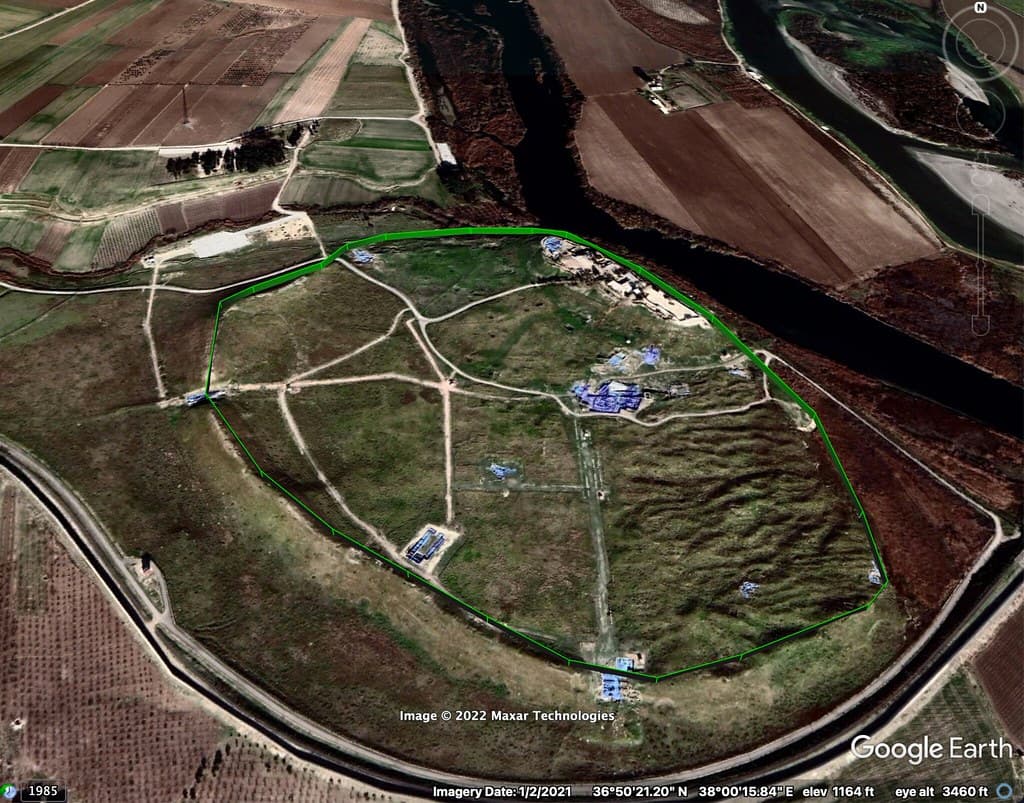
In a pastoral valley where the Anti-Taurus mountains descend toward the Syrian plain, a 40-hectare oval mound holds a city layered across more than two millennia. Ancient Sam'al, modern Zincirli, was an Iron Age Neo-Hittite and Aramaean city-state governing a region where Luwian, Aramaean, and Assyrian cultures met in the 9th and 8th centuries BCE. Its kings built elaborate bit hilani palaces, erected monumental gates with carved reliefs, and commissioned inscriptions in a distinctive local script.
University of Chicago excavators found a basalt stele in an Iron Age room in 2008. Its Sam'alian Aramaic inscription changed scholarly understanding of religion's intellectual history in the ancient Near East.
The stele belongs to Kuttamuwa, a royal official serving King Panamuwa II, who died around 733 BCE. Commissioned for Kuttamuwa's funerary monument, its unprecedented text says his soul, nepeš, cognate with Hebrew nephesh, does not die with his body but resides in the carved stele. The stone is not a memorial to his memory but a dwelling for his living soul.
It prescribes a regular marzea, a ritual meal shared with the dead, with offerings brought to sustain the indwelling soul.
This is personal theology, not mythology: a first-person account of one man's afterlife understanding and the ancient Near East's earliest inscription of its kind. Nepeš also appears throughout the Hebrew Bible with resonances of life, breath, and individual identity that shaped Jewish, Christian, and Islamic understandings of self.
Sam'al/Zincirli remains an active site where the Chicago-Tübingen expedition uncovers more each season. It is already among Turkey's most significant places for understanding the religious world from which the Abrahamic traditions emerged.
Why this place is sacred
The Kuttamuwa Stele is a thin place in text form: an inscription through which an ancient man speaks directly across 2,700 years about the most intimate of human fears — the fear that we will cease to exist, and that those who come after us will forget us.
Kuttamuwa's solution to that fear is interesting in itself, quite apart from its historical significance. He does not claim immortality. He does not describe a divine realm awaiting him. He describes a practical arrangement: his soul will live in this stone, and you will come and eat with it, and through those shared meals, the connection between the living and his soul will persist. The theology is communal, material, and intimate.
It does not require cosmic transcendence — only continued attention.
What makes Zincirli significant as a sacred site is that this theology was not isolated. The marzea feast — the ritual shared meal with the dead — is attested across the ancient Near East, from Ugarit to Israel. The soul concept that underlies it, the nepeš, became the foundational term for individual identity and spiritual essence in the Hebrew Bible.
The trajectory from Kuttamuwa's stele inscription to the biblical nephesh to the Christian soul to the Islamic ruh is speculative in its details but coherent in its direction: a persistent human insistence that something essential about a person does not end at death.
Standing at the mound of Sam'al, where Kuttamuwa's room was excavated, a visitor stands at one of the documented points of origin for that insistence. Not its ultimate origin — humans have always made this claim — but one of the first times it was written down.
Sam'al/Zincirli functioned as the capital of an independent Neo-Hittite/Aramaean city-state governing the Islahiye valley region. Its sacred structures — temples, royal altars, gate reliefs — served both religious and political functions typical of Iron Age Syro-Anatolian kingdoms.
From an Early Bronze Age settlement through its peak as the Sam'al kingdom capital (10th–8th centuries BCE) to Neo-Assyrian provincial administration (after c. 720 BCE), the site passed through multiple cultural phases before abandonment. Archaeological rediscovery began with the German Oriental Society (1888–1902); the current Chicago-Tübingen Expedition has been active since 2006, producing the most significant recent discoveries including the Kuttamuwa Stele.
Experience and orientation
Zincirli occupies a valley that still feels quiet and agricultural. The mound is large — 40 hectares is substantial — and its oval form, defined by the ancient city's outer walls, is visible from the approach road. The valley setting, ringed by low hills, gives the site a sense of enclosure that would have aided its ancient defensive character.
The site has no formal visitor infrastructure comparable to a developed museum. What you encounter is the active archaeology itself: open trenches protected by covering, excavated architectural features marked with interpretive signs, the foundations of city walls and gate complexes visible in sections. During excavation seasons (typically summer), the Chicago-Tübingen expedition team is present and can provide context; outside those periods, the site is accessible but self-guided.
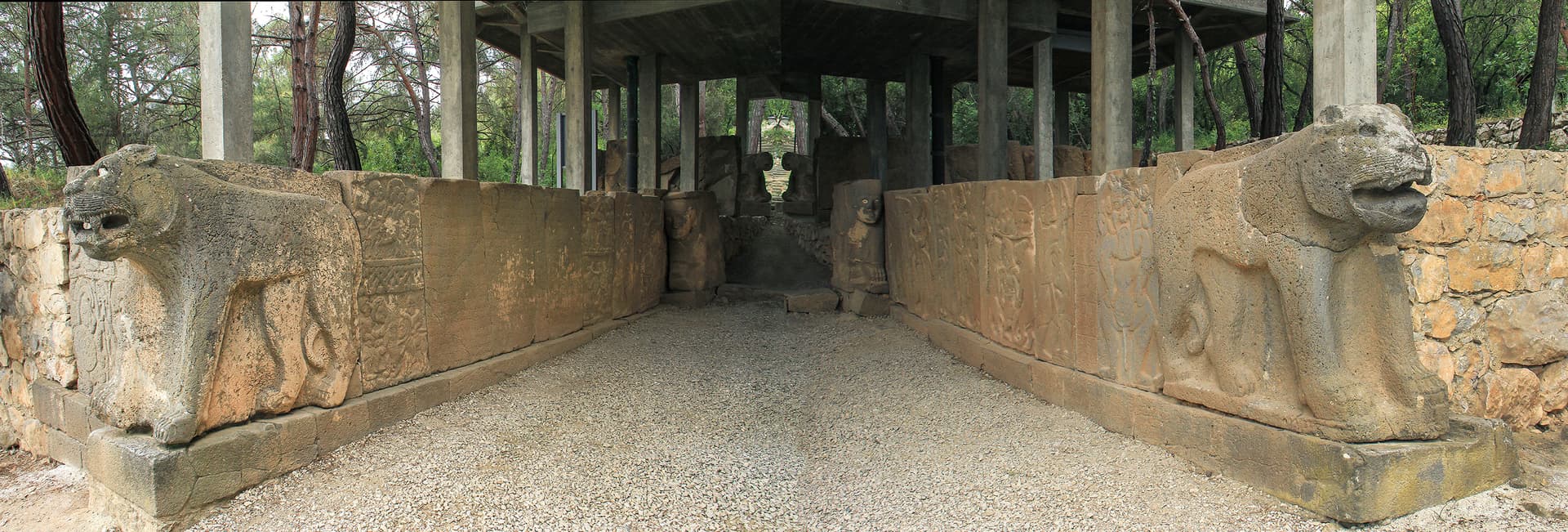
The gate complexes deserve particular attention. The monumental carved reliefs that once decorated Sam'al's gates — many now in Berlin's Pergamon Museum and the Istanbul Archaeological Museum — defined the city's sacred and political identity in stone. What remains in situ are the architectural foundations: the arrangement of rooms, the scale of the entrance, the spatial logic of a city that understood its gates as sacred thresholds requiring divine guardians.
The Kuttamuwa Stele itself is not here; it is held at the Oriental Institute Museum in Chicago. But the room where it was found has been excavated and its position documented. Standing near that location — a residential or official room in an Iron Age city, where a man had prepared his funerary monument and arranged for ongoing feasts — gives the inscription a physical context that the museum display cannot provide.
The scale of the unexcavated mound is also part of the experience. A 40-hectare site with only a fraction excavated means that the majority of Sam'al is still underground, waiting. What other theology, what other stele, what other inscription may still be buried in this valley is a genuinely open question.
Approach via Zincirli village in the Nurdağı/Islahiye area of Gaziantep Province. The mound is visible from the village road. During non-excavation periods, the site is accessible for self-guided visits; during excavation seasons, coordinate with the expedition team. The active dig typically runs in summer months; contact the Oriental Institute at the University of Chicago for current season information.
Context and lineage
The site now known as Zincirli has been inhabited since at least the Early Bronze Age (c. 3000 BCE). The city of Sam'al emerged as a Neo-Hittite/Aramaean kingdom following the collapse of the Hittite Empire, establishing itself as the regional capital of the Islahiye valley from approximately the 10th century BCE onward.
Sam'al's kings built in the tradition of Syro-Anatolian city-states: monumental gates with carved orthostats, bit hilani palaces with pillared entrance halls, royal stelae asserting dynastic legitimacy and divine favor. The Kilamuwa Stela (c. 840–810 BCE), commissioned by King Kilamuwa in the distinctive local Sam'alian dialect, was one of the earliest significant inscriptions from the site, documenting royal beneficence and implicitly the theological framework of kingship.
The most significant religious find is the Kuttamuwa Stele, discovered in 2008 in a small room that may have served as a funerary cult chamber. Kuttamuwa was a royal official under King Panamuwa II (who died c. 733/732 BCE). His inscription prescribes ongoing feasts at the stele to nourish his soul — using the Sam'alian word nepeš, cognate with Hebrew nephesh — that will reside in the stone after his death.
Around 720 BCE, Sam'al was absorbed into the Neo-Assyrian provincial system, ending its independence. The city continued to be inhabited but lost its cultural distinctiveness. Eventually, like so many ancient urban centers, it was abandoned and its layers accumulated into a mound that would not be investigated until German archaeologists arrived in the late 19th century.
Early Bronze Age settlement (c. 3000 BCE) → Middle Bronze Age walled citadel (c. 2000–1600 BCE) → Neo-Hittite/Aramaean Sam'al kingdom (10th–8th centuries BCE) → Neo-Assyrian provincial period (c. 720 BCE onward) → Abandonment → German Oriental Society excavations (1888–1902) → Chicago-Tübingen Expedition (2006–present)
Felix von Luschan
German archaeologist
King Kilamuwa
Sam'al king, c. 840–810 BCE
Kuttamuwa
Royal official, 8th century BCE
King Panamuwa II
Sam'al king, died c. 733/732 BCE
Prof. J. David Schloen
University of Chicago archaeologist
Dr. Virginia Herrmann
University of Tübingen archaeologist
Traditions and practice
The marzea feast at the heart of Sam'alian religion was not a somber funeral rite but a regular shared meal between the living and their honored dead, conducted at the funerary stele that housed the deceased's soul.
The feast prescribed in the Kuttamuwa inscription specifies offerings of sheep, oil, and the produce of the vineyard — the ordinary foods of a living household, offered to sustain a soul that was understood to retain its appetite, its sociality, its need for nourishment.
This form of ancestor veneration, in which the dead remain present and in relationship with the living through regular ritual meals, is attested across the ancient Near East and shares a family resemblance with the funerary feast traditions of neighboring Phoenicia, Ugarit, and later Israel. The theological claim underlying all of them is the same: death does not end the person. It relocates them.
The Storm God (Hadad/Ba'al) worship at Sam'al followed the standard pattern of Syro-Anatolian polytheism: the storm deity controlling rain, thunder, and agricultural fertility was the supreme divine authority, honored through temple worship, royal dedication, and the assumption that royal power derived from his favor. The gate reliefs that decorated Sam'al's entrances projected this theology into the city's physical fabric.
No active religious practices. The Chicago-Tübingen Expedition conducts summer excavation campaigns at the site; check their website (zincirli.uchicago.edu) for current season dates and contact information.
Go to the edge of the mound and look out across the valley. Sam'al controlled this valley — its fields, its trade routes, its water. The mountain horizon in every direction would have been familiar to Kuttamuwa. Then walk the site with the Kuttamuwa inscription in mind: not as a historical document but as a letter from a specific person who had his own fears and his own solutions.
Kuttamuwa wrote his inscription for himself, but he also wrote it for the people who would come after him and perform the feast. He was asking them — people he would never meet, across a future he could not imagine — to keep him company. To eat with him. To not forget him. Three thousand years later, you are here. That request was partially fulfilled by your presence.
The site's landscape — the valley, the anti-Taurus foothills, the sense of enclosure — adds an experiential dimension to the archaeological encounter. Walk the perimeter of the mound if the terrain permits; the scale of the oval city plan communicates the ambition of Iron Age Sam'al in a way that excavation sections alone cannot.
Sam'alian / Aramaean Soul Theology
HistoricalThe Kuttamuwa Stele (8th century BCE) provides the earliest textual evidence from the Near East of a belief in the soul as a distinct entity from the body. The inscription describes the soul residing in a carved stone stele after death and prescribes regular sacrificial feasts for its sustenance. This theology is directly cognate with biblical Hebrew nephesh and illuminates the religious world from which Abrahamic traditions emerged.
Marzea feast rituals — regular sacrificial meals at the funerary stele for the sustenance of the deceased's soul; the stele functioning as a physical dwelling for the soul rather than merely a memorial.
Neo-Hittite / Luwian Royal Religion
HistoricalSam'al maintained Luwian cultural and religious traditions following the Hittite Empire's collapse. The bit hilani palace architecture, monumental gate reliefs, and royal stelae reflect a royal cult combining Luwian, Aramaean, and Assyrian religious elements, with Storm God worship as the supreme theological authority.
Royal cult worship centered on the Storm God (Hadad/Ba'al); gate guardian imagery as sacred threshold protection; monumental stele inscription as act of religious and political legitimation; royal ancestor veneration.
Archaeological / Scholarly
ActiveFirst systematically excavated by the German Oriental Society (1888–1902); the current Chicago-Tübingen Expedition (since 2006) has produced the most significant recent discoveries. The site is one of the most actively researched Iron Age sites in Turkey and a landmark in the study of ancient Near Eastern religion.
Annual summer excavation campaigns; epigraphy; landscape survey; artifact analysis; international publication through the University of Chicago and University of Tübingen.
Perspectives and open questions
Zincirli/Sam'al generates productive scholarly disagreement about the nature of Iron Age Aramaean religion and its relationship to biblical Hebrew theology — debates that have not been resolved and that touch on some of the most consequential questions in the history of religion.
Scholarly perspective
The Chicago-Tübingen Expedition has produced a series of landmark discoveries at Zincirli, of which the Kuttamuwa Stele is the most internationally significant. The stele's inscription is recognized as providing the earliest textual evidence from the ancient Near East of a belief in the soul (nepeš/nephesh) as a distinct entity separable from the body at death.
The parallel with biblical Hebrew nephesh theology is widely noted in the scholarly literature, though the exact relationship — whether Sam'alian theology influenced Israelite religion, reflects a shared Semitic cultural background, or developed independently — is an active research question. The site's broader archive of inscriptions in Sam'alian Aramaic, including recent new alphabetic discoveries, has significantly advanced understanding of Iron Age epigraphy in the region.
Living and traditional perspectives
No living religious tradition is directly connected to the site. Modern Turkish heritage management oversees the site administratively. The Kuttamuwa Stele is held at the Oriental Institute Museum in Chicago, where it is one of the most significant objects in the collection.
Alternative interpretations
The Kuttamuwa Stele has attracted sustained attention from those exploring the origins of biblical soul theology and the religious matrix from which Abrahamic traditions emerged. Researchers interested in early monotheism, the development of the concept of individual identity, and the relationship between Aramaean and Israelite religion find in Zincirli a site of concentrated significance.
The theology of the stele — communal, material, intimate — has also been noted by those interested in alternatives to individualistic modern Western understandings of the self and its relationship to death.
Open questions
The full extent of the Sam'alian religious practices documented at the site is far from understood; the 40-hectare mound has been only partially excavated, and additional finds comparable to the Kuttamuwa Stele may be waiting. The exact relationship between Sam'alian nepeš theology and parallel Phoenician, Hebrew, and Aramaic concepts remains an open question.
The identity and domestic context of the marzea feast — who participated, how often, what the ritual felt like as a lived experience — can only be inferred from textual evidence and comparative anthropology.
Plan your visit
Access and arrival
Located near Zincirli village, Nurdağı district, Gaziantep Province. Approximately 1 hour from Gaziantep city (80 km via D400 toward Islahiye, then north toward Nurdağı; brown tourist signs indicate Zincirli). From Gaziantep airport: domestic connections available. Best reached by private car or taxi from Gaziantep or Islahiye. During active dig seasons, contact the Chicago-Tübingen Expedition (zincirli.uchicago.edu) for current access protocol. Mobile phone signal is intermittent in this area; download offline maps before arriving.
No café or facilities at the site itself; bring water and food.
Islahiye (nearest town, c. 15 km) has basic accommodation. Gaziantep (1 hour) is the preferred base, offering comfortable hotels, excellent cuisine, and the Gaziantep Archaeological Museum (which holds important Neo-Hittite material).
Respectful visit
No religious dress requirements. Practical outdoor clothing for a rural archaeological site; sturdy footwear for uneven terrain. A hat and sun protection are essential in summer.
Generally permitted for personal use. During active excavation seasons, ask the expedition team before photographing any exposed finds, open trenches, or ongoing work. Do not photograph the expedition team at work without permission.
Not applicable; no active religious tradition. The marzea feast tradition is extinct.
Do not disturb excavation areas or enter cordoned sections at any time. Do not touch, move, or remove any material from the site. Stay on designated paths. Do not approach unprotected open trenches. Follow all guidance from the expedition team immediately.
Confirm access with the Chicago-Tübingen Expedition before visiting during summer excavation seasons; some areas may be restricted. The terrain is uneven; appropriate footwear is essential. The site is in a rural area with limited infrastructure — carry water and food.
Location
Map loads as you approach this section.
Pilgrim reflections
A portrait of encounter, not a score
Pilgrims describe what they felt, how present they could become, and whether the place would shape a journey. There are no stars and no ranking of traditions.
No reviewed reflections yet
The first pilgrims can help describe the character of being here.
Share a reflection
Available after an account-backed “Been there.” Every reflection is reviewed before publication.
Nearby sacred places
Explore other sacred places in the region. Proximity does not establish access or travel time; check each place’s guidance.

References
Sources consulted for this page. Source categories describe the publication, not a guarantee that every claim is verified. Traditional accounts and outside interpretations may differ.
- 01Chicago-Tübingen Expedition to Zincirli — Archaeological excavations at ancient Sam'al — University of Chicago / University of TübingenacademicOfficial expedition website with current research and findings
- 02The Neubauer Expedition to Zincirli, Turkey — Institute for the Study of Ancient Cultures, University of ChicagoacademicOfficial ISAC (Oriental Institute) expedition page
- 03Zincirli Höyük | Ancient, Bronze Age, Anatolia — Encyclopaedia BritannicaencyclopediaAuthoritative encyclopaedia entry on the site
- 04Funerary monument reveals Iron Age belief that the soul lived in the stone — University of Chicago NewsacademicOfficial University of Chicago announcement of the Kuttamuwa Stele discovery
- 05Insight into the Soul — Archaeology MagazineacademicIn-depth feature on the Kuttamuwa stele and Iron Age soul beliefs at Zincirli
- 06Settlement History and Urban Planning at Zincirli Höyük, southern Turkey — Academic authors, Academia.eduacademicPeer-reviewed study of settlement patterns and urban development
- 07New Alphabetic Inscription From Zincirli (ancient Sam'al) In Southeast Turkey — Institute for the Study of Ancient CulturesacademicRecent epigraphic discovery at the site
- 08Samʾal - Wikipedia — Wikipedia contributorsencyclopediaComprehensive overview of Sam'al/Zincirli history and archaeology
- 09Kuttamuwa stele - Wikipedia — Wikipedia contributorsencyclopediaDetailed overview of the stele and its religious significance
Share a photo
Help visitors recognize Zincirli. Every submission is reviewed before publication.