Antiphellos
A Lycian city of the dead set against the open sea — where ancient tombs surface in living streets
Understand sacred places, explore living traditions, and learn how to engage respectfully with Pilgrim Map.
Access has not been verified. Check current local guidance before planning a visit.
Antalya, Turkey
Read the sources
Image of Antiphellos. Image source
Visit essentials
A quick read before you go
- Duration
- 2–4 hours to walk the main ruins within Kaş town.
- Access
- Kaş is served by dolmuş from Fethiye (approximately 2.5 hours) and Antalya (approximately 3.5…
Overview
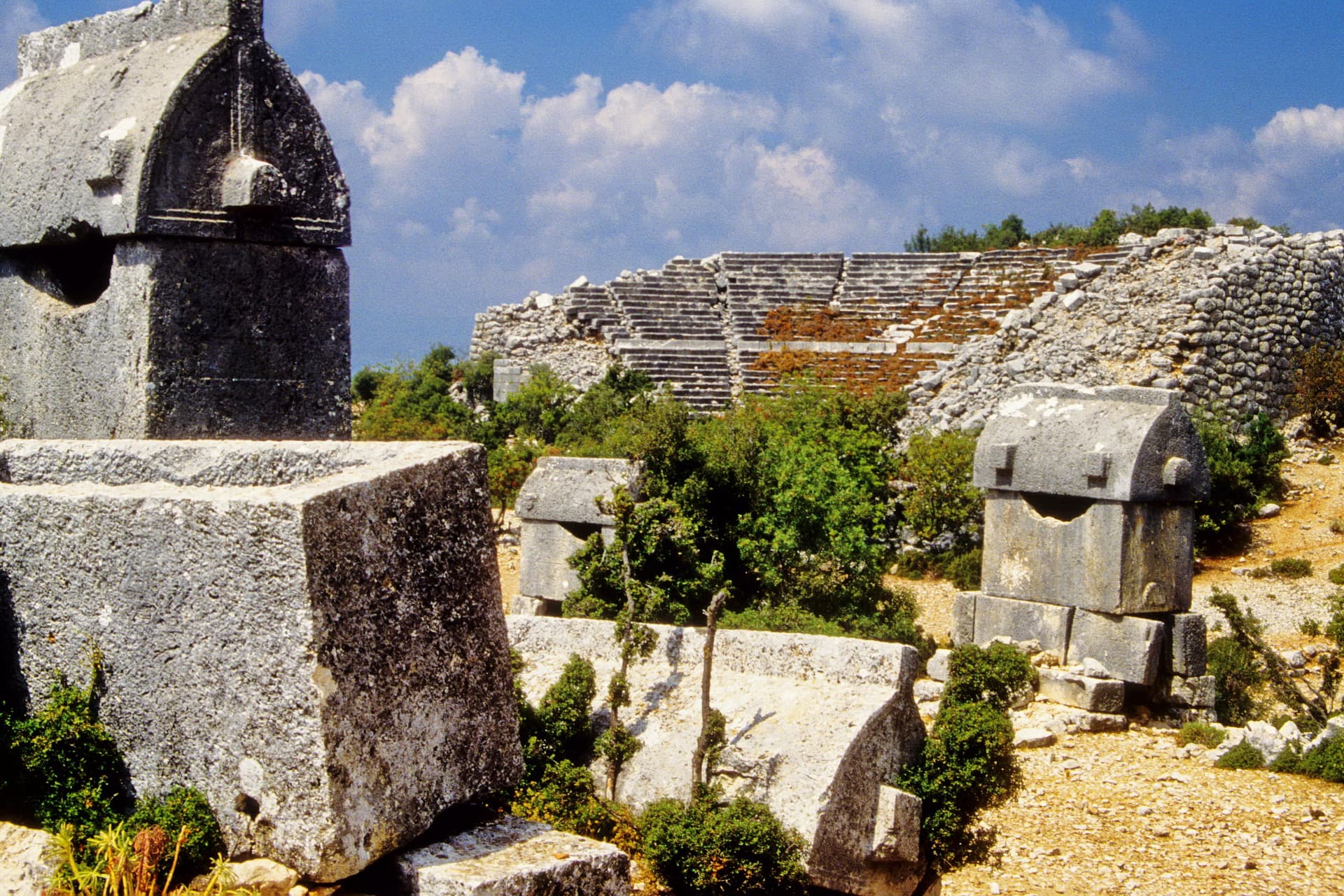
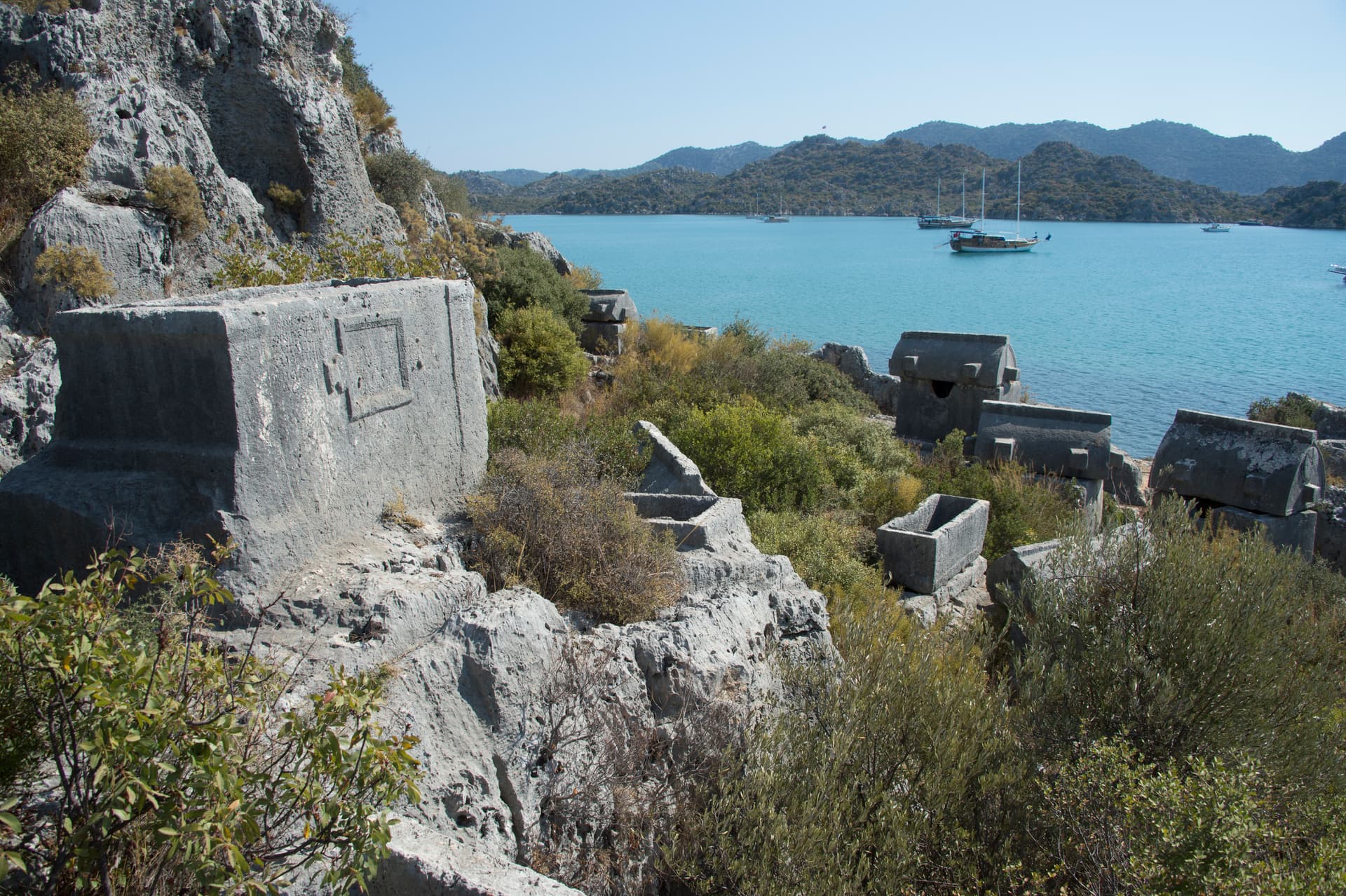
On ancient Lycia's southern coast, Antiphellos became modern Kaş rather than simply a ruin. The town grew through a city flourishing from the 4th century BC: Lycian sarcophagi emerge from garden walls, rock-cut tombs rise above fish restaurants, and the Lion Tomb stands near a café. More than a hundred funerary monuments reflect belief that the dead remained spiritually present and that sarcophagi and tomb facades were dwellings, not memorials; living and dead shared the ridge.
Above the harbour, a 1st-century BC theatre faces the open Aegean rather than a hillside, revealing the sea as the city's emotional centre. Its upper rows look toward Greece and, on clear evenings, Meis—ancient Kastellorizo—less than two kilometres away. Every performance unfolded against that horizon.
Why this place is sacred
The Lycian understanding of death was architectural. To construct a monumental tomb was not to memorialize the departed but to house them — to create a permanent residence from which the dead could continue to influence the world of the living. Fines for violating tombs were not merely legal protections but expressions of a sacred compact.
The inscriptions carved on Antiphellos's sarcophagi record the legal penalties for disturbance because the violation would harm not only the deceased's memory but the deceased themselves. Over a hundred such dwellings have been documented here. Some are rock-cut facades in the hillside. Others are freestanding Doric sarcophagi. The Lion Tomb, with its carved relief of a reclining lion, stands in the middle of the modern town with no fence, no interpretive sign — just stone.
The thinness of this place is produced not by a single sacred feature but by the density of that overlap: the ancient necropolis did not end where the living town began, because the living town grew into the necropolis, and neither has fully displaced the other. The sea-facing theatre adds another quality. Theatres in the ancient Mediterranean were typically cut into hillsides, using the slope to support the cavea.
The Antiphellos theatre is oriented differently — toward the sea, toward the open horizon. This orientation places every performance, every civic assembly, in dialogue with what lies beyond the known world. The view from the theatre at dusk, as the light thickens over the Aegean and the silhouette of Meis appears in the distance, produces a threshold feeling that no historical information can fully explain.
Lycian ancestor veneration; civic religious and theatrical life of a Hellenistic harbor city.
From active Lycian ancestor cult to Hellenistic and Roman civic site, to gradual abandonment and organic integration into the modern town of Kaş, which grew up around and through the ruins. No formal religious continuity survives, but the spatial intimacy of the dead with the living persists as a material fact.
Experience and orientation
Begin at the Lion Tomb, which stands in a small lane near the town center, and let that first encounter calibrate your pace. There is no entrance, no barrier, no interpretation panel with an arrow. The tomb is simply there, as it has been for more than two millennia. A carved lion reclines on the lid; the Lycian inscription records a legal warning against desecration. Then walk uphill.
As the streets thin into paths, more sarcophagi appear in the walls of gardens, half-built into modern structures, incorporated rather than preserved. The Akdam Doric Tomb stands a short distance away, its four-posted canopy form intact enough to suggest the original scale of Lycian funerary ambition. The hillside necropolis proper extends above the town — clusters of rock-cut facades in the limestone cliff, their carved pediments and false doors still partially legible.
The theatre sits above and to the west, reached by a short climb. Enter from the top. Look seaward before you look at the stage. The full geometry of the choice — to open this theatre to the horizon rather than to a hillside — becomes clear from above. The semicircle of seats curves toward water, not stone.
In the late afternoon, when the light moves across the Aegean and the angle of the sun shifts the color of the water toward bronze, the theatre becomes a different kind of instrument. Sit in the upper rows and allow some time to pass without moving to the next thing. The ancient city's coherence reveals itself not in a single monument but in the accumulation: necropolis above, theatre facing the sea, harbor below, sarcophagi in the lanes.
The ruins are scattered within and above modern Kaş. Start at the Lion Tomb in the town center, then work uphill through the necropolis to the theatre. No entry fee anywhere. The theatre is approximately 500 meters from the town square.
Context and lineage
The city's original Lycian name was Habesos. It developed as the natural harbor outlet for Phellos, an inland Lycian city on the ridge above, and for most of its early history it functioned as a dependency. During the Hellenistic period — broadly the 4th to 3rd centuries BC — Antiphellos gained enough commercial and political weight to operate independently, eventually becoming a member of the Lycian League with its own vote. Coins from this period are attested.
The city flourished under Roman rule, when its theatre was enlarged or rebuilt in its current form. The foundations of a double temple have been identified in the town, its dedicatees unidentified. The city gradually diminished during late antiquity and was absorbed into the landscape that would eventually become the Ottoman and then modern Turkish town of Kaş.
Lycian (pre-Hellenistic); Hellenistic Lycian League member; Roman provincial city; gradual decline through late antiquity into the settlement that became modern Kaş.
Thomas Graves
British naval officer who conducted the first recorded survey of the site in the 1840s
Charles Fellows
British explorer who documented over 100 tombs at Antiphellos in 1840
George Bean and John Cook
British scholars who produced a systematic survey of the site and its inscriptions in 1952–1956
Christian Le Roy
French archaeologist who documented the architectural elements from 1982–1988
Nevzat Çevik
Director of comprehensive excavation campaigns at Antiphellos from 2001–2007, Akdeniz University
Traditions and practice
The Lycian funerary tradition at Antiphellos was elaborate and legally enforced. Sarcophagi were constructed with inscribed warnings — fines enumerated for those who violated the tomb's sanctity. This was not merely civic law but sacred compact: the tomb was the dwelling of the deceased spirit, whose continuing presence was assumed.
Construction of the tomb itself was an act of devotion, and the variety of forms — rock-cut facades, freestanding Doric sarcophagi, the unusual Lion Tomb — reflects both social differentiation and a shared understanding that the dead required permanent habitation. The double temple foundations suggest an organized civic cult, though the specific deities remain unidentified.
No active religious ceremonies are associated with the site today. The Lycian Way trekking community treats Antiphellos as a significant waypoint and a staging point for trails above Kaş. Archaeological heritage tourism continues, though the site has no formal management infrastructure or entry fee.
Walk to the Lion Tomb first, before reading about it, and stand with it for a few minutes without consulting a guidebook. Then move uphill slowly, pausing at each sarcophagus encountered in a wall or garden. At the theatre, sit in the upper rows and wait. Let your eyes settle on the horizon. The full experience requires time — not because the ruins are extensive, but because the quality of the place builds through accumulation rather than a single revelation.
Visit at dusk if possible. The sea changes color as the sun lowers and the island of Meis clarifies in the distance. The Lycian Way above town offers a longer engagement with the landscape for those with time.
Lycian Ancestor Cult
HistoricalThe Lycian people practiced an elaborate ancestor cult in which monumental tombs served as the dwelling of the deceased spirit. Over 100 sarcophagi and rock-cut tombs are documented at Antiphellos, reflecting a belief in the ongoing power and presence of the dead.
Funerary monument construction in multiple forms (rock-cut facades, freestanding sarcophagi, the Lion Tomb); legal protections inscribed on tombs recording fines for violation; funerary offerings.
Archaeological and Scholarly Heritage
ActiveAntiphellos has been under systematic scholarly attention since the 1840s, with major surveys by Charles Fellows, George Bean, and Christian Le Roy, culminating in the excavation campaigns of Nevzat Çevik. The site is a significant reference point for Lycian epigraphy and funerary architecture.
Archaeological excavation, architectural documentation, epigraphic study, heritage conservation.
Perspectives and open questions
Antiphellos invites interpretation from multiple angles — as an archaeological monument, a window into Lycian death culture, and an unusually preserved case of ancient and modern cohabitation. No single framework exhausts the site.
Scholarly perspective
Antiphellos was a minor harbor town that grew into an independent Hellenistic polis after separating from Phellos, eventually holding one vote in the Lycian League. Its theatre and tomb architecture are well-studied examples of Lycian funerary and civic traditions. The systematic excavation campaigns from 2001–2007 under Nevzat Çevik produced the most comprehensive architectural record to date. The site remains significant for Lycian epigraphy, with inscribed tomb protections offering detailed evidence of funerary law and social practice.
Living and traditional perspectives
The Lycian understanding of the tomb as dwelling — not memorial but ongoing residence — was not a metaphor. The legal inscriptions protecting tombs against violation suggest a community in active relationship with its dead, whose spiritual presence was treated as real and consequential. The fine levied for disturbing a tomb went partly to the deceased's estate, as though the dead could still receive payment.
The dense placement of sarcophagi throughout what is now a living town carries this older understanding forward in space, even though the belief system that created them has passed.
Alternative interpretations
The sea-facing theatre and the prevalence of tomb symbolism throughout the site have attracted attention from those exploring Lycian practices of honoring boundaries between worlds. The choice to orient the theatre toward open water rather than a hillside may reflect a deliberate cosmological statement — theatre as a technology for confronting the unknown — though this interpretation is not supported by textual evidence and remains speculative.
Open questions
The identities of the deities worshipped in the double temple foundations remain unknown. The full extent of the original city plan, including its harbor infrastructure, has not been mapped. The relationship between Antiphellos and Phellos — whether the harbor ever fully supplanted the inland city or whether they remained in dialogue — is not fully resolved.
Plan your visit
Access and arrival
Kaş is served by dolmuş from Fethiye (approximately 2.5 hours) and Antalya (approximately 3.5 hours). The ruins are distributed within the town and are freely accessible at all hours. No entry fee. The theatre is a 10-minute walk from the town center, uphill. Mobile signal is generally available within Kaş town.
Modern Kaş has a wide range of accommodation from small pansiyons to boutique hotels. The town is well-developed for tourism while retaining its character. No signal issues in town. For the Lycian Way above Kaş, check current trail conditions and accommodation availability with the Lycian Way Association or local tourism offices.
Respectful visit
No specific requirements. The site has no formal entry points. Standard respectful attire appropriate to both a historical site and a Mediterranean town.
Permitted throughout. The Lion Tomb and Akdam tomb are photographed from street level without restriction. Avoid flash photography or close-contact with carved reliefs.
Not applicable to contemporary visit.
Climbing on or defacing ancient tombs and structures is prohibited. Sarcophagi are not steps or furniture. The inscriptions and carved reliefs are irreplaceable and are not protected by physical barriers.
Do not climb on sarcophagi or carved tomb facades. The Lion Tomb and freestanding sarcophagi are fragile stone structures without protective barriers — their vulnerability is a matter of collective responsibility. The Lycian Way trails above town can be unmarked in places; take water and a map for longer walks.
Location
Map loads as you approach this section.
Pilgrim reflections
A portrait of encounter, not a score
Pilgrims describe what they felt, how present they could become, and whether the place would shape a journey. There are no stars and no ranking of traditions.
No reviewed reflections yet
The first pilgrims can help describe the character of being here.
Share a reflection
Available after an account-backed “Been there.” Every reflection is reviewed before publication.
Nearby sacred places
Explore other sacred places in the region. Proximity does not establish access or travel time; check each place’s guidance.


References
Sources consulted for this page. Source categories describe the publication, not a guarantee that every claim is verified. Traditional accounts and outside interpretations may differ.
- 01Ancient Lycian City of Antiphellos – Lycian MonumentsacademicDetailed architectural and inscription data
- 02The Princeton Encyclopedia of Classical Sites: AntiphellosacademicAuthoritative classical reference
- 03Antiphellos (modern Kaş, Turkey) – The Ancient Theatre ArchiveacademicTheatre chronology, excavation phases
- 04Antiphellus – Wikipedia — Wikipedia contributorsencyclopediaGood overview of history, theatre, tombs
- 05The Ancient City of Antiphellos: Historic Ruins by the Sea – Med GuletsguideGood visitor overview
- 06Guide to Antiphellos Ancient City – Antalya Tourist InformationguidePractical visitor and excavation information
- 07Lion Tomb at Antiphellos – Peter Sommer Travels — Peter SommerblogOn-the-ground description of the Lion Tomb and necropolis
Share a photo
Help visitors recognize Antiphellos. Every submission is reviewed before publication.