Alinda
The Carian mountain fortress where a queen waited in exile and a conqueror found a mother
Understand sacred places, explore living traditions, and learn how to engage respectfully with Pilgrim Map.
Access has not been verified. Check current local guidance before planning a visit.
Aydın, Turkey
Read the sources
Visit essentials
A quick read before you go
- Duration
- Two to three hours for a thorough visit encompassing both acropolises, the agora, theater,…
- Access
- Located above the town of Karpuzlu in Aydın Province.
Overview
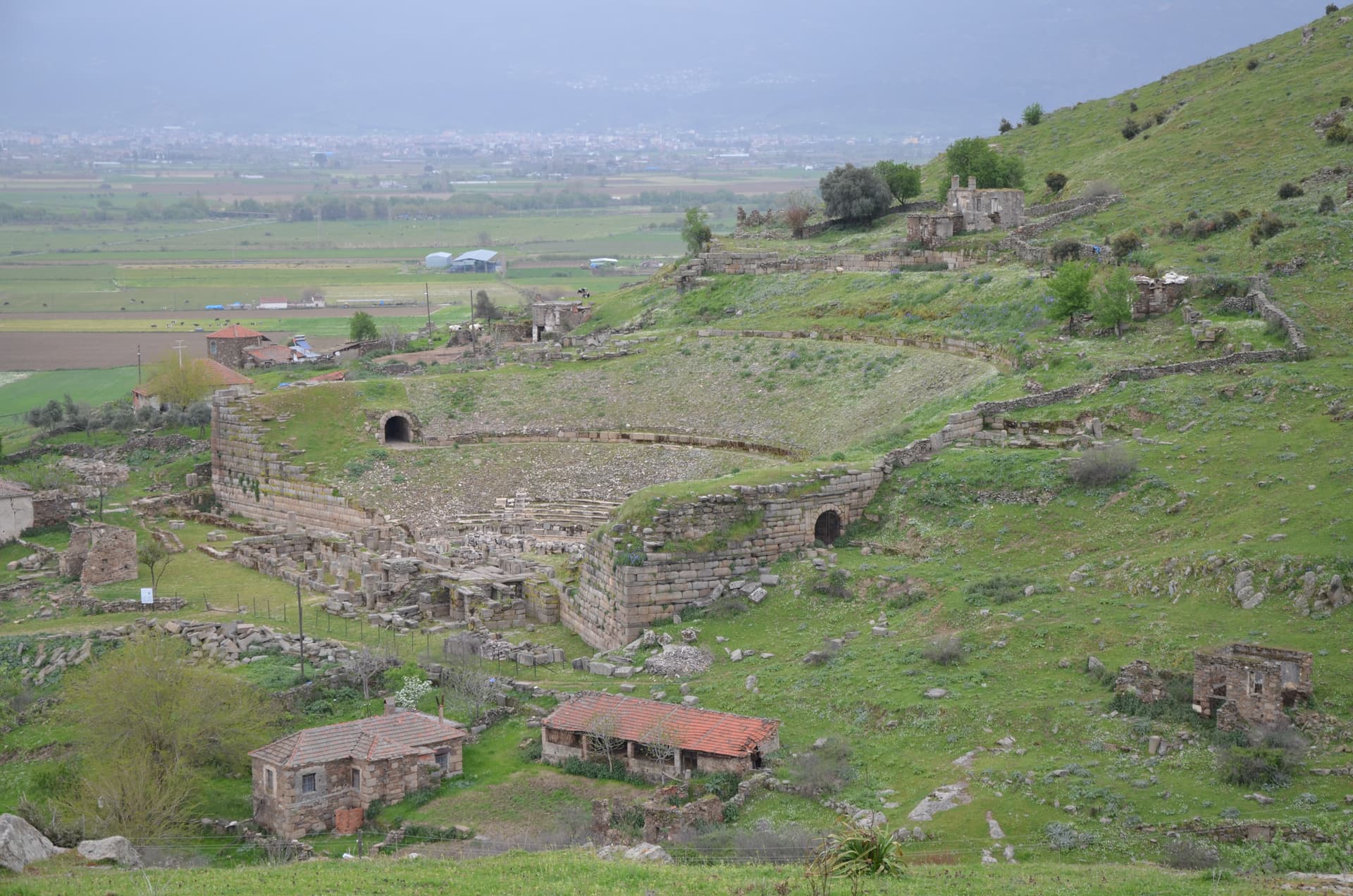
Alinda would be worth visiting for the agora alone. The three-storey market building — a long gallery running the full length of the lower acropolis plateau — has survived with enough of its barrel-vaulted interior intact to give a visitor standing inside it a direct sense of commerce in a Hellenistic Carian city. No restoration, scaffolding, or signs mediate the building; it simply stands, as it has for two thousand years.
Alinda's stones also carry the story of exiled Queen Ada, the last Hecatomnid ruler, who held this fortress after her brother Pixodarus expelled her around 341 BCE. When Alexander the Great arrived in Caria in 334 BCE, he came here first; their alliance restored her as ruler of all Caria, and ancient sources say Alexander called Ada mother while she called him son.
The city's identity before Ada is no less significant. Luwian Studies identifies Alinda with 'Ialanti,' a place-name in Hittite Bronze Age sources — suggesting the hilltop's importance as a named location extends into the second millennium BCE. Apollo and Aphrodite were worshipped here, and a statue of Aphrodite by Praxiteles stood in the Apollo temple. The statue's fate is unknown, and the temple has not been excavated.
Why this place is sacred
The sacredness of Alinda is not anchored in a single powerful tradition but distributed across its history in a way that rewards contemplative rather than doctrinal engagement. The Apollo and Aphrodite cult at its core placed it within the Hellenic sacred world while the Carian architectural tradition — building for permanence over ornament, favouring the solid and functional — gave the sanctuary a character distinct from the more theatrical Aegean Greek style.
The presence of a Praxitelean Aphrodite statue in the Apollo temple is the site's most extraordinary sacred detail. Praxiteles, who worked in 4th-century BCE Athens and Knidos, produced the most celebrated representations of divine beauty in the ancient world. His statues were placed in sanctuaries of significance — not provincial copies but genuine masterworks. That one stood at Alinda tells us something about the city's sacred standing that no inscription could communicate more clearly.
This was a place that merited Praxiteles.
Queen Ada's choice of Alinda as her refuge-sanctuary — a hilltop stronghold from which she maintained her royal dignity during a decade of exile — adds a dimension that is not theological but is sacred in a different register. Alinda was the place that held what was most important: the legitimate claim, the royal identity, the future. The hill preserved Ada in the same way that hilltop sanctuaries were understood to preserve what was placed within them.
When Alexander came and recognised her authority here, the hill's holding function was validated by the most powerful man in the world.
The Byzantine episcopal listing — Alinda as a suffragan bishopric of Stauropolis — extends this accumulation into the Christian period, confirming that the site's importance survived the conversion of sacred languages.
Carian city with Apollo and Aphrodite sanctuaries; later the refuge fortress of Queen Ada during her exile from the Hecatomnid throne. The two acropolises and connecting walls served both defensive and sacred functions.
Possible Hittite-era sacred significance (Ialanti, 2nd millennium BCE) → Carian classical city with Apollo and Aphrodite temples (from at least 3rd century BCE) → Queen Ada's refuge during Hecatomnid exile (c.341–334 BCE) → meeting place of Ada and Alexander (334 BCE) → Hellenistic and Roman period continuation with theater expansion → Byzantine episcopal see → gradual decline and abandonment → Austrian survey project 2007–2012 documenting all remains → free, open site above the living town of Karpuzlu
Experience and orientation
The climb matters. From Karpuzlu town, the path to the acropolis rises steeply for about a kilometre — enough to make the arrival a physical event rather than a simple walk-in. By the time the agora building comes into view, your body has registered that this is a place set apart from the plain below.
The agora is the first major structure encountered on the main approach. Spend time here before moving anywhere else. The three-storey gallery — a long arcade of barrel-vaulted chambers whose upper stories provided covered market space and whose lower section may have served as warehousing — is best understood from inside. Stand in the lower vaulted room and look at the ceiling: the corbelling technique, the precise cutting of the stone, the way the vault distributes weight across its span.
This was built to last and it has lasted. Walk its full length. Count the chambers. Notice how the building follows the natural contour of the plateau rather than imposing a formal axis on it: Carian architecture respects the ground it stands on.
From the agora, the path leads up toward the lower and upper acropolises. The theater occupies the hillside below the upper acropolis — a 5,000-seat cavea whose seating is largely intact, its orchestra visible, its stage building partially standing. The view from the upper rows encompasses the full width of the Carian plain spreading north and east, with the town of Karpuzlu directly below and the agricultural land stretching to distant hills.
On the Saturday market day, Karpuzlu's weekly bazaar operates in the town below — a living echo of the commercial activity that once filled the agora immediately above.
The Apollo temple precinct, located between the two acropolises, requires navigation. The temple itself has not been excavated and its plan is incompletely known; what you encounter is a zone of worked stone and foundation outlines that rewards imagination more than visual impact. This is where the Praxiteles statue stood. The stone you are looking at is the ground of that presence.
The necropolis, distributed across the hilltop and slopes in Carian sarcophagi and rock-cut tombs, extends the city's reach across the entire hill. Some sarcophagi remain in place with their inscriptions partly legible. The aqueduct, which once brought water to the city from the hills behind, is traceable in sections on the approach to the site.
Allow two to three hours for a thorough engagement with both acropolises, the agora, theater, and necropolis. Descend with enough daylight remaining to appreciate the walk back through Karpuzlu — the transition from ancient to present is gradual here, without a clear gate.
The site sits directly above Karpuzlu town; the steep access path (1 km) begins from the town's upper edge, or you can follow the 4-km access road by vehicle. Free admission; open 08:30–17:30 daily. No facilities on site; cafes and a small market in Karpuzlu.
Context and lineage
Luwian Studies connects Alinda to the Bronze Age place-name Ialanti in Hittite sources, suggesting that the hilltop carried significance in the second millennium BCE long before the classical Carian city was built. Whether this represents a continuity of sacred meaning or merely the persistence of a toponym is not yet established.
As a classical city, Alinda's most precisely documented period begins with the Hecatomnid dynasty — the Carian satrapy that produced Mausolus of Halicarnassus and Ada. After the death of Mausolus (353 BCE) and the subsequent death of his wife-queen Artemisia, control of Caria passed through several Hecatomnid siblings in contested succession. Ada, who had ruled Caria, was expelled to Alinda by her brother Pixodarus around 341 BCE.
She held the city as her own domain through the decade of her exile.
When Alexander the Great arrived in Caria in 334 BCE during his campaign through Anatolia, he sought Ada's alliance. Ancient sources — Arrian, Diodorus, Plutarch — record the meeting at Alinda with unusual warmth. Ada formally adopted Alexander, making him her heir and legitimating his claim to Caria through Hecatomnid dynastic law. He, in turn, recognised her as Queen of All Caria.
She sent him daily gifts of food; he reportedly accepted them gratefully and told her that he had been taught sufficient self-sufficiency and had only two cooks — Leonidas who trained him in exercise, and the night-march that prepared an appetite for simple food. The story resists easy categorisation: it is political, maternal, affectionate, and strategically shrewd all at once.
Possible Hittite-era significance (Ialanti, 2nd millennium BCE) → Carian city under Hecatomnid dynasty (from at least 4th century BCE) → refuge of Queen Ada during exile (c.341–334 BCE) → meeting of Ada and Alexander (334 BCE) → Hellenistic expansion with theater and civic development → Roman period continuation → Byzantine episcopal see under Stauropolis → decline and abandonment → Austrian survey 2007–2012 → currently free, open, unexcavated site
Queen Ada of Caria
Ruled from Alinda during her exile from the Hecatomnid throne (c.341–334 BCE); welcomed Alexander and was restored as Queen of All Caria in exchange for Carian loyalty; referred to Alexander as her son
Alexander the Great
Met Queen Ada at Alinda in 334 BCE; accepted her as his adoptive mother; recognised her authority over Caria; one of the few figures in his campaign reported to have accepted the role of son rather than conqueror
Mausolus
Carian satrap and Ada's brother; his death precipitated the dynastic succession that eventually led to Ada's exile; his mausoleum at Halicarnassus was one of the Seven Wonders of the ancient world
Praxiteles
Greatest sculptor of 4th-century BCE Athens; his statue of Aphrodite stood in Alinda's Apollo temple — a work of this kind required a sanctuary of significant regional prestige
Peter Ruggendorfer
Led the Austrian Academy of Sciences survey project at Alinda (2007–2012), producing the first comprehensive documentation of all structural remains
Traditions and practice
The Apollo temple between the two acropolises held a statue of Aphrodite by Praxiteles — ancient sources confirm this, though the statue itself has vanished entirely and the temple has never been excavated. The presence of both Apollo and Aphrodite in a single precinct is not unusual in the ancient world — the two deities shared associations with beauty, music, and divine grace — but the Praxitelean work signals that this was no ordinary provincial sanctuary.
Festivals, sacrificial ceremonies, and votive activity at this precinct would have constituted the city's primary sacred calendar.
Carian funerary tradition expressed itself in the necropolis scattered across the hilltop: sarcophagi of carved stone, some inscribed, some elaborately decorated, placed across the landscape rather than concentrated in a formal cemetery. The act of burial at Alinda was itself a form of claiming the hill's permanence for the dead.
The Austrian survey project (2007–2012) documented all structures and the necropolis but did not excavate. The site receives visitors primarily from Çine and Karpuzlu, with some heritage tourists from the wider Aydın region. The Saturday market in Karpuzlu provides a living commercial context immediately below the ancient market building.
Begin with the agora before the view distracts you. The market building is the most underrated structure at Alinda and deserves attention before your eyes go to the panorama. Walk the full length of the barrel-vaulted gallery and pay attention to the junctions between vaulted sections — these are the engineering decisions that determined whether the building would stand or fall. It stood.
Then climb to the theater and sit in the upper cavea facing the plain. If it is a Saturday, the market noise from Karpuzlu below will drift up — a faint contemporary echo of what the agora above you once generated. The view from the theater seats encompasses exactly the territory that the people who built this city controlled and cared about.
Seek out the Apollo temple zone between the acropolises. Bring whatever knowledge you have of Praxiteles — his Aphrodite of Knidos, the most celebrated nude sculpture of antiquity, or simply the idea that a sculptor of that calibre had his work placed here. Stand in the unexcavated ground and understand that the statue once occupied this space. Not where exactly.
Just: here, on this hill, in this city where a queen kept her dignity while waiting for the world to change.
Walk the necropolis on your descent. The inscribed sarcophagi, even for those without Greek, communicate something through their materiality: the care taken with the carving, the choice of stone, the positioning of the tomb in sight of the city.
Carian Religion / Apollo and Aphrodite Worship
HistoricalThe Apollo temple at Alinda housed a statue of Aphrodite by Praxiteles — one of the greatest sculptors of antiquity — indicating a sanctuary of significant pan-regional prestige. Both deities' cults continued through the Hellenistic and Roman periods.
Temple rituals, sacrifices, and public festivals at the Apollo-Aphrodite sanctuary; veneration of the Praxitelean Aphrodite; funerary rites in the necropolis
Byzantine Christianity
HistoricalAlinda appears on Byzantine episcopal lists as a suffragan bishopric of Stauropolis (capital of the Roman province of Caria), confirming its continued religious importance into the Christian era.
Christian liturgy; episcopal administration within the provincial church hierarchy
Archaeological Heritage
ActiveThe Austrian Academy of Sciences survey (2007–2012) established Alinda's significance as one of the finest unexcavated Carian sites. The site is considered a priority for future formal excavation, particularly regarding the Apollo temple and the Hittite-era possible predecessor.
Survey documentation; heritage tourism; academic research on Carian urbanism and the Queen Ada episode
Perspectives and open questions
Alinda invites engagement as a Carian architectural landmark, as a stage for one of antiquity's most humanly compelling political meetings, as a repository of sacred art (the Praxitelean statue, still lost), and as an unexcavated site whose secrets remain genuinely intact.
Scholarly perspective
Alinda is considered among the finest Carian sites in Turkey. The Austrian survey conducted by Peter Ruggendorfer for the Institut für Kulturgeschichte der Antike (2007–2012) established it as an exceptionally well-preserved example of Hellenistic and Roman Carian urbanism, with particular significance attributed to the near-intact agora gallery and the theater. The identification with Hittite-era Ialanti, proposed by Luwian Studies, awaits formal archaeological investigation.
The Apollo temple with its Praxitelean Aphrodite statue is one of the most compelling unexcavated sacred contexts in western Anatolia: ancient sources confirm both the temple's existence and the statue's presence, but neither has been archaeologically verified or located. The site's unexcavated status means that its research potential remains entirely intact.
Living and traditional perspectives
The Carians are among the better-documented ancient Anatolian peoples — their language is partially deciphered, their inscriptions relatively numerous, their artistic and architectural legacy still visible across western Turkey.
But Alinda's story belongs not only to Carian culture in the abstract but to a specific Carian woman — Ada — whose dignity and political intelligence in circumstances of forced exile, and whose warmth toward a conqueror young enough to be her son, preserved something in the historical record that wars and empires rarely preserve: a story of mutual recognition across an asymmetry of power that could have been merely transactional but was, apparently, genuinely affectionate.
Alternative interpretations
The connection to Queen Ada and the protective, nurturing maternal archetype — the queen who fed the world-conqueror, who held power in abeyance until its proper moment — has drawn attention from those exploring feminine sacred power in ancient Anatolian culture. Caria is distinguished among the ancient cultures of the region for women's prominence in dynastic succession (the Hecatomnids included multiple ruling queens), and Alinda carries a specific episode of feminine resilience that is unusual in the historical record.
Open questions
The Praxitelean Aphrodite statue stood in the Apollo temple at Alinda. Its fate is entirely unknown. The temple has not been excavated. The statue may be beneath the ground of the precinct zone between the two acropolises; it may have been removed in antiquity; it may have been broken and its fragments scattered.
This is one of the most significant missing works of ancient Greek sculpture, and its absence — its presence as absence — gives the unexcavated temple precinct an unusual quality of latent significance. Whether Alinda is identical with Hittite-era Ialanti, and what that identity would imply for the hilltop's Bronze Age sacred history, also remains formally unresolved.
Plan your visit
Access and arrival
Located above the town of Karpuzlu in Aydın Province. From Çine (approximately 20 km east), coaches serve Karpuzlu; from the town, the site is a 1-km steep walk uphill or a 4-km drive on the access road. From Milas or Muğla, travel via Çine. Free admission; open daily 08:30–17:30. No facilities on site; cafes and a small market in Karpuzlu town.
Mobile phone signal is generally available in Karpuzlu but may be unreliable at the upper acropolis; no emergency access information was available at time of writing — for current details, contact the Karpuzlu municipality or Aydın Provincial Culture and Tourism Directorate.
No accommodation in Karpuzlu. Çine (~20 km east) has basic accommodation options. Milas (~45 km west) and Muğla (~70 km west) offer wider choices. Alinda works well as a half-day excursion from the Bodrum or Marmaris coast, or as part of an inland Carian cities itinerary.
Respectful visit
No religious dress code. Sturdy footwear essential for the steep climb and the uneven terrain of both acropolises.
Permitted freely throughout the site.
Not applicable.
No formal restrictions. The absence of formal enforcement makes the ordinary obligations of care — not moving stones, not removing anything, not climbing on structures — entirely a matter of individual judgment. The site depends on it.
The steep 1-km ascent requires reasonable fitness and is not suitable for those with mobility limitations. The alternative 4-km road approach is driveable but requires navigational attention. No water is available on site; bring sufficient for the visit and the return.
Location
Map loads as you approach this section.
Pilgrim reflections
A portrait of encounter, not a score
Pilgrims describe what they felt, how present they could become, and whether the place would shape a journey. There are no stars and no ranking of traditions.
No reviewed reflections yet
The first pilgrims can help describe the character of being here.
Share a reflection
Available after an account-backed “Been there.” Every reflection is reviewed before publication.
Nearby sacred places
Explore other sacred places in the region. Proximity does not establish access or travel time; check each place’s guidance.


References
Sources consulted for this page. Source categories describe the publication, not a guarantee that every claim is verified. Traditional accounts and outside interpretations may differ.
- 01Alinda — Livius.org — Jona LenderingacademicScholarly overview from a trusted classical history reference
- 02Alinda — Luwian Studies — Luwian StudiesacademicConnects Alinda to Hittite-era Ialanti; Luwian cultural context
- 03Alinda in Karia: The Fortifications — ResearchGate / Peter RuggendorferacademicAcademic publication from the 2007–2012 Austrian survey project
- 04Alinda — Wikipedia — Wikipedia contributorsencyclopediaDetailed article with history, Queen Ada connection, architectural description, and coordinates
- 05Alinda — Turkish Archaeological News — Turkish Archaeological NewsguideArchaeological site listing with current status
- 06Alinda: the powerful Carian stronghold — Aeternitas NumismaticsacademicNumismatic evidence and historical overview; coin-minting evidence for trade importance
- 07Alinda Ancient City — ArticHaeology — ArticHaeologyguideHistorical and architectural overview
- 08Alinda Ancient Site — Slow Travel Guide — Slow Travel GuideguideVisitor practical information with opening hours and access
Share a photo
Help visitors recognize Alinda. Every submission is reviewed before publication.