Myrina
Amazon-founded harbor of Aeolis, whose 4,000 terracotta devotions now live in the Louvre
Understand sacred places, explore living traditions, and learn how to engage respectfully with Pilgrim Map.
Access has not been verified. Check current local guidance before planning a visit.
İzmir, Turkey
Read the sources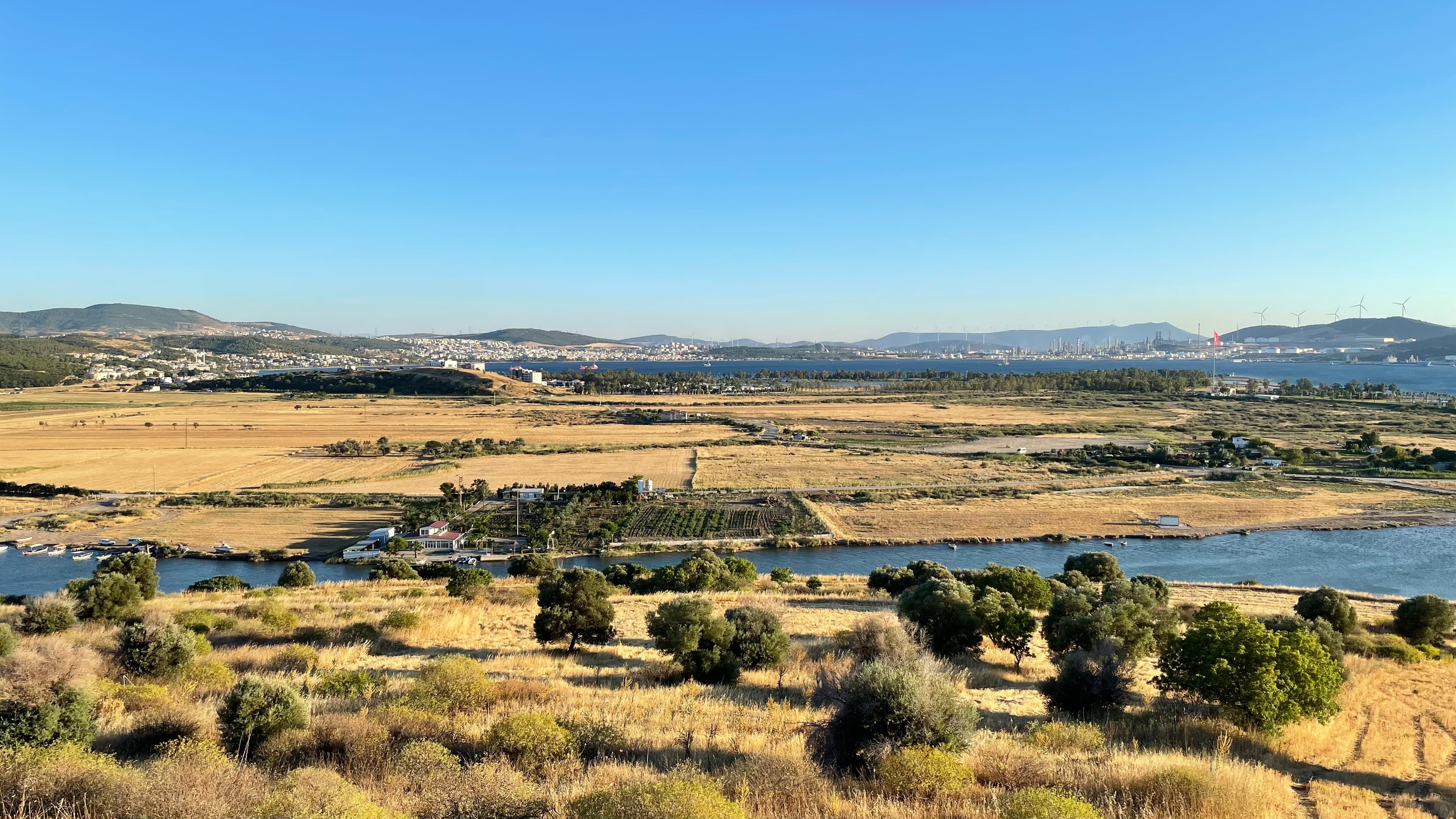
Image of Myrina. Image source
Visit essentials
A quick read before you go
- Duration
- 1–2 hours for the landscape and shoreline.
- Access
- Located north of Aliağa in İzmir Province, in the Kalabasari/Sandarlik area.
Overview
Myrina's primary existence is elsewhere. Of thousands of objects that defined its spiritual and artistic life—Aphrodite figurines in women's graves, Eros and Dionysus votives, and theatrical masks and children's toys buried with the dead—almost none remain onsite. The Louvre holds the largest collection from French excavations in 1880–1882 that opened roughly four thousand tombs; Istanbul's Archaeological Museum holds more. Myrina retains a coastal and riparian landscape, occasional surface ceramics, and faint traces of a harbor city.
The dispersal resonates with the Amazon queen Myrina, whose legendary campaign crossed North Africa and Asia before she founded the settlement. Her tradition connects Myrina to pan-Aegean place-names, including another Myrina on Lemnos, suggesting a pre-Greek sacred geography later overlaid by Greek colonization.
Visitors reach the edge of a vanished city knowing its finds are curated three thousand kilometers away in Paris. The relationship between site and artifact remains unresolved after a century and a half of scholarship.
Why this place is sacred
Myrina's sacred character expressed itself most fully through objects made to accompany the dead and please the gods — the approximately four thousand terracotta figurines recovered from the necropolis constitute one of the densest concentrations of votive religious material from a single Hellenistic site.
The assemblage includes representations of the full Greek pantheon, but Aphrodite and Eros figures dominate female graves, children's toy-figurines appear in children's burials, and theatrical masks suggest that the boundary between sacred and artistic was permeable in Myrinaean piety.
The practice of depositing such objects in graves reflects a belief in the gods' ongoing presence and power in the afterlife — not a philosophical abstraction but a material commitment, expressed in the care and skill of each fired clay figure. These objects were made locally, and Myrina's terracotta workshops constituted a significant production center serving regional religious markets as well as local funerary need.
The Amazon founding tradition — whatever its historical root — aligns Myrina with a pre-Greek Anatolian sacred order in which female sovereignty and divine patronage were intertwined. That the city's name appears both here and at Lemnos, connected to the same legendary queen, suggests this was not a local invention but a shared Aegean cultural memory, perhaps preserving traces of matrilineal religious practices that preceded Greek colonization.
The site's present emptiness carries its own weight: a place so saturated with devotional objects that its absence now speaks as loudly as its former presence.
Aeolian harbor city; center of terracotta figurine production for votive, funerary, and commercial purposes
Pre-Aeolian settlement; Aeolian city formally established before or contemporaneously with neighboring cities; flourished in Hellenistic period as terracotta production center; renamed Sebastopolis in Roman period; above-ground remains largely destroyed by stone robbing; French excavations 1880–1882 removed primary artifact assemblage; Turkish archaeological excavations resumed 2011
Experience and orientation
Standing at Myrina requires a particular kind of imaginative patience. The above-ground remains are sparse — stone robbing over centuries removed most of the architectural fabric, and the 1880–1882 French excavations that yielded the terracotta thousands were conducted before modern stratigraphic methods. What the landscape offers is not ruins but ground: the same coastal shelf, at the mouth of the Koca Çay river, where the harbor once stood.
Walk the perimeter of the site — identifiable through a combination of local knowledge and the faint topographic irregularities of the Öteki and Beriki hills — and notice the ceramic fragments that appear at the surface after rain. Each fragment is a trace of the manufacturing and devotional culture that made this city notable.
The coastal setting, where river meets sea, has a quality of threshold that the ancient world consistently recognized as significant: liminal terrain between flowing and still water, between land and ocean.
The knowledge that the Louvre's Salle des Antiquités Grecques holds perhaps the finest Hellenistic terracotta collection in the world — assembled almost entirely from this ground — creates a peculiar overlay on the experience of standing here. What the museum has made beautiful and organized, the site offers as earth, wind, and the occasional ceramic shard. Neither is wrong; both are partial.
Recent excavations since 2011 have begun mapping the city's urban topography, and seasonal dig activity brings new finds to the surface within cordoned areas. Outside excavation season, the landscape is open and unmediated.
The site is identifiable north of Aliağa near the Kalabasari/Sandarlik area. Approach by car, park near the area of Öteki Hill. Walk the shoreline and agricultural margin to orient yourself to the harbor's former position. Ceramic surface finds are more common after winter rains.
Context and lineage
Myrina's foundation is attributed either to the Amazon queen Myrina — who gives her name to the city and whose campaigns are narrated in Diodorus Siculus — or to a figure named Myrinus, said to have established the settlement before the other Aeolian cities were formally founded.
The Amazon tradition links Myrina to a network of place-names across the Aegean associated with the same queen: the island capital of Lemnos bears the same name, and the geographical coincidence suggests a stratum of pre-Greek sacred geography rather than coincidental repetition.
Aeolian settlers formalized the city as part of the twelve-city confederation, with Cyme as the league's metropolis. Myrina's harbor position at the mouth of the Koca Çay gave it commercial and navigational advantages, and its terracotta workshops eventually supplied religious objects across the Aegean region.
Pre-Aeolian; Aeolian Greek colonial; Hellenistic terracotta production city; Roman Sebastopolis; Byzantine period; abandoned
Amazon Queen Myrina
Legendary founder
Pottier and Reinach
French archaeologists; 1880–1882 excavations
Dr. Yusuf Albayrak
Lead excavator, Ankara Yıldırım Beyazıt University
Traditions and practice
The dominant religious practice at Myrina, as documented through the necropolis assemblage, was the deposition of terracotta figurines as both votive offerings at sanctuaries and grave goods for the dead. The figurines represent the full Greek pantheon — Aphrodite, Eros, Dionysus, Athena, Nike — with Aphrodite and Eros figures particularly concentrated in women's and children's graves. This suggests a specific association between these deities and the feminine sphere of domestic piety and afterlife passage.
Theatrical masks and seated female figures appear alongside deity representations, indicating that the sacred and artistic were not sharply distinguished in Myrinaean practice. The industry that produced these figurines was itself embedded in the city's economic and religious life — craft and cult intertwined in a way that archaeology makes visible.
No active religious practices at the site. The ongoing Turkish archaeological excavations since 2011, under Ankara Yıldırım Beyazıt University, constitute the primary active engagement. Museum visitors in Paris and Istanbul encounter the city's devotional life in the Louvre's Myrina terracotta collection and the Istanbul Archaeological Museum holdings.
Come in the morning or late afternoon, when the coastal light is oblique. Walk the agricultural margin between the Öteki and Beriki hills, moving slowly enough to notice the ground's surface — ceramic fragments appear after rain and give a tactile sense of what lies beneath. Spend time at the shoreline where the Koca Çay meets the sea, the threshold terrain that ancient harbor cities consistently chose for their most important liminal activities.
If you can visit Paris or Istanbul before or after — the Louvre's collection from this site is one of the finest encounters available with Hellenistic piety. The figurines make more sense having stood at the ground they came from.
Ancient Greek / Aeolian Religion
HistoricalMyrina's religious life was expressed most densely through the production and deposition of terracotta votive figurines — representing Aphrodite, Eros, Dionysus, Athena, and others — as grave goods and sanctuary offerings. The concentration of female deity figures in women's and children's graves documents a specific form of Hellenistic domestic and funerary piety.
Terracotta figurine deposition at tombs and sanctuaries; domestic cult; possible sanctuary worship at an as-yet unidentified precinct
Archaeological Heritage
ActiveMyrina holds a significant place in the history of Hellenistic archaeology; its terracotta assemblage in the Louvre remains a primary reference for the study of Hellenistic figurine production. Ongoing Turkish excavations are recovering the urban topography that nineteenth-century excavations left undocumented.
Annual excavation campaigns; university-led research; international museum collections in active scholarly use
Perspectives and open questions
Myrina is assessed differently by archaeologists studying material culture, historians of the Amazon tradition, and those drawn to the ethics of nineteenth-century excavation and museum collecting.
Scholarly perspective
The scholarly significance of Myrina rests almost entirely on its terracotta assemblage — among the largest and finest Hellenistic figurine collections from any single site. The 1880–1882 Pottier and Reinach excavations, conducted under the auspices of the French School at Athens, opened thousands of tombs in conditions that would not meet modern standards of stratigraphic documentation. The primary publication (Figurines de Terre Cuite) remains a foundational text for Hellenistic terracotta studies.
Contemporary Turkish excavations since 2011 are working to map the urban topography that the earlier campaigns disrupted.
Living and traditional perspectives
The Amazon tradition at Myrina is denser than is sometimes acknowledged. The same name appears at Lemnos, in ancient literary geography (Diodorus Siculus), and in the topographic traces of the Aeolian coast, suggesting that 'Amazon' was not merely a Greek term for foreign women warriors but a persistent Aegean cultural category connected to specific places and pre-colonial sacred authority. Myrina's position in this network gives the site a significance that extends beyond its archaeological finds.
Alternative interpretations
The density of Aphrodite and Eros figurines in female graves has been interpreted by some scholars as evidence of a distinctive feminine-divine orientation in Myrinaean funerary piety — a city where love, desire, and sacred protection for women were materially enacted at the moment of death. This reading gives Myrina a particular resonance for those interested in the sacred feminine in the Hellenistic world.
Open questions
The main sanctuary precinct of Myrina has not been definitively located or excavated. The specific cult practices that generated the figurine demand — whether primarily domestic, sanctuary-based, or funerary — remain unclear. The relationship between Myrina's figurine industry and specific local cult beliefs, as opposed to regional trade patterns, is incompletely understood.
Plan your visit
Access and arrival
Located north of Aliağa in İzmir Province, in the Kalabasari/Sandarlik area. Accessible by car from Aliağa (follow roads toward the river mouth north of town). Bus from İzmir to Aliağa, then taxi. No formal parking area. Mobile phone signal generally available near Aliağa; may weaken toward the site. Nearest emergency services and supplies: Aliağa town.
Aliağa town (approx. 5 km south) offers basic accommodation. İzmir city provides the full range of options and is the practical base for visiting the Aeolian sites.
Respectful visit
No specific requirements. Practical outdoor clothing; waterproof footwear recommended in wet seasons.
Permitted in open areas outside active excavation cordons.
None associated with the site.
Active excavation areas are off-limits during dig seasons (typically spring and summer). Do not collect surface ceramics or disturb the ground.
Active excavation areas during dig season are cordoned and should not be crossed. The site has no facilities — carry water and food from Aliağa. The coastal terrain can be muddy after rain.
Location
Map loads as you approach this section.
Pilgrim reflections
A portrait of encounter, not a score
Pilgrims describe what they felt, how present they could become, and whether the place would shape a journey. There are no stars and no ranking of traditions.
No reviewed reflections yet
The first pilgrims can help describe the character of being here.
Share a reflection
Available after an account-backed “Been there.” Every reflection is reviewed before publication.
Nearby sacred places
Explore other sacred places in the region. Proximity does not establish access or travel time; check each place’s guidance.



References
Sources consulted for this page. Source categories describe the publication, not a guarantee that every claim is verified. Traditional accounts and outside interpretations may differ.
- 01Archaeological Excavation for Ancient City in Aliağa District of İzmir — AYBU — Ankara Yıldırım Beyazıt Universityacademic2021 excavation season under Dr. Yusuf Albayrak
- 02History, Trade, and the Terracottas — Expedition Magazine — Penn MuseumacademicContext for Myrina terracotta figurines in Louvre and other collections
- 03Myrina Antik Kenti (Aliağa-İzmir) Çevresinde Paleocoğrafya AraştırmalarıacademicPaleogeographic research around Myrina
- 04Myrina (Aeolis) - Wikipedia — Wikipedia contributorsencyclopediaHistory, location, and excavation summary
- 05Myrina (Sebastopolis) Ancient City Aliağa / İzmir — Visit İzmirofficialOfficial provincial tourism board overview
- 06Category: Terracotta figurines from Myrina — Wikimedia Commons — Wikimedia contributorsSource contextVisual record of figurine types
Share a photo
Help visitors recognize Myrina. Every submission is reviewed before publication.