Cyme
Mother city of Aeolis, where an Amazon queen named the sea and the oracle shaped its fate
Understand sacred places, explore living traditions, and learn how to engage respectfully with Pilgrim Map.
Access has not been verified. Check current local guidance before planning a visit.
İzmir, Turkey
Read the sources
Visit essentials
A quick read before you go
- Duration
- 2–3 hours for a thorough exploration of the harbor, tower, and scattered ruins.
- Access
- Located in Aliağa district, İzmir Province, approximately 10 km from Aliağa town center.
Overview
Once called the metropolis of Aeolis, Cyme now offers no interpretive signs or barriers: only harbor stones, partly submerged moles beneath clear Aegean water, and a Byzantine tower where older structures served older gods. The site asks patient attention.
Cyme was the first and greatest of twelve cities founded by Aeolian Greeks from Thessaly and Boeotia on the Anatolian coast. Its traditions name both the Amazon queen Kyme and later Greek settlers as founders, layering myth and migration. Herodotus records citizens consulting its Apollo oracle during extreme political crises and receiving consequential answers.
Cyme also traveled through people and names. The poet Hesiod's father emigrated from here to Boeotia, while Ephoros of Cyme carried its reputation into classical history. A Roman-period Isis temple placed the city within the Mediterranean-wide Egyptian cult network. Today its ancient engineered moles extend underwater, and surrounding ground holds eight centuries of incompletely excavated burials. A city that mattered enormously has fallen quiet; the sea remains.
Why this place is sacred
The sanctity of Cyme accumulated through several overlapping registers. The founding myth attributes the city to the Amazon queen Kyme, placing the settlement within the deep stratum of pre-Greek Anatolian female divine authority — a tradition in which the Amazon represents sovereignty over landscape and sacred threshold. Whether or not the story is historical, it shaped how the city understood its own origins.
The Apollo oracle gave Cyme a prophetic function within the Aeolian confederation. Herodotus records a specific instance in which the Cymaeans sought its guidance on a politically fraught question — whether to hand over a suppliant to the Persians — and received an answer that confirmed the oracle's moral authority. This was not merely a civic amenity but a site of genuine theological weight, where divine will was thought to communicate through human uncertainty.
In the Roman period, the Isis temple extended Cyme's sacred geography eastward and southward, linking it to the Mediterranean-wide Egyptian mystery religion. The temple has since been re-buried during excavation and is currently not discoverable above ground, but its existence testifies to the city's role in the broader spiritual commerce of the ancient world.
The submerged harbor moles carry their own resonance — thresholds between the terrestrial and aquatic, the built and the dissolved, still legible to those who look carefully.
Aeolian colonial harbor city; religious and oracular center for the twelve-city confederation
Founded as an Aeolian colony in the 11th century BCE; rose to prominence as metropolis of the Aeolian League; declined after the Attalid kingdom's collapse; Byzantine reoccupation left the castle tower; largely abandoned thereafter, site now in extended archaeological study phase
Experience and orientation
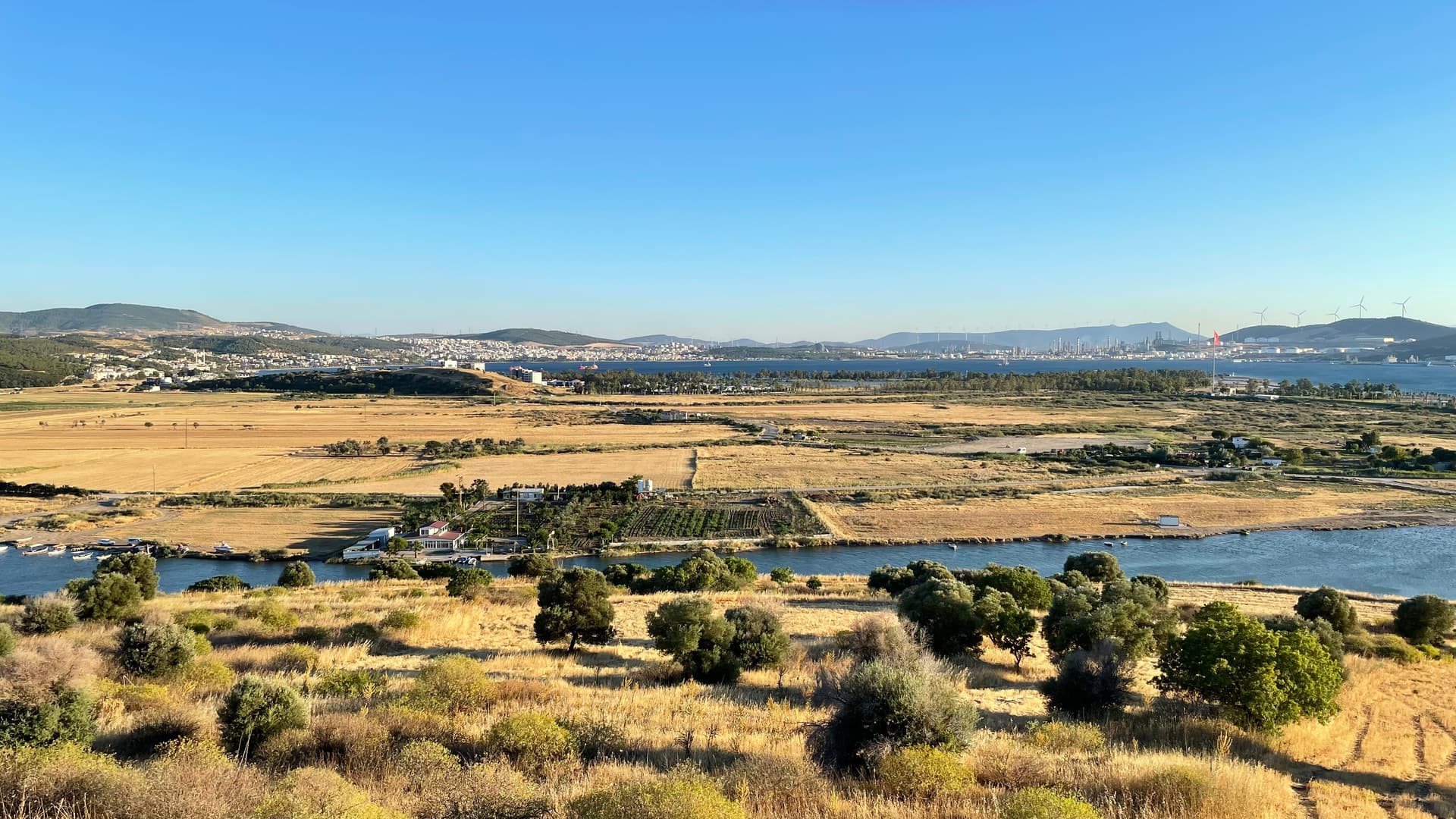
The site announces itself through the absence of what you might expect. There are no ticket booths, no audio guides, no reconstructed columns. The landscape is hilly, scrub-covered, and oriented toward the water in a way that makes the harbor's former importance legible even without explanation.
Walk toward the sea and you will find the ancient moles — built harbor structures that now extend into the water, one partially submerged, visible through the clear shallows as stone geometry beneath the surface.
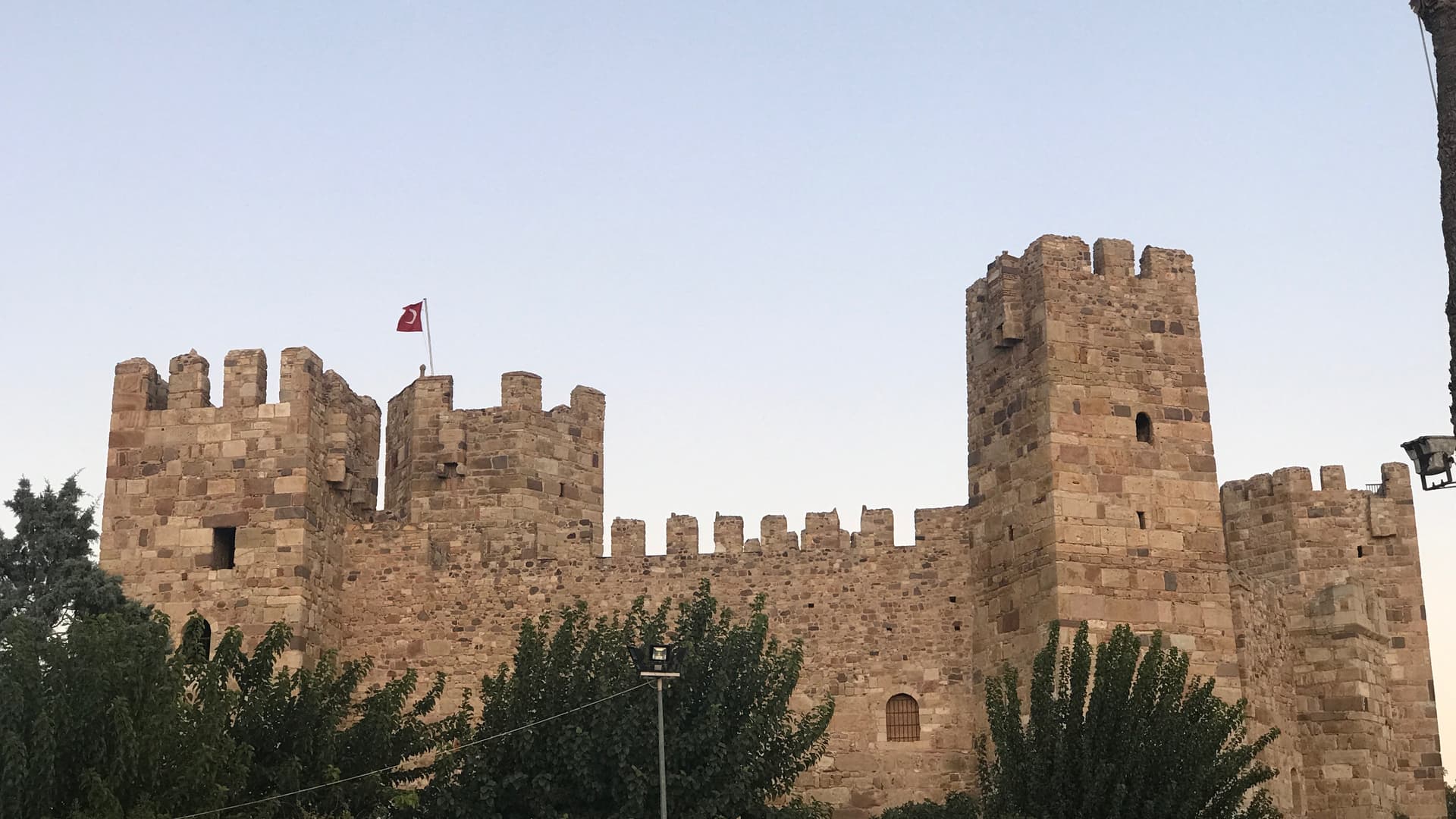
The Byzantine castle tower is the most substantial vertical element remaining, rising from the headland above the harbor. Its interior is flooded and inaccessible, but the exterior gives scale to the site and orients the surrounding terrain. From this elevated vantage, the relationship between settlement, harbor, and the open Aegean becomes clear — the city was built to face outward, toward the network of islands and coasts the Aeolians navigated.
Elsewhere on the site, masonry surfaces from the soil without ceremony: column drums, wall courses, the scattered material of a city quarried for later construction. The eastern necropolis lies in the same open landscape, its ground holding the evidence of eight hundred years of burial practice that academic study has only begun to document.
The quality of the experience is one of unhurried solitude and wide sea-light. The site rewards slow walking and patient observation more than any particular destination within it.
Park near the harbor area and approach on foot. The submerged harbor moles are best seen from the shoreline in clear weather. Walk inland and uphill to find the scattered architectural remains and the Byzantine tower. Allow time for the landscape to give up its proportions — the site is large and dispersed.
Context and lineage
Aeolian Greeks from Thessaly and Boeotia settled this harbor coast in the 11th century BCE, part of a migration wave that established the twelve-city Aeolian League along the Anatolian shore. The founding myth names an Amazon queen — Kyme — as the city's eponymous founder, a tradition that parallels similar Amazon foundation stories across the Aegean littoral and reflects the persistence of pre-Greek sacred geography in colonial memory.
Later tradition also names the colonists from Phriconis in Thessaly as the human agents of the settlement.
The city grew to become the largest of the Aeolian twelve, controlling significant agricultural hinterland and a functional harbor that sustained commercial and diplomatic connections across the Aegean. Its Apollo oracle was consulted by citizens at critical moments — Herodotus records the oracle's response to the question of whether Cyme should hand over a Persian-era suppliant, describing a morally complex answer that affirmed divine justice over political expediency.
The historian Ephoros was born here in the 4th century BCE, as was — according to tradition — the father of Hesiod, who emigrated to Boeotia before his son's birth. The city thus stands at an oblique angle to the origins of Greek literature.
Aeolian Greek colonial tradition; later Roman provincial city; Byzantine fortress reuse; no continuous occupation to the present
Amazon Queen Kyme
Legendary founder
Ephoros of Cyme
Greek historian, 4th century BCE
Father of Hesiod
Emigrant from Cyme to Boeotia
Traditions and practice
The Apollo oracle at Cyme functioned as a site of civic consultation in moments of political and moral crisis. Citizens brought their most pressing uncertainties to the oracle and received answers that were understood as divine guidance — Herodotus's account of the Persian-era consultation suggests the oracle's responses carried genuine moral authority, not merely political convenience.
In the Roman period, the Isis temple served the Egyptian mystery cult in a form documented across the Aegean world: regular ritual, perhaps initiation, the visual presence of Egyptian iconography in a Greek harbor setting.
No active religious practices at the site. The ongoing scholarly study of the eastern necropolis — documenting the transition from cremation to inhumation across eight centuries of burial practice — constitutes the primary active engagement with the site's material legacy.
Arrive in the morning before the light becomes harsh. Walk to the shoreline first and look at the submerged harbor moles — allow your eyes to adjust to the underwater stone geometry. Then move inland, following the natural topography uphill toward the Byzantine tower. Sit somewhere with a clear view of the sea and let the proportion of the landscape register: this harbor once served the leading city of an entire Aeolian world.
The quality of the silence here — no ambient tourism noise, few other visitors — makes sustained attention possible. The necropolis terrain rewards slow walking; the ground occasionally surfaces ceramics and architectural fragments that speak without explanation. Bring enough water to stay an extra hour past the point you planned to leave.
Ancient Greek / Aeolian Religion
HistoricalCyme served as the religious and political metropolis of the twelve-city Aeolian League, maintaining an Apollo oracle consulted at moments of civic crisis. The Roman-period Isis temple extended this sacred function into the eastern Mediterranean mystery religion networks.
Oracle consultation of Apollo; Isis temple worship in the Roman period; civic and domestic cult practices documented through necropolis grave goods
Archaeological Heritage
ActiveThe site preserves the largest Aeolian city of Asia Minor, with an eastern necropolis spanning eight centuries of burial practice. Ongoing scholarly study is documenting the transition from cremation to inhumation and the material culture of Aeolian colonial society.
Academic necropolis excavation and analysis; surface survey; paleogeographic research
Perspectives and open questions
Cyme's significance has been evaluated differently by historians, archaeologists, and those drawn to the Amazon and oracular traditions — each finding a different city at the same ruins.
Scholarly perspective
Scholarship identifies Cyme as the largest and most politically significant city of the Aeolian League, the confederation of twelve Aeolian poleis along the Anatolian coast. Necropolis excavations have documented burial practice transitions from the 8th century BCE cremation to Roman-period inhumation, providing a near-continuous record of funerary custom spanning eight hundred years.
The city's material remains are modest relative to its historical standing, partly because the site was systematically quarried for Byzantine and later construction — a common fate for ancient sites without continuous institutional protection.
Living and traditional perspectives
The Amazon founding tradition places Cyme within a pan-Aegean network of place-names and foundation stories associated with pre-Greek female sovereignty. The Amazon queen Kyme is not a historical figure in the conventional sense but a carrier of cultural memory about who held this landscape before the colonial period — a placeholder for the Anatolian indigenous sacred order that Greek colonization overlaid without entirely erasing.
Alternative interpretations
Cyme's role in the genealogy of Greek literature — as the origin of Hesiod's father and the home of the historian Ephoros — gives the site an unusual resonance for those drawn to the cultural and intellectual heritage of the Aegean world. The city that shaped the background of Works and Days and the first universal history stands empty and largely unexcavated, a reminder of how much of antiquity's intellectual substance originated outside Athens.
Open questions
The exact location of the Apollo oracle precinct has not been archaeologically identified. The Isis temple, once excavated, has been re-buried and is currently inaccessible. The full extent of Bronze Age occupation beneath the classical city is undocumented. What percentage of the necropolis remains unexcavated and what it holds cannot be said.
Plan your visit
Access and arrival
Located in Aliağa district, İzmir Province, approximately 10 km from Aliağa town center. Accessible by car via the İzmir–Çanakkale coastal road. Limited public transport to the immediate site; bus from İzmir to Aliağa then local transport or taxi. No admission fee. Mobile phone signal: generally available near Aliağa, may be intermittent at the site perimeter. For emergencies, Aliağa town is the nearest settlement with full services.
Aliağa town (10 km) offers hotels and guesthouses. İzmir city (60 km south) provides the full range of accommodation options and is the most practical base for visiting multiple Aeolian sites.
Respectful visit
No specific dress requirements. Practical outdoor clothing and sturdy shoes appropriate for uneven terrain are strongly advised.
Freely permitted throughout the open landscape. No restrictions noted.
None traditionally associated with the site in its current state.
Byzantine castle interior is flooded and structurally unsafe — do not enter. Do not remove surface material (ceramics, architectural fragments). Active excavation areas, if marked, should be respected.
The Byzantine castle interior is flooded and structurally uncertain — do not attempt to enter it. The site has no facilities; the nearest amenities are in Aliağa town. In summer, shade is limited and heat exposure can be significant.
Location
Map loads as you approach this section.
Pilgrim reflections
A portrait of encounter, not a score
Pilgrims describe what they felt, how present they could become, and whether the place would shape a journey. There are no stars and no ranking of traditions.
No reviewed reflections yet
The first pilgrims can help describe the character of being here.
Share a reflection
Available after an account-backed “Been there.” Every reflection is reviewed before publication.
Nearby sacred places
Explore other sacred places in the region. Proximity does not establish access or travel time; check each place’s guidance.


References
Sources consulted for this page. Source categories describe the publication, not a guarantee that every claim is verified. Traditional accounts and outside interpretations may differ.
- 01Eastern Necropolis of Cyme: Transition from Cremation to Inhumation and Grave TypesacademicAcademic study of 343 graves from 8th c. BCE to 1st c. CE
- 02Kyme (Aiolis) - ToposText — ToposTextacademicAncient source references and geographic data
- 03Cyme (Aeolis) - Wikipedia — Wikipedia contributorsencyclopediaGood general overview of history and archaeology
- 04Cyme Ancient City | Discover | TourTurka — TourTurkaguidePractical visitor information
- 05Kyme: The ancient aeolian harbour - Aeternitas NumismaticsSource contextCoins and economic history
- 06Exploring the AR Tetradrachm of Kyme: A Glimpse into Ancient AeolisSource contextAmazon founding legend and numismatic data
- 07About: Cyme (Aeolis) - DBpediaencyclopediaStructured data extracted from Wikipedia
Share a photo
Help visitors recognize Cyme. Every submission is reviewed before publication.