Abaj Takalik
A 1,700-year ceremonial landscape where the Olmec world gave way to the earliest Maya kingship
Understand sacred places, explore living traditions, and learn how to engage respectfully with Pilgrim Map.
Access has not been verified. Check current local guidance before planning a visit.
El Asintal, Retalhuleu, Guatemala
Read the sources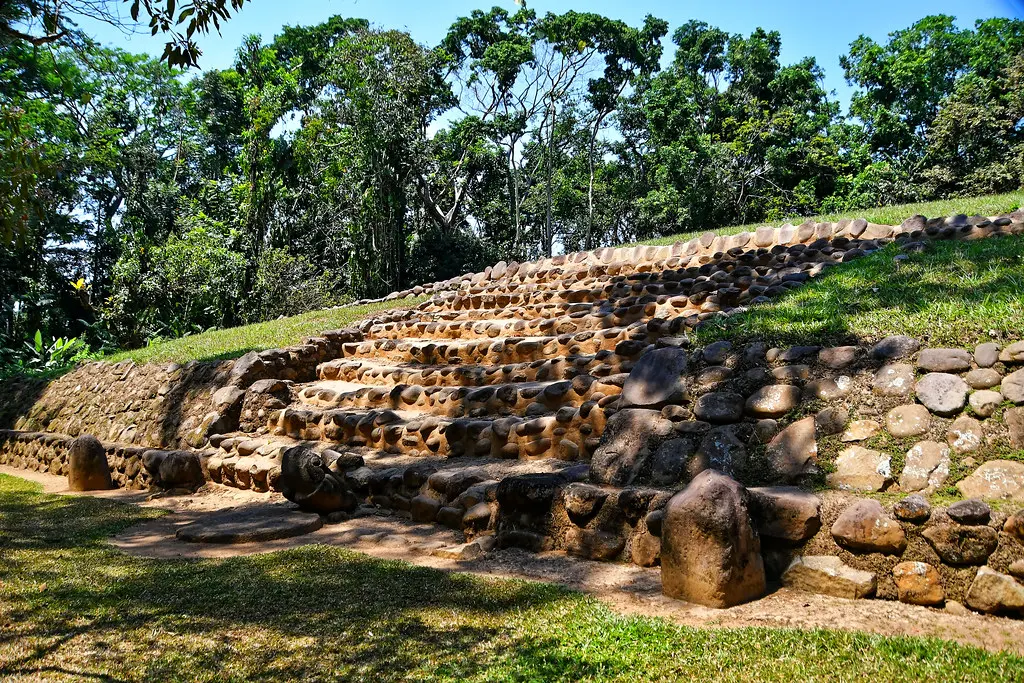
Image of Abaj Takalik. Image source
Visit essentials
A quick read before you go
- Duration
- 1.5 to 3 hours to walk the main plazas and monument groups.
- Access
- About 190 km (120 mi) west of Guatemala City near El Asintal, Retalhuleu; reached by road via…
Overview
In the Sierra Madre piedmont near El Asintal, Retalhuleu, tropical forest and distant volcanic cones surround Tak'alik Ab'aj's seventeen-century ceremonial landscape. Its K'iche' name means “standing stones”: a six-and-a-half-square-kilometre core holds around 239 monuments, plazas, terraces, ballcourts, and a water system arranged by cosmological principles. Settled in the Early Preclassic around 1000–800 BC on a trade route from the Isthmus of Tehuantepec toward El Salvador, it became a place where the Olmec world yielded to the earliest Maya.
The site combines one of the greatest concentrations of Olmec-style sculpture outside the Gulf of Mexico with early Maya writing and kingship, including the royal Tomb of the Vulture Lord. UNESCO inscribed it as World Heritage in 2023. Yet this is more than a ruin: contemporary Maya of twenty-two Mayan language affiliations regard it as living sacred ground, where ajq'ijab' spiritual guides still conduct calendrical ceremonies. Its forested plazas hold ancient monuments and present ritual in one continuity.
Why this place is sacred
Tak'alik Ab'aj draws its resonance from continuity. The plazas, stelae, and altars were aligned to cosmological principles by people who lived here across many centuries, and the site witnessed the slow turning from the Olmec world to the first Maya kingship and writing. What distinguishes it from a closed archaeological site is that the ceremony has not ended: Maya communities of many language groups still come to pray and make offerings, led by their own spiritual guides.
The forested setting in the volcanic piedmont, quiet and alive with wildlife, deepens the sense of a sacred ground rather than a monument under glass. The thinness here is the thinness of unbroken devotion, where to witness a living ceremony among ancient stones is to feel cultural and spiritual continuity directly.
Experience and orientation
Visitors describe a quiet, forested park threaded with paths among abundant stone monuments, with wildlife in the trees and the volcanic piedmont rising beyond. The Olmec-style sculptures and early Maya stelae and altars reward slow attention, and a guide helps read the transition encoded in them. Because the site remains in active ceremonial use, visitors may encounter ajq'ijab' conducting rituals at altars; these are not performances and should be observed at a respectful distance, if at all.
The combination of ancient monuments and living ritual is what most distinguishes the experience and fosters a strong sense of cultural and spiritual continuity.
Allow 1.5 to 3 hours to walk the main plazas and monument groups. Mornings are coolest and best for wildlife. Observe the site's etiquette around the monuments and any ceremonies in progress.
Context and lineage
The site's monuments carry deep cosmological imagery: some depict the Olmec 'Descent of the Grandfather' myth and figures emerging from a jaguar's mouth, linking rulers to divine and ancestral power. Archaeologically, Tak'alik Ab'aj is read as a place where Olmec-influenced and ancestral Maya populations of the Pacific piedmont shaped, over centuries, the emergence of early Maya kingship, writing, and cosmological urban planning.
From Olmec-influenced ceremonial culture through Preclassic and Classic Maya religion to the living Maya spirituality of many contemporary language communities.
Olmec-influenced and ancestral Maya builders
Builders
The 'Vulture Lord'
Early Maya ruler
Ajq'ijab' (Maya spiritual guides)
Contemporary ritual leaders
Archaeologists and conservators
Excavators and custodians
Traditions and practice
Ancient stela and altar dedications, royal burials such as the Tomb of the Vulture Lord, and ballgame ritual, alongside Olmec-style monumental sculpture.
Maya spiritual guides (ajq'ijab') conduct calendrical ceremonies with offerings of candles, flowers, copal incense, and prayer.
Walk the plazas slowly and read the monuments with a guide to grasp the Olmec-to-Maya transition. If a ceremony is in progress, observe respectfully and at a distance; do not join uninvited or interrupt.
Contemporary Maya spirituality
ActiveIndigenous groups of the twenty-two Mayan language affiliations regard the site as sacred and visit to perform rituals.
Calendrical ceremonies with offerings of candles, flowers, copal incense, and prayers led by ajq'ijab' (Maya spiritual guides).
Preclassic Maya religion
HistoricalThe site shows the emergence of early Maya kingship, writing, and cosmological architecture in the Late Preclassic.
Stela and altar dedication, royal burial (e.g., the Tomb of the Vulture Lord), and ballgame ritual.
Olmec-influenced ceremonial culture
HistoricalHolds one of the greatest concentrations of Olmec-style sculpture outside the Gulf of Mexico, marking the Olmec-to-Maya cultural transition.
Monumental sculpture, potbelly figures, and ceremonial plaza construction.
Perspectives and open questions
Tak'alik Ab'aj is read as a key site of the Olmec-to-Maya transition, venerated as a living sacred place by contemporary Maya, and discussed in popular accounts for its shamanic transformation imagery.
Scholarly perspective
Scholars regard Tak'alik Ab'aj as a key site documenting the transition from Olmec-influenced to Maya culture, with early evidence of Maya writing, kingship, and cosmological urban planning along a major trade route.
Living and traditional perspectives
Contemporary Maya communities of many language groups regard the site as a living sacred place and continue ceremonies there.
Alternative interpretations
Some popular accounts emphasize the jaguar-transformation and 'Descent of the Grandfather' imagery as evidence of shamanic ecstatic practice.
Open questions
The precise ethnic and linguistic dynamics of the Olmec-to-Maya transition, and the identities of the rulers buried at the site, remain debated. A detailed calendar of contemporary Maya ceremonies at the site is not documented.
Plan your visit
Access and arrival
About 190 km (120 mi) west of Guatemala City near El Asintal, Retalhuleu; reached by road via Retalhuleu, typically by car or tour. Precise current opening hours and entrance fees were not confirmed; check the national-park authority for current details.
Respectful visit
Modest, practical clothing; sun protection for the open tropical setting.
Generally permitted for the monuments; do not photograph ceremonies or participants without explicit permission.
Leave offerings only as directed by Maya spiritual guides; do not disturb existing offerings.
Stay on paths; do not climb or touch monuments; respect any roped-off conservation areas and ceremonies in progress.
Do not photograph ceremonies or participants without explicit permission, and do not disturb existing offerings. Leave offerings only as directed by Maya spiritual guides.
Current practical details
Address
J7Q8+CX7, El Asintal, Guatemala
Phone
Hours
Hours, fees, and access can change — verify on the official source before you travel. Practical details last checked Jun 2026.
Location
Map loads as you approach this section.
Pilgrim reflections
A portrait of encounter, not a score
Pilgrims describe what they felt, how present they could become, and whether the place would shape a journey. There are no stars and no ranking of traditions.
No reviewed reflections yet
The first pilgrims can help describe the character of being here.
Share a reflection
Available after an account-backed “Been there.” Every reflection is reviewed before publication.
Nearby sacred places
Explore other sacred places in the region. Proximity does not establish access or travel time; check each place’s guidance.


References
Sources consulted for this page. Source categories describe the publication, not a guarantee that every claim is verified. Traditional accounts and outside interpretations may differ.
- 01Takalik Abaj — Wikipedia — Wikipedia contributorsacademicConfirms Olmec-to-Maya transition, location in El Asintal/Retalhuleu, 6.5 km² core, ~239 monuments, Preclassic chronology.
- 02National Archaeological Park Tak'alik Ab'aj — UNESCO World Heritage Centre — UNESCOofficialConfirms 2023 World Heritage inscription, cosmological site layout, water management, ballcourts, stelae and altars, sacred status for contemporary Maya.
- 03Tomb of the Vulture Lord — Archaeology Magazine — Archaeology MagazineSource contextDocuments royal Maya tomb ('Vulture Lord') excavation, evidence of early Maya kingship at the site.
- 04Takalik Abaj — Encyclopedia.com — Encyclopedia.comacademicConfirms Early Preclassic settlement and role on long-distance trade route from Isthmus of Tehuantepec to El Salvador.
- 05Tak'alik Ab'aj Inscribed as a UNESCO World Heritage Site — Guatemalan News Agency — GTNewsSource contextOfficial Guatemalan announcement of 2023 inscription; notes 22 Mayan linguistic groups consider it sacred.
- 06Discovering Takalik Abaj: Where Mayan and Olmec Worlds Collide — guat2do — guat2doSource contextVisitor-oriented overview of Olmec and Maya monuments and visiting context.
Photo gallery
3 curated photos
Share a photo
Help visitors recognize Abaj Takalik. Every submission is reviewed before publication.