Yesemek
The sacred factory of the Hittite world — three hundred guardian figures still lying where they were abandoned three thousand years ago
Understand sacred places, explore living traditions, and learn how to engage respectfully with Pilgrim Map.
Access has not been verified. Check current local guidance before planning a visit.
Gaziantep, Turkey
Read the sources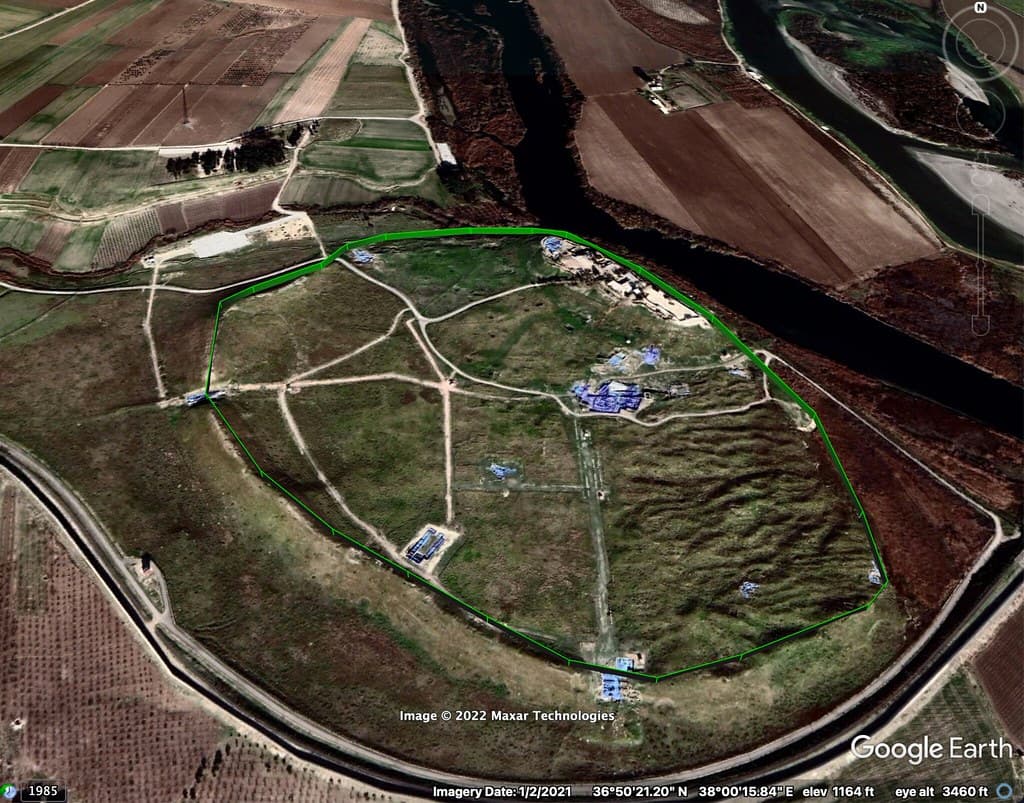
Image of Yesemek. Image source
Visit essentials
A quick read before you go
- Duration
- 45 minutes to one hour for the sculpture landscape at a steady pace; allow 90 minutes for a…
- Access
- Located 23 km southeast of Islahiye, in Gaziantep Province.
Overview
Twenty-three kilometres southeast of Islahiye, where Anti-Taurus foothills meet the Syrian plain, Yesemek preserves the workshop where divine guardians of the Hittite world were made. It is not a temple or a tomb.
Established around 1344 BCE under Emperor Suppiluliuma I, the basalt quarry served as the primary production site for sacred figures for city, palace, and temple entrances: female-headed sphinxes, winged lions, mountain gods with raised arms, and hunting reliefs. Gate guardians across the empire may have been shaped here before transport to Zincirli, Karkamish, Aleppo, and perhaps Hattusa.
The workshop operated roughly two centuries through the Hittite imperial era and a 9th-century BCE Neo-Hittite reactivation, then was permanently abandoned, perhaps as Assyrian expansion ended the Sam'al kingdom. Approximately 300 sculptures remained at stages from rough cuts to near completion, undisturbed for three thousand years.
Felix von Luschan first discovered the site in 1890; Bahadır Alkım's systematic 1957-1961 campaigns revealed 100,000 square metres of sphinx heads, lion torsos, partial reliefs, and workshop debris. Turkey placed Yesemek on UNESCO's tentative list in 2012. The hillside freezes a civilization's transformation of divine protection into material form.
Why this place is sacred
Sacred sites are typically places where the sacred was worshipped or manifested. Yesemek is something rarer: a place where the sacred was made. The theological premise underlying every sphinx and lion here is that divine protection can be materially embodied — that a craftsman working with the right intention, the right iconographic form, the right sacred commission, can produce an object that genuinely houses and channels divine protective power.
The mountain god figures at Yesemek are particularly significant. They appear in the same iconographic tradition as the figures at the Eflatun Pınar spring sanctuary near Konya — a Hittite site contemporary with Yesemek where the connection between sacred water, divine fertility, and the mountain deity is explicit. The mountain god stood for the divine forces at work in weather, in rain, in the cycle of agricultural productivity.
To place this figure at a gate was to station that divine energy as guardian of the threshold.
The sphinxes combine the human and the animal in a form that Hittite theology understood as specifically suited to liminal spaces — doorways, gates, passages between one state and another. The sphinx guarded not just the physical entrance but the conceptual boundary: the threshold between the profane world and the sacred interior, between the ordinary and the consecrated.
What makes Yesemek a thin place is not the figures that were completed and installed in their temples — those are scattered across museum collections and distant archaeological sites. It is the figures that remained: the guardians that never left, that never reached their intended posts. Three hundred sacred beings in various stages of becoming, lying on the hillside where they were shaped, preserving the act of creation more completely than any finished object could.
Production center for sacred guardian sculptures destined for the gates of Hittite temples, palaces, and cities. Every figure here was made with the explicit theological purpose of embodying and projecting divine protective power at sacred thresholds.
Established under Hittite Emperor Suppiluliuma I (c. 1344–1322 BCE) as an imperial sacred production facility; reactivated in the 9th century BCE by the Aramaic kingdom of Sam'al, when the workshop produced figures blending Hittite, Aramaic, and Assyrian iconographic traditions. Abandoned permanently around the 8th century BCE following Assyrian expansion. Rediscovered archaeologically from 1890; developed as an open-air museum in the 20th century.
Experience and orientation
The walk through Yesemek is unlike any other archaeological experience in Turkey. The site is not organized around a single monument or building complex. It is a landscape of stone: some fragments recognizably sphinx-shaped, some blocky and barely worked, some showing the decisive lines of a sculptor who had refined this form hundreds of times. Sphinxes with their characteristic female heads and lion bodies lie with their faces upward or tilted to the side.
Mountain god reliefs project from unfinished slabs. Winged lions catch the morning light.
The path through the sculpture landscape follows a prepared track with wooden marker posts. The density of figures increases as you move deeper into the workshop area; in some sections, finished and unfinished sphinxes lie within arm's reach of each other, the contrast between the polished face of a completed head and the rough-cut body of its neighbor making the production process physically legible.
The basalt stone itself is worth attention. Black and fine-grained in some sections, red-tinged and coarser in others, it has a weight and presence that explains the Hittite preference for it in sacred sculpture. The quarry faces visible on the hillside show where raw blocks were extracted; the chisel marks on unfinished figures are still crisp.
The site faces southeast and catches the morning light well. Arrive early if possible — the low-angle sun throws the sculptural relief into sharp visibility and the heat has not yet accumulated. The small café at the entrance is open during museum hours. The site is free; no guides are available on-site, but the information boards provide adequate context for self-guided exploration.
The silence at Yesemek is its most persistent quality. There are no other large sites nearby to generate visitor traffic, and the topography absorbs sound. A sense of isolation accompanies the encounter with these scattered guardians — a productive solitude for reflection on what the people who made them understood about the nature of divine protection.
The entrance is signposted from the road south of Yesemek village. Park at the entrance and follow the prepared path into the sculpture landscape. The full circuit of the main sculpture area takes approximately 45 minutes at a steady pace. The café and information center at the entrance provide context before entering the site.
Context and lineage
The decision to establish a dedicated production facility for sacred sculpture reflects the scale and organizational ambition of the Hittite imperial project. Suppiluliuma I (reigned c. 1344–1322 BCE), who expanded the Hittite Empire to its greatest extent through military and diplomatic means, required an infrastructure capable of equipping the gates of newly acquired cities and newly built sanctuaries with appropriate divine protection.
Yesemek, in the Islahiye region where the Anti-Taurus foothills provide excellent basalt, was the answer to that requirement. The quarry provided raw material; the workshop trained craftsmen who had internalized the iconographic vocabulary of Hittite sacred art — the specific proportions of the sphinx head, the gesture of the mountain god, the stance of the winged lion — and who could reproduce these forms at scale.
The workshop operated through the Hittite imperial period, which ended with the empire's collapse around 1200 BCE. Several centuries later, when the Aramaic kingdom of Sam'al controlled the region, Yesemek was reactivated. Sam'al-period sculptures show Aramaic and Assyrian stylistic influences layered over the Hittite tradition, reflecting the cultural syncretism of the Neo-Hittite successor states.
Assyrian expansion in the 8th century BCE ended Sam'al's independence and apparently ended work at Yesemek permanently. When the last craftsmen left — with perhaps a hundred finished figures still lying in the workshop yard and another two hundred in various stages of completion — they left behind an archaeological record of unusual completeness.
Hittite Empire (Suppiluliuma I, c. 1344–1322 BCE) → Post-imperial period → Neo-Hittite / Aramaic Sam'al kingdom reactivation (9th century BCE) → Abandonment following Assyrian expansion (8th century BCE) → Archaeological discovery (1890, von Luschan) → Systematic excavation (1957–1961, Alkım) → Open-air museum and UNESCO tentative list (2012)
Suppiluliuma I
Hittite Emperor
Felix von Luschan
Austrian archaeologist
Bahadır Alkım
Turkish archaeologist
İlhan Temizsoy
Museum of Anatolian Civilizations director
Traditions and practice
At Yesemek, the sacred practice was the production itself. The craftsmen working here were not priests performing rituals in the conventional sense, but their labor was understood as a form of sacred service. Each sphinx and lion was being shaped into a form that would, once complete and installed at a gate, become the physical dwelling place of divine protective energy.
The mountain god figures deserve particular attention. In Hittite theology, the mountain god — depicted with arms raised and a characteristic headdress — was associated with the weather deity tradition, with the divine forces that controlled rain, storm, and the agricultural cycle. Installing these figures at sacred thresholds was an act of deliberate theological statement about what forces governed the space within.
The Sam'al-period reactivation introduced new iconographic elements — Aramaic facial types, Assyrian decorative motifs — but the theological function of the figures appears to have remained consistent: sacred guardians for sacred and royal thresholds.
No active religious practices. The site is open for heritage tourism and occasional archaeological study. The Turkish cultural heritage authorities manage the site under the provincial directorate for Gaziantep.
Walk to the densest section of sculptures before consulting the information boards. Allow the landscape to register first — the number of figures, their varied states of completion, the sheer volume of sacred intention concentrated in this hillside. Only then read the interpretive material; it will be more resonant for having first encountered the raw experience.
Choose one sphinx and sit near it. Study the face. The proportions of the Hittite sphinx are specific and consistent — a female face with a particular serene authority, a headdress that identifies her as divine rather than merely human. Consider that this specific face was understood to be capable of housing divine protective power: that the iconographic form, correctly reproduced, was not merely symbolic but functionally sacred.
The distinction between a symbol of protection and an actual embodiment of protection is one that this site invites you to sit with.
Arriving at the site with a downloaded image of Hittite sphinxes from the Istanbul Archaeological Museum (where finished examples from comparable sites are held) allows comparison between completed and incomplete examples — a revealing exercise in understanding the sacred production process.
Hittite Imperial / Neo-Hittite Religious Iconography
HistoricalEstablished by Hittite Emperor Suppiluliuma I as the primary production site for sacred guardian sculptures. Every sphinx, lion, and mountain god figure produced here was destined to guard a sacred threshold, embodying divine protective power at the gates of temples, palaces, and cities.
Quarrying and sculpting of sacred guardian figures in basalt; transportation to Hittite cities and sanctuaries across the empire; dedication of completed figures at city gates and temple entrances.
Neo-Hittite / Aramaic Sam'al
HistoricalAfter the Hittite Empire's collapse around 1200 BCE, the workshop lay dormant until reactivated in the 9th century BCE by the Aramaic kingdom of Sam'al. Sam'al-period figures show the cultural synthesis characteristic of Neo-Hittite successor states: Hittite compositional forms inflected with Aramaic facial types and Assyrian decorative elements.
Continuation of guardian sculpture production under new cultural authority; adaptation of Hittite iconographic vocabulary to Aramaic-Assyrian aesthetic sensibilities.
Archaeological / Scholarly
ActiveRediscovered by Felix von Luschan in 1890; systematically excavated by Bahadır Alkım (1957–1961) and İlhan Temizsoy (1990s). The site is recognized as the largest ancient stonemasonry workshop in the Near East and a UNESCO tentative list member since 2012.
Archaeological survey and excavation; open-air museum development and visitor interpretation; ongoing occasional excavation seasons adding new sculptures to the known count.
Perspectives and open questions
Yesemek invites questions that standard archaeological interpretation does not fully address: what was the relationship between the craftsmen and the sacred beings they were creating? Was the workshop a sacred space itself, or merely a production facility? And what does the incompleteness of so many figures — their suspension between stone and guardian — tell us about Hittite theology?
Scholarly perspective
Academic consensus recognizes Yesemek as the largest known ancient stonemasonry workshop in the Near East, and a critical resource for understanding Hittite sacred art, imperial organization, and the iconographic vocabulary of Neo-Hittite culture. The UNESCO tentative list submission (2012) reflects international scholarly recognition of the site's outstanding universal value. Research by the Hittite Monuments Project has established the typological connections between Yesemek's figures and parallel examples at installed Hittite sacred sites across Turkey and Syria.
Living and traditional perspectives
No living religious tradition is directly connected to Yesemek. Turkish state heritage management oversees the site. Modern archaeological and heritage tourism traditions constitute the primary current form of engagement.
Alternative interpretations
The site has attracted significant interest from those studying Hittite sacred iconography, the theology of threshold guardians, and the role of sacred art production in ancient Near Eastern religious systems. The question of whether the unfinished sphinxes constitute 'incomplete' divine beings — whether they possessed partial sacred power before completion — is a productive thought experiment for those interested in Hittite theology.
The site has also been noted by researchers interested in the archaeology of labor and devotion: the craft knowledge embedded in these figures, maintained across generations of workshop practitioners, constitutes a form of embodied sacred transmission.
Open questions
The precise logistics of how completed figures were transported from Yesemek to their installation sites remain incompletely understood. The largest figures weigh several tonnes; the infrastructure required for such transport in the Bronze Age was substantial. The ritual ceremonies that may have accompanied the completion and departure of each finished guardian — whether any blessing or dedication occurred at the workshop itself — are entirely undocumented.
The total number of sculptures still buried on the site is unknown; each excavation season has revealed additional figures, and large areas remain unexcavated.
Plan your visit
Access and arrival
Located 23 km southeast of Islahiye, in Gaziantep Province. From Islahiye, follow the D400 highway south then turn onto the road signed for Yesemek village (brown tourist signs visible). From Gaziantep city: approximately 113 km via D400; allow 90 minutes. Public transport to Islahiye (bus from Gaziantep) then taxi to the site. Free admission. Open during daylight hours; no published closing time — aim to arrive before 4:00 PM. Small café at entrance.
Mobile signal: intermittent at the site; download offline maps before arriving.
Islahiye (23 km north) has basic accommodation. Gaziantep (113 km) is the preferred base, offering hotels across all price ranges and excellent food; the city's archaeological museum contains important Near Eastern finds. Antakya (Antioch) is an alternative base for the wider Hatay region.
Respectful visit
No religious dress requirements. Practical outdoor clothing; sun protection mandatory in summer. Sturdy closed-toe footwear for rocky terrain.
Permitted throughout the site and encouraged — the sculptures benefit from documentation. Do not position yourself on or against any sculpture for photographs. Low-angle morning light (first two hours after sunrise) produces the best sculptural detail in photographs.
Not applicable; no active religious tradition.
Do not touch, lean against, or climb on any sculpture. Do not remove any material from the site — stone fragments, pottery, or any other material. Stay on the prepared path system through the sculpture landscape. Do not bring vehicles beyond the parking area.
The sculptures are ancient and fragile. Do not touch or climb on any figure, regardless of its apparent solidity. The basalt can be sharp-edged in unfinished sections. The path through the site is unpaved; appropriate footwear is essential. No shade over most of the sculpture area; sun protection is critical in summer.
Location
Map loads as you approach this section.
Pilgrim reflections
A portrait of encounter, not a score
Pilgrims describe what they felt, how present they could become, and whether the place would shape a journey. There are no stars and no ranking of traditions.
No reviewed reflections yet
The first pilgrims can help describe the character of being here.
Share a reflection
Available after an account-backed “Been there.” Every reflection is reviewed before publication.
Nearby sacred places
Explore other sacred places in the region. Proximity does not establish access or travel time; check each place’s guidance.


References
Sources consulted for this page. Source categories describe the publication, not a guarantee that every claim is verified. Traditional accounts and outside interpretations may differ.
- 01Yesemek Quarry and Sculpture Workshop - UNESCO World Heritage Tentative List — UNESCOofficialUNESCO tentative list entry since 2012 with OUV rationale
- 02Gaziantep Yesemek Archaeological Site — Turkish MuseumsofficialOfficial Turkish museum authority coverage with site details
- 03Hittite Monuments - Yesemek — Hittite Monuments ProjectacademicSpecialized academic reference on Hittite monuments at the site
- 0415 new sculptures discovered in Turkey's sculpture paradise Yesemek — ArkeonewsacademicRecent excavation discoveries at the site
- 05Yesemek Open Air Museum — Gaziantep Provincial Directorate of Culture and TourismofficialOfficial government tourism page for the museum
- 06Yesemek Quarry and Sculpture Workshop - Wikipedia — Wikipedia contributorsencyclopediaComprehensive overview of site history, excavation, and sculptures
- 07Yesemek | Turkish Archaeological News — Turkish Archaeological NewsacademicArchaeological news and updates on the site
- 08Exploring Yesemek: The Ancient Stone Workshop of Türkiye — HolyLandPhotos BlogguideDetailed visitor perspective with descriptions of the sculptures and their religious significance
Share a photo
Help visitors recognize Yesemek. Every submission is reviewed before publication.