Yakushima Island
Where thousand-year cedars hold the memory of Shinto gods and eternal rain falls
Understand sacred places, explore living traditions, and learn how to engage respectfully with Pilgrim Map.
Access has not been verified. Check current local guidance before planning a visit.
Yakushima, Kagoshima Prefecture, Japan
Read the sources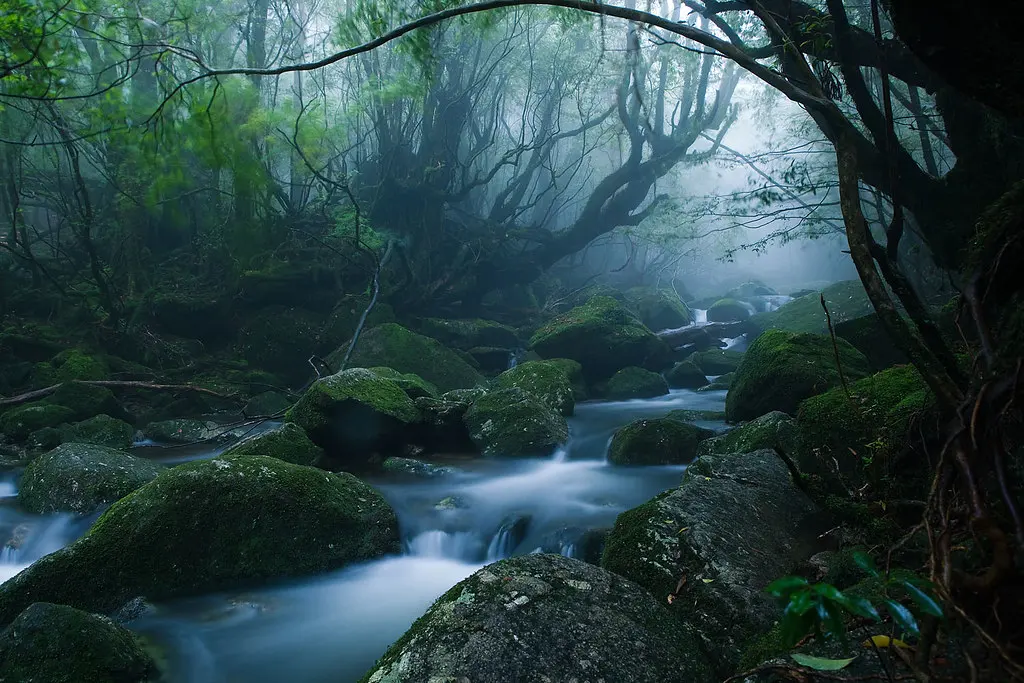
Image of Yakushima Island. Image source
Visit essentials
A quick read before you go
- Duration
- 3-4 days to include Jomon Sugi trek and other sites
- Etiquette
- Proper hiking attire is mandatory.
Overview
In 1993 UNESCO inscribed Yakushima as Japan's first Natural World Heritage Site, calling it the last and best example of its ecosystem on Earth. The designation recognized what pilgrims had known for centuries: this island preserves something rare and unrepeatable. From sea level to 1,935-meter Mount Miyanoura, Kyushu's highest peak, its 500 square kilometers compress climates from subtropical to subarctic and hold over 1,900 plant species. Dense forests inspired Studio Ghibli's Princess Mononoke.
Yakusugi are sugi over 1,000 years old, trees whose forms seem individual. Jomon Sugi is estimated at 2,170-7,200 years, placing its germination between the Jomon period, Japan's earliest known civilization, and the Egyptian pyramids. Reaching it requires a physically demanding nine- to ten-hour hike, effort integral to the encounter.
In Shinto understanding, yakusugi are shinboku, sacred trees where kami dwell. Perpetually cloud- and mist-shrouded Mount Miyanoura has been venerated as a sacred abode of mountain deities since ancient times. Twice-yearly pilgrimages honor the mountain god with Mitake shochu at summit shrines, while legends teach respect for kodama tree spirits. Annual rainfall of 4,000-10,000 millimeters across different zones is understood as continuous purification from heaven.
Why this place is sacred
What makes Yakushima feel like another world begins with simple facts that become strange upon reflection. The island's isolation, 60 kilometers off Kyushu's coast, creates a feeling of crossing into different territory that boats and planes reinforce but do not entirely explain. When you step onto Yakushima, something shifts. The air carries moisture continuously; rain is not an interruption but a condition of existence. The scale of time here differs from anywhere in mainland Japan.
A tree can be called young at 800 years old. The Jomon Sugi has been growing since before written language existed anywhere on Earth. To stand before such a being is to confront a timeline that renders human concerns genuinely small without making them meaningless. The trees have witnessed everything and continue witnessing, silent but not absent. The forests themselves create conditions for altered perception.
Moss covers every surface, softening sound and absorbing color until the spectrum narrows to infinite gradations of green. Light filters through canopy layers, changing quality as clouds pass. Mist enters and exits without announcement, revealing and concealing, making the visible world feel contingent. In these conditions, it becomes easy to understand why people would perceive spirits here. Not as belief adopted but as experience recognized.
Shinto theology names what is already happening when you walk among the yakusugi: you are in the presence of kami, dwelling in trees that were already old when the shrines were young. The physical demands of reaching the deepest forest contribute to the transformation. The trek to Jomon Sugi takes nine to ten hours, climbing through increasingly ancient landscapes, earning through effort what cannot be reached by convenience. This pilgrimage structure, present in sacred traditions worldwide, serves purpose beyond gatekeeping.
The body's exhaustion quiets the mind's chatter. By the time you reach the oldest trees, you have been prepared to receive them.
Sacred landscape where kami dwell in ancient trees and mountain peaks.
Venerated since prehistoric times. First documented in Chinese Sui dynasty records (6th century CE). Major logging during Edo period nearly destroyed the forests. Modern conservation movement began after discovery of Jomon Sugi in 1966. UNESCO World Heritage inscription 1993. National Park establishment 2012. Ongoing balance between preservation and access.
Experience and orientation
Yakushima offers encounters at every level of commitment. For those with limited time or mobility, Yakusugi Land provides boardwalk access to ancient cedars, including the Sennen Sugi (Thousand-Year Cedar) and Buddha Sugi, whose name reflects its contemplative presence. Two to four hour hiking courses wind through mossy forest that introduces the island's character without demanding extreme effort.
Shiratani Unsuikyo Ravine, the moss forest that inspired Princess Mononoke, offers intermediate trails where the quality of green light through ancient branches can shift perception within minutes of entering. The deeper you go, the more the modern world recedes, until you might believe you have wandered into a realm where different rules apply. Here is where kodama, the tree spirits of Japanese folklore, become not superstition but reasonable hypothesis. The full pilgrimage to Jomon Sugi requires commitment.
Beginning before dawn at Arakawa Trailhead, hikers follow an old logging railway through increasingly ancient forest, then climb steep mountain trails to finally stand before the oldest tree. The sight after nine hours of walking produces responses that vary with each person but rarely leave anyone unchanged. The tree's massive trunk, estimated circumference of over 16 meters, splits and heals and grows in ways that seem to express something beyond mere survival.
You cannot touch it, a platform keeps visitors at respectful distance, but presence requires no contact. Mount Miyanoura summit offers another dimension of sacred encounter for those prepared for overnight stays and challenging terrain. At Kyushu's highest point, traditional pilgrims have made offerings for centuries, and the perspective from above the cloud forest reveals Yakushima's true character: a sacred mountain that happens to be surrounded by sea.
The island offers multiple entry points to sacred forest. Yakusugi Land and Shiratani Unsuikyo are accessible by car or bus. The Jomon Sugi trek begins at Arakawa Trailhead (requires mountain bus in peak season). Mount Miyanoura summit requires overnight stay at mountain huts. All serious hikes require registration at police station, town hall, or trailheads and payment of Mountain Environmental Conservation Donation.
Context and lineage
According to Japanese mythology, sugi cedar trees came to Earth from the gods. The exceptionally long-lived yakusugi of Yakushima are seen as the purest embodiments of this divine origin. Local legends speak of kodama, tree spirits who inhabit the ancient forests. One tale tells of men from Miyanoura village who discussed felling a particular tree, only to hear supernatural sawing and crashing sounds from within, the tree's spirit warning them against unnecessary cutting.
Another legend speaks of a beautiful tree sprite who appears in the guise of a woman, smiling at those she encounters. Should someone fail to smile in return, the sprite would take vengeance. This spirit was particularly active on festival days of the mountain gods, times when locals knew to avoid the deep forest.
Yakushima exists within the broader tradition of Japanese mountain worship (sangaku shinko) that venerates peaks as sacred dwelling places of kami. The island's forests represent an extreme expression of the Shinto principle that exceptional natural features house divine spirits. The conservation of Yakushima connects to global recognition that certain places hold irreplaceable natural and spiritual value.
Jomon Sugi
Hayao Miyazaki
Traditions and practice
Biannual pilgrimages to Mount Miyanoura to honor the mountain kami represent the island's most ancient spiritual practice. Pilgrims pray at Kusugawa Tenmangu Shrine before ascending, make offerings at wayside shrines and sacred trees along the route, and offer Mitake sweet potato shochu at the summit. The Triple Cedar in Kusugawa has been a destination for village pilgrimages since the early 1900s. Small shrines mark the base of particularly significant yakusugi, and shimenawa ropes identify trees where kami dwell.
Traditional ceremonies at Masaki Forest are presided over by Buddhist monks, reflecting the blend of Shinto and Buddhist practices in mountain worship.
Modern visitors engage in what might be called conservation pilgrimage, trekking to Jomon Sugi and other ancient cedars as a form of nature reverence that combines physical challenge with contemplative experience. Sea turtle observation tours at Nagata Beach from May to September offer encounters with ancient creatures treated with sacred respect under strict conservation guidelines.
Year-round visitors come for what many describe as spiritual experiences in the ancient forest, finding in the moss and mist and impossible green a quality of presence that shifts perspective.
Enter the forest with reverence, understanding you are walking among what Shinto considers the dwelling places of kami. Pay respect at any shrines or shimenawa-marked trees you encounter. Move quietly; the forest rewards silence. If hiking to Jomon Sugi, treat the journey as pilgrimage, not merely exercise. At the platform before the ancient tree, take time to simply be present, allowing whatever response arises. Consider visiting the smaller, less crowded shrines where local traditions remain more intimate.
Shinto
ActiveYakushima embodies core Shinto principles of nature worship. The ancient cedars are regarded as shinboku believed to house kami. The entire island is considered a sacred landscape where the divine manifests in natural forms. Mount Miyanoura has been venerated as a sacred abode of the kami since ancient times.
Mountain pilgrimages to sacred peaks. Veneration of ancient cedars as dwelling places of kami. Offerings and prayers at wayside shrines along mountain trails. Rituals at Yakushima Shrine for protection of the island. Prayers at Kusugawa Tenmangu Shrine before mountain pilgrimages.
Sangaku Shinko (Mountain Worship)
ActiveThis tradition, blending Shinto and Buddhist beliefs, holds that all mountains are sacred. Yakushima's towering peaks, perpetual mists, and ancient forests create ideal conditions for mountain worship. The island is often called the home of the gods due to the spiritual significance attributed to its landscape.
Biannual pilgrimages to Mount Miyanoura. Offerings of Mitake sweet potato shochu at mountain shrines. Prayers at the Triple Cedar and other sacred yakusugi. Closing rituals at Masaki Forest presided over by Buddhist monks.
Perspectives and open questions
Yakushima exists at the intersection of ecological uniqueness, Shinto nature veneration, and humanity's relationship with ancient living beings.
Scholarly perspective
Yakushima is recognized scientifically as containing one of the last remnants of warm-temperate ancient forest in East Asia, with documented ecological significance supporting UNESCO World Heritage status. Archaeological evidence confirms human settlement from the Jomon period. The island's biodiversity of 1,900 plant species, 16 mammal species, and 150 bird species represents a unique biogeographical meeting point of palaearctic and oriental biotic regions.
Living and traditional perspectives
Within Shinto tradition, Yakushima embodies the principle that exceptional natural features are dwelling places for kami. The ancient cedars are shinboku, sacred trees marking connections between human and spiritual realms. Mountain worship (sangaku shinko) treats the peaks as sacred abodes of deities requiring proper reverence through pilgrimage and offerings. The entire island is understood as a sacred landscape where the divine manifests in natural forms.
Alternative interpretations
Yakushima is considered one of Japan's premier power spots due to its pristine natural energy and ancient trees. Some practitioners view the island as a rare location where the veil between worlds is thin, allowing direct communion with nature spirits. The extreme rainfall is interpreted as continuous spiritual purification energy descending from the heavens. The island's inspiration for Princess Mononoke's forest spirits reflects its resonance with archetypal imagery of the sacred forest.
Open questions
The exact age of Jomon Sugi remains disputed, with estimates ranging from 2,170 to 7,200 years, creating uncertainty about whether the tree predates or merely reaches Japan's Jomon period. Whether the island's myths about tree sprites and mountain spirits reflect actual experiences or cultural creation cannot be determined. The specific spiritual practices of the island's Jomon-period inhabitants remain unknown. Why loggerhead sea turtles choose Yakushima's beaches for such a high proportion of their North Pacific nesting is not fully understood.
Plan your visit
Access and arrival
Range of accommodations from guesthouses to hotels in Miyanoura and other villages. Mountain huts available for overnight treks. Book in advance during peak seasons.
Respectful visit
Waterproof jacket is mandatory (4,000-10,000mm annual rainfall). Sturdy hiking boots with good grip. Layered clothing for temperature variations from sea level to mountain. Smart casual for shrine visits.
Photography is permitted throughout most of the island. Be respectful at shrines and during ceremonies. Do not use flash during nighttime sea turtle observation tours.
Alcohol, traditionally Mitake shochu, may be offered at mountain shrines. Standard Shinto offerings are appropriate at Yakushima Shrine and other sacred sites.
Stay on designated trails without exception. Do not collect vegetation, stones, or any materials. No pets (risk of introducing non-native species). Do not enter areas marked with protective ropes. Refrain from loud music or noise on trails. Do not enter Nagata Beach at night during turtle season (May-September) except on guided tours. Submit climbing notice before mountain hikes. Pay the Mountain Environmental Conservation Donation (1,000 yen/day or 2,000 yen/2+ days).
The forest ecosystem is extremely fragile. Stay on designated trails at all times; the moss cannot recover from trampling. Do not collect any plants, stones, or artifacts. Attach rubber caps to hiking staffs. The island's weather changes rapidly; proper gear is essential for safety as well as respect.
Current practical details
Address
Yakushima Island, Yakushima, Kumage District, Kagoshima, Japan
Hours, fees, and access can change — verify on the official source before you travel. Practical details last checked Jun 2026.
Location
Map loads as you approach this section.
Pilgrim reflections
A portrait of encounter, not a score
Pilgrims describe what they felt, how present they could become, and whether the place would shape a journey. There are no stars and no ranking of traditions.
No reviewed reflections yet
The first pilgrims can help describe the character of being here.
Share a reflection
Available after an account-backed “Been there.” Every reflection is reviewed before publication.
Nearby sacred places
Explore other sacred places in the region. Proximity does not establish access or travel time; check each place’s guidance.

References
Sources consulted for this page. Source categories describe the publication, not a guarantee that every claim is verified. Traditional accounts and outside interpretations may differ.
- 01Yakushima - UNESCO World Heritage Centre — UNESCOofficialOfficial UNESCO World Heritage documentation
- 02Yakushima Island (UNESCO) | World Heritage | Travel Japan — Japan National Tourism OrganizationofficialOfficial Japanese tourism body
- 03Yakushima World Heritage Conservation Center — Ministry of the Environment, JapanofficialOfficial government conservation information
- 04Hiking Etiquette - Yakushima Town — Yakushima Town OfficeofficialOfficial local government visitor guidance
- 05Welcome to Yakushima, a sea turtles nesting site! — Yakushima Umigame-KanofficialSea turtle conservation organization
- 06Yakushima - Wikipedia — Wikipedia contributorsacademicComprehensive overview with historical and geographical details
- 07Jomon Sugi - Wikipedia — Wikipedia contributorsacademicDetails on the ancient cedar tree
- 08Yakushima Travel Guide — Japan GuideguideComprehensive travel resource
- 09Yakushima - Green Shinto — Green ShintospiritualShinto perspective on Yakushima's spirituality
- 10Yakushima Myths & Tales — Yes YakushimaspiritualLocal myths and folklore
- 11Yakushima's tradition of mountain pilgrimages — World Natural Heritage JapanspiritualDetails on mountain worship traditions
- 12Princess Mononoke - Wikipedia — Wikipedia contributorsacademicDetails on Studio Ghibli film inspiration
- 13Visit Yakushima: Adventure Awaits in the Real-Life Forest from Princess Mononoke — JRPassguidePrincess Mononoke connection details
Pilgrim glossary
- Shimenawa
- A sacred straw rope marking the boundary of a Shinto holy place.
Share a photo
Help visitors recognize Yakushima Island. Every submission is reviewed before publication.