Amanoiwato Shrine
Where the sun goddess emerged from darkness and light returned to the world
Understand sacred places, explore living traditions, and learn how to engage respectfully with Pilgrim Map.
Access has not been verified. Check current local guidance before planning a visit.
Takachiho, Miyazaki Prefecture, Japan
Read the sources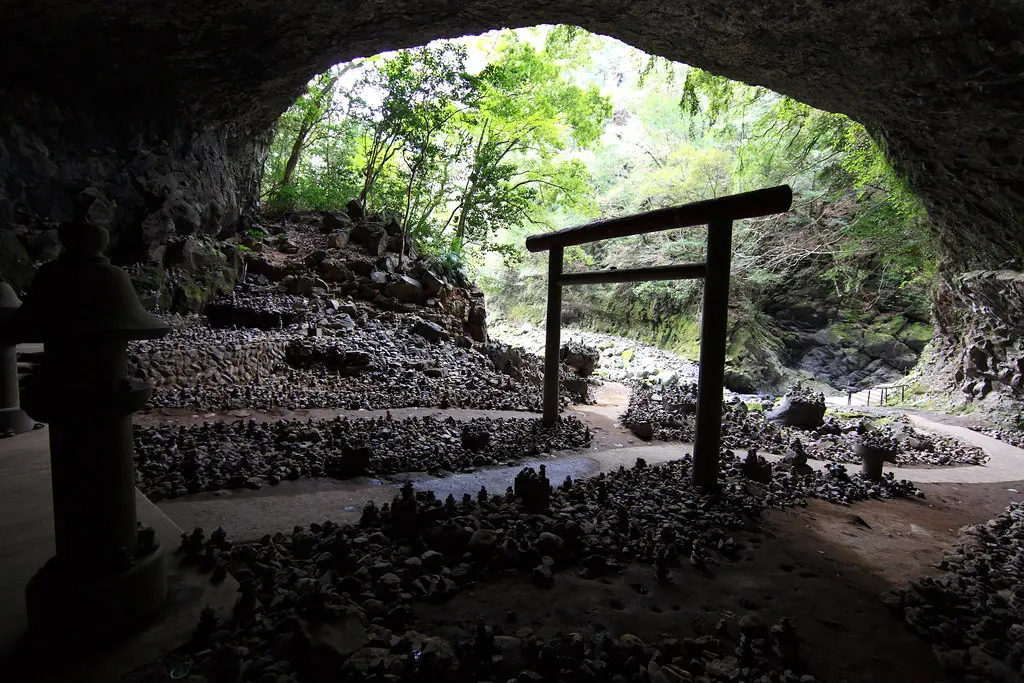
Image of Amanoiwato Shrine. Image source
Visit essentials
A quick read before you go
- Duration
- Minimum 1-2 hours to visit the West Shrine and Amano Yasukawara cave.
- Access
- From central Takachiho: local bus to Amanoiwato Shrine (15 minutes, approximately 200 yen,…
Overview
Amanoiwato Shrine marks a profound threshold in Japanese mythology: where light abandoned the world and was coaxed back. In the Kojiki and Nihon Shoki, Japan's founding chronicles, sun goddess Amaterasu Ōmikami withdrew into the cave after her brother's violence and darkness engulfed everything. Eight million kami gathered at a nearby riverbed, and Ame-no-Uzume's ecstatic dance drew Amaterasu's curiosity, originating the kagura tradition practiced here for more than eight centuries.
Shinto priests now guide visitors to a platform overlooking the strictly off-limits divine cave. A forest-and-gorge walk reaches Amano Yasukawara, where the kami deliberated and countless visitors have stacked stones in prayer. Amanoiwato remains living mythology for devotees, cultural pilgrims, and other visitors drawn to Japanese spiritual roots.
Why this place is sacred
In Shinto understanding, Amano-Iwato is not symbolic but the actual rock where Amaterasu withdrew and all existence darkened—the place light was rescued from extinction. A ten-minute walk through forested gorge reaches Amano Yasukawara, where eight million kami met in cosmic council. Ame-no-Uzume's ecstatic dance and the gods' laughter drew Amaterasu out and originated kagura.
This is a geography of creation: the viewing platform stands at an edge between worlds, while thousands of cairns left with wishes and prayers form an ever-growing monument to human seeking. Centuries of pilgrimage and the myth's primordial power give the gorge the thinness between realms that visitors consistently report.
The site's sanctity predates historical records, rooted in Japan's foundational mythology as recorded in the Kojiki (712 CE) and Nihon Shoki (720 CE). The shrine exists to enshrine the cave itself as a direct connection to the divine realm.
While the mythology has remained constant, the practice of kagura developed as ritual reenactment of the cave narrative. The 33 dances performed during winter festivals preserve techniques passed down for over 800 years, designated today as an Important Intangible Folk Cultural Property. The stone-stacking practice at Amano Yasukawara has grown organically, transforming the cave into a participatory sacred landscape.
Experience and orientation
The visit unfolds in stages. At the West Main Shrine, worship faces the mountain across the Iwato River, with the cave hidden in the cliff. Priest-led visits every thirty minutes reach the yohaijo platform, revealing it across a forested ravine. With photography forbidden, presence and the site's weight come forward.
The path to Amano Yasukawara descends through forest into a narrowing gorge, then opens into a cavern carpeted by thousands of cairns—each someone's prayer, wish, or reaching beyond themselves. Their accumulation can overwhelm; many visitors add a stone without needing a belief system. At nearby Takachiho Shrine, nightly abbreviated kagura and full overnight festivals from November through February animate the myth through masks, drum, flute, and Uzume's firelit dance, continuing an eight-century tradition among fellow witnesses.
Begin at the West Main Shrine for formal worship and the guided cave viewing. Allow the walk to Amano Yasukawara to serve as transition—the descent through forest prepares one for the cave's impact. Carry a small stone to add to the cairns if you wish. Consider staying overnight in Takachiho to attend evening kagura at Takachiho Shrine; for the deepest immersion, plan a winter visit during the Amano Iwato Kagura festival season.
Context and lineage
The Kojiki records that Amaterasu Ōmikami was born when the primordial deity Izanagi washed his left eye while purifying himself after visiting the underworld. She was appointed to rule Takamagahara, the High Plain of Heaven. Her brother Susanoo committed a series of terrible offenses—destroying rice paddies, spreading filth in the palace, and finally throwing a flayed horse into her weaving hall, causing the death of one of her attendants. Traumatized, Amaterasu retreated into the Ama-no-Iwato cave, sealing herself within.
All light vanished from the universe. The eight million kami gathered at Amano Yasukawara to devise a plan. They commissioned the forging of a sacred mirror and strings of jewels, and asked Ame-no-Uzume, goddess of dawn and revelry, to perform before the cave mouth. Her dance became increasingly ecstatic—according to some versions, erotic—causing such uproarious laughter among the assembled gods that Amaterasu emerged to see what could possibly be so amusing.
The deity Tajikarao seized her and pulled her fully from the cave, while others stretched a shimenawa rope across the entrance to prevent her return. Light flooded back into existence.
The shrine belongs to the Shinto tradition and maintains direct connection to Japan's foundational mythology. The kagura dances performed here preserve techniques transmitted through generations of performers for over 800 years.
Amaterasu Ōmikami
The sun goddess, supreme deity of Shinto, and divine ancestress of the Imperial line. Her withdrawal into the cave and emergence represent cosmic crisis and restoration.
Ame-no-Uzume
Goddess of dawn, mirth, and revelry. Her ecstatic dance before the cave—the mythological origin of kagura—lured Amaterasu back to the world.
Tajikarao
Deity of strength who physically pulled Amaterasu from the cave once she emerged to investigate the commotion.
Traditions and practice
The 33 kagura dances of the Amano Iwato tradition ritually reenact the entire mythological narrative. Tejikarao no Mai depicts the god of strength searching for the hidden sun goddess. Uzume no Mai recreates the ecstatic dance that lured Amaterasu from darkness. Totori no Mai shows the opening of the stone doors. These performances occur in full during overnight festivals from November through February, when dancers perform through the night before shrine communities.
The tradition has been designated an Important Intangible Folk Cultural Property of Japan.
Daily guided visits to view the sacred cave depart every thirty minutes from 8:30 AM to 4:30 PM, led by Shinto priests who explain the mythology and proper worship etiquette. Evening kagura performances occur nightly year-round at nearby Takachiho Shrine from 8:00 to 9:00 PM, offering abbreviated versions of the traditional dances. Stone-stacking at Amano Yasukawara has become a widely-practiced form of personal prayer.
Join the guided cave viewing to receive the mythology directly from shrine priests. Walk slowly to Amano Yasukawara, allowing the forest descent to settle the mind. At the cave, take time with the accumulated cairns before adding your own stone—there is no required prayer or formula; simply hold your intention. If visiting in the evening, attend kagura at Takachiho Shrine to see the mythology in motion.
Shinto
ActiveAmanoiwato Shrine is one of the most spiritually significant Shinto sites in Japan, enshrining the cave where the sun goddess Amaterasu Ōmikami hid herself according to the foundational myths recorded in the Kojiki and Nihon Shoki. As the ancestress of the Imperial line and the central deity of Shinto, Amaterasu's connection to this site makes it a profound pilgrimage destination. The shrine is considered the spiritual birthplace of the kagura dance tradition.
Daily worship at the West and East Main Shrines continues the tradition of honoring Amaterasu and related deities. Priests guide visitors to view the sacred cave, explaining mythology and proper worship form. Seasonal kagura performances—33 ritual dances—reenact the entire mythological narrative. Stone-stacking prayers at Amano Yasukawara connect practitioners to the gathering of the eight million kami.
Perspectives and open questions
Amanoiwato occupies a unique position—a site whose significance is mythological yet whose spiritual impact is experienced directly by visitors regardless of belief. Understanding the multiple frameworks through which the site can be approached enriches rather than diminishes encounter.
Scholarly perspective
Historians and mythologists recognize the Kojiki (712 CE) and Nihon Shoki (720 CE) as the primary textual sources for the Amaterasu cave myth. The narrative likely served multiple functions: explaining solar phenomena (possibly eclipses), establishing the divine lineage of the Imperial family, and encoding ritual knowledge about kagura and shimenawa. Multiple sites across Japan claim to be the location of the mythological cave, though Takachiho's claim is the most prominent and oldest established.
The specific founding date of the shrine remains uncertain, and archaeological excavation data is limited in available sources.
Living and traditional perspectives
Within Shinto tradition, Amanoiwato is literally the cave where Amaterasu Ōmikami—the supreme deity of the sun and ancestress of the Imperial line—withdrew from the world. The site is not symbolic but actual sacred geography. The kagura dances are not performances but ritual reenactments that renew cosmic order, maintaining the original restoration of light through their repetition. The stone-stacking at Amano Yasukawara connects practitioners to the council of eight million kami.
The cave remains shiniki—divine territory—requiring the same reverence owed to the kami themselves.
Alternative interpretations
Some visitors approach the site as a power spot where the boundary between dimensions is particularly thin. The cave mythology is sometimes interpreted through the lens of shamanic initiation—the descent into darkness followed by rebirth into light—or as encoding astronomical knowledge about solar cycles. Contemporary spiritual seekers may find personal meaning in the mythological structure without adopting Shinto belief.
Open questions
The precise dating of when this specific location became associated with the Amaterasu myth remains uncertain. Archaeological evidence of the site's earliest use has not been extensively documented in available sources. The exact nature of prehistoric ritual activity at this gorge is unknown. Whether this was the original inspiration for the myth, or whether the myth was later mapped onto this landscape, cannot be determined with current evidence.
Plan your visit
Access and arrival
From central Takachiho: local bus to Amanoiwato Shrine (15 minutes, approximately 200 yen, hourly service) or taxi (approximately 2,700 yen one way). From JR Nobeoka Station: Miyako Bus to Takachiho Bus Center (1 hour 16 minutes) then transfer to Amanoiwato Jinja bus (16 minutes). No direct train access—Takachiho is bus-accessible only.
Takachiho offers traditional ryokan and modern hotels. Staying overnight is strongly recommended to attend evening kagura and experience the region's atmosphere after day-trippers depart.
Respectful visit
Modest dress appropriate for a sacred site. No specific requirements, but shorts, tank tops, and very casual attire may feel inappropriate given the solemnity of the cave viewing.
Strictly prohibited at the cave viewing platform and all shiniki (divine areas). Allowed in general shrine grounds. The prohibition preserves both the dignity of sacred space and the quality of visitors' own experiences.
Monetary offerings may be placed in offering boxes at worship areas. Formal omamori (protective charms) and omikuji (fortune slips) are available at the shrine office.
The sacred cave cannot be approached—viewing is possible only from the designated platform with priest guidance. Pets should observe proper shrine etiquette. The grounds are not parks; playing with balls or toys is inappropriate.
Photography is strictly prohibited at the cave viewing platform and all designated divine areas. The prohibition exists to preserve the dignity and silence of sacred space. Respect the meditative atmosphere at Amano Yasukawara; this is not a performance space but a place of accumulated prayer.
Current practical details
Address
1073-1 Iwato, Takachiho, Nishiusuki District, Miyazaki 882-1621, Japan
Phone
Hours
Hours, fees, and access can change — verify on the official source before you travel. Practical details last checked Jun 2026.
Location
Map loads as you approach this section.
Pilgrim reflections
A portrait of encounter, not a score
Pilgrims describe what they felt, how present they could become, and whether the place would shape a journey. There are no stars and no ranking of traditions.
No reviewed reflections yet
The first pilgrims can help describe the character of being here.
Share a reflection
Available after an account-backed “Been there.” Every reflection is reviewed before publication.
Nearby sacred places
Explore other sacred places in the region. Proximity does not establish access or travel time; check each place’s guidance.


References
Sources consulted for this page. Source categories describe the publication, not a guarantee that every claim is verified. Traditional accounts and outside interpretations may differ.
- 01Amanoiwato Shrine Official Website — Amanoiwato ShrineofficialOfficial shrine website with authentic information on worship, Kagura, and visitor guidance
- 02Japan National Tourism Organization — JNTOofficialOfficial Japanese government tourism resource
- 03Amaterasu - Mythopedia — MythopediaacademicAcademic mythology reference with citations to Kojiki and Nihon Shoki
- 04The Myths, Legends, and Rituals of the Takachiho Night Kagura — Google Arts & Culture / Ministry of Agriculture, Forestry and FisheriesspiritualOfficial Japanese government cultural documentation
- 05Visit Kyushu - Amanoiwato Shrine — Kyushu Tourism OrganizationofficialRegional tourism authority
- 06Amaterasu: The Japanese Sun Goddess — Nippon.comacademicJapanese cultural documentation site
- 07Amanoiwato Shrine - Wikipedia — Wikipedia contributorsencyclopediaGeneral overview with citations to primary sources
- 08Amano Iwato Shrine - Japan Guide — Japan GuideguideReputable travel resource with practical visitor information
Pilgrim glossary
- Shimenawa
- A sacred straw rope marking the boundary of a Shinto holy place.
Share a photo
Help visitors recognize Amanoiwato Shrine. Every submission is reviewed before publication.