Kirishima Shrine
Where the grandson of the sun goddess descended from heaven, his lance still thrust into the mountain summit
Understand sacred places, explore living traditions, and learn how to engage respectfully with Pilgrim Map.
Access has not been verified. Check current local guidance before planning a visit.
Kirishima, Kagoshima Prefecture, Japan
Read the sources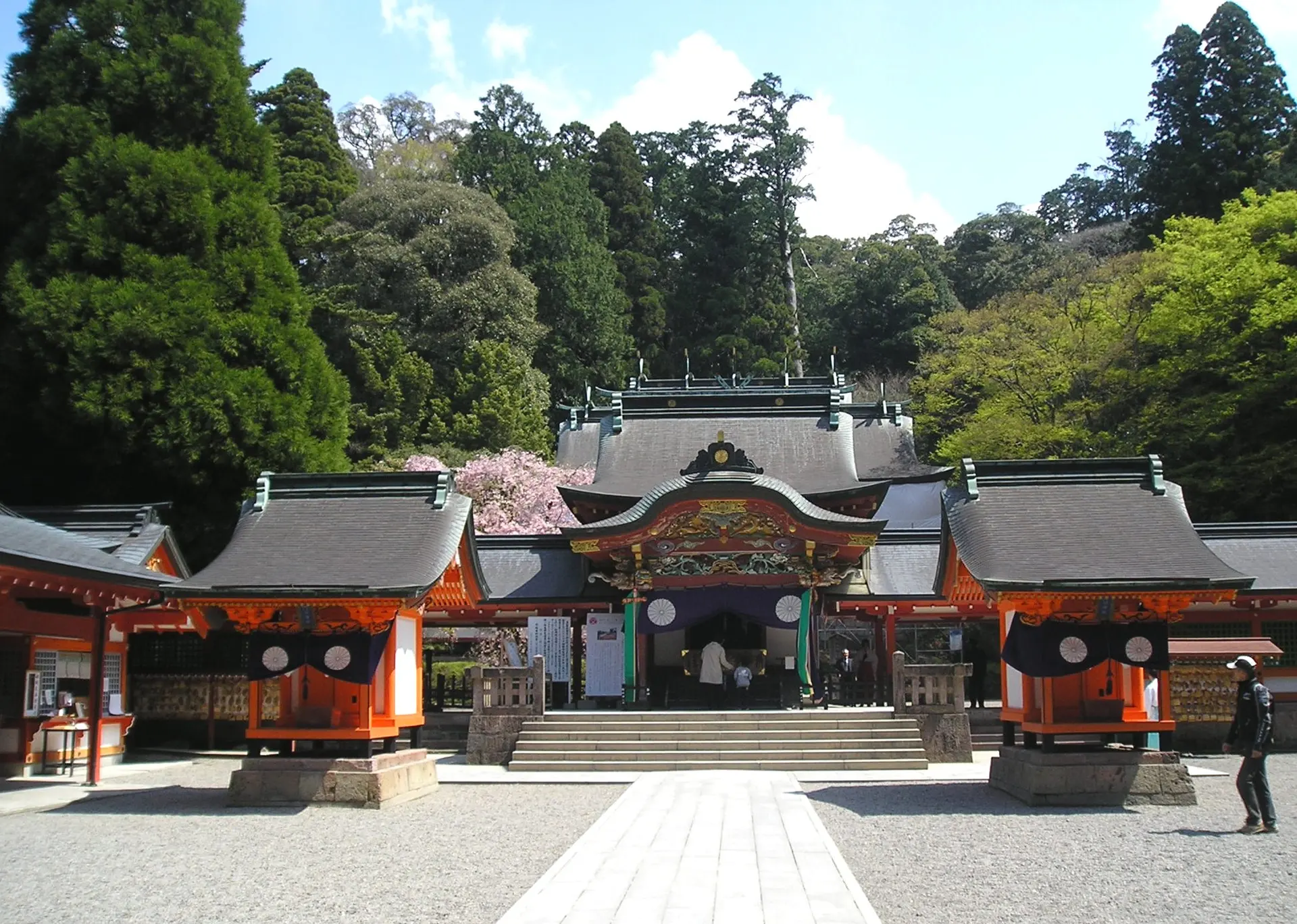
Image of Kirishima Shrine. Image source · CC-BY-3.0
Visit essentials
A quick read before you go
- Duration
- 1-2 hours for shrine visit; additional time for hiking to Mount Takachiho
- Access
- Open daily (hours vary).
Overview
In the volcanic mountains of southern Kyushu stands the place where, according to Shinto mythology, the gods came to earth. Kirishima Shrine commemorates the Tenson Korin - the Descent of the Heavenly Grandchild - when Ninigi-no-Mikoto, grandson of the sun goddess Amaterasu, descended to Mount Takachiho bringing the three imperial regalia: sword, mirror, and gem.
This is Japan's Genesis story. Ninigi sank his three-pronged lance, Amanosakahoko, into the mountain's summit to mark his arrival. He married the beautiful Princess Konohanasakuya-hime, and in becoming mortal, established the lineage that would produce all Japanese emperors. The lance can still be seen jutting from the rocks at Mount Takachiho's peak - a blade planted by divine hands in an age before history.
The shrine that commemorates this founding myth was first constructed in the 6th century, making it one of Japan's oldest. But the Kirishima volcanic range has repeatedly tested devotion. Eruptions in the 10th century forced the shrine to move. A massive eruption in 1234 completely destroyed it. The current shrine buildings, constructed in 1715, represent the latest reconstruction in a cycle of destruction and renewal that mirrors the volcanic landscape itself.
Known as the 'Nikko of the West' for its vermillion buildings and colorful reliefs, Kirishima Shrine received an extraordinary honor in 2022: its Main Hall was designated a National Treasure, the first architectural National Treasure in Kagoshima Prefecture. This recognition affirms what worshipers have known for centuries - that this shrine, repeatedly destroyed and rebuilt, maintains something irreplaceable.
Why this place is sacred
The thinness of Kirishima operates on mythological scale. This is not merely an ancient sacred site but the location where the divine touched earth and became human. According to the mythology that has shaped Japanese civilization, the lineage of emperors - unbroken for over 2,600 years according to tradition - began here with Ninigi's descent.
The Amanosakahoko lance at Mount Takachiho's summit makes this thinness tangible. If you climb to the peak, you can see the blade thrust into the rocks - physical evidence of the mythology. Whether understood as literal divine artifact or as a symbol charged with centuries of belief, the lance creates a direct connection to the founding moment.
The volcanic activity adds another dimension. The shrine has been destroyed multiple times by eruptions that demonstrate nature's power over human construction. Yet worship has never ceased. Each rebuilding is itself a statement: what happens here matters enough to restore again and again. The current 1715 buildings are beautiful, but their deeper meaning lies in being the latest expression of something that refuses to die.
For practitioners, the thinness is immediate. To pray at Kirishima is to pray at the origin point of Japanese spiritual and national identity. The kami who descended here are not distant - they are present, as they have been since Ninigi stepped from the clouds.
Kirishima Shrine was established to honor the descent of Ninigi-no-Mikoto and to maintain connection with the divine origins of Japanese civilization. The shrine preserves the founding mythology at its geographical location, allowing worshipers to encounter the beginning of their civilization.
The shrine's evolution has been shaped by volcanic destruction. Repeated eruptions forced relocations from the original site at Mount Takachiho's base to the present location. Each destruction was followed by rebuilding, maintaining the tradition through physical change. The 2022 National Treasure designation for the Main Hall represents official recognition of the shrine's exceptional significance.
Experience and orientation
The approach to Kirishima Shrine reveals its distinctive character. Vermillion torii gates emerge from the forested mountainside. The shrine buildings, richly decorated with colorful reliefs, justify the comparison to Nikko in far northern Japan. But here, unlike Nikko, active volcanoes form the backdrop.
The shrine complex is more intimate than grand. The Main Hall - now a National Treasure - displays Edo-period craftsmanship at its finest. The colorful reliefs and careful proportions create beauty that draws the eye while the atmosphere invites spiritual attention. Pilgrims and tourists alike often find themselves moving slowly, speaking quietly.
What distinguishes the experience is context. This is where, according to the mythology that has shaped Japanese civilization for millennia, the gods came to earth. The vermillion buildings stand where Ninigi descended. The volcanic mountains that rise behind the shrine are the very peaks he chose as his landing place.
For those who wish to deepen the encounter, the Amanosakahoko lance waits at Mount Takachiho's summit. The climb is not for everyone, but those who make it find Ninigi's three-pronged blade thrust into the rocks, just as mythology describes. This is thin place territory: a physical object at a mythological location, maintaining presence across millennia.
The Tenson Korin Festival on November 10th brings the founding mythology to life through ritual. Dancers and priests enact the descent of the heavenly grandchild, making the origin story present for a new generation.
Kirishima Shrine stands in Kirishima City, Kagoshima Prefecture, within the Kirishima volcanic mountain range. The shrine complex occupies a forested slope with views of the volcanic peaks. Mount Takachiho, where Ninigi is said to have landed and where the Amanosakahoko lance can be seen, rises nearby.
Context and lineage
The story begins before human history. According to Japanese mythology, Ninigi-no-Mikoto was the grandson of Amaterasu, the sun goddess who is the supreme deity of Shinto. The celestial kami decided that Ninigi should descend from Takama-ga-hara - the High Plain of Heaven - to rule the earth.
Ninigi descended to Mount Takachiho, bringing with him the three imperial regalia: the sword Kusanagi, the mirror Yata no Kagami, and the gem Yasakani no Magatama. He thrust his three-pronged lance, Amanosakahoko, into the mountain's summit to mark his arrival. This lance can still be seen at the peak.
Ninigi encountered the beautiful Princess Konohanasakuya-hime, daughter of the mountain god Ohoyamazumi. He married her, and in accepting mortal love, became mortal himself. Their descendants would become the emperors of Japan - an unbroken lineage according to tradition.
The shrine commemorating this descent was first constructed in the 6th century. Since then, volcanic eruptions have forced multiple relocations and rebuildings. A mid-10th century eruption moved the shrine to Takachihogawara. A massive 1234 eruption completely destroyed it. The current shrine, built in 1715, represents the latest chapter in this cycle of destruction and renewal.
Kirishima Shrine preserves the mythology of imperial divine descent that has shaped Japanese civilization. The shrine tradition maintains that the imperial family descends directly from Ninigi and, through him, from Amaterasu herself. This lineage doctrine has been central to Shinto and Japanese national identity for millennia.
Ninigi-no-Mikoto
Divine ancestor
Princess Konohanasakuya-hime
Divine consort
Amaterasu
Supreme deity
Traditions and practice
Traditional practice at Kirishima Shrine centers on honoring Ninigi-no-Mikoto and the related deities of the founding mythology. The annual Tenson Korin Festival (November 10th) ritually reenacts the descent of the heavenly grandchild through dance and ceremony. Imperial rites have been performed here throughout Japanese history. Mountain veneration of the volcanic peaks continues the connection to Ninigi's landing place.
Contemporary practice maintains daily worship services. Visitors perform standard Shinto worship: purification at the temizu, offering coins, bowing twice, clapping twice, bowing once. The shrine is popular for weddings and Shichi-Go-San celebrations. Omamori (amulets) carrying the shrine's blessing are widely sought. The Tenson Korin Festival draws practitioners and observers from across Japan.
Visitors seeking to connect with the shrine's deep significance might contemplate the meaning of origin. This is where Japanese civilization began, according to its foundational mythology. What does it mean to stand at a beginning? If time permits, consider the climb to Mount Takachiho to see the Amanosakahoko lance - the blade Ninigi thrust into the earth to mark his arrival. Attend the November 10th festival if possible for the most powerful encounter with the living mythology.
Shinto
ActiveKirishima Shrine is the 'Nikko of the West' and one of Japan's oldest shrines, constructed in the 6th century. It is dedicated to Ninigi-no-Mikoto, grandson of the sun goddess Amaterasu, who descended from heaven to rule the earth at nearby Mount Takachiho. The shrine commemorates the origin of the Japanese imperial line and preserves Japan's creation mythology.
Worship of Ninigi-no-Mikoto and related deities, Tenson Korin Festival (November 10), prayers for prosperity and imperial blessings, mountain veneration
Perspectives and open questions
Kirishima Shrine's connection to Japan's founding mythology invites multiple interpretations while maintaining its active religious significance.
Scholarly perspective
Scholars recognize Kirishima Shrine's exceptional significance in Japanese religious and political history as a site connecting Shinto mythology to imperial legitimacy. The mythology of Ninigi's descent (Tenson Korin) is foundational to Shinto and Japanese national identity. The shrine's repeated destruction and rebuilding due to volcanic activity demonstrates the persistence of sacred sites across natural catastrophes. The 2022 National Treasure designation acknowledges the Main Hall's outstanding architectural and cultural value.
Living and traditional perspectives
In Shinto belief, Ninigi-no-Mikoto genuinely descended from heaven at this location, and the imperial family traces its lineage directly to him and to Amaterasu. The mountains are alive with kami presence. Worship here connects devotees to the most ancient divine beings of Japan and to the founding moment of Japanese civilization.
Alternative interpretations
Some view the Kirishima mountains as a powerful spiritual energy center. The Amanosakahoko lance at Mount Takachiho's summit is understood as a genuine divine artifact, regardless of how it came to be there. The volcanic activity is seen as evidence of spiritual power concentrated in this landscape.
Open questions
The historical origins of the descent mythology remain subjects of scholarly debate. The original appearance of the 6th-century shrine is unknown. The nature and origin of the Amanosakahoko lance at the summit invites speculation.
Plan your visit
Access and arrival
Open daily (hours vary). Free admission. Accessible by bus from Kirishima Jingu Station. Car from Kagoshima Airport approximately 40 minutes.
Ryokan and hotels in Kirishima area, many with onsen (hot springs); accommodations in Kagoshima city
Respectful visit
No specific dress code; respectful attire recommended for a major Shinto shrine.
Permitted in most areas; restrictions in main sanctuary.
Coins at offering boxes; prayers at main hall.
{"Follow Shinto shrine etiquette","Purify at temizu before worship","Bow before entering through torii","Respect inner sanctuary restrictions"}
The volcanic mountains are actively monitored. Check conditions before planning any hiking. The shrine itself is safe, but respect for the volcanic power that has shaped this landscape is appropriate.
Current practical details
Address
2608-5 Kirishimataguchi, Kirishima, Kagoshima 899-4201, Japan
Phone
Hours
Hours, fees, and access can change — verify on the official source before you travel. Practical details last checked Jun 2026.
Location
Map loads as you approach this section.
Pilgrim reflections
A portrait of encounter, not a score
Pilgrims describe what they felt, how present they could become, and whether the place would shape a journey. There are no stars and no ranking of traditions.
No reviewed reflections yet
The first pilgrims can help describe the character of being here.
Share a reflection
Available after an account-backed “Been there.” Every reflection is reviewed before publication.
Nearby sacred places
Explore other sacred places in the region. Proximity does not establish access or travel time; check each place’s guidance.

References
Sources consulted for this page. Source categories describe the publication, not a guarantee that every claim is verified. Traditional accounts and outside interpretations may differ.
- 01Kirishima-jingu Shrine - Japan Travel — Japan National Tourism OrganizationSource contextOfficial tourism information
- 02Explore a Land of Legends - Discover Kagoshima — Kagoshima TourismSource contextOfficial regional tourism
- 03Kirishima Shrine - Wikipedia — Wikipedia contributorsencyclopediaComprehensive overview
- 04Kirishima Shrine - Japan Guide — Japan GuideguideVisitor information
- 05Ninigi's Heavenly Descent — Your Secret JapanspiritualMythology context
Pilgrim glossary
- Torii
- The traditional Japanese gate marking the entrance to a Shinto sacred area.
Share a photo
Help visitors recognize Kirishima Shrine. Every submission is reviewed before publication.