Takachiho Gorge
Where the Sun Goddess emerged from darkness and divine rule descended to earth
Understand sacred places, explore living traditions, and learn how to engage respectfully with Pilgrim Map.
Access has not been verified. Check current local guidance before planning a visit.
Takachiho, Miyazaki Prefecture, Japan
Read the sources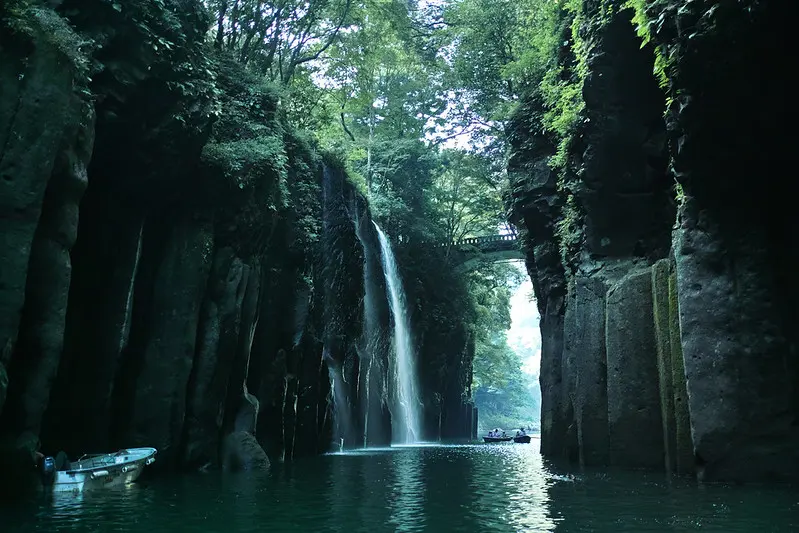
Visit essentials
A quick read before you go
- Duration
- The gorge itself requires 1-2 hours for walking exploration and boat experience.
- Access
- From Kumamoto: highway bus approximately 3 hours to Takachiho.
Overview
Takachiho Gorge holds the landscape where Japan began according to the mythology that shaped Japanese civilization. The Gokase River carved its volcanic cliffs through basalt from Mount Aso's ancient eruptions, creating a setting for stories of gods and sacred lineage.
Amaterasu, Sun Goddess and ancestress of the imperial line, withdrew into the cave Amano Iwato after her brother Susanoo's violent rampage and took all light with her. The eight million kami gathered outside. The dawn goddess Ame-no-Uzume danced until their laughter drew Amaterasu to look out, whereupon the strongman Ame-no-Tajikarao threw aside the rock door and restored light to all realms.
Eight kilometers from the gorge, Amano Iwato Shrine faces the cave where Amaterasu is held to have hidden. It cannot be entered but may be viewed from across the river with a shrine priest's guidance. Nearby, Amano Yasugawara preserves the cave where the kami planned, while 17-meter Manai Falls marks where Ame-no-Murakumo is said to have drawn water from the heavenly realm into the gorge's emerald pools.
Takachiho also holds the descent of Ninigi-no-Mikoto. Amaterasu sent her grandson to earth with the three imperial regalia to establish divine rule. This tenson korin, or heavenly grandson's descent, grounds the Japanese imperial line's mythology; from Kunimigaoka hill, Ninigi surveyed the land he would govern.
Why this place is sacred
The concept of the thin place applies to Takachiho not merely as a location where the divine feels close but as a place where mythology records the very creation of divine order in the human world. The thinness here has historical depth within Japanese cosmology.
When Amaterasu withdrew into Amano Iwato, all light ceased. Sun, moon, stars provided no illumination. The fundamental boundary between day and night, the rhythm that makes life possible, had collapsed. The cave's darkness was not merely absence of light but the world's return to primordial chaos. When the kami successfully drew her out, they were not merely solving a problem but re-establishing cosmic order.
The shimenawa rope placed across the cave entrance to prevent her return represents permanent protection of that order.
The tenson korin, Ninigi's descent, represents a different kind of thinness. Heaven and earth were fully distinct realms, and the transmission of sacred authority from one to the other required physical passage. Ninigi came down bearing the three imperial regalia, mirror, sword, and jewel, objects that remain central to imperial legitimacy. The mythological event that made human civilization possible under divine rule occurred in this landscape.
The gorge's volcanic origin adds to its quality as a thin place. The basalt cliffs were formed by Mount Aso's eruptions approximately 120,000 years ago. The forces that created this landscape were themselves primordial, earth-shaping on a scale that echoes the cosmological events mythology places here. Water, in the form of Manai Falls and the Gokase River, continues to carve and shape, adding the element of ongoing creation to a place already saturated with origin stories.
The sacred character of Takachiho predates written records. The myths of Amaterasu and Ninigi were recorded in the Kojiki in 712 CE, but they preserve oral traditions of unknown antiquity. The landscape was almost certainly sacred before those particular stories were attached to it.
The mythology recorded in the Kojiki and Nihon Shoki established Takachiho's place in the official narrative of Japanese origins. The shrines, including Amano Iwato Shrine and Takachiho Shrine, formalized worship at specific locations within the sacred landscape. The kagura tradition, which the mythology traces to the original dance that drew out Amaterasu, has been maintained continuously. Modern designation as National Natural Monument and National Place of Scenic Beauty added legal protection to continuing sacred function.
Experience and orientation
The gorge itself provides immediate impact. Walking the trail along the river, visitors move between towering basalt cliffs whose columnar structure speaks to volcanic origins. The emerald color of the water, the way light filters through the narrow passage, the sound of Manai Falls all create an atmosphere that needs no mythological overlay to feel significant.
Yet knowing the mythology transforms observation into participation. Standing before Manai Falls, understanding that this is where heavenly water first poured into the earthly realm, charges a natural feature with narrative weight. The falls become not just beautiful but meaningful within a cosmological framework.
Renting a rowboat and paddling beneath the falls has become an iconic Takachiho experience. The physical activity, the closeness to the water and cliffs, the sound and spray of the falls as you pass beneath, all of this creates embodied encounter with the sacred landscape. Boats are available most of the year, though wait times can be significant during peak seasons.
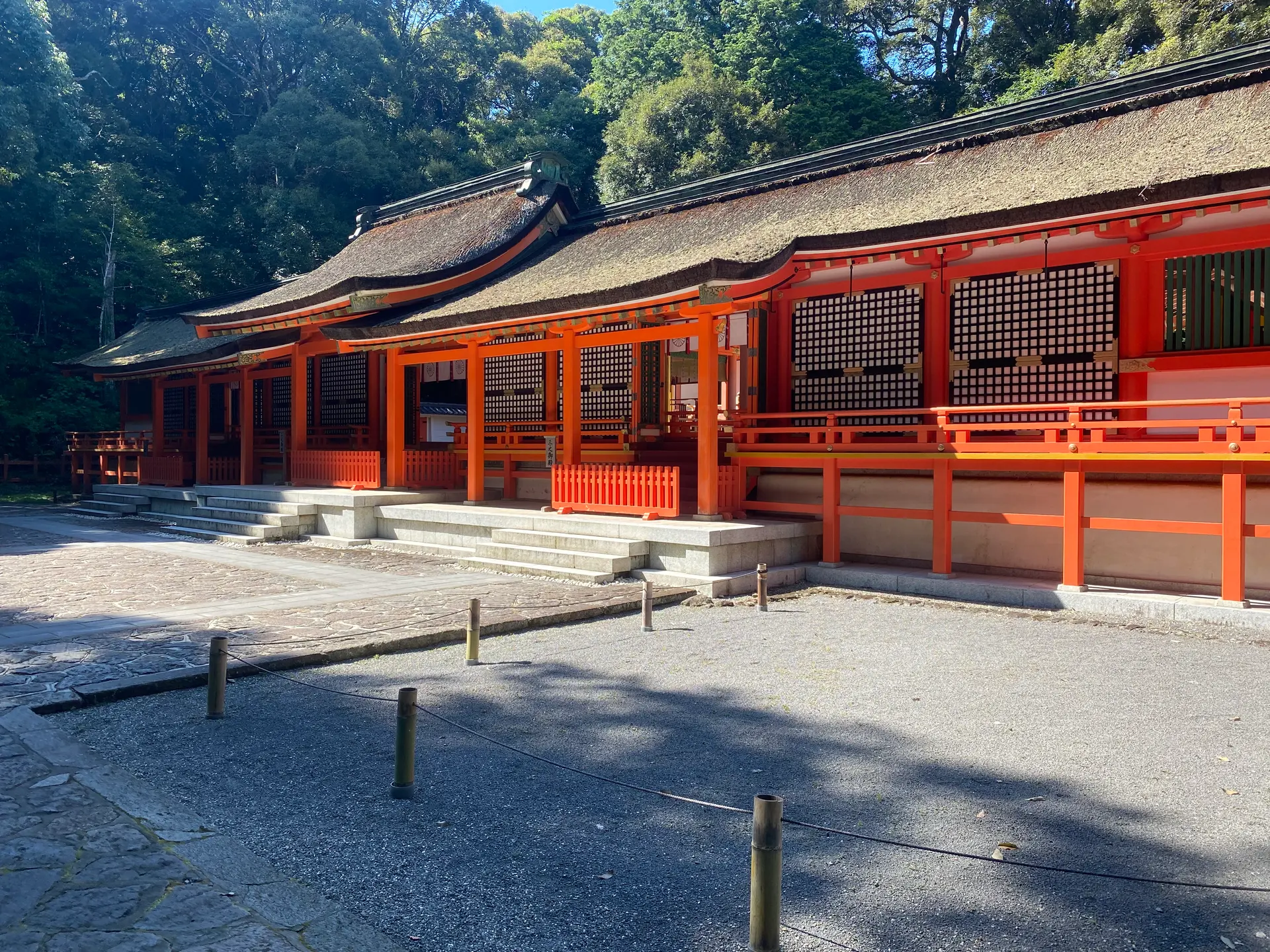
Amano Iwato Shrine, eight kilometers from the gorge, holds the site of Amaterasu's cave. The shrine itself consists of two halls facing each other across the river. The west hall, Nishi Hongu, looks toward the cave where the Sun Goddess hid. With a shrine priest's guidance, visitors walk to a point where they can view the cave across the gorge. The cave itself cannot be entered, it is too sacred, but its presence can be witnessed.
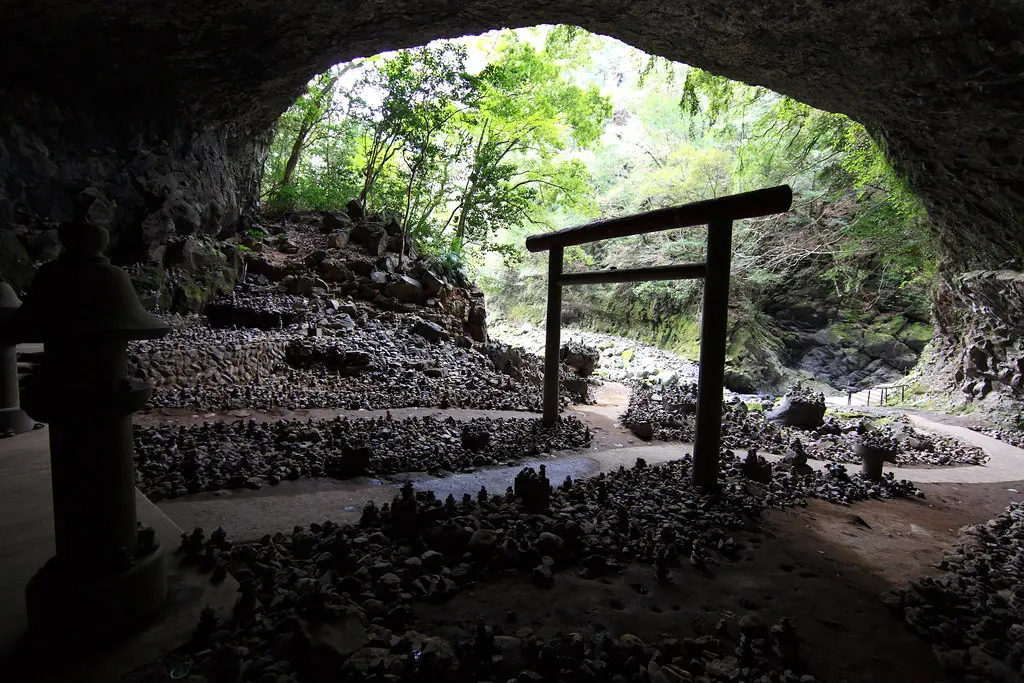
Near Amano Iwato Shrine, Amano Yasugawara preserves the cave where the eight million kami gathered to devise their plan. Visitors stack small stones here, a practice that has created fields of piled rocks around the cave entrance. The atmosphere is contemplative, almost eerie, a place where countless human hopes have been expressed in balanced stone.
Takachiho Shrine, closer to the gorge, offers daily kagura performances that compress the full yokagura tradition into accessible form. The complete yokagura, performed from November through February, lasts through the night, presenting the full cycle of dances that preserve the moment when light returned. Attending yokagura, whether in its abbreviated or full form, connects visitors to performance traditions the mythology traces to divine origins.
Begin at the gorge to establish physical relationship with the landscape. Walk the riverside trail, rent a boat if moved to do so, feel the scale and atmosphere of the volcanic cliffs and sacred water. Then visit Amano Iwato Shrine to encounter the cave where Amaterasu hid. Request the priest-guided viewing to see the cave across the gorge. Visit Amano Yasugawara for its contemplative atmosphere. Conclude at Takachiho Shrine, ideally timing your visit to include a kagura performance.
Context and lineage
The Kojiki, compiled in 712 CE, provides the fullest account of the Amano Iwato story. Susanoo, the storm god, had been banished from heaven for his violent behavior. Amaterasu, his sister, had endured his offenses until he went too far, causing the death of one of her attendants by throwing a flayed horse into the weaving hall where she worked. Amaterasu fled into the cave called Amano Iwato, sealing it with a boulder and plunging all realms into complete darkness.
The eight million kami gathered outside, desperately seeking to lure her out. They hung a mirror and jewels on a sacred tree. The dawn goddess Ame-no-Uzume overturned a tub outside the cave and performed a dance so ecstatic and provocative that the gathered deities burst into laughter. Amaterasu, curious about what could cause merriment in such darkness, cracked open the cave door to peek. The kami told her a new goddess had come who surpassed even her brilliance.
When Amaterasu came farther out to see the mirror's reflection, the strongman Ame-no-Tajikarao grabbed the door and threw it aside. Light returned to all worlds.
The descent of Ninigi represents a later mythological moment. Amaterasu sent her grandson to govern the terrestrial realm, giving him the three imperial regalia. He descended to the Takachiho region, and from Kunimigaoka hill surveyed the land. His descendants would eventually become the imperial line.
The mythological lineage established at Takachiho connects the Sun Goddess to the Japanese imperial line through Ninigi's descent. This lineage provided the ideological foundation for the imperial institution throughout Japanese history. The continuity of kagura performance traces directly to Ame-no-Uzume's dance, making contemporary performers heirs to a tradition with mythological origin. Takachiho Shrine and Amano Iwato Shrine maintain worship at the sites where these events occurred.
Amaterasu
Sun Goddess who hid in Amano Iwato
Ame-no-Uzume
Dawn goddess who performed the dance that drew Amaterasu out
Ninigi-no-Mikoto
Grandson of Amaterasu who descended to establish divine rule
Traditions and practice
Kagura sacred dance forms the central living tradition of Takachiho. The yokagura, performed from November through February, presents the full cycle of 33 dances through the night at various locations. These dances preserve the movements that mythology traces to the gathering outside Amaterasu's cave. Attending yokagura is not entertainment but participation in ritual that has continued since the events it depicts.
Worship at Amano Iwato Shrine involves veneration directed toward the cave where Amaterasu hid. The shrine's two halls face each other across the river, with the west hall oriented toward the cave. Approaching this shrine is approaching the site of cosmic crisis and restoration.
Pilgrimage to the various sacred sites, including Amano Yasugawara where the kami gathered, creates an embodied journey through mythological geography. The practice of stacking stones at Amano Yasugawara, while not ancient, has become a way visitors express their prayers and hopes in the landscape.
Daily kagura performances at Takachiho Shrine offer abbreviated versions of the tradition for visitors who cannot attend the full yokagura. Shrine worship continues at both Takachiho Shrine and Amano Iwato Shrine. The priest-guided viewing of the cave at Amano Iwato Shrine provides controlled access to the most sacred location.
Rowboat exploration of the gorge, while not explicitly religious, has become a contemporary mode of encounter with sacred landscape. The proximity to Manai Falls and the experience of the gorge from water level creates physical engagement with the mythological geography.
Allow time for multiple modes of encounter. The gorge deserves unhurried exploration, ideally including a boat ride. At Amano Iwato Shrine, request the guided viewing of the cave, this direct sight of the location where light was restored carries weight that cannot be achieved otherwise. Spend quiet time at Amano Yasugawara, letting the atmosphere of that gathering place speak. If possible, time your visit to include kagura performance, whether the abbreviated daily version or the full yokagura.
Approach Takachiho as a landscape holding story, not merely as scenic sites to photograph. The beauty is inseparable from the meaning. Allow the mythology to frame your experience without demanding that you believe it literally. What matters is letting the landscape speak through its stories.
Shinto
ActiveTakachiho holds the sites where Japan's central Shinto mythology is located: the cave where Amaterasu hid, the gathering place of the eight million kami, the landing place of Ninigi's descent. The shrines here maintain worship at these cosmologically significant locations. Kagura sacred dance, traced to the divine origin when Ame-no-Uzume's dance drew out the Sun Goddess, continues as living practice.
Worship at Amano Iwato Shrine directed toward the sacred cave. Pilgrimage to Amano Yasugawara and Kunimigaoka. Kagura performance, both abbreviated daily versions and full yokagura from November through February. Shrine worship at Takachiho Shrine. Contemplative encounter with the mythological landscape.
Perspectives and open questions
Takachiho can be understood as the physical setting of Japan's creation mythology, as a landscape of exceptional natural drama, as a center of living kagura tradition, or as the cosmological foundation of Japanese imperial ideology.
Scholarly perspective
Scholars recognize Takachiho as a major center of Japanese mythological tradition, though debates continue about the historical layers beneath the mythology. The region's ancient kagura traditions preserve performance practices of considerable antiquity. The geological evidence confirms the volcanic landscape's formation through Mount Aso eruptions, creating the dramatic setting that likely contributed to its selection as a mythological site.
The Kojiki's selection of Takachiho for the central events of divine descent raises questions about earlier traditions that may have already marked this landscape as sacred. The mythology may have been attached to a pre-existing sacred geography. The imperial ideology that used these myths for legitimation drew on traditions of unknown origin.
Living and traditional perspectives
In Shinto belief, Takachiho is literally where heaven and earth connected. The events described in mythology are not metaphor but history of a sacred kind. Amano Iwato Shrine's two halls face the actual cave where Amaterasu hid. The kagura performed here are the same dances that drew out the Sun Goddess. The landscape is not symbolic of sacred events but is the location where those events occurred.
This understanding shapes practice. Worship at these shrines is not commemoration of ancient events but ongoing participation in the sacred geography they established. Kagura is not performance about the original dance but continuation of it.
Alternative interpretations
Takachiho ranks among Japan's most recognized spiritual sites among contemporary seekers. The concentration of mythological locations, the dramatic energy of the volcanic landscape, and millennia of worship create an atmosphere many experience as charged with sacred power. The convergence of natural beauty and cosmological significance draws visitors who may not share Shinto belief but who respond to the site's numinous quality.
Open questions
Why this particular location became associated with Japan's central cosmological myths is not fully understood. Some scholars suggest earlier sacred traditions were incorporated into the imperial mythology recorded in the Kojiki and Nihon Shoki. The relationship between the landscape's natural drama and its mythological significance, whether the mythology was created to explain the landscape or the landscape was selected for pre-existing mythology, remains debated.
Plan your visit
Access and arrival
From Kumamoto: highway bus approximately 3 hours to Takachiho. From Nobeoka: bus approximately 1.5 hours. By car: mountain roads provide access from multiple directions; parking available at the gorge and shrines.
No direct rail service to Takachiho exists. The nearest JR station is Nobeoka. Car is the most flexible option for exploring the spread-out sacred sites.
Rowboats are available for rent at the gorge. Wait times can be significant during peak periods; arrive early or during off-peak hours.
Takachiho offers traditional Japanese inns (ryokan) and minshuku that allow overnight immersion in the area. Staying overnight is strongly recommended for those wishing to attend full yokagura performances or to experience the gorge at dawn before crowds arrive.
Respectful visit
No specific dress requirements apply for most activities. Comfortable shoes are essential for gorge walks and shrine visits. If attending extended kagura performances, warm clothing may be needed, especially during the November-February yokagura season.
Photography is permitted throughout the gorge and at shrine grounds generally. The Amano Iwato cave itself should not be photographed, it is too sacred. At kagura performances, check current policies, some may allow photography while others restrict it.
Standard shrine offerings are appropriate at Takachiho Shrine and Amano Iwato Shrine. Coins are commonly offered. The stone stacking at Amano Yasugawara functions as a form of offering or prayer expression.
Do not attempt to access Amano Iwato cave except through guided viewing. Do not enter restricted areas at the shrines. During kagura performances, remain seated and attentive throughout, do not leave during the dances.
The cave at Amano Iwato should not be approached except through the designated viewing point with priest guidance. Do not attempt to reach or enter the cave. Respect the sacred character of Amano Yasugawara despite its more accessible atmosphere. Photography at the cave itself should be avoided, it is sacred space.
Current practical details
Address
Mukoyama, Takachiho, Nishiusuki District, Miyazaki 882-1103, Japan
Phone
Hours
Hours, fees, and access can change — verify on the official source before you travel. Practical details last checked Jun 2026.
Location
Map loads as you approach this section.
Pilgrim reflections
A portrait of encounter, not a score
Pilgrims describe what they felt, how present they could become, and whether the place would shape a journey. There are no stars and no ranking of traditions.
No reviewed reflections yet
The first pilgrims can help describe the character of being here.
Share a reflection
Available after an account-backed “Been there.” Every reflection is reviewed before publication.
Nearby sacred places
Explore other sacred places in the region. Proximity does not establish access or travel time; check each place’s guidance.


References
Sources consulted for this page. Source categories describe the publication, not a guarantee that every claim is verified. Traditional accounts and outside interpretations may differ.
- 01高千穂峡 - 高千穂町観光協会 — Takachiho Tourism AssociationSource contextOfficial tourism information
- 02Takachiho Gorge - Japan National Tourism Organization — JNTOSource contextNational tourism authority
- 03高千穂峡 - みやざき観光ナビ — Miyazaki Prefecture TourismSource contextPrefectural tourism information
- 04天岩戸神社 — Amano Iwato ShrineofficialOfficial shrine website
- 05Takachiho, Miyazaki - Wikipedia — Wikipedia contributorsencyclopediaOverview of town and sacred sites
Pilgrim glossary
- Shimenawa
- A sacred straw rope marking the boundary of a Shinto holy place.
Share a photo
Help visitors recognize Takachiho Gorge. Every submission is reviewed before publication.