Wat Xieng Mouane
A gilded Luang Prabang temple that teaches the sacred arts keeping the holy town alive
Understand sacred places, explore living traditions, and learn how to engage respectfully with Pilgrim Map.
Access has not been verified. Check current local guidance before planning a visit.
Luang Prabang, Luang Prabang, Laos
Read the sources
Visit essentials
A quick read before you go
- Duration
- Thirty to forty-five minutes.
- Access
- Central Luang Prabang on the main temple peninsula, walkable among the heritage-town temples…
Overview
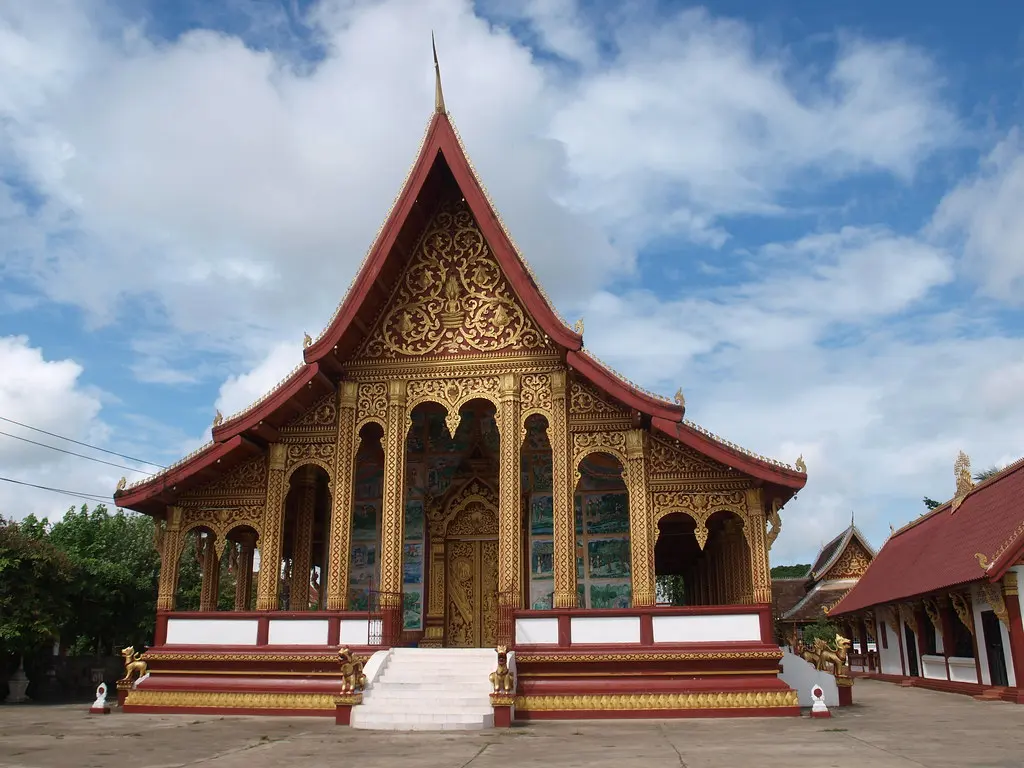
Wat Xieng Mouane sits on the main temple peninsula of Luang Prabang, the royal Buddhist town inscribed by UNESCO in 1995, within easy walking distance of the Royal Palace and the celebrated Wat Xieng Thong. Founded in 1853 by the patron Phanya Sisonxay during the reign of King Chantarath, it is an intimate temple rather than a grand one, its two-tiered ordination hall notable for a gold naga-painted ceiling and ornate decoration.
The name Xieng Mouane, 'Melodious Sounds,' recalls the temple's renowned drums. Its deeper significance today lies in a living mission: a UNESCO-backed Cultural Survival Project has made the restored monks' quarters into a classroom where novices are taught the sacred temple arts, mural painting, woodcarving, bronze Buddha-casting, lacquer, and stencilling, skills that almost ceased after 1975 and that maintain the many temples of the holy town.
Quieter than the major sites nearby, Wat Xieng Mouane offers the chance to witness both the dawn alms procession and the patient transmission of a devotional craft tradition across generations.
Why this place is sacred
Wat Xieng Mouane draws its meaning from its place within Luang Prabang, a town whose whole character is sacred, and from the particular role it has taken on. Its gold naga-painted ordination hall and ornate decoration mark it as part of the gilded royal-era fabric that gives the town its holy aspect. But what sets it apart is its function as a guardian of the craft tradition itself.
The mural painting, carving, casting, and lacquer that beautify temples across Luang Prabang depend on skills that nearly died out after 1975, and here those skills are taught anew to young monks. To stand in the temple is to be near a workshop where devotion is literally being made, where the daily alms procession in the heritage townscape meets the slow, attentive transmission of sacred craft.
The thinness of the place is bound up with cultural survival, the sense of a tradition kept from lapsing and handed on.
Experience and orientation
Visitors describe Wat Xieng Mouane as small but beautifully decorated, its two-tiered ordination hall set off by gold naga motifs and detailed ornament that reward unhurried looking. Because it draws fewer crowds than the headline temples of the peninsula, it offers a calmer encounter, and the presence of novices at work or study, sometimes engaged in the craft training the temple is known for, gives it a quietly purposeful air.
The surrounding heritage town, with its lovely Mekong-area views, frames the visit. The most affecting moment for many is the dawn alms ceremony, the Sai Bat, when the monks process through the still streets to receive offerings; witnessing it, alongside the patient making of sacred crafts, prompts reflection on devotion, continuity, and the survival of a tradition.
On the main temple peninsula of central Luang Prabang, walkable among the heritage-town temples between the Royal Palace Museum area and Wat Xieng Thong.
Context and lineage
Wat Xieng Mouane was founded in 1853 by Phanya Sisonxay, a royal-era patron of Luang Prabang, during the reign of King Chantarath. Its name, 'Melodious Sounds,' is said to honor the temple's especially harmonious drums. The temple lies within the protected Town of Luang Prabang, inscribed as a UNESCO World Heritage Site in 1995.
After the temple arts of the region fell into decline following 1975, the restored monks' quarters were turned into a classroom under a UNESCO-supported Cultural Survival Project, reviving and teaching mural painting, woodcarving, bronze Buddha-casting, and related crafts to novices.
Theravada Buddhism in the royal Lao tradition of Luang Prabang, with a modern role as a UNESCO-supported center for the sacred temple arts.
Phanya Sisonxay
Royal-era patron of Luang Prabang who founded the temple in 1853.
King Chantarath
Reigning monarch of Luang Prabang at the temple's founding.
Traditions and practice
The temple's characteristic observances include ordination, the drumming that gave it its name, and the sacred temple arts, mural painting, woodcarving, bronze Buddha-casting, lacquer, and stencilling, that have long served Luang Prabang's monasteries.
Today the resident community keeps the morning alms ceremony, Sai Bat, and merit-making, while novices continue their training in the temple arts under the UNESCO-supported program. The making and display of craft work is part of the temple's daily life.
Come at dawn to witness the Sai Bat from a respectful distance, then view the craft work and the naga-painted hall once the procession has passed; let the quiet of the early hour set the pace.
Theravada Buddhism
ActiveA mid-19th-century royal-era Luang Prabang temple notable for its gold naga-decorated sim and, today, as the home of a UNESCO-backed Cultural Survival Project reviving and teaching the sacred temple arts, mural painting, woodcarving, bronze Buddha-casting, and lacquer, that nearly ceased after 1975, thereby sustaining the spiritual craft heritage of the holy town.
Morning alms-giving (Sai Bat), merit-making, training of novices in the sacred temple arts, and ordination and daily monastic ritual.
Perspectives and open questions
The temple is regarded both as a modest but finely decorated royal-era monastery and as a significant center for the revival of the sacred temple arts.
Scholarly perspective
Available accounts treat it as an 1853 royal-era Luang Prabang temple of modest scale but notable decorative quality, significant today chiefly as a UNESCO-supported center reviving the sacred temple arts that lapsed after 1975, while noting that documentation is largely guide-based.
Living and traditional perspectives
Locally the temple is valued as part of Luang Prabang's living monastic fabric and as a training ground preserving the craft skills that maintain the town's many temples.
Open questions
The manifest lists the location as Luang Namtha, conflicting with the well-attested Luang Prabang location followed here, which should be corrected before import.
Plan your visit
Access and arrival
Central Luang Prabang on the main temple peninsula, walkable among the heritage-town temples between the Royal Palace Museum area and Wat Xieng Thong.
Respectful visit
Dress modestly, covering shoulders and knees, and remove shoes and hats before entering the sim.
Use no flash; for the alms ceremony stand back across the road, do not block or walk in front of the monks, keep a respectful distance, and ask before photographing individuals.
If joining the alms, buy sticky rice from local vendors and offer it with the right hand, palms open; incense and flowers are appropriate at the sim.
Maintain silence during the alms; do not touch monks, especially for women; do not approach novices intrusively; and keep a low impact in the heritage town.
The alms ceremony is widely abused by visitors; keep silent, stand well back, do not block or walk in front of the monks, and use no flash. Approach novices with care rather than intruding on their work.
Location
Map loads as you approach this section.
Pilgrim reflections
A portrait of encounter, not a score
Pilgrims describe what they felt, how present they could become, and whether the place would shape a journey. There are no stars and no ranking of traditions.
No reviewed reflections yet
The first pilgrims can help describe the character of being here.
Share a reflection
Available after an account-backed “Been there.” Every reflection is reviewed before publication.
Nearby sacred places
Explore other sacred places in the region. Proximity does not establish access or travel time; check each place’s guidance.


References
Sources consulted for this page. Source categories describe the publication, not a guarantee that every claim is verified. Traditional accounts and outside interpretations may differ.
- 01Town of Luang Prabang — UNESCO World Heritage CentreofficialLuang Prabang inscribed 1995; Wat Xieng Mouane lies within the protected heritage town.
- 02Wat Xieng Mouane - Luang Prabang Attractions — Lonely PlanetguideCultural Survival Project teaching mural painting, woodcarving, bronze-casting; restored monks' quarters as classroom training novices in temple arts after 1975 hiatus.
- 03Morning Alms (Sai Bat) — Official Website for Tourism Luang PrabangofficialAuthoritative guidance on the alms-giving ceremony etiquette in Luang Prabang.
- 04Wat Xieng Mouane — luangprabang-laos.comguideFounded 1853 by Phanya Sisonxay under King Chantarath; name means 'Melodious Sounds' (harmonious drums); gold naga ceiling and candle rail; UNESCO/Norway craft-training program.
- 05Luang Prabang: The Royal Buddhist UNESCO World Heritage Site — Facts and DetailsencyclopediaContext on Luang Prabang's temple culture and heritage status.
- 06Wat Xieng Mouane: A Serene Buddhist Retreat — EvendoguideVisitor experience and etiquette; aggregator, lower reliability.
Share a photo
Help visitors recognize Wat Xieng Mouane. Every submission is reviewed before publication.