Wat Xiengthong
The golden royal monastery where the Mekong and Nam Khan rivers meet
Understand sacred places, explore living traditions, and learn how to engage respectfully with Pilgrim Map.
Access has not been verified. Check current local guidance before planning a visit.
Luang Prabang, Luang Prabang, Laos
Read the sources
Visit essentials
A quick read before you go
- Duration
- One to two hours to explore the sim, the chapels, the mosaics and the Chariot Hall.
- Access
- On the northern tip of the Luang Prabang peninsula, walkable from the old town.
Overview
Wat Xieng Thong sits at the very tip of the Luang Prabang peninsula, on the spit of land where the Mekong receives the Nam Khan. The position is not incidental. In Lao understanding a confluence is an auspicious meeting, and the temple was placed here in the sixteenth century to draw on that grace.
Its name is usually translated as the Temple of the Golden City, and gold is everywhere: in the stencilled walls of the sim, in the gilded spire crowning its roofs, in the small rose-and-gold mosaics set into outer walls.
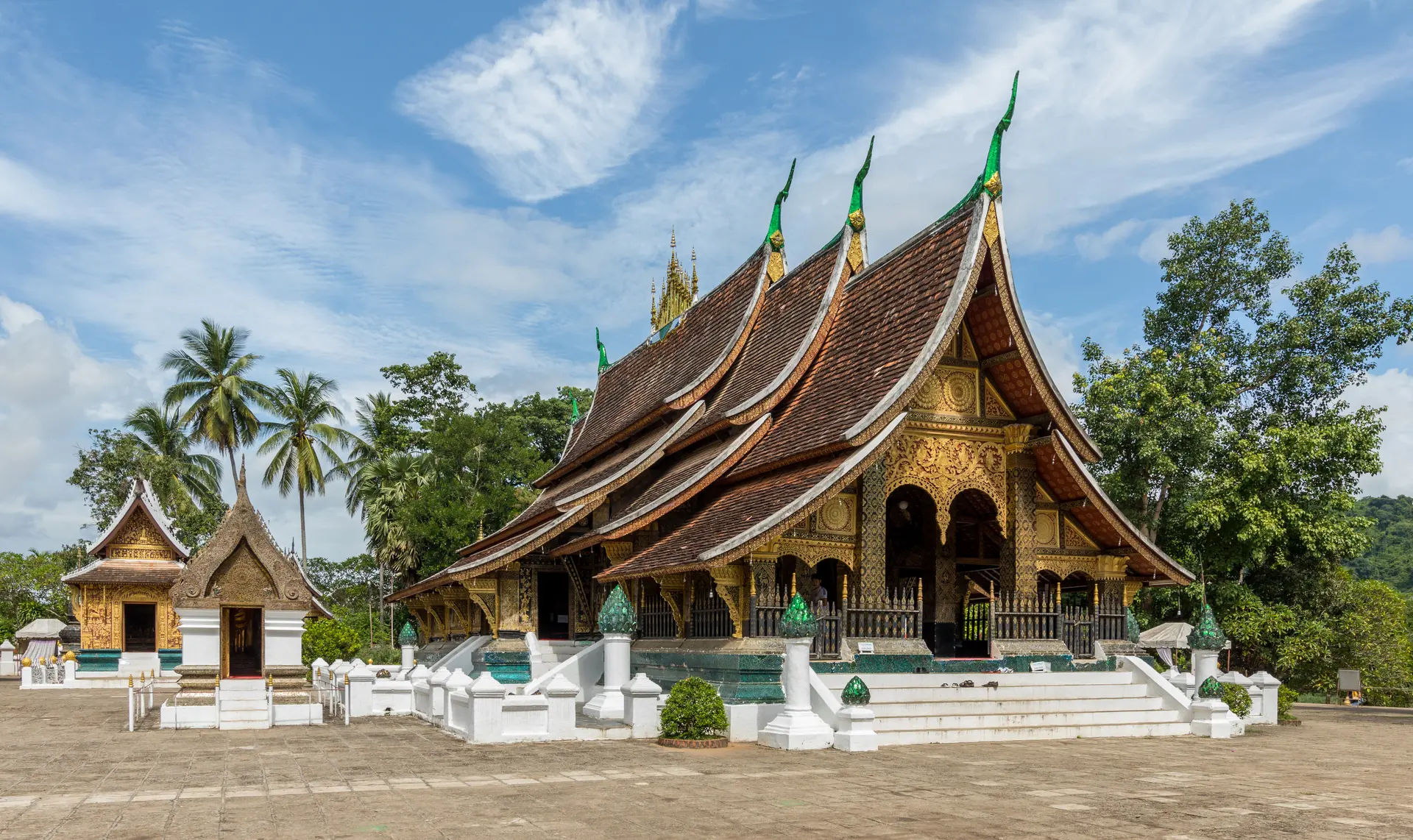
What distinguishes the temple is its restraint as much as its ornament. The main ordination hall, or sim, carries the classic Luang Prabang form, a steep roof in several tiers that sweeps down close to the ground, as if bowing toward the earth. The effect is intimate rather than monumental. Inside, the dim, gold-on-black interior and the hush of an active monastery tend to slow visitors down.
For most of its history this was the foremost royal temple of the kingdom, the place where kings were crowned, where their funerals were held, and where Buddhist relics and royal ashes were kept. That double inheritance, of the dhamma and of kingship, still hangs over the site. Yet it is not a museum.
Monks live and chant here, laypeople come to make merit, and during the Lao New Year the temple stands at the centre of the town's most important rituals.
Why this place is sacred
Several things converge to make Wat Xieng Thong feel charged. The first is its geography. The temple occupies the narrow point where the Mekong and the Nam Khan come together, and in Lao Buddhist sensibility the meeting of waters is itself auspicious, a place where currents and energies join. The peninsula gathers to a tip here, and the temple gathers with it.
The second is the long marriage of religion and kingship the site embodies. For Lao Buddhists the temple expresses the union of dhamma and royal legitimacy. It held the relics of the Buddha and the ashes of kings; it was where the monarch was crowned and where, eventually, he was mourned. To stand in the sim is to stand where the spiritual and the dynastic were deliberately bound together.
The third is the temple's imagery. The glass-mosaic Tree of Life on the rear exterior wall, set in rose and gold against a deep ground, is read in more than one way at once: as the Bodhi tree under which Sakyamuni reached enlightenment, and as a cosmological tree uniting earth and the heavens.
The nine descending roofs and the gilded Dok So Fa pointing skyward make a similar gesture, drawing the eye down toward the ground and up toward the sky in the same sweep.
Founded as the principal royal monastery of the Lan Xang and Luang Prabang kingdoms: a site of coronation, royal funerary rites, relic veneration and merit-making, binding Buddhist devotion to the legitimacy of the crown.
Royal patronage sustained and embellished the temple until the monarchy ended in 1975, adding the Chariot Hall in 1959-1962 and the Tree of Life mosaic in 1960. Since then it has continued as a working Theravada monastery and, with Luang Prabang's 1995 UNESCO inscription, as one of the protected town's principal monuments and a major visitor site.
Experience and orientation
The approach to Wat Xieng Thong is a short walk along the peninsula from the old town, and the temple announces itself first by its roofline, the long tiers of the sim dipping almost to the ground.
Visitors most often describe the main hall's interior as the finest surviving example of the classic Luang Prabang style: the walls dense with gold stencilwork against a dark ground, the air dim and cool, the atmosphere reverent and quiet even when others are present.
The rear wall of the sim holds the rose-and-gold Tree of Life mosaic, one of the most photographed details in Laos, and the small funerary chapel nearby shelters a reclining Buddha image. The Chariot Hall, with its towering gilded funeral chariot, is the other set-piece. Many visitors single out these three, the mosaic, the reclining Buddha and the chariot, but the temple rewards a slower circuit through its courtyards and smaller buildings as well.
Most report a hushed, reverent mood, helped by the riverside setting and the presence of resident monks going about ordinary monastic life. Coming early, before the heat and the crowds, and pausing to watch the town's dawn alms round nearby, gives a sense of living devotion rather than heritage display.
On the northern tip of the Luang Prabang peninsula, where the Mekong meets the Nam Khan. Enter through the temple gate; the sim (ordination hall) is the central focus, with the Tree of Life mosaic on its rear wall, the reclining-Buddha chapel and the Chariot Hall set around the grounds. Remove shoes before entering any building. Monastic quarters are off-limits.
Context and lineage
Wat Xieng Thong was founded around 1559-1560 by King Setthathirath of Lan Xang, whose reign is dated to roughly 1548-1571. (Sources give the founding date as 1559-1560 or simply 1560.) Tradition holds that the temple was built to commemorate Chanthaphanith, a betel merchant remembered as the legendary first king of Luang Prabang; his story is rendered in gold stencil on the interior walls of the sim.
The historical figure behind that founder-king legend remains uncertain, blending merchant lore with dynastic myth. From its founding it served as the principal royal monastery of the kingdom, the site of coronations and royal funerals and a repository of Buddhist relics and royal ashes.
The temple belongs to Lao Theravada Buddhism. Patronage descended through the royal house of Lan Xang and then of Luang Prabang, sustaining and embellishing the temple until the monarchy was abolished in 1975. The Tree of Life mosaic was created in 1960 by a Lao master craftsman. Since 1975 the site has continued as a functioning monastery, and since 1995 it has stood within the UNESCO-inscribed Town of Luang Prabang.
King Setthathirath
King of Lan Xang (reigned c. 1548-1571) who founded the temple around 1560.
Chanthaphanith
Betel merchant remembered in tradition as the legendary first king of Luang Prabang, whom the temple is said to commemorate; his story is stencilled in gold inside the sim.
King Sisavang Vong
Twentieth-century monarch for whom the Chariot Hall, with its gilded funeral chariot, was built in 1959-1962.
Traditions and practice
Historically the temple was the stage for royal coronations and funerals, and the keeper of Buddhist relics and royal ashes. Ordinations and merit-making by laypeople have long been part of its life.
Wat Xieng Thong remains a living monastery. Resident monks keep up daily chanting and meditation, and the dawn alms round (tak bat) passes through the surrounding town. Laypeople bring offerings and make merit. The temple is the chief site of Luang Prabang's Pi Mai (Lao New Year) celebrations in mid-April, when the revered Prabang Buddha is processed and ceremonially bathed in lustral water and when paper-boat and elephant processions converge here.
Arrive early to catch the soft light and the quiet of the morning. If you wish to observe the alms round, watch from a respectful distance without obstructing the monks or the giving laypeople. Inside the sim, let your eyes adjust to the dim gold interior before moving on; a slow, silent circuit of the grounds honours the space better than a quick photographic sweep.
Theravada Buddhism (Lao)
ActiveOne of Laos's most revered monasteries and the foremost royal temple of the former kingdom of Luang Prabang, long regarded as the most important temple in the kingdom for its ties to coronation, royal funerals and the veneration of relics. It remains a living centre of merit-making, ordination and festival ritual.
Daily alms round (tak bat), merit-making offerings, chanting and meditation, ordination ceremonies, and the Pi Mai Buddha-bathing rituals.
Perspectives and open questions
Wat Xieng Thong is approached as architectural masterwork, as the cradle of Lao religious kingship, and as a screen onto which older symbols and legends are read.
Scholarly perspective
Scholars regard Wat Xieng Thong as the masterwork of classic Luang Prabang temple architecture and the principal royal monastery of the Lan Xang and Luang Prabang kingdoms, central to the UNESCO inscription of the historic town in 1995.
Living and traditional perspectives
For Lao Buddhists the temple embodies the union of dhamma and kingship. Its relics, its connection to the Prabang Buddha during Pi Mai, and the founder-king legend make it a touchstone of national and religious identity.
Alternative interpretations
The Tree of Life mosaic is read both as the Bodhi tree of the Buddha's enlightenment and as a cosmological symbol uniting earth and the heavens, a single image carrying more than one layer of meaning.
Open questions
The precise historical figure behind the Chanthaphanith founder-king legend remains uncertain, and the founding date is variously given as 1559, 1560 or thereabouts.
Plan your visit
Access and arrival
On the northern tip of the Luang Prabang peninsula, walkable from the old town. A small admission fee applies (around 20,000 Lao Kip, roughly USD 2-3); the exact figure fluctuates with the exchange rate.
Luang Prabang's old town, a short walk away, offers a full range of guesthouses, boutique hotels and restaurants within the UNESCO-protected area.
Respectful visit
Cover shoulders and knees and avoid revealing clothing. Sarongs can be hired locally to cover the legs. Remove shoes before entering any temple building.
Generally permitted in the courtyards and most areas, but observe any posted restrictions in sacred interiors and be considerate of worshippers. Do not photograph monks without their consent.
Flowers, incense and candles are customary; donations support the monastery.
Maintain silence and reverence near worshippers, do not touch the antiquities or images, keep displays of affection private, and show deference to monks and novices.
This is an active place of worship and a monastic community, not only a heritage site. Keep silence near anyone praying, do not photograph monks without consent, and do not touch the antiquities or images.
Location
Map loads as you approach this section.
Pilgrim reflections
A portrait of encounter, not a score
Pilgrims describe what they felt, how present they could become, and whether the place would shape a journey. There are no stars and no ranking of traditions.
No reviewed reflections yet
The first pilgrims can help describe the character of being here.
Share a reflection
Available after an account-backed “Been there.” Every reflection is reviewed before publication.
Nearby sacred places
Explore other sacred places in the region. Proximity does not establish access or travel time; check each place’s guidance.


References
Sources consulted for this page. Source categories describe the publication, not a guarantee that every claim is verified. Traditional accounts and outside interpretations may differ.
- 01Wat Xieng Thong — Wikipedia contributorsencyclopediaFounding by King Setthathirath 1559-1560; royal patronage until 1975; nine-tiered roof; reclining Buddha cast 1569, sent to 1931 Paris Exhibition, returned 1964.
- 02Vat Xieng Thong - Luang Prabang Culture — Luang Prabang CultureofficialFunctions as coronation site, relic shrine, library; classic Luang Prabang sim style.
- 03Wat Xieng Thong: A Masterpiece of Lao Royal Architecture — Vivu JourneysguideChariot Hall built 1959-1962 for King Sisavang Vong; repository of royal ashes.
- 04Wat Xieng Thong Temple: Discover the Golden City Temple — IzitourguideTree of Life mosaic; Chanthaphanith merchant legend; commemoration purpose.
- 05Mosaics of Wat Xieng Thong — Institute of Contemporary MosaicguideTree of Life glass mosaic created 1960 by Lao master; enlightenment of Sakyamuni interpretation.
- 06Luang Prabang Pi Mai 2026: 10-Day Festival Guide — Laos JourneyguidePi Mai elephant procession from Wat Mai to Wat Xieng Thong; Prabang Buddha bathing; UNESCO town festival.
- 07Wat Xieng Thong - Temple of Golden City — Laos TravelguideReclining Buddha image, royal funeral chapel, golden funeral chariot.
Share a photo
Help visitors recognize Wat Xiengthong. Every submission is reviewed before publication.