Visoki Decani Monastery
The largest medieval church in the Balkans, guarded and at prayer
Understand sacred places, explore living traditions, and learn how to engage respectfully with Pilgrim Map.
Access has not been verified. Check current local guidance before planning a visit.
Deçan, Deçan Municipality, Kosovo
Read the sources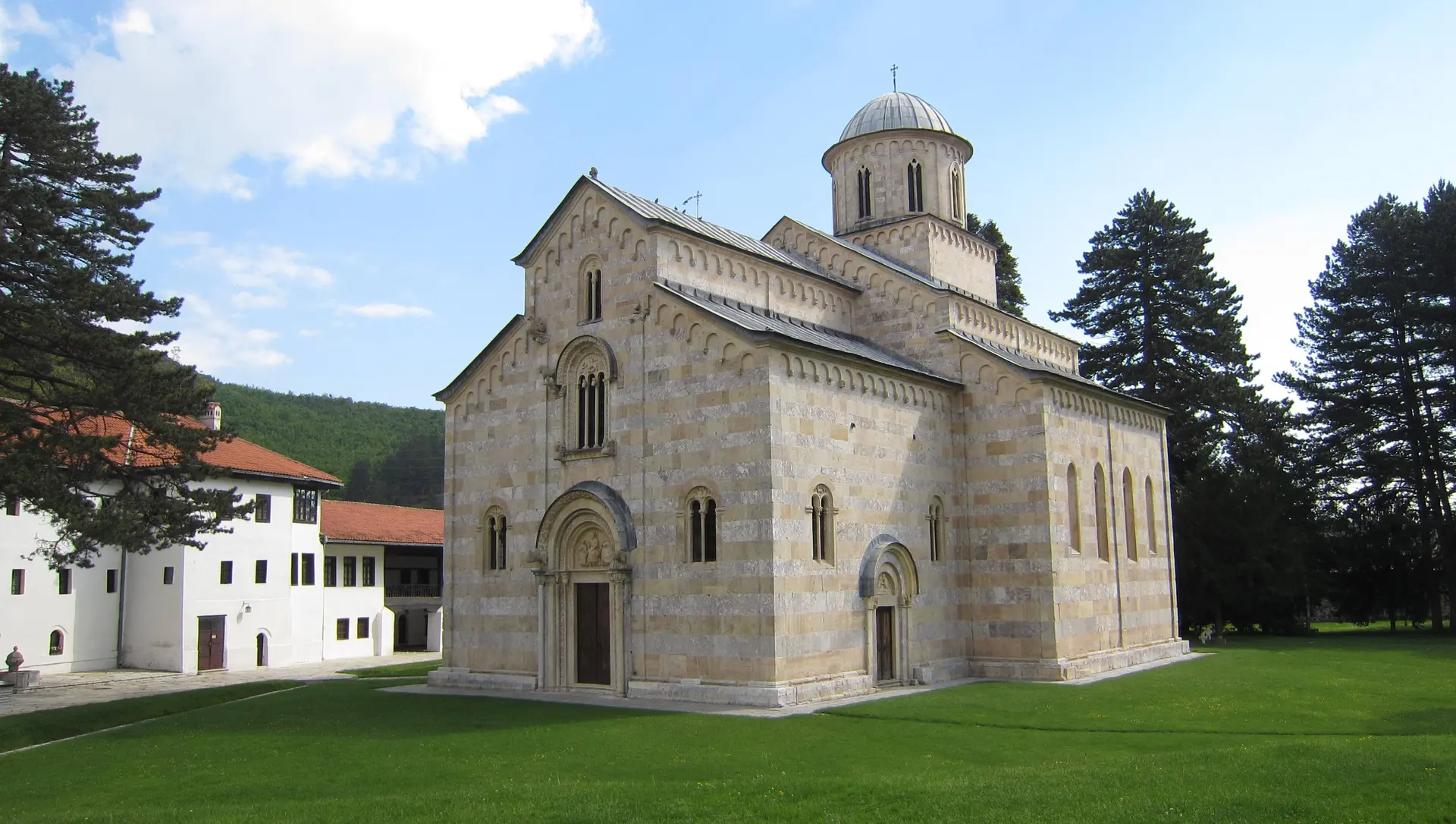
Image of Visoki Decani Monastery. Image source · CC-BY-3.0
Visit essentials
A quick read before you go
- Duration
- One to two hours.
- Access
- Near the town of Deçan/Dečani in western Kosovo, in the Dečanska Bistrica river valley below the…
Overview
In the valley of the Dečanska Bistrica river, below the peaks of the Prokletije, the Accursed Mountains, a vast church of banded marble rises within monastery walls. This is Visoki Dečani, the grandest monument of medieval Serbian Orthodoxy and the largest medieval church in the Balkans.
King Stefan Dečanski vowed and began it around 1327 as his royal endowment and tomb; after his death in 1331 he was buried in the unfinished monastery, and his son and successor Stefan Dušan completed the work in the mid-1330s. The design was entrusted to a Franciscan friar, Vito of Kotor, and the building fuses Byzantine, Romanesque, and Gothic traditions into something singular.
Inside, more than a thousand frescoes cover the walls floor to vault, the most complete surviving program of fourteenth-century Orthodox painting, a whole gallery of the faith. At its heart lie the relics of St King Stefan of Dečani, venerated as miraculously incorrupt and credited with healings. The monastery is alive: a community of monks observes the full daily round of services, from the midnight office before dawn to evening vespers.
Yet the approach passes through a checkpoint, for Dečani is a UNESCO World Heritage Site on the List of World Heritage in Danger and the only cultural monument in Europe under continuous NATO/KFOR military guard. Visitors describe the contrast that defines a visit: deep peace within, visible protection without.
Why this place is sacred
Several rare things converge at Dečani to make it feel charged. At its center are the incorrupt relics of St King Stefan Dečanski, the founder buried in his own great church, venerated as miraculously preserved and credited by pilgrims and monks with healings and answered prayers. Surrounding the relics is the largest surviving medieval Orthodox fresco cycle, more than a thousand images that function for believers as a gallery of the faith, walls that teach and sanctify at once.
There is the unbroken prayer of the monks, maintained through war and danger when much around it was lost. And there is the setting, the forest-and-river valley below the Prokletije mountains, which lends the enclosed peace a wilder frame. For Orthodox believers, Dečani is among the holiest places of Kosovo and Metohija; for many visitors of any background, the endurance of monastic life under guard is itself what moves them.
Experience and orientation
Visitors describe approaching through a KFOR checkpoint into a tranquil walled monastery beside the Dečanska Bistrica river, then stepping into a soaring marble-banded church whose walls are covered from floor to vault in frescoes. Many are struck by the contrast between the deep peace within and the visible military protection without, and by the chant of the monks during the services.
The relics of St Stefan and the great fresco program draw the longest pauses; pilgrims frequently report profound stillness and emotion before them. The endurance of monastic life under guard tends to move visitors regardless of their faith, leaving an impression that lingers well beyond the walls.
Allow extra time for secured admission before the monastery visit.
Context and lineage
King Stefan Dečanski (Stefan Uroš III) vowed and began the great church around 1327, with the founding charter, the Dečani chrysobull, issued in 1330. After his death in 1331 he was buried in the still-unfinished monastery, and his relics came to be venerated as miraculously incorrupt.
His son Stefan Dušan completed the work in the mid-1330s, entrusting the design to the Franciscan friar Vito of Kotor, so that the building joins Byzantine, Romanesque, and Gothic elements in a striking fusion of Eastern and Western traditions.
Dečani belongs to Serbian Orthodox Christianity within the Eastern Orthodox tradition, a Nemanjić-era royal endowment that remains one of the most revered active monasteries of the Serbian Orthodox Church and a station on the pilgrimage to the medieval monasteries of Kosovo and Metohija.
Traditions and practice
The monastery keeps the complete Orthodox monastic cycle, the midnight office, matins, the hours, the Divine Liturgy, vespers, and night vigils before Sundays and feasts, together with the veneration of relics on major feast days.
A resident community of monks sustains daily worship and cares for the heritage. The most solemn day is the feast of the patron, St King Stefan of Dečani, which gathers clergy, monastics, and laypeople, and pilgrimage continues year-round under KFOR protection.
Time a visit to coincide with a service to hear the monks' chant, and allow unhurried time before the relics of St Stefan and the fresco cycle. The patron-saint feast offers the fullest spiritual experience. Approach as a guest of a working monastery, and let the stillness within set the pace.
Serbian Orthodox Christianity
ActiveA royal foundation and mausoleum of King Stefan Dečanski, the largest medieval church in the Balkans, holding the most complete surviving cycle of medieval Byzantine-style fresco painting and the incorrupt relics of its sainted founder. It is among the most revered active monasteries of the Serbian Orthodox Church.
The full daily monastic office from the midnight office through evening vespers, vigils before Sundays and feasts, veneration of the relics of St Stefan and other saints, pilgrimage especially on the patron-saint feast, and icon and fresco veneration.
Perspectives and open questions
Scholars and UNESCO regard Dečani as the supreme achievement of fourteenth-century Serbian church art, while for the Serbian Orthodox it is a living holy place; this account treats the region's competing narratives even-handedly.
Scholarly perspective
Scholars and UNESCO recognize Dečani as the supreme achievement of fourteenth-century Serbian church architecture and painting, the largest Balkan medieval church and the most complete surviving Orthodox fresco ensemble. Its conservation is endangered by the region's political instability, hence its continuous KFOR protection and its place on the List of World Heritage in Danger since 2006.
Living and traditional perspectives
For the Serbian Orthodox Church and the Serbian community, Dečani is among the holiest places in Kosovo and Metohija, the tomb-church of a sainted king whose incorrupt relics are held to work miracles, and a beacon of monastic continuity under threat.
Alternative interpretations
Pilgrim and monastic accounts attribute healings and answered prayers to St Stefan's relics, and the monastery is sometimes cited for the reported incorruptibility of the founder's body.
Open questions
The precise completion date and the full attribution of the many fresco hands remain debated, and the long-term resolution of the protective-zone and land disputes continues to evolve. This account does not endorse any position on Kosovo's status.
Plan your visit
Access and arrival
Near the town of Deçan/Dečani in western Kosovo, in the Dečanska Bistrica river valley below the Prokletije (Accursed) Mountains. Under continuous KFOR guard; approach via the checkpoint with identification and obtain entry at the gate. Reachable by car or taxi from Peja/Peć.
Respectful visit
Strict: men in long trousers, no shorts; women with knees and shoulders covered. Skirts, wraps, and headscarves are often provided at the entrance.
Permitted in some areas per monastery rules, but photography of KFOR/military positions and checkpoints is prohibited; flash on the frescoes is discouraged.
Candles and donations to the monastery; the monks also sell their own products.
Pass the KFOR checkpoint with identification, obtain entry at the gate, keep quiet and reverent, and do not disturb the monks or services.
Pass the KFOR checkpoint with identification and obtain entry at the gate; photography of military positions and checkpoints is prohibited. Hours and access can change for security reasons. This is a high-sensitivity site amid land and protective-zone disputes; observe quietly and avoid making the protection or the surrounding tensions into spectacle.
Location
Map loads as you approach this section.
Pilgrim reflections
A portrait of encounter, not a score
Pilgrims describe what they felt, how present they could become, and whether the place would shape a journey. There are no stars and no ranking of traditions.
No reviewed reflections yet
The first pilgrims can help describe the character of being here.
Share a reflection
Available after an account-backed “Been there.” Every reflection is reviewed before publication.
Nearby sacred places
Explore other sacred places in the region. Proximity does not establish access or travel time; check each place’s guidance.


References
Sources consulted for this page. Source categories describe the publication, not a guarantee that every claim is verified. Traditional accounts and outside interpretations may differ.
- 01Visoki Dečani Monastery (official site) — Serbian Orthodox Monastery of Visoki DečaniofficialMonastic life, liturgical rule, relics, patron saint feast, history
- 02Medieval Monuments in Kosovo — UNESCO World Heritage CentreofficialWorld Heritage listing and danger-list status; OUV
- 03Endangered Site: Visoki Decani Monastery, Kosovo — Smithsonian MagazinenewsEndangerment, security, history
- 04Kosovo Court Ruling Awarding Serb Monastery Disputed Land Implemented (2024) — Balkan Insight (BIRN)news2016 Constitutional Court ruling on 24 ha; 2024 implementation; Council of Europe context
- 05Kosovo Urged Not to Build Road in Serbian Monastery's Protected Area (2020) — Balkan Insight (BIRN)newsSpecial protective zone, disputed road near the church
- 06Visoki Dečani — Wikipedia contributorsencyclopediaFoundation by Stefan Dečanski, Vito of Kotor, frescoes, relics, UNESCO, KFOR
- 07What's so special about the Visoki Dečani Monastery in Kosovo? — Bradt GuidesguideVisitor practicalities, dress code, security/access
- 08Decani Monastery — OrthodoxWikispiritualOrthodox perspective, relics, liturgical life
Share a photo
Help visitors recognize Visoki Decani Monastery. Every submission is reviewed before publication.