Prizren, Church of Our Lady of Ljeviš
A five-domed church to the Merciful Mother, wounded and standing
Understand sacred places, explore living traditions, and learn how to engage respectfully with Pilgrim Map.
Access has not been verified. Check current local guidance before planning a visit.
Prizren, Prizren, Kosovo
Read the sources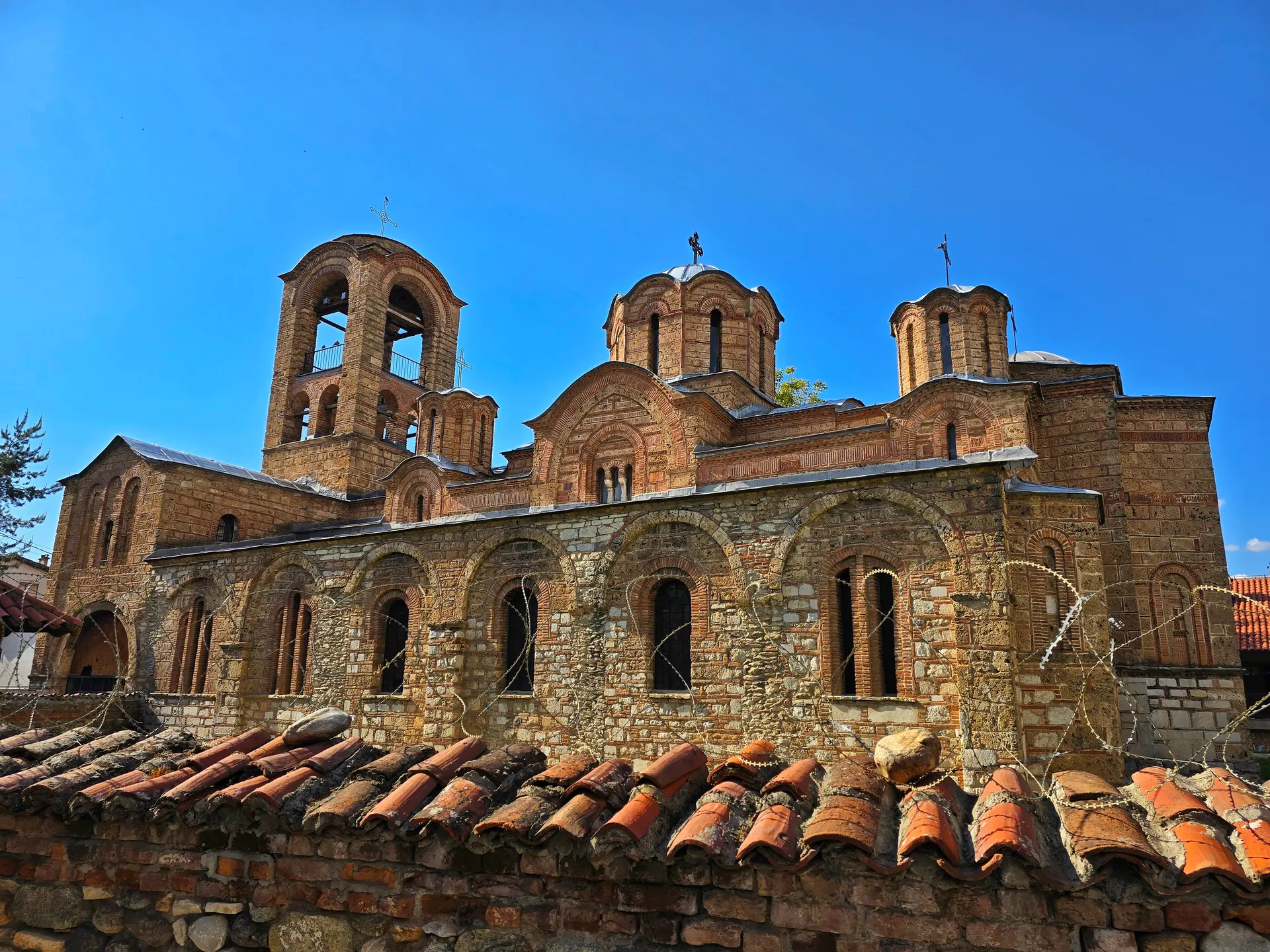
Visit essentials
A quick read before you go
- Duration
- Thirty to sixty minutes once admitted.
- Access
- In the old town of Prizren, southern Kosovo, near the historic center.
Overview
Five domes and a Byzantine belfry rise above old-town Prizren as Bogorodica Ljeviška, Our Lady of Ljeviš. Serbian king Stefan Milutin raised the church in 1306–1307 over an eleventh-century Byzantine basilica and dedicated it to the Mother of God as Eleousa, the Merciful Mother tenderly embracing the Christ Child. The Slavicized name Ljeviška descends from that Greek word.
Inside, fresco cycles by Byzantine painters Michael and Eutychios Astrapas of the Thessaloniki school depict the Great Feasts, Christ's miracles and parables, and the Passion. They rank among the supreme surviving achievements of the Palaiologan Renaissance in Serbian lands.
Under Ottoman rule the church served for centuries as the Friday mosque, with a minaret where bells had hung, until the minaret was removed and Christian worship restored in the early twentieth century. In March 2004, during inter-ethnic riots, it was set ablaze; its frescoes remain scarred. Restored with European support, it is a UNESCO World Heritage Site on the List of World Heritage in Danger, usually locked behind protective fencing and opened only by prior arrangement.
The wounded building holds seven centuries of devotion, conquest, and endurance.
Why this place is sacred
What charges this place is a Marian devotion that has held the same ground across Byzantine and Serbian eras. The dedication to the Theotokos Eleousa, the Merciful Mother who tenderly holds her child, was carried forward from the earlier Byzantine basilica into Milutin's royal church, an unbroken thread of devotion to the same tender presence.
The frescoes of Michael and Eutychios Astrapas make the church one of the supreme surviving Palaiologan ensembles, sacred images that for believers open onto the holy. As a Nemanjić royal endowment it fused Serbian piety with Byzantine imperial identity. And its survival, through Ottoman conversion, the removal of its minaret, and the arson of 2004, has made it a symbol of endurance, a sanctuary that outlasted every attempt to silence or unmake it.
For Orthodox pilgrims, prayer here connects to the protective, merciful presence of the Mother of God across all those centuries.
Experience and orientation
From the streets of old-town Prizren the church announces itself by its distinctive five-domed silhouette and Byzantine belfry. Most visitors encounter it from the outside, locked behind protective fencing, and the building's stillness is part of its presence. Those admitted by arrangement enter to find faded but powerful medieval frescoes, some still bearing the scars of the 2004 fire and the marks of earlier whitewashing from the mosque period.
The experience is quieter and more solemn than at a working monastery; this is largely a preserved and protected monument, opened for limited worship. For Orthodox pilgrims, prayer here links to seven centuries of Marian devotion and to the resilience of a sanctuary that survived conquest, conversion, and arson.
The church stands in the old town of Prizren in southern Kosovo, near the historic center, its domes visible above the surrounding rooftops. It is generally locked; visits must be arranged in advance through the Serbian Orthodox eparchy or custodians, and a security clearance procedure may apply.
Context and lineage
The church rose on the site of an eleventh-century Byzantine basilica known as Metera or Panagia Eleousa, the All-Holy Merciful Mother. King Stefan Milutin rebuilt and expanded it in 1306 to 1307, with frescoes painted around 1307 to 1313, partly to proclaim his Byzantine imperial lineage. The name Ljeviška preserves the Greek Eleousa, the iconographic type of the Virgin tenderly embracing the Christ Child.
Under Ottoman rule the church was converted into the Friday mosque with a minaret added, serving as a mosque for centuries until the minaret was removed and Christian worship restored in the early twentieth century. In March 2004 it was badly damaged by arson during inter-ethnic riots and has since been restored with EU and Council of Europe support.
The church belongs to Serbian Orthodox Christianity, of the eparchy of Raška-Prizren, and stands within the Nemanjić-era tradition of royal endowments. Its layered history also includes an earlier Byzantine Orthodox basilica and a centuries-long period as an Ottoman mosque. It forms part of the pilgrimage to the medieval monuments of Kosovo and Metohija.
Traditions and practice
The customary worship is Orthodox liturgy and veneration of the Theotokos, particularly on Marian feast days when the church is opened.
Worship is now limited and supervised; the church is primarily preserved as a restored monument under protection, opened for liturgy and visits by arrangement rather than serving as a daily place of prayer.
Plan ahead: contact the Serbian Orthodox eparchy or custodians well in advance, and time a visit, if possible, to a Marian feast day when the church may be open. Even from the outside, the five-domed form above old Prizren rewards a slow, attentive look. Keep your visit quiet and unobtrusive.
Serbian Orthodox Christianity
ActiveOne of the most celebrated medieval Serbian Orthodox churches, the royal endowment of King Stefan Milutin and a masterwork of the Palaiologan era, dedicated to the Mother of God under the Eleousa (Merciful) type.
Liturgy on feast days when accessible, veneration of the Theotokos, and supervised pilgrimage visits.
Islam (historical)
HistoricalDuring Ottoman rule the church was converted into the Friday mosque, with a minaret added; it functioned as a mosque for centuries until the minaret was removed and the church restored to Christian use in the early twentieth century.
Perspectives and open questions
Scholars regard the church as a landmark of Palaiologan art, while for the Serbian Orthodox it is a wounded but enduring royal sanctuary; this account treats the region's competing narratives even-handedly.
Scholarly perspective
Art historians regard Bogorodica Ljeviška as a landmark of the Palaiologan Renaissance in Serbian lands and an outstanding example of King Milutin's church-building. UNESCO lists it among the 'Medieval Monuments in Kosovo' for its outstanding universal value while noting endangerment from conservation difficulties and the region's instability.
Living and traditional perspectives
For the Serbian Orthodox Church it is a sacred royal endowment and a wounded but enduring witness to Serbian Christian presence in Prizren, especially after the 2004 arson.
Alternative interpretations
Devotional accounts emphasize the protective, merciful presence of the Theotokos Eleousa, the Merciful Mother to whom the church is dedicated.
Open questions
The full extent of fresco loss and overpainting across the mosque period and the 2004 fire, and the exact form of the original eleventh-century basilica, remain incompletely known. This account does not editorialize on Kosovo's political status.
Plan your visit
Access and arrival
In the old town of Prizren, southern Kosovo, near the historic center. The church is generally locked; arrange visits in advance through the Serbian Orthodox eparchy or custodians, and expect that security clearance may be required.
Respectful visit
Modest Orthodox-church dress with covered shoulders and knees; women may be asked to cover the head.
Subject to permission and security rules; flash photography of the frescoes is typically discouraged.
Candles where provided, and donations toward conservation.
Access only by prior arrangement and possible security clearance; follow all instructions from custodians and security.
Access is only by prior arrangement and may require security clearance; do not expect to enter without notice. The church's recent history of arson and its contested status call for sensitivity; observe respectfully and avoid treating the damage or the surrounding tensions as spectacle.
Location
Map loads as you approach this section.
Pilgrim reflections
A portrait of encounter, not a score
Pilgrims describe what they felt, how present they could become, and whether the place would shape a journey. There are no stars and no ranking of traditions.
No reviewed reflections yet
The first pilgrims can help describe the character of being here.
Share a reflection
Available after an account-backed “Been there.” Every reflection is reviewed before publication.
Nearby sacred places
Explore other sacred places in the region. Proximity does not establish access or travel time; check each place’s guidance.

Arabati Baba Tekke
Tetovo, Tetovo, Polog Region, North Macedonia
29.4 km away

Painted Mosque, Tetovo
Tetovo, Tetovo, Polog Region, North Macedonia
29.8 km away
Visoki Decani Monastery
Deçan, Deçan Municipality, Kosovo
53.6 km away

Church of Saint Nicetas, Banjani
Banjani, Banjani/Gornjane, Čučer-Sandevo Municipality, Skopje Region, North Macedonia
54.3 km away
References
Sources consulted for this page. Source categories describe the publication, not a guarantee that every claim is verified. Traditional accounts and outside interpretations may differ.
- 01Church of Bogorodica Ljeviška — Encyclopaedia BritannicaencyclopediaArchitecture and art-historical significance
- 02Medieval Monuments in Kosovo — UNESCO World Heritage CentreofficialWorld Heritage listing including Ljeviša; danger-list status
- 03Prizren, Bogorodica Ljeviska Church (archive) — BLAGO FundacademicDetailed photographic and art-historical documentation of frescoes and architecture
- 04Our Lady of Ljeviš — Wikipedia contributorsencyclopediaHistory, Milutin rebuild, Astrapas frescoes, Ottoman mosque conversion, 2004 damage, UNESCO, restoration
- 05Church of the Holy Virgin Ljeviška in Prizren (2017) — Academia.edu (scholarly PDF)academicScholarly monograph reference
- 06Our Lady of Ljeviš | Atlas Obscura — Atlas ObscuraencyclopediaVisitor-facing summary, location, current condition
- 07Anniversary of the Pogrom Against Serbs in Kosovo: Life Among the Ruins — Kosovo OnlinenewsSerbian-perspective coverage of 2004 damage; note partisan framing
- 08Lady of Ljeviš — ljeviska.comspiritualDevotional/heritage site; name etymology and veneration; epistemic marker only
Share a photo
Help visitors recognize Prizren, Church of Our Lady of Ljeviš. Every submission is reviewed before publication.