Gračanica Monastery
Where Byzantine artistry and Serbian Orthodox devotion have endured for seven centuries
Understand sacred places, explore living traditions, and learn how to engage respectfully with Pilgrim Map.
Access has not been verified. Check current local guidance before planning a visit.
Gračanica, Gračanica, Kosovo
Read the sources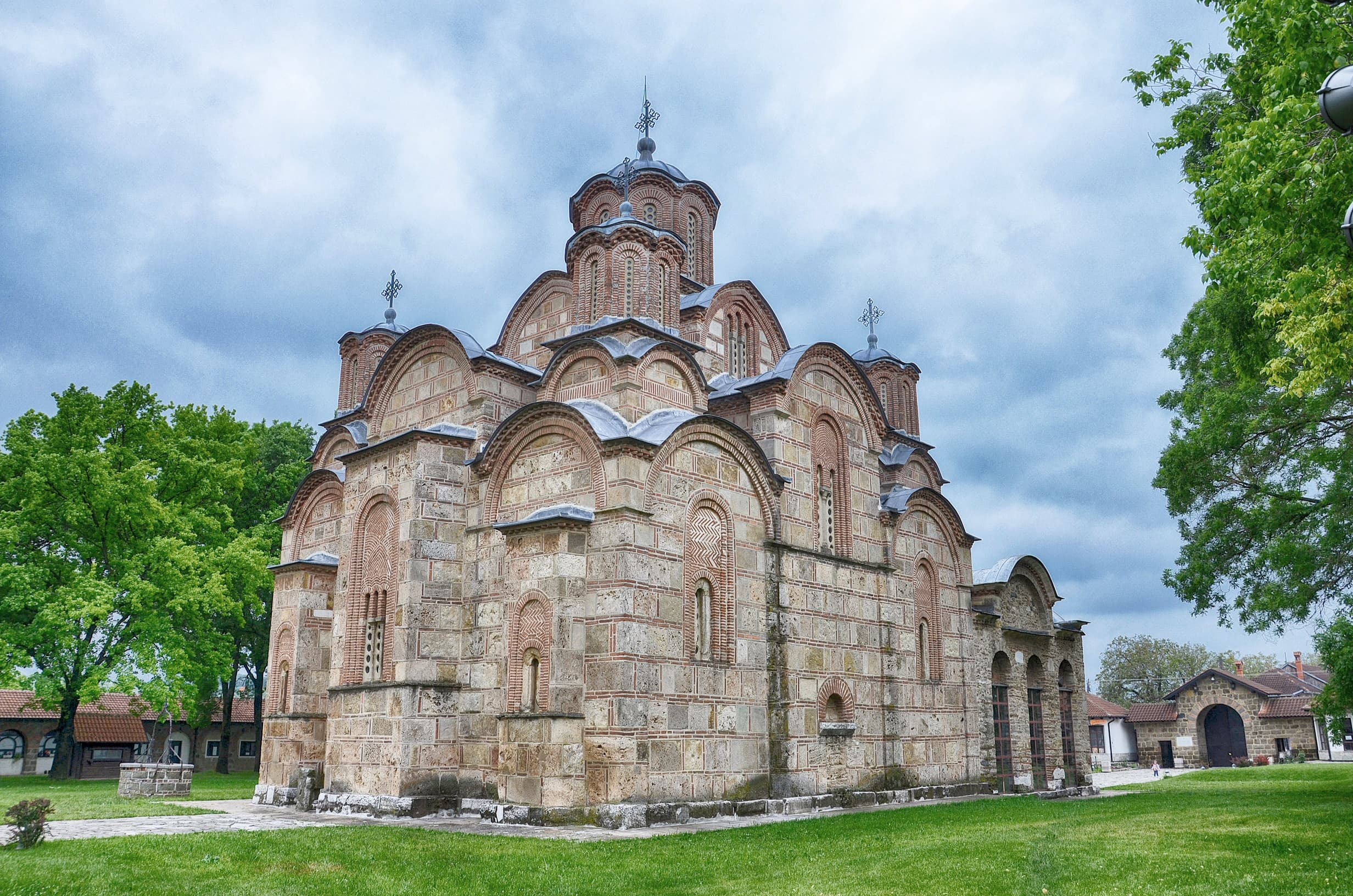
Image of Gračanica Monastery. Image source · CC-BY-SA-4.0
Visit essentials
A quick read before you go
- Duration
- A thoughtful visit to the church and grounds takes one to two hours.
- Etiquette
- Gracanica is an active monastery requiring modest dress and respectful behavior.
Overview
The first thing you notice inside Gracanica is the weight of being seen. Over four thousand painted faces cover every surface—saints, prophets, angels, Christ, the Virgin, the royal founders who built this place. They do not merely decorate. They witness.
King Stefan Milutin commissioned this church in the early fourteenth century as the seat of the ancient Eparchy of Lipljan, building upon the ruins of earlier Byzantine churches that had marked this ground as sacred. He brought the finest architects from Kotor and the leading painters from Thessaloniki—artists whose work represents the Paleologan Renaissance, the final flowering of Byzantine art before Constantinople fell. What they created here rivals anything produced in the Byzantine capital itself.
Seven centuries later, the monastery continues. Ottoman conquest, the Battle of Kosovo, world wars, and recent conflicts have all passed through this region. Yet each morning, the nuns gather for the Divine Liturgy beneath the same frescoes that watched over medieval monks. The candles flicker. The incense rises. The prayers have not stopped.
Gracanica survives not as museum but as living church. For Serbian Orthodox faithful, it represents the spiritual heart of their presence in Kosovo—a land central to their history, now politically contested. For all who enter, it offers encounter with an artistic and devotional tradition that continues to breathe.
Why this place is sacred
Seven hundred years of prayer leave a residue. Visitors to Gracanica—regardless of their relationship to Orthodox Christianity—consistently describe a quality of presence that goes beyond the undeniable artistic splendor. Something has accumulated here.
The church itself was designed to create this effect. The compact cross-in-square plan, topped by five domes, draws the eye inevitably upward. The pronounced verticality—taller than it is wide, rising in graded masses toward the central dome—creates a sense of ascent even for those standing still. Light enters through narrow windows, illuminating frescoes arranged in seven registers that tell the story of salvation from floor to vault.
Those frescoes are not merely illustration. In Orthodox understanding, icons are windows to heaven—places where the boundary between visible and invisible thins. Gracanica contains over four thousand painted faces: the entire Festival Cycle, the Passion of Christ, saints and prophets, angels watching from the corners. To stand in this space is to be surrounded by what the Orthodox call the great cloud of witnesses.
The monastery also carries the weight of Serbian national memory. The Nemanjic dynasty genealogy painted here was the first of its kind—a visual claim to legitimacy and continuity. King Milutin and Queen Simonida appear on the walls, forever presenting their church to Christ. When later centuries brought conquest and suffering, Gracanica became a symbol of endurance—the faith that survived when kingdoms fell.
This accumulated meaning continues. After the Kosovo War, the monastery became the de facto seat of the Serbian Orthodox bishop for the region. The nuns who maintain daily prayers do so with full awareness that they continue something larger than themselves.
King Stefan Milutin built Gracanica as the new seat of the Eparchy of Lipljan, an ancient bishopric dating to the earliest centuries of Christianity in the Balkans. His inscription on the southern wall declares his intention: he saw the ruins of earlier churches on this site and resolved to rebuild worthy of the bishopric's dignity. The church was designed to serve episcopal functions—hosting the bishop's throne, enabling liturgical ceremony appropriate to a cathedral, housing relics and treasures.
When the Serbian Archbishopric was elevated to Patriarchate in 1346, the Bishop of Lipljan became a Metropolitan, and Gracanica his cathedral.
The Ottoman conquest transformed the region but did not destroy the monastery. The narthex tower burned in the 1380s, with the loss of precious manuscripts, but the church itself survived and was repaired. Through centuries of Ottoman rule, Gracanica continued as a monastery—sometimes wealthy, sometimes impoverished, but always present.
After World War II, the Yugoslav authorities transformed it into a convent for nuns, a status it maintains today. The monastery adapted to communist governance, then to post-Yugoslav instability. After the Kosovo War of 1998-99, when the Serbian Orthodox bishop could no longer safely reside in Prizren, he transferred his seat to Gracanica. The monastery thus returned to its original function—the center of episcopal authority for the region—while remaining home to a community of religious women.
The twenty-four nuns continue the daily cycle of prayer, maintaining traditions of icon painting, beekeeping, and hospitality alongside their liturgical duties.
Experience and orientation
The exterior prepares you for beauty but not for intimacy. Gracanica rises in harmonious proportions, its five domes and patterned brickwork announcing its medieval origins. You expect grandeur. What you find instead is enclosure—a relatively small church that holds its visitors close.
Inside, the frescoes surround you. Unlike Western churches where paintings hang on walls or fill isolated chapels, here the images cover every surface in seven registers rising toward the central dome. Christ Pantocrator looks down from the vault. Saints line the walls at eye level. The effect is immersive, almost overwhelming—you are not observing the paintings but entering them.
The quality of the light matters. Narrow windows admit controlled illumination that shifts through the day, bringing different faces forward at different hours. The gold grounds of the icons catch whatever light finds them, creating movement in what first appeared static. Many visitors find themselves drawn back to the same fresco again and again, noticing details invisible on first encounter.
The nuns move through the church on their own rhythms—preparing for services, receiving pilgrims, going about the quiet business of monastic life. Their presence transforms the experience from museum visit to witness of living tradition. This is not preservation of something dead but continuation of something alive. The prayers spoken here this morning echo prayers spoken here for seven centuries.
Pilgrims on the Feast of the Dormition in August describe the most intense experience—hundreds gathered for hierarchical liturgy, the bishop presiding, chanting that fills the small space until it seems impossible that stone walls could contain such sound. But quieter visits carry their own power. To sit alone beneath these frescoes, joining the silent company of four thousand painted witnesses, is to understand why people have sought out thin places since long before anyone named them that.
Gracanica rewards attention rather than haste. The frescoes that seem static on first glance reveal movement and depth when you stay with them. Notice how the figures orient themselves—toward Christ, toward the altar, toward each other in conversation across centuries.
If you arrive during a service, remain at the back of the nave and simply listen. Orthodox liturgy is designed to be experienced rather than understood on first encounter. The chanting, the incense, the movements of the clergy create a pattern that carries its own meaning apart from comprehension of Slavonic texts.
Between services, move slowly. The church is small enough to see in minutes but rich enough to hold attention for hours. Pay particular attention to the southern wall, where King Milutin and Queen Simonida are depicted presenting their church to Christ. These are portraits of actual people—Simonida's famous beauty still evident after seven hundred years.
The monastery grounds themselves offer space for reflection. Walking slowly, allowing what you have seen to settle, completes the experience. The nuns' gift shop provides opportunity to take something with you—an icon, perhaps, continuing the tradition of the painters who first adorned these walls.
Context and lineage
King Stefan Uros II Milutin ruled Serbia during its golden age, extending his realm and filling it with churches. He built or restored over forty foundations—so many that later traditions claimed he could not remember them all. Gracanica was his last and finest endowment.
Milutin's marriage to Simonida, daughter of Byzantine Emperor Andronikos II Palaiologos, brought a wave of Byzantine culture to Serbia. Court ceremonies, dress, titles, and artistic styles all reflected the sophisticated traditions of Constantinople. When Milutin decided to rebuild the ruined churches at the site of the Eparchy of Lipljan—a bishopric tracing its origins to the earliest centuries of Christianity in the Balkans—he summoned the finest talent his Byzantine connections could provide.
The architect, Vitus from Kotor, designed a church that synthesized the cross-in-square plan of Thessalonian Byzantine architecture with the pronounced verticality inherited from the earlier Serbian Raska school. The result was something new—later scholars would call it the 'Gracanica type'—a style of church building that would influence Serbian religious architecture for generations.
For the frescoes, Milutin engaged a workshop believed to have been led by Michael Astrapas, a painter who had worked on other royal commissions and who represented the artistic movement scholars call the Paleologan Renaissance. Between 1321 and 1322, this workshop covered the interior with images that rival contemporary work in Constantinople itself.
When Milutin issued the monastery's charter in 1321, he declared that he had seen the ruins of earlier churches and built anew from the ground—decorating it, as his inscription proclaims, both within and without.
Gracanica was designed as the seat of the Eparchy of Lipljan, an ancient bishopric serving the region since the early centuries of Christianity. The site itself held earlier churches—an early Byzantine basilica and a thirteenth-century church—whose ruins Milutin incorporated into his foundation.
When the Serbian Archbishopric was elevated to Patriarchate in 1346, twenty-five years after Gracanica's consecration, the Bishop of Lipljan received the title of Metropolitan. The monastery thus served as a metropolitan cathedral until Ottoman conquest disrupted ecclesiastical organization.
Through centuries of Ottoman rule, monastic life continued. The community adapted, survived, and maintained the liturgical tradition that gave the place meaning. After World War II, the monastery became a convent, its male monastic community replaced by the sisterhood that continues today.
The Kosovo War of 1998-99 brought the monastery unexpected prominence when the Serbian Orthodox bishop transferred his seat from Prizren to Gracanica, returning the monastery to its original function as episcopal headquarters. Today, under the protection of Kosovo Police after the handover from KFOR, Gracanica serves simultaneously as convent, episcopal seat, and living symbol of Serbian Orthodox presence in Kosovo.
Stefan Milutin
founder
King of Serbia 1282-1321, known as the Holy King after his canonization. Builder of over forty churches, he created Gracanica as his final and most magnificent endowment. His portrait appears on the monastery walls, presenting the church to Christ.
Queen Simonida
founder
Daughter of Byzantine Emperor Andronikos II, she married Milutin as a child and became the conduit for Byzantine artistic and cultural influence in medieval Serbia. Her portrait in Gracanica, noted for its beauty, appears alongside her husband's.
Michael Astrapas
artist
Leading painter from Thessaloniki whose workshop is believed to have created the Gracanica frescoes. His work represents the Paleologan Renaissance—the final flowering of Byzantine art. He had previously worked on other Milutin commissions.
Theotokos (Virgin Mary)
patron
The monastery is dedicated to the Dormition of the Most Holy Theotokos. Images of the Virgin appear throughout the church, and her feast day on August 15/28 is the monastery's patronal celebration.
Traditions and practice
The Divine Liturgy of St. John Chrysostom forms the heart of Orthodox worship at Gracanica. This ancient service, with roots in the early Christian communities of Constantinople, is celebrated regularly, uniting the monastery with Orthodox churches worldwide in a common liturgical rhythm.
The daily cycle includes the services of hours—matins, vespers, and the smaller hours—maintaining the continuous offering of prayer that gives monasteries their reason for being. The monastic community structures its day around this cycle, with work and rest fitted between the times of prayer.
Major feasts follow the Orthodox calendar. Christmas, Pascha (Easter), and the great feasts of the Lord and the Theotokos bring special services. The Dormition of the Most Holy Theotokos—August 15 on the civil calendar, August 28 by the Julian calendar the Serbian Church maintains—is the monastery's slava, its patronal feast. On this day, the Bishop of Raska-Prizren leads a hierarchical liturgy, with clergy in full ceremonial vestments, chanting that has not changed in essence for centuries.
The twenty-four nuns who maintain Gracanica today continue traditions adapted to modern circumstances. They rise before dawn for the first prayers, follow the rhythm of services through the day, and retire after compline. Between liturgies, they practice obediences—the work assigned to monastic communities. Icon painting continues here, maintaining the artistic tradition that made Gracanica famous. Beekeeping provides both contemplative labor and products for the monastery shop. The nuns sew vestments and create other liturgical items.
Hospitality to visitors is itself a monastic tradition. The nuns welcome pilgrims and tourists alike, staffing the gift shop, answering questions, and offering the quiet presence that makes Gracanica feel like living church rather than museum. Some visitors come for personal blessing from the clergy or to request prayers for specific intentions.
Enter the church slowly and allow your eyes to adjust to the luminous darkness. The frescoes reveal themselves gradually—notice how the saints seem to turn toward the altar, drawing your attention to the same center.
If a service is in progress, remain in the back and simply witness. You need not understand the Slavonic words; Orthodox liturgy communicates through the total experience of chant, incense, movement, and light. Let it wash over you without requiring comprehension.
Between services, light a candle at the sand-filled stand near the entrance. This practice, shared by Orthodox and Catholic traditions alike, offers a simple way to leave something of yourself in this place—a light and a prayer, however wordless.
Before leaving, spend time with a single fresco. Choose one face that draws you and simply look. Seven hundred years ago, a painter climbed scaffolding to create this image. Others have looked at this face since. Now you. The communion of witnesses extends across centuries.
Serbian Orthodox Christianity
ActiveGracanica is one of the most important Serbian Orthodox monasteries and a masterpiece of medieval Serbian art. Built as the seat of the Eparchy of Lipljan in 1321, it represents the culmination of the Serbo-Byzantine tradition. After the Kosovo War, the monastery became the de facto episcopal seat for the region, making it the spiritual center of Serbian Orthodoxy in Kosovo. The monastic community of twenty-four nuns maintains the full cycle of Orthodox liturgical prayer.
The Divine Liturgy is celebrated regularly, with hierarchical liturgy led by the bishop on major feast days. The Feast of the Dormition (August 15/28) is the monastery's patronal celebration, drawing hundreds of believers. The nuns maintain daily prayer services, venerate icons, and offer hospitality to visitors. Traditional practices of candle-lighting, receiving blessings, and requesting prayers continue. The sisters also practice traditional monastic obediences including icon painting, beekeeping, and the creation of liturgical items.
Byzantine Art and Iconography
ActiveThe frescoes of Gracanica, painted in 1321-1322, represent one of the highest achievements of late Byzantine art—specifically the style scholars call the Paleologan Renaissance. The painting workshop, led by Michael Astrapas of Thessaloniki, created over four thousand painted faces in seven registers, including the Festival Cycle, the Passion of Christ, saints and prophets, and the first painted Nemanjic dynasty genealogy. This tradition continues through the nuns who practice icon painting as a monastic obedience.
The nuns of Gracanica maintain the Byzantine tradition of icon painting, creating traditional Orthodox icons following the techniques and theological principles established in the medieval period. The ancient frescoes continue to function as liturgical art—not merely decoration but windows through which the saints are present to worshippers. Visitors may purchase icons created at the monastery, extending the artistic tradition into homes and prayer corners.
Perspectives and open questions
Gracanica invites interpretation from multiple angles—art historical, theological, political, and experiential. These perspectives sometimes sit in tension with each other. The monastery functions differently as a masterpiece of Byzantine art, as a living Orthodox church, and as a symbol of Serbian presence in a contested territory. Honest engagement requires holding these dimensions together without forcing resolution.
Scholarly perspective
Art historians recognize Gracanica as one of the masterpieces of late Byzantine art and architecture. The church represents the culmination of the so-called 'Gracanica type'—a synthesis of the cross-in-square plan inherited from Thessalonian models with the pronounced verticality of the earlier Serbian Raska school. This architectural innovation influenced church building throughout the medieval Balkans.
The frescoes, attributed to a workshop led by Michael Astrapas, represent the Paleologan Renaissance—the final flowering of Byzantine art before the fall of Constantinople. Art historians note the expressive faces, the dynamic compositions, and the sophisticated use of light and shade that distinguish this late Byzantine style. The over four thousand painted faces arranged in seven registers create a comprehensive iconographic program that would have communicated Orthodox theology to medieval viewers.
UNESCO's inscription of the Medieval Monuments in Kosovo acknowledges their Outstanding Universal Value as examples of the fusion of Byzantine and Western European (particularly Romanesque) ecclesiastical culture. However, the site's inscription on the World Heritage in Danger list reflects the political complexity of preserving Serbian Orthodox monuments in a territory with contested sovereignty.
Living and traditional perspectives
For Serbian Orthodox faithful, Gracanica is not primarily an art historical monument but a living church where the Divine Liturgy has been celebrated for over seven hundred years. The frescoes are not decoration but icons—windows to heaven through which the saints remain present to the community that gathers beneath them.
The monastery's significance extends beyond the religious to the national. Kosovo and Metohija (the Serbian name for the region) contains the heartland of medieval Serbia—the monasteries, battlefields, and sacred sites that form the core of Serbian historical memory. Gracanica's survival through centuries of Ottoman rule, world wars, and recent conflicts is understood providentially, as evidence of divine protection for the Serbian people and their faith.
The twenty-four nuns who maintain the monastery today see themselves as continuing something that cannot be measured in artistic or historical terms—a living tradition of prayer that connects the present community to King Milutin's original endowment and forward to believers not yet born.
Alternative interpretations
Some visitors describe Gracanica as possessing an unusually powerful atmosphere that transcends its religious and artistic significance. The concentration of over four thousand painted faces has been described as creating an 'enchanted cavern' effect—a space where the ordinary sense of separation between self and surroundings seems to thin.
The church's architectural proportions, particularly the octagonal dome drums inherited from the Raska tradition, carry potential symbolic resonance. In Christian numerology, eight represents resurrection and new creation—the 'eighth day' beyond the seven of the week. Whether the builders intended such symbolism, or whether it operates on visitors unconsciously, remains open to interpretation.
The site's construction on earlier Byzantine foundations suggests that something about this particular location has drawn sacred attention for over a millennium. What made this spot significant before Milutin's time remains unclear, adding to the sense of accumulated mystery.
Open questions
Genuine mysteries remain about Gracanica. What exactly was the nature of the earlier churches whose ruins Milutin incorporated into his foundation? The early Byzantine basilica and thirteenth-century church are known only from brief references and archaeological traces.
What manuscripts and treasures were lost when the narthex tower burned in the 1380s during Ottoman attacks? Medieval libraries contained irreplaceable texts; we cannot know what knowledge disappeared in those flames.
Why was the monastery's dedication changed from the Annunciation (as it appears in some early sources) to the Dormition of the Theotokos? The answer may be lost to administrative history or may reflect a significant theological or political choice.
What exactly was Michael Astrapas's role versus other painters in his workshop? Some sources attribute the frescoes definitively to him; others use more cautious language. The question of artistic attribution in medieval workshops—where master painters led teams of assistants—resists easy resolution.
These unknowns are not failures of scholarship but honest acknowledgment that the past keeps some of its secrets.
Plan your visit
Access and arrival
Pristina, five kilometers away, offers a full range of hotels from international chains to local guesthouses. There are no accommodations at the monastery itself, though pilgrims attending major feasts sometimes arrange to stay in the village. Those wishing to visit multiple Medieval Monuments in Kosovo might base themselves in Pristina or plan a multi-day driving circuit.
Respectful visit
Modest dress is required for both men and women. Long pants or skirts covering the knees. Shoulders covered—no tank tops or sleeveless shirts. Women should bring or borrow a headscarf for wearing inside the church. Comfortable shoes for walking on uneven monastery grounds. Cloths for covering up are available at the entrance for visitors who arrive unprepared.
Photography is strictly forbidden inside the church. This rule is carefully enforced. The monastery grounds and exterior architecture may be photographed freely. If you wish to have images of the frescoes for later contemplation, high-quality reproductions are available in books at the monastery shop or through the Blago Fund's online archive.
Visitors may purchase candles to light in the church—a traditional form of offering and prayer. The monastery gift shop sells icons (some painted by the nuns themselves), religious items, and monastery products like fruit preserves made from the orchard. These purchases support the monastic community. Monetary donations are welcomed but never required.
Some areas of the monastery complex are private—the nuns' living quarters, for instance. Respect closed doors and posted signs. During major services, particularly the Dormition feast, the church may become crowded; be prepared to wait or observe from outside. The monastery functions on Orthodox liturgical time; service schedules may shift for feast days and fasting seasons.
This is an active place of worship, not a museum. Your presence during services is a privilege extended by people who are there for prayer. Behave accordingly—silence, stillness, and attention are the basic requirements.
Do not approach the altar area (the iconostasis marks the boundary). Do not interrupt clergy or nuns with questions during services. Photography is forbidden inside the church—this is strictly enforced to protect both the sacred space and the fragile frescoes.
If you wish to receive personal blessing or request prayers, approach the nuns or clergy after services, not during. The monastery maintains its traditions; visitors adapt to them, not the reverse.
Current practical details
Address
H5XV+99X, Gračanica 10500
Hours, fees, and access can change — verify on the official source before you travel. Practical details last checked Jun 2026.
Location
Map loads as you approach this section.
Pilgrim reflections
A portrait of encounter, not a score
Pilgrims describe what they felt, how present they could become, and whether the place would shape a journey. There are no stars and no ranking of traditions.
No reviewed reflections yet
The first pilgrims can help describe the character of being here.
Share a reflection
Available after an account-backed “Been there.” Every reflection is reviewed before publication.
Nearby sacred places
Explore other sacred places in the region. Proximity does not establish access or travel time; check each place’s guidance.

Church of the Black Madonna
Letnicë, Viti, Kosovo
40.2 km away

Church of Saint Nicetas, Banjani
Banjani, Banjani/Gornjane, Čučer-Sandevo Municipality, Skopje Region, North Macedonia
56.7 km away

Church of the Presentation of the Theotokos, Kučevište
Kučevište, Kučevište, Čučer-Sandevo Municipality, Skopje Region, North Macedonia
57.1 km away
Prizren, Church of Our Lady of Ljeviš
Prizren, Prizren, Kosovo
57.1 km away
References
Sources consulted for this page. Source categories describe the publication, not a guarantee that every claim is verified. Traditional accounts and outside interpretations may differ.
- 01Medieval Monuments in Kosovo — UNESCO World Heritage CentreofficialOfficial World Heritage documentation for the four Medieval Monuments in Kosovo
- 02Monastery Gracanica — Blago Fund ArchivesacademicComprehensive documentation of Serbian medieval monasteries with detailed fresco analysis
- 03Gracanica Monastery — Princeton University - Mapping Eastern EuropeacademicAcademic resource on the monastery's historical and architectural significance
- 04State of Conservation Report 2025 - Medieval Monuments in Kosovo — UNESCO World Heritage CentreofficialCurrent conservation status and political context
- 05Gracanica Monastery — Wikipedia contributorsencyclopediaComprehensive overview with citations on history, architecture, and UNESCO status
- 06Gracanica Monastery of the Dormition - the Serbian Pearl — OrthoChristian.comspiritualOrthodox Christian perspective on the monastery's religious significance
- 07Michael Astrapas and Eutychios — Wikipedia contributorsencyclopediaInformation on the Byzantine painters who created the frescoes
- 08Dormition of the Most Holy Mother of God in Gracanica Monastery — Orthodox TimesspiritualCoverage of the main feast day celebrations at the monastery
- 09Simonida — Wikipedia contributorsencyclopediaInformation on Queen Simonida depicted in the monastery frescoes
- 10Eparchy of Lipljan — Wikipedia contributorsencyclopediaHistorical context of the bishopric that the monastery served
- 11Gracanica Monastery — Lonely PlanetguidePractical visitor information and travel logistics
- 12Gracanica Monastery Reviews — TripAdvisor contributorsSource contextVisitor reviews and practical experiences
Photo gallery
3 curated photos
Share a photo
Help visitors recognize Gračanica Monastery. Every submission is reviewed before publication.