Patriarchate of Peć Monastery
Four churches under one roof, the throne of a church and its memory
Understand sacred places, explore living traditions, and learn how to engage respectfully with Pilgrim Map.
Access has not been verified. Check current local guidance before planning a visit.
Peja, Peja, Kosovo
Read the sources
Visit essentials
A quick read before you go
- Duration
- One to two hours.
- Access
- About two kilometers from the center of Peja/Peć, beside the Peć Bistrica river at the entrance…
Overview
Beside the Peć Bistrica where the mountains open into Rugova Gorge, four joined churches form the Patriarchate of Peć, historic cathedra of the Serbian Orthodox Church. It housed Serbian archbishops from the thirteenth century and, from 1346, patriarchs enthroned and buried here. The Holy Apostles, St Demetrius, Virgin Hodegetria, and St Nicholas churches hold thirteenth- to seventeenth-century frescoes; the monumental Holy Apostles cycle ranks among medieval Orthodox painting's highest achievements.
This living convent's black-clad nuns sustain full services, including chant near the five o'clock evening office. Entry passes a police checkpoint with identification and photography restrictions. A UNESCO World Heritage Site on the List of World Heritage in Danger, it remains a Serbian Orthodox monument in a contested landscape where heritage and politics intertwine—continuous prayer kept under protection.
Why this place is sacred
The Patriarchate's sacredness is bound to its role as the throne of an entire church. This is where Serbian patriarchs were enthroned and many were buried, making the ground itself a record of ecclesiastical authority, continuity, and memory. For Orthodox believers it is hallowed not as a relic but as the historic center of their church's self-understanding.
The four conjoined churches form one sacred ensemble whose frescoes are venerated as windows onto the holy rather than as art alone, and pilgrims report miracle-working icons among them. The setting deepens the sense of a thin place: the dramatic mouth of the Rugova Gorge, the sound of mountain water, the centuries of continuous monastic prayer, and the concentration of sacred art and relics within the walls.
That this life persists amid difficult circumstances only sharpens the feeling, for many, of standing somewhere held in trust across time.
Experience and orientation
Visitors describe a tranquil walled enclosure beside the rushing Peć Bistrica, the church interiors dense with color where thirteenth- to seventeenth-century frescoes cover the walls. The atmosphere is most affecting around the evening services near five o'clock, when the haunting chant of the resident nuns fills the conjoined churches. The contrast leaves a lasting impression: deep stillness and prayer within, the marks of protection without.
The security checkpoint and guarded approach make plain that this is a sacred site held under watch, and many find that awareness woven into the experience rather than apart from it. Pilgrims speak of a powerful sense of historical depth and the continuity of monastic life sustained through hardship.
The monastery lies about two kilometers from the center of Peja/Peć, beside the Peć Bistrica river at the entrance to the Rugova Gorge, near the gorge visitor center. It is reached by car or taxi from Peja, with entry past a police checkpoint where identification may be requested.
Context and lineage
The complex grew from a thirteenth-century foundation of the Serbian archbishopric beside the Peć Bistrica river at the mouth of the Rugova Gorge. The earliest church, the Holy Apostles, dates to the mid-thirteenth century, its precise founding still debated. Over generations successive prelates added churches, fresco cycles, and tombs, transforming the site into the mausoleum-cathedral of the Serbian Church.
In 1346, under Emperor Stefan Dušan, it was elevated to the seat of the autocephalous Serbian Patriarchate, a status it held until the patriarchate was suppressed in 1766.
The site belongs to Serbian Orthodox Christianity within the Eastern Orthodox tradition, shaped by Nemanjić-era patronage. As the historic seat of the Serbian Patriarchate it remains a defining symbol of Serbian Orthodox identity and a station on the pilgrimage to the medieval monasteries of Kosovo and Metohija.
Traditions and practice
The monastery observes the full round of Orthodox monastic services, vespers, matins, and the Divine Liturgy, sung by the resident nuns, alongside the veneration of relics and icons and the commemoration of the Serbian patriarchs buried here.
A community of nuns maintains daily worship and cares for the complex. Pilgrims come to pray and venerate icons, and visitors are accommodated under security supervision during daytime hours.
Arrive in the late afternoon if you can, to catch the evening chant, which visitors describe as the most moving part of a visit. Move slowly through the four churches to take in the frescoes, and light a candle if you wish. Approach as a guest of a working convent, not a museum.
Serbian Orthodox Christianity
ActiveThe historic spiritual seat of the Serbian Orthodox Church: residence of Serbian archbishops from the thirteenth century and, from 1346, of the Serbian patriarchs, who were enthroned and buried here. It remains a defining symbol of Serbian Orthodox identity and continuity.
Daily monastic services chanted by the resident nuns, veneration of relics and icons, pilgrimage, and patriarchal and episcopal commemorations.
Perspectives and open questions
Recognized by scholars and UNESCO as a supreme medieval ensemble, the Patriarchate is at once a monument and, for the Serbian Orthodox, a living spiritual seat, within a contested heritage landscape.
Scholarly perspective
Art historians and UNESCO recognize the Patriarchate of Peć as an outstanding ensemble of medieval Serbian-Byzantine architecture and fresco painting and the historic seat of the Serbian Church. Its inscription as part of 'Medieval Monuments in Kosovo' (2004, extended 2006) is paired with placement on the List of World Heritage in Danger since 2006, its conservation hampered by the region's political instability.
Living and traditional perspectives
For the Serbian Orthodox Church and the Serbian community it is a sacred national-spiritual center, the throne of the patriarchate and the resting place of its primates, a living monastery rather than merely a monument.
Alternative interpretations
Pilgrim accounts speak of miracle-working icons and answered prayers within the complex.
Open questions
The precise sequence and dating of the earliest building phases, and the full original fresco programs lost or altered over the centuries, remain subjects of ongoing study. Heritage narratives here are also politically charged, including disputes over museum reinterpretation, and this account does not take a position on Kosovo's status.
Plan your visit
Access and arrival
About two kilometers from the center of Peja/Peć, beside the Peć Bistrica river at the entrance to the Rugova Gorge near the gorge visitor center. Guarded by Kosovo police; bring a passport, as identification may be required. Entry is free. Reachable by car or taxi from Peja. Hours can vary and visits are at the discretion of the community and security.
Respectful visit
Strict modest dress: men in long trousers with covered shoulders and long sleeves expected; women with shoulders and knees covered and often a headscarf. Wraps may be available at the entrance.
No photography near the checkpoint; photography around and inside the monastery is restricted, so follow posted rules and the instructions of staff and clergy.
Candles and donations to the monastery.
Keep quiet and reverent, do not disturb the nuns or services, and carry identification (a passport) for the police checkpoint.
Carry a passport for the police checkpoint and expect photography to be restricted near the checkpoint and within the complex. This is a politically charged heritage site; observe quietly and do not make the protection or the surrounding tensions into spectacle.
Location
Map loads as you approach this section.
Pilgrim reflections
A portrait of encounter, not a score
Pilgrims describe what they felt, how present they could become, and whether the place would shape a journey. There are no stars and no ranking of traditions.
No reviewed reflections yet
The first pilgrims can help describe the character of being here.
Share a reflection
Available after an account-backed “Been there.” Every reflection is reviewed before publication.
Nearby sacred places
Explore other sacred places in the region. Proximity does not establish access or travel time; check each place’s guidance.
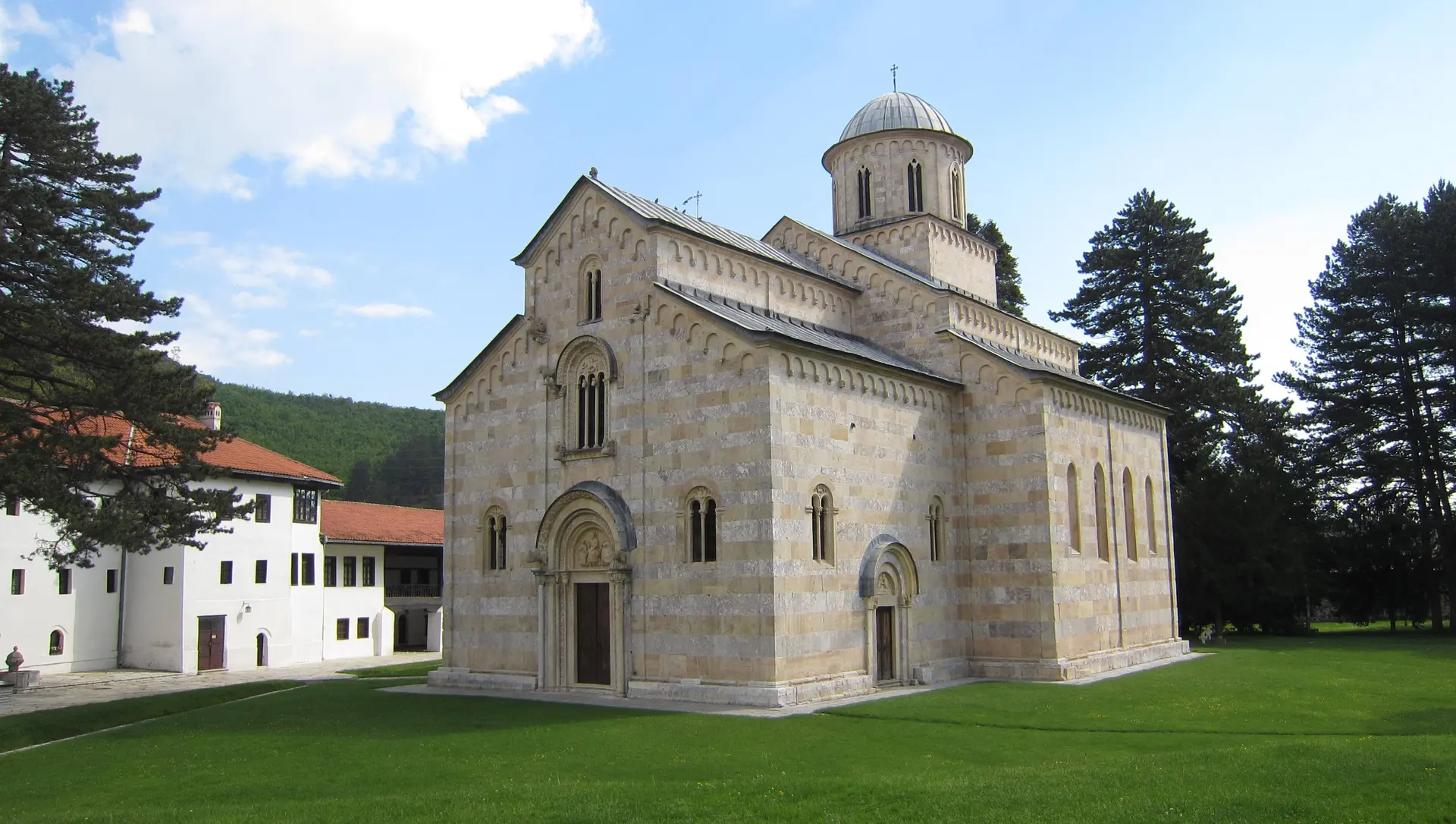
Visoki Decani Monastery
Deçan, Deçan Municipality, Kosovo
12.8 km away

Kučanska Mosque, Rožaje
Rožaje, Rožaje, Rožaje Municipality, Montenegro
21.9 km away

Crna Reka Monastery
Ribariće, Ribariće / Tutin, Raška District, Serbia
36.1 km away

Sopoćani Monastery
Sopoćani, Sopoćani / Novi Pazar, Raška District, Serbia
51.6 km away
References
Sources consulted for this page. Source categories describe the publication, not a guarantee that every claim is verified. Traditional accounts and outside interpretations may differ.
- 01Medieval Monuments in Kosovo — UNESCO World Heritage CentreofficialOfficial World Heritage listing and danger-list status; OUV description
- 02World Heritage Committee puts Medieval Monuments in Kosovo on Danger List (2006) — UNESCO World Heritage CentreofficialDanger-listing rationale: political instability, management/conservation difficulties
- 03State of Conservation (SOC) - Medieval Monuments in Kosovo — UNESCO World Heritage CentreofficialConservation status reporting
- 04Patriarchate of Peć (monastery) — Wikipedia contributorsencyclopediaFour churches, history, patriarchal seat, frescoes, UNESCO, restoration
- 05Patriarchate of Peć — Lonely PlanetguideVisitor information, location, practicalities
- 06Monastery of the Patriarchate of Pec — OrthodoxWikispiritualOrthodox perspective on the monastery's role and patriarchs
- 07Patriarchate of Peć | Atlas Obscura — Atlas ObscuraencyclopediaLiving nunnery, atmosphere, chants, setting at Rugova canyon
- 08A monastery behind enemy lines (visiting the Patriarchate of Peć) — Pegs on the LineguideDress code, photography rules, passport/ID and police checkpoint, hours
Share a photo
Help visitors recognize Patriarchate of Peć Monastery. Every submission is reviewed before publication.